
Ettringite is a highly hydrated calcium aluminum sulfate sub-silicate mineral characterized by the complex chemical formula Ca₆Al₂(SO₄)₃(OH)₁₂·26H₂O. Mineralogically, it crystallizes within the trigonal system, typically presenting as elongated, prismatic, or needle-like (acicular) crystals that are colorless to white, though impurities can occasionally impart a soft yellow or green hue. Due to its unique crystalline structure, which features open channels housing water molecules and sulfate anions bound to sturdy columns of calcium and aluminum octahedra, it exhibits a relatively low Mohs hardness of 2 to 2.5 and a low specific gravity of approximately 1.77. While highly prized by mineral collectors for its delicate and intricate crystal clusters, ettringite holds paramount industrial significance in civil engineering and concrete technology, where it serves as a foundational crystalline phase during the early-stage hydration of ordinary Portland cement.
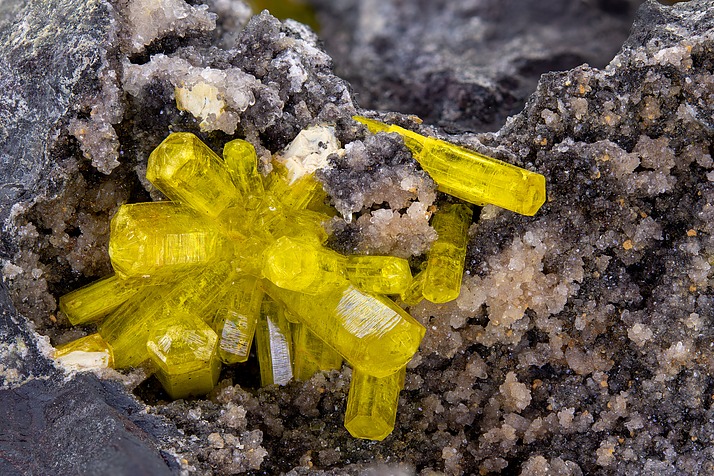
In natural geological environments, ettringite forms primarily through low-temperature secondary alteration processes, typically occurring within cavities of basaltic volcanic rocks, weathered veins of contact-metamorphic limestone, or xenoliths embedded in alkaline igneous environments. Conversely, its industrial synthesis occurs dynamically during the hydration of Portland cement, initiated when tricalcium aluminate (C₃A) reacts rapidly with added gypsum (calcium sulfate dihydrate) and water. This exothermic reaction precipitates fine, needle-like ettringite crystals that interlock to regulate the initial setting time and workability of the fresh concrete paste.
However, this mineral also carries severe implications for structural durability through a phenomenon known as Delayed Ettringite Formation (DEF). If concrete is cured at excessive temperatures—typically above 65°C (149°F)—early ettringite is chemically suppressed or destroyed. If the concrete is subsequently exposed to moisture later in its lifecycle, the latent sulfate and aluminate phases will slowly recrystallize into ettringite; the massive volumetric expansion of these nascent crystals exerts immense internal tensile stress, ultimately leading to micro-cracking, structural degradation, and concrete cancer.
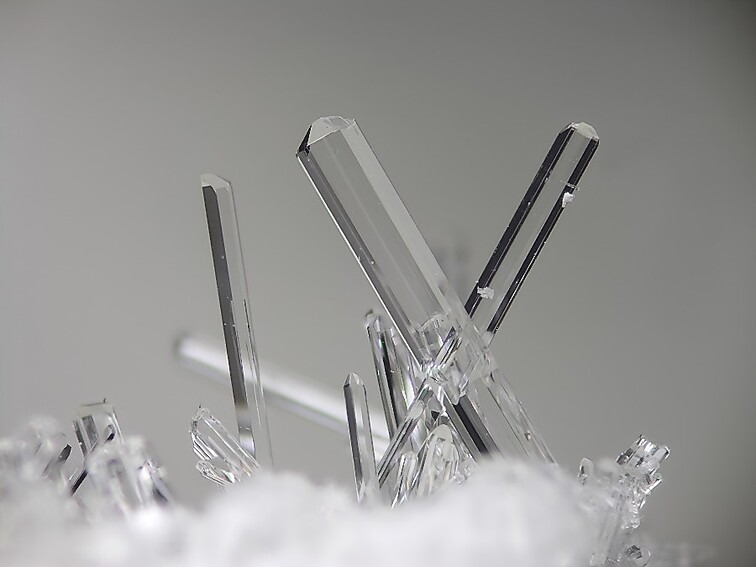
The history of ettringite dates back to 1874, when it was first formally discovered, analyzed, and described by the German mineralogist J. Lehmann. The mineral was named in honor of its type locality near Ettringen, situated within the Bellerberg volcano complex in the Eifel district of Rhineland-Palatinate, Germany, a region renowned for its highly unusual, calcium-rich volcanic mineral assemblages. For several decades following its discovery, ettringite remained a purely academic curiosity confined to mineralogical catalogs.The mineral’s historical trajectory shifted dramatically in the early 20th century with the rapid advancement of industrial cement chemistry. Researchers investigating the premature failure and chemical corrosion of marine concrete structures identified a crystalline substance they initially dubbed “cement bacillus” due to its destructive, needle-like growth pattern. Subsequent X-ray diffraction and chemical analyses confirmed that this synthetic compound was identical to Lehmann’s natural ettringite, forever bridging the gap between natural geology and modern infrastructure engineering.
Occurrence and Major Localities
In nature, ettringite is a relatively rare mineral restricted to hyper-alkaline, calcium-rich, and sulfate-abundant environments, forming primarily through low-temperature secondary alteration within the cavities of basaltic volcanic rocks, contact-metamorphic skarns, and altered limestone formations where well-preserved specimens remain scarce due to the mineral’s high hydration and chemical sensitivity. While it was first discovered and named in 1874 at its type locality in the Bellerberg volcano complex near Ettringen, Germany, the most spectacular, world-class collector specimens—featuring large, translucent crystals in vibrant shades of lemon yellow, honey gold, and lime green—hail from the Kalahari Manganese Field in South Africa, alongside other notable natural occurrences like the pyrolyzed Hatrurim Formation in Israel and Jordan, Mont Saint-Hilaire in Canada, and Fuka in Japan. Conversely, on an anthropogenic scale, ettringite occurs ubiquitously worldwide as a fundamental crystalline phase generated during the early-stage hydration of ordinary Portland cement, as well as a secondary alteration product in weathered civil infrastructure and a targeted precipitate in environmental wastewater treatment facilities engineered to capture heavy metal and sulfate pollution.
Crystal Structure of Ettringite
The crystal structure of ettringite is highly unique and complex, characterized by an open, column-and-channel framework that accounts for its low density and high water content. Crystallizing in the trigonal system (space group P31c), the structural backbone of ettringite consists of long, positively charged columns running parallel to the c-axis. These rigid columns are composed of alternating aluminum octahedra [Al(OH)₆]³⁻ and calcium polyhedra [Ca₃(OH)₄(H₂O)₄]²⁺, effectively forming a cylindrical coordination polymer.
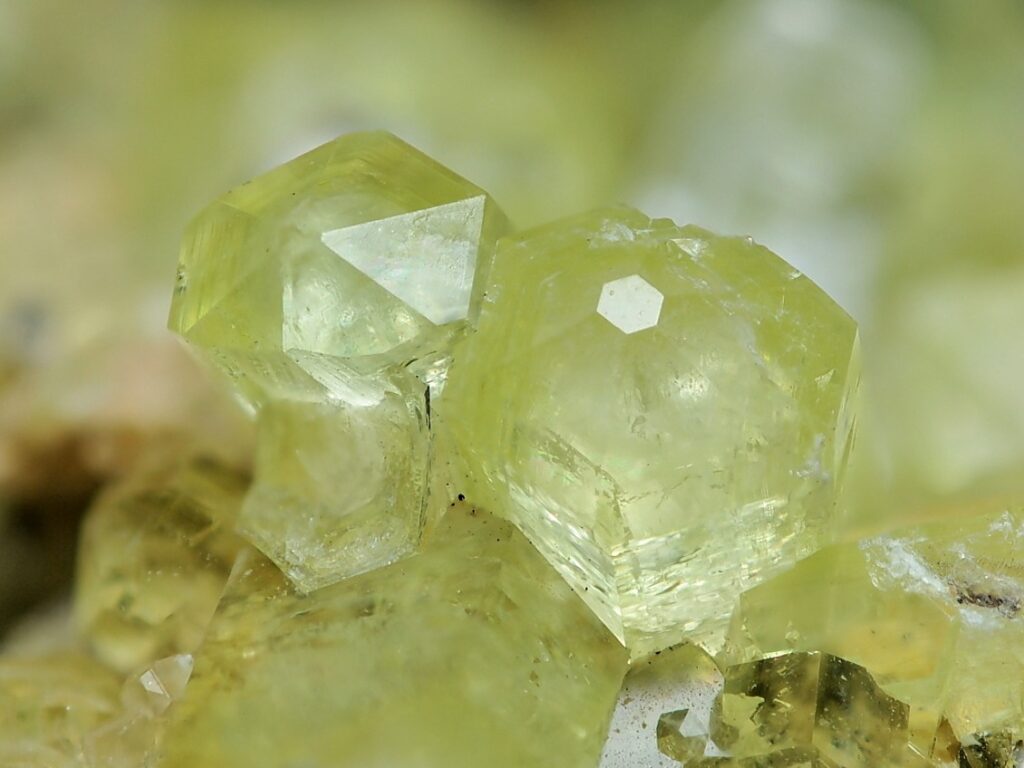
Between these solid, positively charged structural columns lie wide, open channels that carry a net negative charge. These channels house the remaining components of the mineral: mobile sulfate anions (SO₄²⁻) and a vast network of uncoordinated water molecules. Specifically, out of the 32 water molecules present in the formula unit, 24 are tightly bound within the calcium coordination spheres of the columns, while the remaining 8 reside freely within the interstitial channels. This configuration creates a highly porous, zeolitic behavior, allowing the channel water and sulfate ions to undergo ion exchange or partial dehydration without destroying the underlying skeletal framework of the crystal.
Color and Optical Properties of Ettringite
In its purest natural and synthetic forms, ettringite is completely colorless or transparent white, as its baseline chemical composition contains no intrinsic transition metal chromophores. However, geological specimens frequently display a range of delicate, translucent colors—most notably pale yellow, lemon yellow, honey gold, and occasionally light green or fibrous white—which are typically caused by trace impurities or microscopic inclusions of iron, manganese, or chromium substituting within the crystal lattice.Optically, ettringite belongs to the hexagonal/trigonal crystal system and is strictly uniaxial negative. It exhibits an exceptionally low refractive index, with the extraordinary ray (ne) measuring approximately 1.458 and the ordinary ray (no) around 1.462 to 1.466. This extremely low refractive index, paired with a very weak birefringence (ranging from 0.006 to 0.008), gives the mineral a distinctively low relief under a polarizing microscope, making its crystals appear almost invisible when immersed in standard petrographic oils. Additionally, under cross-polarized light, ettringite displays very low-order interference colors, typically restricted to first-order grays and whites, which serves as a vital diagnostic feature for material scientists distinguishing it from other cement hydration products.
Identification of Ettringite
The definitive identification of ettringite relies on a combination of its distinctive macromorphological habits, diagnostic optical properties, and advanced microanalytical techniques. Macroscopically, it is recognized by its characteristic acicular (needle-like) or prismatic crystal habit, exceptionally low specific gravity (1.75 to 1.80), white streak, and highly restricted occurrence within hyper-alkaline, sulfate-rich environments. Under a polarizing microscope, ettringite is distinguished as a uniaxial negative mineral displaying characteristically low refractive indices (ne = 1.458, no = 1.462 to 1.466), weak birefringence (0.006 to 0.008), and low-order, first-order gray interference colors, which collectively impart a distinctively low relief in standard petrographic sections.
While it can be easily confused with thaumasite due to their nearly identical fibrous morphology and overlapping presence as secondary products in deteriorated concrete, the two are chemically distinct; thaumasite incorporates carbonate and silicon within its structural framework, whereas ettringite is strictly an aluminum-bearing sulfate mineral. Consequently, authoritative differentiation and positive identification are routinely achieved through X-ray diffraction (XRD) to isolate its characteristic crystallographic d-spacings, scanning electron microscopy (SEM) coupled with energy-dispersive X-ray spectroscopy (EDS) to visually confirm the interlocking needle formations and elemental ratios, and thermal analysis like thermogravimetric analysis (TGA) to monitor its dramatic low-temperature dehydration profile.
Physical and Chemical Properties of Ettringite
Physically, ettringite is characterized by its distinct habit, typically forming elongated, prismatic crystals, acicular needle-like aggregates, or fibrous and radiating masses. It is a relatively soft mineral with a Mohs hardness of only 2 to 2.5, meaning it can be easily scratched by a fingernail, and it possesses a perfect cleavage parallel to the prism faces {1010}. The mineral features a notably low specific gravity, ranging from 1.75 to 1.80, which is a direct consequence of its highly open, porous crystal structure. When fresh and unaltered, ettringite exhibits a vitreous (glassy) luster on crystal faces, which can transition to a silky or dull appearance in fibrous or weathered varieties.
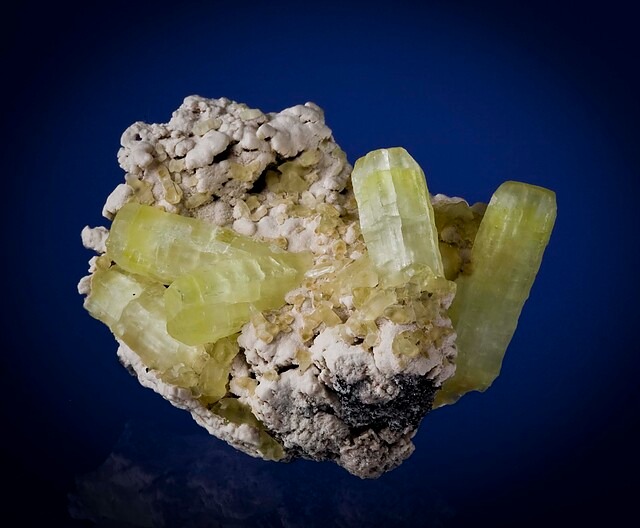
Chemically, ettringite is a complex hydrous calcium aluminum sulfate mineral with the formula Ca₆Al₂(SO₄)₃(OH)₁₂·26H₂O. One of its most defining chemical traits is its extreme hydration level, where water molecules account for nearly half of its total molecular weight. This high water content makes the mineral thermally unstable; when heated above 50°C to 60°C (122°F to 140°F), ettringite rapidly dehydrates, losing a significant portion of its channel water and collapsing into an amorphous or lower-hydrate state. Furthermore, ettringite is chemically sensitive to pH levels, remaining stable only in highly alkaline environments, typically between a pH of 11.5 and 12.5. If the pH drops below 10.5, the mineral becomes unstable and dissolves, breaking down into gypsum, aluminum hydroxide, and calcium ions, which makes its chemical stability a critical factor in monitoring the durability of industrial concrete.
Applications and Metaphysical Significance of Ettringite
Ettringite is primarily important in cement chemistry, construction materials science, and environmental engineering. As one of the principal hydration products formed during the reaction of Portland cement with water, it contributes to the regulation of setting time and the development of the microstructure of concrete. The mineral is also studied extensively in durability research because excessive or delayed ettringite formation can influence the long-term performance of concrete structures. Beyond the construction industry, synthetic ettringite has attracted attention for environmental applications due to its ability to incorporate and immobilize various contaminants, including heavy metals and sulfate-bearing compounds, making it useful in certain waste treatment and remediation technologies. In geology and mineralogy, natural occurrences of ettringite provide valuable information about alkaline, sulfate-rich alteration processes and hydrothermal environments.
In metaphysical traditions, ettringite is not among the most widely recognized healing minerals, but it is occasionally associated with themes of growth, stability, and transformation. Its radiating crystal formations are sometimes viewed as symbols of structural balance and the gradual development of strong foundations, reflecting the mineral’s role in cementitious systems. Some crystal practitioners believe it encourages organization, patience, and steady personal progress. These interpretations, however, are based on spiritual and metaphysical beliefs rather than scientific evidence. From a scientific perspective, ettringite is valued primarily for its distinctive crystal chemistry, geological significance, and practical applications in construction and environmental research.