
Ammolite is an iridescent organic gemstone material formed from the fossilized shells of extinct ammonites, especially species belonging to the genus Placenticeras. Unlike mineral species such as quartz, calcite, or feldspar, Ammolite has a biological origin and represents a fossilized portion of an ancient marine organism. Its principal constituent is aragonite, a crystalline form of calcium carbonate that originally made up much of the ammonite shell. The material is best known for its intense iridescence, which can produce red, orange, yellow, green, blue, and violet colors across the surface of a single specimen. These colors are produced primarily by optical interference within extremely thin, closely spaced layers of aragonite preserved in the fossil shell rather than simply by pigments or trace elements. As the thickness and orientation of these layers vary across the shell, different wavelengths of light are reflected more strongly from different areas, creating the characteristic shifting bands of color for which Ammolite is recognized.
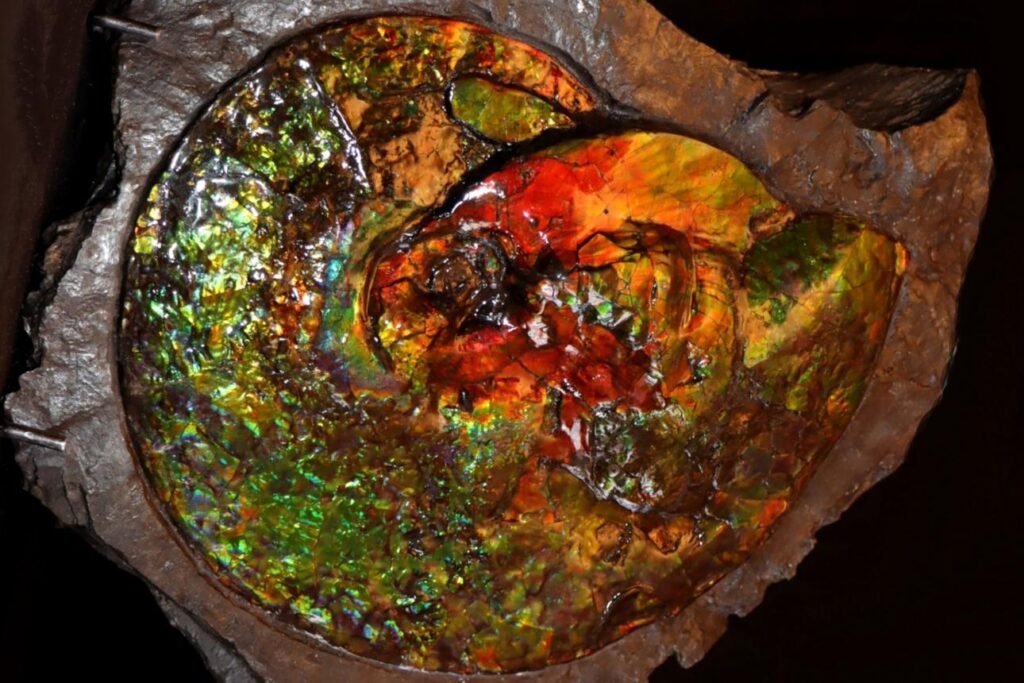
Ammolite is closely associated with Late Cretaceous ammonite fossils preserved in the Bearpaw Formation of southern Alberta, Canada. During the Late Cretaceous, this region formed part of the Western Interior Seaway, a large inland marine environment that extended across much of central North America. Ammonites were widespread marine organisms in this ecosystem, and after they died, their shells accumulated in marine sediments on the seafloor. Burial, compaction, and geological alteration subsequently transformed the surrounding sediments into sedimentary rock while allowing some ammonite shells to remain sufficiently well preserved. In favorable conditions, the original layered structure of the shell survived geological alteration and developed the optical properties now associated with Ammolite. The preservation of aragonite is particularly important because aragonite commonly changes into other forms of calcium carbonate or is replaced by secondary minerals during fossilization. Where the original shell structure has been retained, its microscopic layering can interact with incident light and produce strong structural iridescence.
The term Ammolite therefore refers to a specific type of gem-quality fossil shell material rather than to a mineral species. Its characteristics depend on both the composition of the fossil shell and the preservation of its internal structure. Natural Ammolite may occur as thin sections of fossil shell, while commercial material is also commonly stabilized or incorporated into composite forms such as doublets and triplets to improve durability and make use of relatively thin iridescent layers. The quality of Ammolite is generally evaluated according to factors such as the intensity and distribution of its iridescence, the range of visible colors, the thickness and stability of the shell material, surface condition, pattern, orientation, and degree of natural preservation. Because its appearance originates from a fossilized biological structure, Ammolite occupies an unusual position in the gemstone world, combining geological, paleontological, mineralogical, and optical characteristics in a single material.
History and Geological Background of Ammolite
The geological history of Ammolite is closely connected with the ammonites that inhabited the Western Interior Seaway during the Late Cretaceous. Ammonites were marine cephalopods related to modern squid, cuttlefish, and nautiluses, and they possessed coiled external shells that provided protection and buoyancy. The shells were primarily constructed from aragonite, arranged in a complex layered structure that included growth lines, septa, and other microscopic features. When these organisms died, their shells settled onto the seafloor and became incorporated into sediments deposited within the shallow and relatively warm marine environments of the Western Interior Seaway. Over millions of years, continued burial compressed and lithified these sediments, preserving large numbers of ammonite fossils within what is now southern Alberta and adjacent regions. Some of these fossils retained enough of their original shell structure for the aragonite layers to produce strong iridescence after fossilization.
The most important Ammolite deposits are associated with the Bearpaw Formation in Alberta, Canada. The formation consists largely of marine sedimentary rocks deposited during the later part of the Cretaceous Period, when the Western Interior Seaway still occupied much of the region. Among the fossils preserved in these sediments are large ammonites, including Placenticeras, whose shells can develop the thin, iridescent layers characteristic of gem-quality Ammolite. The fossilization process was not uniform, and many ammonite shells underwent chemical alteration, recrystallization, fracturing, or replacement by other minerals. In specimens that retained the original aragonitic shell layers, however, the microscopic structure remained capable of producing structural interference colors. Geological weathering and erosion later exposed fossil-bearing layers at or near the surface, allowing the iridescent shell material to be recovered.
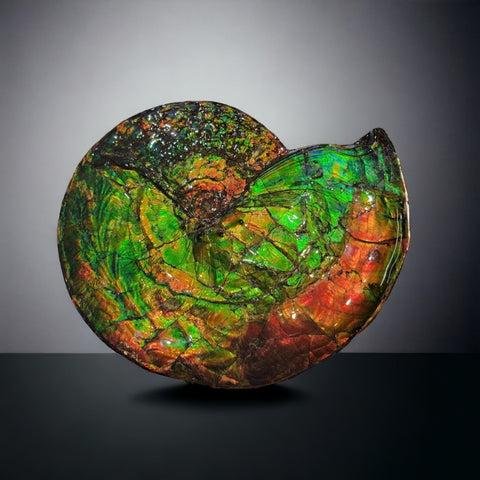
The modern recognition of Ammolite as a gemstone developed relatively recently compared with the geological age of the material itself. Indigenous peoples of the Alberta region had long encountered fossil ammonite material, and ammonite fossils have also attracted scientific and collecting interest because of their paleontological importance. Commercial interest in the iridescent fossil material increased during the twentieth century as its distinctive optical properties became better understood and methods for cutting, stabilizing, and polishing the thin shell layers improved. The name “Ammolite” became associated with the gem material derived from these ammonite fossils, distinguishing it from ordinary fossil ammonite specimens that do not display significant iridescence. In 1981, Ammolite received additional recognition when the Canadian government officially designated it as an organic gemstone, contributing to its development as a commercially recognized gem material from Alberta.
Formation and Fossilization of Ammolite
The formation of Ammolite begins with the biological growth of an ammonite shell rather than with the crystallization of a mineral from a geological fluid. As the ammonite grew, it added successive layers of aragonitic shell material, creating a highly organized structure at both microscopic and macroscopic scales. After burial, the shell was subjected to increasing pressure and changing chemical conditions within the surrounding sediment. The preservation of the original aragonite was influenced by the chemistry of the pore waters, the rate of burial, the permeability of the surrounding sediment, and subsequent geological alteration. Where these conditions favored preservation, the original shell layers remained sufficiently intact to retain their optical properties. Where preservation was poorer, the aragonite could be altered or replaced, resulting in fossil material without the characteristic iridescence of gem-quality Ammolite.
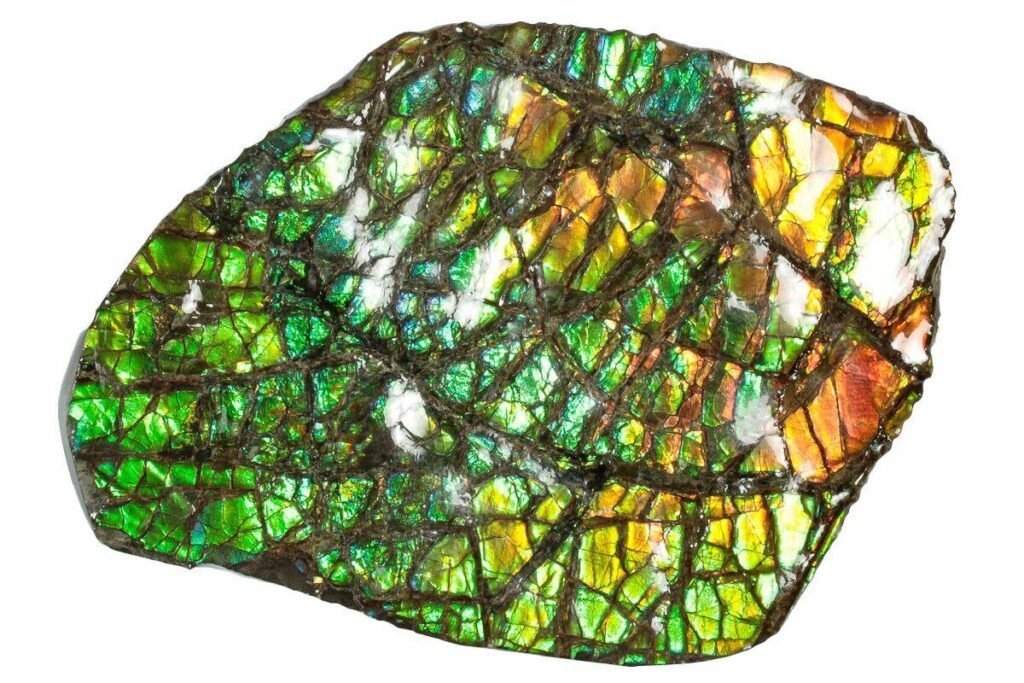
The colors seen in Ammolite are therefore closely related to the physical structure inherited from the original ammonite shell. The aragonite occurs in extremely thin layers, and light interacting with these layers can undergo interference. Small differences in layer thickness change which wavelengths of visible light are reinforced, so one area of a specimen may appear predominantly red or orange while another area can display green, blue, or violet. Thicker or differently arranged layers can produce different portions of the visible spectrum, while the angle at which the material is viewed can also influence the observed color. This explains why Ammolite often appears to change color as the specimen is rotated or as the direction of illumination changes. The phenomenon is structural rather than simply chemical, making the preservation of the shell’s microscopic architecture an essential factor in determining gem quality.
Physical and Optical Characteristics of Ammolite
Ammolite has a distinctive combination of fossil, mineralogical, and optical characteristics that separates it from most conventional gemstones. The material is primarily composed of aragonite, with its properties strongly influenced by the degree of fossilization, preservation, and subsequent alteration of the original ammonite shell. Fresh aragonite has a hardness of approximately 3.5 to 4 on the Mohs scale, making Ammolite relatively soft compared with quartz, corundum, or diamond. Its effective durability can be lower than its mineral hardness alone would suggest because gem-quality Ammolite is often thin, naturally layered, and vulnerable to abrasion, impact, dehydration, and damage along fractures or weakened areas of the fossil shell. For this reason, much commercial Ammolite is stabilized with a transparent resin or mounted as a composite material to improve its structural integrity. The material generally has a relatively low specific gravity compared with many inorganic gemstones, although measurements can vary according to the composition and degree of alteration of the fossil shell.
The most important optical property of Ammolite is its iridescence. Unlike the body color of minerals such as ruby or emerald, Ammolite’s visible color is primarily produced by interference of light within its microscopic layered structure. When light reaches the closely spaced aragonite layers, certain wavelengths can be reinforced while others are weakened through interference. The resulting color depends largely on the thickness, spacing, orientation, and continuity of these layers. Thin structural layers can favor shorter wavelengths and produce blue, green, or violet colors, while different layer thicknesses can produce yellow, orange, and red. A single piece may therefore contain several colors arranged in irregular bands, patches, or patterns. The strongest iridescence is generally observed when the shell layers are preserved close to the surface and oriented appropriately relative to the observer and light source.
The appearance of Ammolite can also vary considerably according to the condition and orientation of the fossil shell. Some specimens show broad areas of relatively uniform color, while others display complex patterns produced by the original growth structure, fractures, mineral inclusions, and variations in shell thickness. The surface may be polished to reveal the iridescent layer, although excessive polishing can reduce the thickness of the remaining material and potentially affect its durability. Natural matrix may also remain attached to portions of the shell, particularly in specimens intended for mineral and fossil collections rather than jewelry. Because Ammolite is derived from a biological shell that has undergone geological preservation, no two pieces necessarily display exactly the same combination of structure, color distribution, pattern, and surface characteristics.
Color and Iridescence of Ammolite
The color range of Ammolite is one of its most recognizable characteristics, with specimens displaying combinations of red, orange, yellow, green, blue, and violet. Red and orange are relatively common in commercial material, while strong blue and violet can be less frequently encountered depending on the geological preservation and structure of the shell. Green may occur together with yellow or blue, producing transitional colors across the surface. The presence of multiple colors in a single specimen is often caused by gradual changes in the thickness and arrangement of the aragonite layers rather than by separate chemical impurities. As the shell is viewed from different angles, the apparent intensity and hue may change because the path of light through the layered structure changes as well.
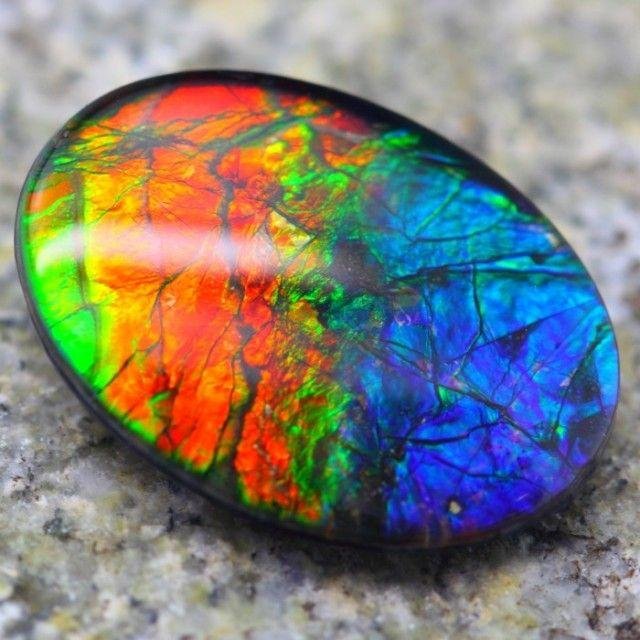
The term “iridescence” is particularly important when describing Ammolite because its color is fundamentally structural. Similar optical effects occur in several natural materials, but the specific effect in Ammolite is associated with the layered aragonitic shell of the fossil ammonite. The intensity of the iridescence depends on how well the original shell structure has been preserved and how effectively the surface exposes the relevant layers. Weathering, fractures, mineral replacement, polishing, and stabilization can all influence the final appearance. High-quality material typically has a strong and clearly visible play of color across a substantial portion of the surface, although the evaluation of Ammolite also considers factors such as color distribution, pattern, surface condition, thickness, and stability rather than color alone.
Crystal Structure and Chemical Composition of Ammolite
Ammolite is unusual because its material does not originate from a conventional mineral crystal system formed independently in the Earth’s crust. Instead, it preserves the mineralized shell structure of an ammonite, with aragonite as the principal crystalline component. Aragonite is a polymorph of calcium carbonate with the chemical formula CaCO₃, meaning that it has the same basic chemical composition as calcite but a different crystal structure. In the original ammonite shell, aragonite was deposited biologically in successive layers, producing a highly organized composite structure rather than a massive crystal. These layers followed the growth of the shell and were arranged in ways that contributed to the mechanical strength of the shell during the animal’s life. During fossilization, some of this original structure was preserved, while other portions could undergo recrystallization, mineral replacement, fracturing, or partial dissolution. The gem-quality material known as Ammolite is distinguished by the preservation of enough of this original layered structure to generate visible iridescence.
The aragonite layers in Ammolite are extremely important to its optical behavior. When light enters or reflects from the closely spaced layers, differences in refractive index between adjacent structural components cause light to be reflected and interfere with itself. The thickness of the layers determines which wavelengths are preferentially reinforced, producing different visible colors. Because the shell was formed gradually during the growth of the ammonite, its internal structure can vary across different areas of the fossil. This produces the characteristic patches, bands, and transitions of color observed in polished Ammolite. The structure may also contain organic remnants, microscopic defects, secondary minerals, and alteration products introduced during fossilization. Consequently, Ammolite should not be regarded simply as a piece of aragonite; its distinctive properties depend on the preservation of a complex biological mineral structure.
Types and Varieties of Ammolite
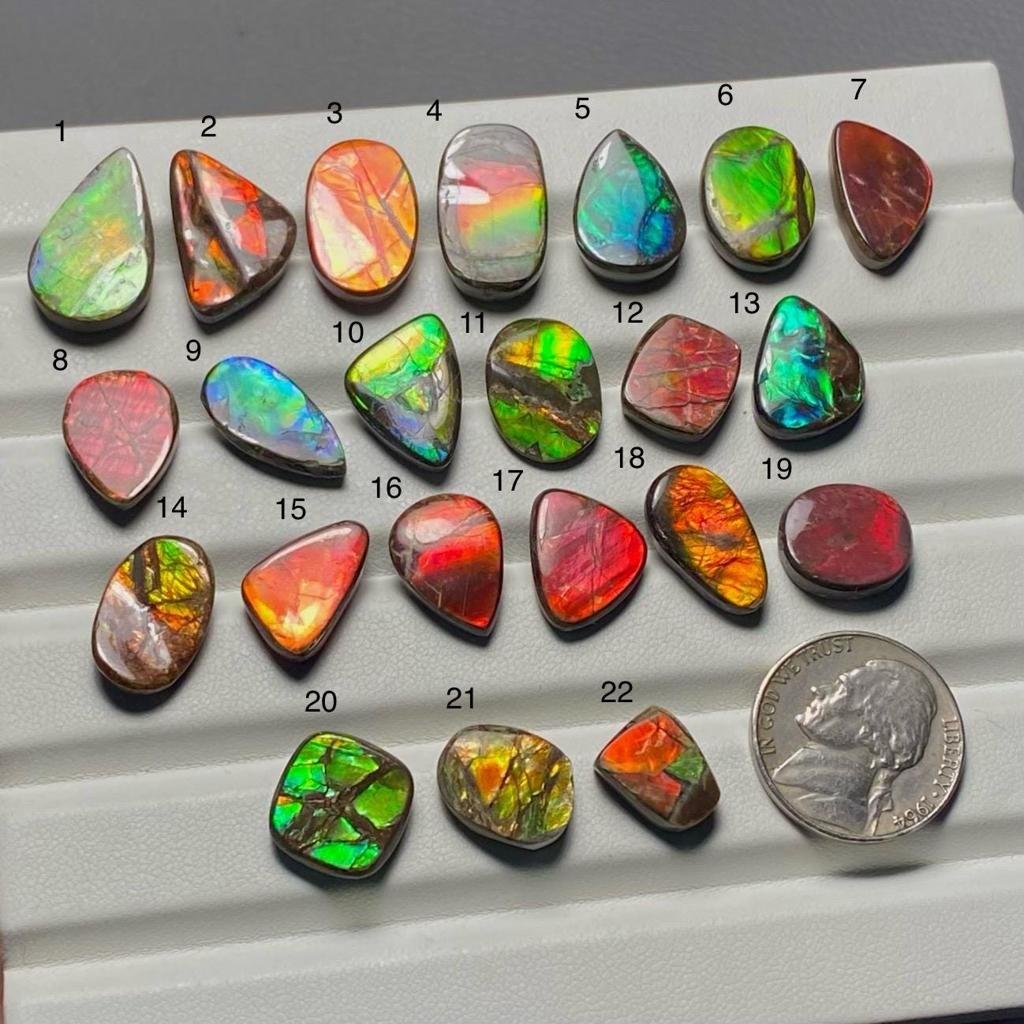
Ammolite is commonly classified according to its geological preservation, appearance, construction, and treatment rather than according to formally recognized mineral varieties. In the gem trade and collecting market, several forms are encountered:
- Natural Ammolite – Ammolite consisting primarily of naturally preserved iridescent ammonite shell material without the addition of a backing layer or assembled construction. It may retain portions of the original fossil matrix.
- Stabilized Ammolite – Thin or fragile Ammolite that has been impregnated with a transparent stabilizing material, usually to strengthen the fossil shell and reduce the risk of cracking or deterioration during cutting and use.
- Ammolite Doublet – A composite gem consisting of a thin layer of iridescent Ammolite attached to a supporting backing material. The backing provides additional thickness and structural stability while allowing the iridescent shell to remain visible from the top.
- Ammolite Triplet – A composite construction in which the iridescent Ammolite layer is combined with a backing and a transparent protective layer on the upper surface. The protective layer can help shield the relatively soft fossil material from abrasion and environmental exposure.
- Blue Ammolite – Material in which blue is a dominant component of the visible iridescence. Blue may occur alone or together with green, violet, or other colors depending on the structure and orientation of the shell layers.
- Red Ammolite – Material dominated by red or reddish-orange structural colors. Red is one of the commonly observed colors in Ammolite and can range from relatively subdued tones to strong saturated areas of iridescence.
- Multicolored Ammolite – Material displaying several distinct colors across the same surface, potentially including red, orange, yellow, green, blue, and violet. The distribution of colors is controlled by variations in the thickness and orientation of the preserved shell layers.
These descriptions are primarily practical classifications used to describe Ammolite material and commercial forms. They do not represent separate mineral species or formally established mineralogical varieties. The fundamental material remains fossilized ammonite shell dominated by aragonite, while differences in appearance and construction result from variations in fossil preservation, shell structure, processing, and treatment.
Ammolite Deposits and Major Localities
The most important source of gem-quality Ammolite is southern Alberta, Canada, where iridescent ammonite fossils occur within the Late Cretaceous Bearpaw Formation. The deposits are concentrated in areas associated with the former Western Interior Seaway, particularly along the eastern foothills of the Rocky Mountains and the St. Mary River region. The ammonite fossils found in these sediments include Placenticeras and related forms, whose shells can preserve the layered aragonite structure necessary for strong iridescence. The fossil-bearing strata extend across a broad geological region, but not every ammonite specimen contains material suitable for cutting and polishing. Differences in shell preservation, thickness, fracturing, weathering, mineral replacement, and the intensity of iridescence determine whether an individual fossil has gem-quality potential.
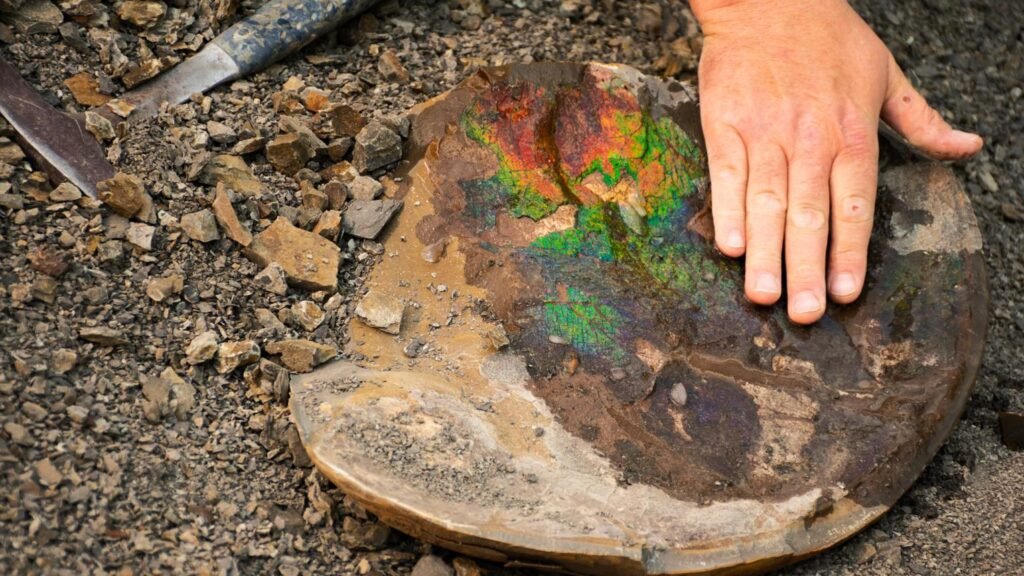
The southern Alberta deposits are significant because they preserve ammonite shells in geological conditions that allowed portions of the original aragonitic structure to survive. The surrounding Bearpaw Formation was deposited in a marine environment and contains a diverse assemblage of Cretaceous fossils, including marine mollusks and vertebrates. Over geological time, erosion exposed portions of these fossil-bearing sediments, making the ammonites accessible for collection and commercial recovery. Some fossils occur close to the surface and can be extracted from weathered sediments, while others remain embedded within harder sedimentary material. Mining and recovery methods depend on the geological setting and the intended use of the material, with some specimens processed primarily as gemstone rough and others retained as complete fossil specimens.
Although ammonite fossils occur in many parts of the world, the combination of fossil preservation and strong structural iridescence found in Alberta is particularly important to the Ammolite trade. Fossil ammonites have been reported from numerous regions, including Europe, Asia, Africa, and other parts of North America, but most ammonite fossils do not develop the specific optical properties required for gem-quality Ammolite. In many deposits, the original aragonite is destroyed or replaced during fossilization, eliminating the layered structure responsible for the characteristic play of color. Alberta therefore remains the principal commercial locality associated with Ammolite, and the geographic origin of the material is an important part of its identification and geological classification.
Mining and Processing of Ammolite
Ammolite recovery differs from the extraction of most mineral gemstones because the target material is a fossilized shell preserved within sedimentary rock rather than a crystalline mineral deposit. Rough material may be recovered from fossil-bearing strata and then examined for shell thickness, structural integrity, iridescence, and the distribution of color. The outer portions of an ammonite fossil can be weathered or damaged, while the internal shell may contain better-preserved material. Once suitable sections are identified, the fossil shell can be cut into slabs or thinner pieces to expose the iridescent layers. The orientation of the cut is particularly important because the visible color depends on the relationship between the shell’s layered structure, the polished surface, and the direction of incident light.
Because Ammolite is relatively thin and mechanically fragile, processing requires greater care than the cutting of many conventional gemstones. The iridescent shell layer may be only a small portion of the total fossil, and excessive grinding or polishing can remove valuable material. Stabilization is therefore commonly used for fragile pieces, with a transparent material penetrating cracks or porous areas and helping reinforce the shell. Some Ammolite is also assembled into doublets or triplets, in which the thin iridescent layer is attached to a stronger backing and, in the case of a triplet, protected by a transparent upper layer. These constructions allow thin fossil material to be used in jewelry while reducing the likelihood of breakage during handling.
The finished surface is normally polished to reveal the optical effect of the preserved shell layers. The amount of visible color can vary substantially depending on the quality of the original fossil, and cutting is often planned around the most strongly iridescent areas rather than according to a standardized gemstone shape. Cabochons, freeform pieces, inlays, and other shapes are therefore common. Larger fossil sections may retain their natural ammonite form and be prepared as specimens for fossil collections, while smaller sections with particularly strong color may be cut for jewelry or decorative applications. This combination of paleontological preservation and gemstone processing is one of the defining characteristics of Ammolite as a commercial material.
Ammolite in Jewelry and Decorative Uses
Ammolite is primarily used as a gemstone and ornamental material because of its strong iridescence and distinctive fossil origin. It is commonly cut into cabochons, freeform polished pieces, pendants, earrings, rings, and other jewelry components. Cabochon cutting is particularly suitable because the material does not depend on transparent optical properties such as those of faceted sapphire or quartz. Instead, the objective is to expose and preserve the thin iridescent shell layers across the upper surface. The shape and orientation of a finished piece may therefore be determined by the natural distribution of color within the fossil rather than by a standardized cutting pattern. Pieces displaying broad areas of intense color can be selected for larger jewelry components, while smaller fragments may be used as accents or in composite designs.
Ammolite is also used in decorative objects, inlays, collector specimens, and fossil displays. Larger ammonite sections can retain the natural spiral geometry of the original shell while exposing areas of iridescent material along the fossil surface. These pieces may be polished selectively to balance the preservation of the fossil structure with the visibility of the color. Ammolite can also be combined with other materials in ornamental objects, where its strong structural color provides visual contrast against metal, stone, wood, or other decorative materials. Because the material can be relatively thin and fragile, stabilized or composite forms are particularly useful for applications where additional mechanical support is required.
The use of Ammolite in jewelry also requires consideration of its relatively low hardness and sensitivity to impact. It is generally less suitable for applications that experience frequent abrasion or heavy mechanical contact than harder gemstones such as corundum or quartz. Rings and bracelets can expose the material to repeated contact with hard surfaces, while pendants and earrings generally provide a more protected setting. A protective setting or transparent surface layer can help reduce direct abrasion, especially for doublet and triplet constructions. The choice of setting, thickness, treatment, and construction therefore has a significant influence on the practical durability of an Ammolite jewelry item.
Ammolite and Fossil Ammonites
The relationship between Ammolite and ammonite fossils is fundamental to understanding the material. Ammonites were extinct marine cephalopods that lived from the Devonian Period until the end-Cretaceous mass extinction approximately 66 million years ago. Their shells were externally visible, tightly coiled structures divided internally by septa into a series of chambers. During the animal’s life, the shell provided protection and played an important role in buoyancy. As the ammonite grew, new shell material was added along the outer edge, producing the characteristic spiral form. The original shell consisted largely of aragonite, and the preservation of this mineralized structure is responsible for the connection between ammonite fossils and Ammolite.
Not every fossil ammonite is Ammolite. Most ammonite fossils do not possess the intense iridescence required to be classified as gem-quality Ammolite. During fossilization, the original aragonite may dissolve, recrystallize, or be replaced by calcite, silica, pyrite, or other minerals. In some cases, the shell structure is preserved but loses the optical layering necessary for strong iridescence. Ammolite represents the relatively uncommon situation in which the shell’s original layered architecture has been preserved sufficiently to produce visible structural color. This distinction is important when describing the material because an ordinary ammonite fossil and gem-quality Ammolite can have the same biological origin while having very different mineralogical and optical characteristics.
The fossil structure can sometimes remain visible beneath or alongside the polished iridescent surface. Growth lines, shell curvature, fractures, mineral inclusions, and remnants of the original morphology may contribute to the appearance of a finished specimen. These features can provide information about the biological and geological history of the material, making Ammolite relevant not only to gemology but also to paleontology and sedimentary geology. For this reason, some specimens are preserved primarily as fossils rather than being completely processed into gemstone pieces, particularly when the ammonite retains an unusually complete or scientifically significant structure.