
Witherite is a barium carbonate mineral with the chemical formula BaCO₃. It is an uncommon carbonate mineral that typically forms in hydrothermal veins and low-temperature mineral deposits, where it is commonly associated with baryte, galena, fluorite, calcite, and other carbonate or sulfide minerals. Witherite is usually white, gray, yellowish, or pale brown, although its color can vary depending on impurities and the geological environment in which it formed. It commonly occurs as orthorhombic crystals, but well-developed individual crystals are relatively uncommon compared with massive, granular, globular, or fibrous aggregates.
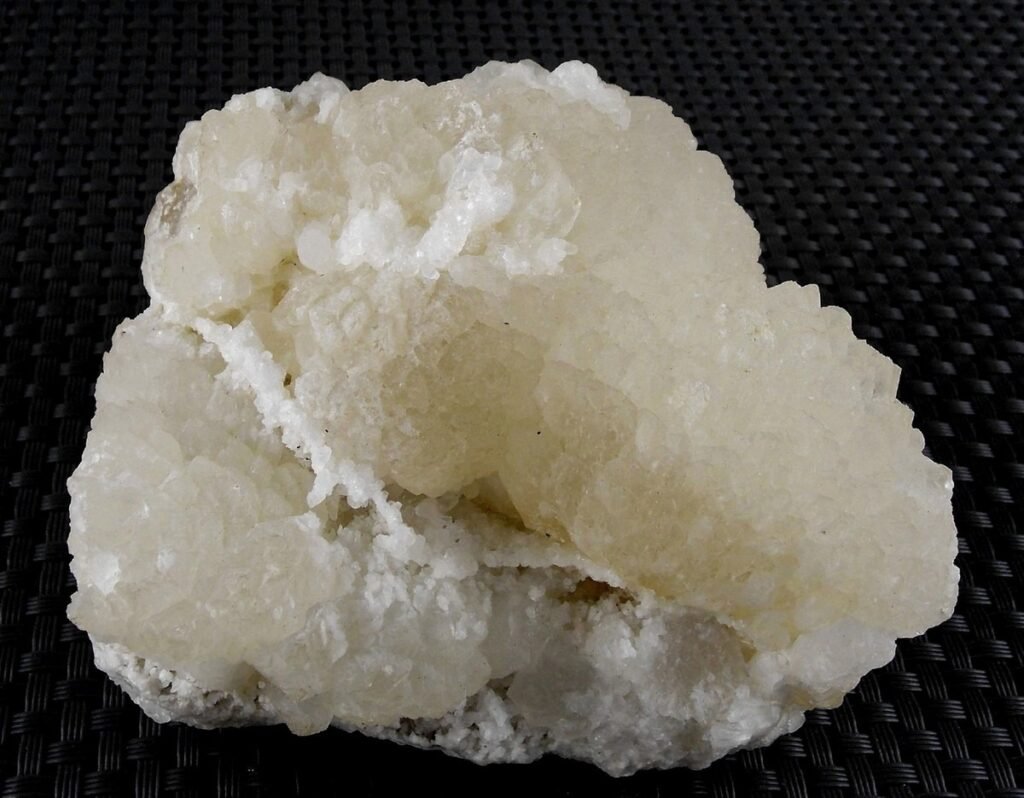
The mineral has a Mohs hardness of about 3 to 3.5 and a relatively high specific gravity of approximately 4.2–4.3, reflecting the presence of the heavy element barium. Its luster is generally vitreous to resinous, while transparent to translucent specimens can display a distinct internal appearance. Witherite has good cleavage in several directions and can be distinguished from visually similar carbonate minerals through its combination of crystal form, density, cleavage, and chemical composition. Like other carbonate minerals, it reacts with acids, although the reaction can be affected by the physical form and surface condition of the specimen.Witherite is also significant as a naturally occurring source of barium. Historically, specimens were collected and the mineral was investigated for its barium content, while barium compounds derived from witherite have been used in various industrial and chemical applications. Because soluble barium compounds can be toxic, natural witherite specimens should not be treated as ordinary decorative material, and powdered or chemically altered material requires appropriate handling. In mineralogical collections, witherite is primarily recognized for its distinctive composition, orthorhombic crystal structure, high density, and occurrence in hydrothermal mineral assemblages.
History and Discovery of Witherite
Witherite was recognized as a distinct mineral in the late 18th century and was named in honor of William Withering (1741–1799), an English physician and botanist who investigated the mineral and helped establish its identity. Withering studied a heavy mineral from the lead-mining district of northern England and recognized that it differed from other carbonate minerals known at the time. The mineral was subsequently named witherite in recognition of his contribution to its study. The type locality is generally associated with the Anglezarke area near Chorley in Lancashire, England, where witherite occurs in association with lead-bearing hydrothermal mineralization.
The identification of witherite was particularly important in the development of early mineral chemistry because its composition contains barium, an element that had not yet been fully characterized when the mineral was first investigated. William Withering’s work on the material contributed to the recognition of barium as a distinct chemical element. Later chemical studies established witherite as barium carbonate, BaCO₃, and distinguished it from chemically similar carbonate minerals such as strontianite, which is composed primarily of strontium carbonate. The historical study of witherite therefore forms part of the broader development of mineral classification based on chemical composition rather than solely on external appearance.
Formation and Geological Occurrence of Witherite
Witherite typically forms in low-temperature to moderate-temperature hydrothermal environments, particularly within veins and cavities associated with lead-bearing and barium-rich mineralization. It is most commonly produced where barium-bearing fluids interact with carbonate-rich rocks or where chemical conditions favor the precipitation of barium carbonate. Because barium can readily combine with sulfate to form baryte, the formation of witherite is favored in environments where sulfate activity is relatively low or where the chemical conditions allow carbonate to become the dominant anion available for barium. As a result, witherite and baryte may occur together, but their relative abundance depends strongly on the composition and evolution of the mineralizing fluids.
In hydrothermal veins, witherite commonly occurs alongside galena, sphalerite, baryte, fluorite, calcite, quartz, and other carbonate or sulfide minerals. It may form as individual orthorhombic crystals, radiating aggregates, globular masses, granular coatings, or compact vein material. Some specimens develop rounded or botryoidal surfaces, while others consist of pale-colored crystalline masses filling fractures and cavities. The mineral can also occur as a secondary phase produced during the alteration of earlier barium- and lead-bearing mineral assemblages.
One of the best-known occurrences of witherite is in the northern English Pennines and other historic lead-mining districts of England, where it is associated with hydrothermal vein systems containing galena and baryte. Important specimens have also been reported from localities in Germany, Scotland, Canada, and the United States. The geological setting varies between localities, but the recurring association with barium-rich hydrothermal fluids and lead-bearing mineralization is characteristic of many witherite occurrences. Geological conditions such as temperature, fluid composition, pressure, host-rock chemistry, and the availability of carbonate all influence whether witherite crystallizes and what form its crystals and aggregates take.
Crystal Structure of Witherite
Witherite crystallizes in the orthorhombic crystal system and belongs to the aragonite group of carbonate minerals. Its structure is based on carbonate (CO₃) groups combined with barium (Ba²⁺) cations. The carbonate groups have a trigonal planar arrangement of carbon and oxygen atoms, while the larger barium ions occupy irregular coordination sites within the three-dimensional structure. The size and coordination requirements of Ba²⁺ contribute to the structural differences between witherite and other carbonate minerals containing smaller cations.
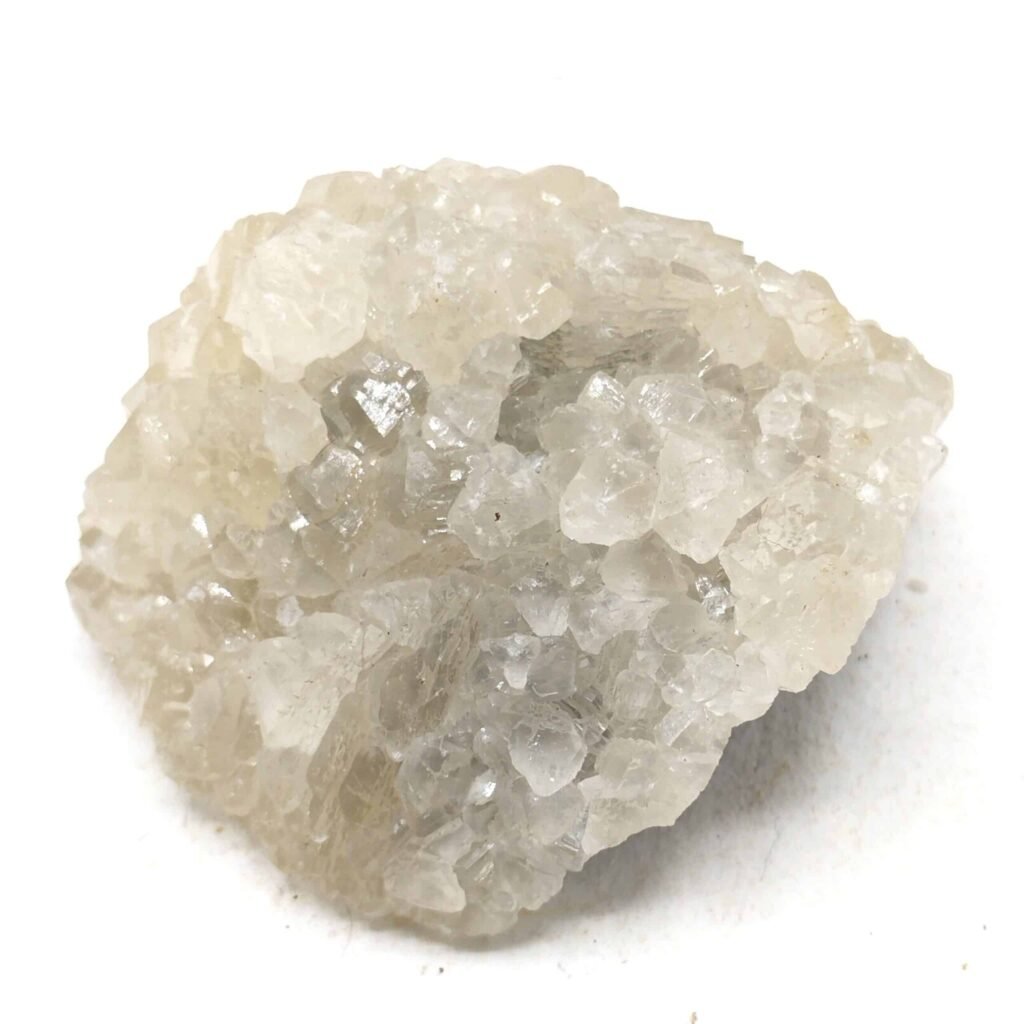
The orthorhombic structure gives witherite its characteristic crystallographic symmetry and influences the shapes in which it develops. Well-formed crystals may appear prismatic, tabular, or pyramidal, although massive and aggregated forms are also common. The arrangement of atoms within the crystal lattice is also responsible for its cleavage and other physical properties. Witherite commonly shows cleavage in several directions, reflecting planes within the structure where bonding is comparatively weaker.
Witherite is structurally related to other members of the aragonite group, including aragonite (CaCO₃) and strontianite (SrCO₃). These minerals share related structural arrangements but contain different dominant cations. The larger ionic radius of barium affects the dimensions and geometry of the crystal structure and contributes to witherite’s relatively high density. This relationship is useful in mineral classification because chemical composition and crystal structure together distinguish witherite from visually similar carbonate minerals.
Physical and Chemical Properties of Witherite
Witherite is typically white, colorless, gray, pale yellow, yellowish-brown, or occasionally greenish depending on impurities and associated minerals. It commonly has a vitreous to resinous luster, while its streak is white. Transparent to translucent crystals can occur, although most massive and aggregated specimens are translucent or opaque. The mineral has a Mohs hardness of approximately 3 to 3.5, making it relatively soft and susceptible to scratching by harder materials. Its specific gravity is comparatively high, generally around 4.2–4.3, which is an important diagnostic property and reflects the presence of the heavy element barium.
Witherite has an orthorhombic crystal structure and commonly develops as prismatic, tabular, pyramidal, globular, radiating, or massive aggregates. Cleavage is distinct in several directions, while fracture is generally uneven to subconchoidal. Individual crystals may show well-developed crystal faces, but massive and granular forms are more frequently encountered in some deposits. The mineral can also exhibit twinning, and some specimens display curved or rounded crystal surfaces caused by the development of aggregates rather than isolated crystals.
Chemically, witherite is barium carbonate, with the ideal formula BaCO₃. It belongs to the carbonate mineral class and the aragonite group. The carbonate component consists of CO₃ groups, while Ba²⁺ is the dominant cation. Witherite reacts with acids, producing carbon dioxide, although the reaction is generally less vigorous than that of calcite under comparable conditions. Heating can cause decomposition of the carbonate structure and produce barium oxide with the release of carbon dioxide. Its chemical behavior reflects both its carbonate composition and the relatively large ionic size of barium.
Because barium compounds vary considerably in solubility and toxicity, witherite should be handled with reasonable care, particularly when material is crushed, powdered, or subjected to chemical treatment. Intact mineral specimens present a different exposure situation from soluble barium compounds, but unnecessary ingestion or inhalation of mineral dust should be avoided. These chemical characteristics are also relevant to the historical use and processing of witherite as a natural source of barium.
Color, Luster, and Crystal Habits of Witherite
Witherite is most commonly white or colorless, but natural specimens may also appear gray, pale yellow, yellowish-brown, or slightly green depending on impurities and the minerals surrounding it. Color zoning and surface discoloration can occur in specimens exposed to weathering or alteration. Fresh crystals generally have a vitreous to resinous luster, while massive specimens may appear duller because of their granular or compact texture. The streak of witherite is white, providing a useful distinction from some darker associated minerals found in hydrothermal veins.
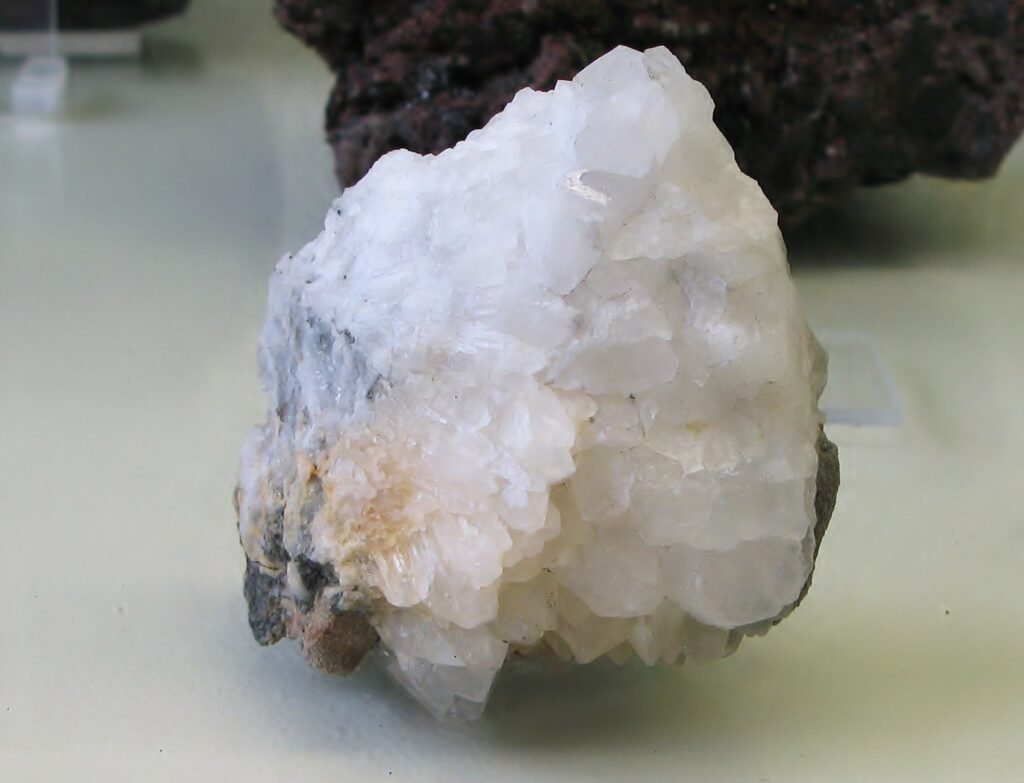
The crystal habit of witherite is variable. Well-developed crystals belong to the orthorhombic system and may occur as prismatic, tabular, pyramidal, or more complex combinations of crystal faces. However, witherite is also frequently found as globular, botryoidal, radiating, fibrous, granular, or massive aggregates. Some specimens consist of clusters of small crystals that grow outward from a common center, producing rounded or radiating forms. These aggregate habits are particularly important in identifying specimens from hydrothermal vein deposits, where limited space and changing fluid conditions can prevent the development of large individual crystals.
Witherite can also form distinctive spherical or hemispherical aggregates with a relatively smooth or crystalline surface. In some occurrences, crystals develop within cavities and fractures, allowing more open crystal growth and better preservation of individual crystal faces. The combination of high specific gravity, relatively low hardness, white to pale coloration, orthorhombic crystal habit, and carbonate reaction can help distinguish witherite from visually similar minerals such as calcite, aragonite, strontianite, and baryte. However, reliable identification may require additional testing because these minerals can occur together and may have overlapping colors and crystal habits.
Types and Varieties of Witherite
Witherite is generally treated as a single mineral species rather than a mineral with a large number of formally recognized varieties. Differences between specimens are more commonly described according to crystal habit, aggregate form, color, transparency, and geological occurrence. Common forms include:
- Crystalline Witherite – Occurs as individual orthorhombic crystals, commonly showing prismatic, tabular, or pyramidal forms. Well-developed crystals are relatively uncommon and are particularly valued for mineralogical study and collections.
- Globular Witherite – Forms rounded or spherical aggregates composed of numerous small crystals. These aggregates may occur individually or in clusters and are characteristic of some hydrothermal occurrences.
- Botryoidal Witherite – Develops as rounded, grape-like masses produced by closely packed crystalline aggregates. The outer surface may range from relatively smooth to distinctly crystalline.
- Radiating Witherite – Consists of crystals growing outward from central points, producing fan-shaped, radial, or star-like aggregates. Fine radiating structures may be visible on broken or weathered surfaces.
- Fibrous Witherite – Occurs as fine, elongated crystalline aggregates in which individual crystals may be difficult to distinguish. This habit can develop where mineral growth is restricted or where repeated crystallization produces closely packed fibers.
- Massive Witherite – Occurs as compact, granular, or irregular masses without clearly developed individual crystal faces. Massive material is commonly associated with hydrothermal veins and replacement zones.
- Banded or Vein Witherite – Forms layers, coatings, or irregular vein fillings together with minerals such as baryte, galena, calcite, and fluorite. The appearance of these specimens depends strongly on the sequence of mineral deposition and later alteration.
These forms do not represent separate chemical species; they describe differences in the physical appearance and mode of occurrence of BaCO₃. A single geological deposit may contain more than one habit depending on changes in fluid chemistry, available space, temperature, and the composition of the surrounding rocks.
Mineral Associations and Common Localities of Witherite
Witherite commonly occurs in hydrothermal mineral deposits where barium-rich fluids interact with carbonate-bearing rocks or lead-bearing vein systems. It is frequently associated with baryte, galena, fluorite, calcite, quartz, and other carbonate and sulfide minerals. The relationship between witherite and baryte is particularly important because both minerals contain barium, but they form under different chemical conditions. Witherite is favored where carbonate is available and sulfate activity is sufficiently low, whereas baryte becomes more stable when sulfate is abundant. Changes in the chemistry of hydrothermal fluids can therefore result in the formation of both minerals within the same vein system.
In many occurrences, witherite is closely associated with galena and other lead minerals in low-temperature hydrothermal veins. It may occur as vein fillings, coatings on earlier minerals, cavity linings, or secondary masses formed during later stages of mineralization. Calcite and fluorite may occupy the same fractures and cavities, while quartz and sulfide minerals can represent earlier or later stages of deposition. The exact sequence varies between deposits and can provide information about the changing composition and temperature of the mineralizing fluids.
Historically important witherite localities occur in the lead-mining districts of northern England, particularly in the Pennine region of England. The mineral has also been reported from Scotland, Germany, Canada, and several localities in the United States. Some English deposits are especially notable for well-formed crystals and globular aggregates associated with lead and baryte mineralization. Locality information is useful when evaluating specimens because crystal habit, associated minerals, and color can vary significantly between different geological environments.
Uses and Applications of Witherite
The principal historical importance of witherite comes from its role as a natural source of barium. Because the mineral consists primarily of barium carbonate, it has been mined in some deposits to obtain barium for chemical processing. Before the development of more extensive industrial sources of barium compounds, naturally occurring witherite was an important barium-bearing material in parts of Britain, particularly in areas where it occurred together with lead-mining deposits.Barium carbonate obtained from witherite can be converted into other barium compounds through chemical processing. These compounds have applications in ceramics, glass manufacturing, chemical production, and other industrial processes. Barium carbonate itself has also been used in ceramic glazes and in the production of certain specialty materials. However, modern industrial applications generally rely on processed barium compounds and commercially managed raw materials rather than mineral specimens collected directly for their appearance.
Witherite also has a continuing role in mineralogical research and geological collections. Its unusual combination of high specific gravity, relatively low hardness, orthorhombic crystal structure, and occurrence with lead, baryte, fluorite, and carbonate minerals makes it useful for studying hydrothermal mineral assemblages. Well-formed crystals and distinctive globular or radiating aggregates are collected as mineral specimens, particularly from historically important localities. Because witherite is a barium carbonate mineral and should not be confused with soluble barium salts, specimens should be handled appropriately and should not be used for food, medicinal, or other direct-contact purposes.