
Realgar is a rare arsenic sulfide mineral recognized for its vivid orange-red to deep red color, resinous luster, and distinctive chemical composition. It belongs to the sulfide mineral group and is primarily composed of arsenic and sulfur, with the chemical formula commonly represented as AsS, while its molecular structure is more accurately described as As₄S₄. Realgar crystallizes in the monoclinic crystal system and is typically found as prismatic crystals, granular aggregates, coatings, or massive formations within mineral deposits. Although it is not one of the most abundant minerals in the Earth’s crust, its intense coloration and unusual arsenic chemistry have made it an important mineral specimen for collectors and researchers.
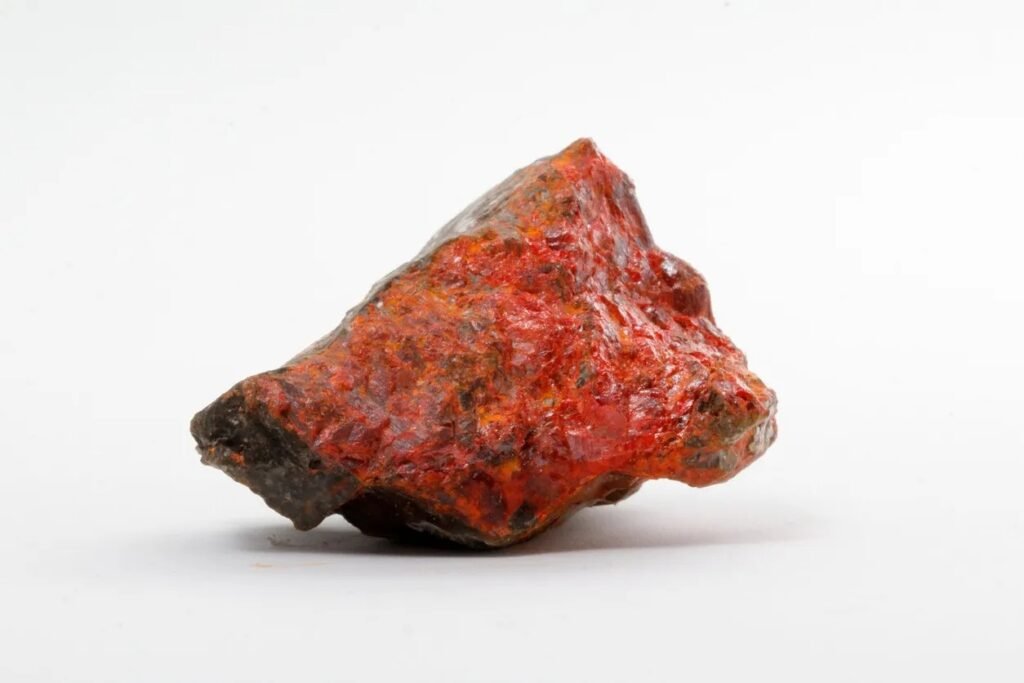
The bright orange-red appearance of realgar is one of its most distinctive characteristics. Unlike many metallic sulfide minerals that display dark or metallic colors, realgar has a warm, almost gemstone-like appearance caused by its unique electronic structure and sulfur-arsenic bonding. Fresh realgar specimens may appear transparent to translucent with a strong orange glow, while older specimens exposed to sunlight may gradually darken or transform into other arsenic sulfide minerals such as pararealgar. This light sensitivity is an important identifying feature and explains why well-preserved specimens are often stored away from direct illumination.
Realgar is closely associated with another arsenic sulfide mineral called orpiment, which has a yellow to golden-yellow color and a similar geological origin. Both minerals commonly occur together in low-temperature hydrothermal environments, volcanic deposits, and arsenic-rich mineral veins. While realgar is mainly valued today as a collector’s mineral and a subject of mineralogical study, it has played significant roles throughout human history as a pigment, alchemical substance, and source material in early chemical investigations. Due to its arsenic content, realgar is considered toxic and requires careful handling.
History of Realgar
Realgar has been known and utilized by humans for thousands of years due to its striking color and unusual chemical properties. Ancient civilizations recognized the mineral as a source of bright red-orange pigment and used it in artistic materials, decorative applications, and early chemical practices. Historical records from ancient Greece, Rome, China, and the Middle East mention arsenic sulfide minerals, although the exact identification of realgar and related minerals was sometimes unclear because early mineral classification systems were based mainly on appearance rather than chemical composition.
In ancient China, realgar held particular cultural and practical importance. It was used as a traditional pigment and was also incorporated into historical practices because of its perceived protective properties. Realgar powder was sometimes applied in ceremonial objects, paintings, and traditional materials. However, modern scientific understanding shows that arsenic-bearing minerals can pose health risks, and such uses have largely disappeared due to safety concerns.During the medieval period, realgar became an important material in alchemy because of its unusual reactions when heated or combined with other substances. Alchemists studied arsenic sulfide minerals because they displayed dramatic color changes and chemical transformations, making them interesting materials in attempts to understand the nature of matter. Realgar was sometimes referred to as “ruby sulfur” because of its intense red color and sulfur-related composition.
With the development of modern mineralogy and chemistry, realgar became recognized as a distinct mineral species with a defined chemical structure. Today, its importance is mainly scientific and mineralogical. High-quality crystals are collected because of their exceptional color and rarity, while researchers continue to study realgar because of its unique molecular structure, light-induced transformation, and role in understanding arsenic mineral systems.
Formation and Geological Occurrence of Realgar
Realgar forms primarily in geological environments where arsenic-rich fluids interact with sulfur-bearing conditions. It is most commonly associated with low-temperature hydrothermal systems, where hot mineral-rich solutions move through fractures and cavities in rocks before cooling and depositing minerals. During this process, arsenic and sulfur combine to form arsenic sulfide minerals, including realgar and the closely related mineral orpiment.
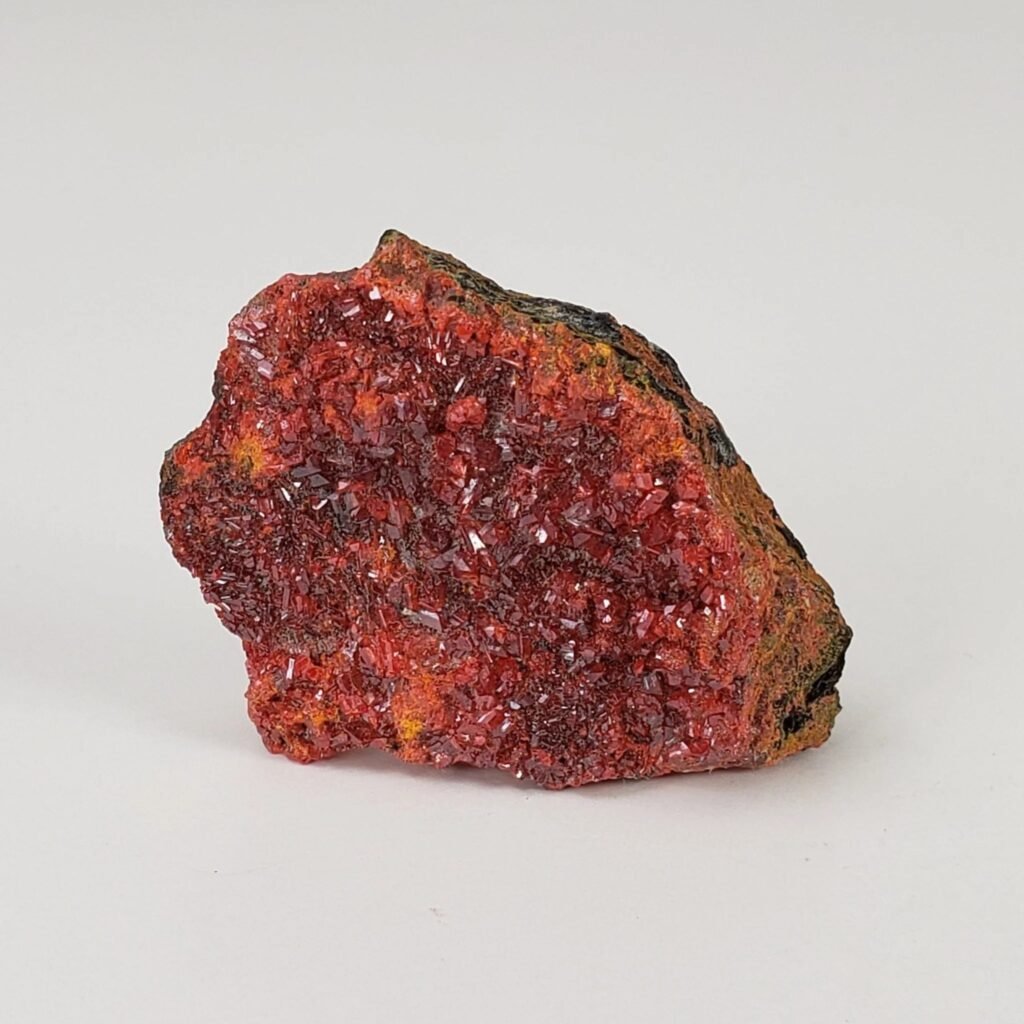
Many realgar deposits are found near volcanic regions, geothermal areas, and hydrothermal veins because these environments provide suitable sources of sulfur and arsenic. Volcanic activity can release arsenic-bearing gases and fluids, which later precipitate as sulfide minerals when temperatures decrease. In some locations, realgar forms around hot springs or fumaroles where sulfur-rich gases interact with surrounding rocks.Within mineral veins, realgar commonly occurs alongside other sulfide minerals such as orpiment, arsenopyrite, stibnite, cinnabar, pyrite, and various lead or silver sulfides. It often fills small cracks, coats cavity walls, or forms small crystals embedded within host rocks. Because realgar typically forms under specific chemical conditions, it is considered an indicator mineral for certain arsenic-rich hydrothermal environments.
One of the most notable characteristics of realgar is its instability when exposed to light. Over time, ultraviolet radiation can cause realgar to undergo chemical transformation, changing its structure and appearance. Fresh orange-red crystals may gradually develop yellow or orange alteration products, particularly pararealgar. This process is why many museum-quality realgar specimens are carefully stored in dark environments to preserve their original appearance.
Types and Varieties of Realgar
Realgar is recognized as a single mineral species and does not have officially accepted varieties in mineralogical classification. However, natural specimens can display different forms and appearances depending on crystal growth conditions, geological environments, impurities, and the degree of alteration caused by exposure to light and weathering. These different forms are commonly described by collectors and mineralogists based on their physical appearance, crystal habit, and occurrence style rather than as separate mineral varieties.
- Crystalline Realgar – Crystalline realgar represents the most desirable form among mineral collectors because of its well-developed crystal shapes and vivid coloration. Individual crystals are usually elongated or prismatic and belong to the monoclinic crystal system. Fresh crystals often display a bright orange-red color with a resinous to glassy luster, and some specimens may show transparent to translucent areas that allow light to pass through the crystal. Although realgar crystals are not extremely rare, large and perfectly formed examples are uncommon because the mineral is relatively soft and easily altered by environmental conditions.
- Massive Realgar – Massive realgar occurs as compact aggregates without clearly developed crystal faces. This form is more commonly encountered in mineral deposits and usually appears as orange-red, reddish-orange, or deep red masses within host rocks. Massive specimens often form when realgar precipitates rapidly from hydrothermal fluids, leaving insufficient space or time for large crystals to develop. While they may lack the aesthetic appeal of individual crystals, massive realgar samples are still important for scientific study because they provide information about the geological conditions under which the mineral formed.
- Granular Realgar – Granular realgar consists of numerous small crystals grouped together into a fine-grained aggregate. This texture commonly develops in mineral veins or replacement deposits where many small crystal growth centers form simultaneously. Granular specimens may display a slightly rough surface and a less intense luster compared with larger crystals, but they can still show the characteristic orange-red color that makes realgar easily recognizable.
- Vein and Coating Realgar – In hydrothermal deposits, realgar may occur as thin layers, crusts, or coatings along fractures, cavities, and rock surfaces. These formations develop when arsenic- and sulfur-rich fluids move through cracks in rocks and gradually deposit mineral material along the walls of open spaces. Coating-type realgar specimens often occur together with other minerals such as orpiment, calcite, quartz, or sulfide minerals, creating attractive mineral associations for collectors.
- Altered Realgar and Pararealgar-Related Forms – Realgar is a light-sensitive mineral that can gradually transform when exposed to sunlight or strong artificial light. During this alteration process, the original orange-red color may fade or become more yellow-orange as the crystal structure changes and pararealgar forms. These altered surfaces are common on older specimens that have not been stored properly. Although altered material is not considered a separate realgar variety, it is an important feature in understanding the stability and environmental behavior of arsenic sulfide minerals.
The different appearances of realgar reflect the complex geological processes involved in its formation. Factors such as temperature, chemical composition of mineralizing fluids, growth space, and environmental exposure all influence the final appearance of specimens. For collectors, the most valuable realgar samples are usually those with bright natural coloration, well-formed crystals, and minimal alteration.
Crystal Structure of Realgar
Realgar crystallizes in the monoclinic crystal system and belongs to the prismatic crystal class. Unlike many common sulfide minerals that have simple repeating ionic structures, realgar has a unique molecular structure represented by the formula As₄S₄, consisting of four arsenic atoms and four sulfur atoms arranged into distinct molecular units. The arsenic and sulfur atoms are connected through strong covalent bonds, creating cage-like molecular groups that are held together by weaker interactions. This special atomic arrangement gives realgar its relatively low hardness, brittle nature, and sensitivity to environmental conditions compared with more stable sulfide minerals.
The monoclinic structure allows realgar to develop elongated or prismatic crystals with well-defined crystal faces when favorable growth conditions are available. However, most natural specimens occur as massive, granular, or coating-like aggregates because ideal crystal growth environments are relatively uncommon. The formation of realgar crystals depends on factors such as temperature, pressure, chemical composition of hydrothermal fluids, and available space within fractures or cavities. Another important characteristic of its crystal structure is its instability under prolonged light exposure. Ultraviolet radiation can alter the molecular arrangement of realgar, causing it to transform into other arsenic sulfide phases such as pararealgar. This structural sensitivity makes realgar an important mineral for studying arsenic-sulfur chemistry and mineral alteration processes, while also requiring careful storage to preserve its original color and crystal appearance.
Physical and Chemical Properties of Realgar
Realgar is a distinctive arsenic sulfide mineral recognized for its bright orange-red to deep red color, resinous luster, and unusual chemical composition. The mineral is relatively soft, with a Mohs hardness of approximately 1.5–2, making it easy to scratch and susceptible to physical damage. It commonly appears transparent to translucent in well-formed crystals and massive forms, while its characteristic orange-red streak helps distinguish it from other sulfide minerals. Realgar has a specific gravity of about 3.5–3.6, which is relatively high due to the presence of arsenic in its composition. Its surface may display a resinous, greasy, or slightly glassy appearance, especially on fresh crystal surfaces.
Chemically, realgar belongs to the sulfide mineral group and is mainly composed of arsenic and sulfur, with the chemical formula commonly written as AsS and structurally represented as As₄S₄. Its unique molecular structure gives it several unusual properties, including low hardness, brittleness, and sensitivity to environmental changes. Realgar is highly affected by prolonged exposure to light, especially ultraviolet radiation, which can cause the mineral to undergo structural transformation and gradually alter into other arsenic sulfide phases such as pararealgar. Because it contains arsenic, realgar is considered toxic and should be handled carefully, avoiding activities that may produce dust or expose the material to prolonged direct contact.
The combination of its vivid coloration, soft physical nature, and chemically reactive structure makes realgar a unique mineral among sulfide minerals. These characteristics not only influence how realgar forms and changes in nature but also determine how specimens should be collected, stored, and preserved. Mineral collectors and museums typically keep realgar specimens away from strong light and humidity to maintain their original color and crystal appearance.
Major Realgar Localities
Realgar occurs in a variety of arsenic-rich geological environments around the world, particularly in areas associated with low-temperature hydrothermal activity, volcanic systems, and sulfide mineral deposits. Although it is distributed globally, high-quality specimens with well-developed crystals and strong orange-red coloration are relatively uncommon. The mineral is usually found within veins, cavities, and fractures of host rocks, where arsenic- and sulfur-bearing fluids have deposited mineral material during the cooling stages of hydrothermal activity. Realgar commonly occurs together with minerals such as orpiment, arsenopyrite, stibnite, cinnabar, pyrite, quartz, and calcite, reflecting the complex chemical conditions required for its formation.
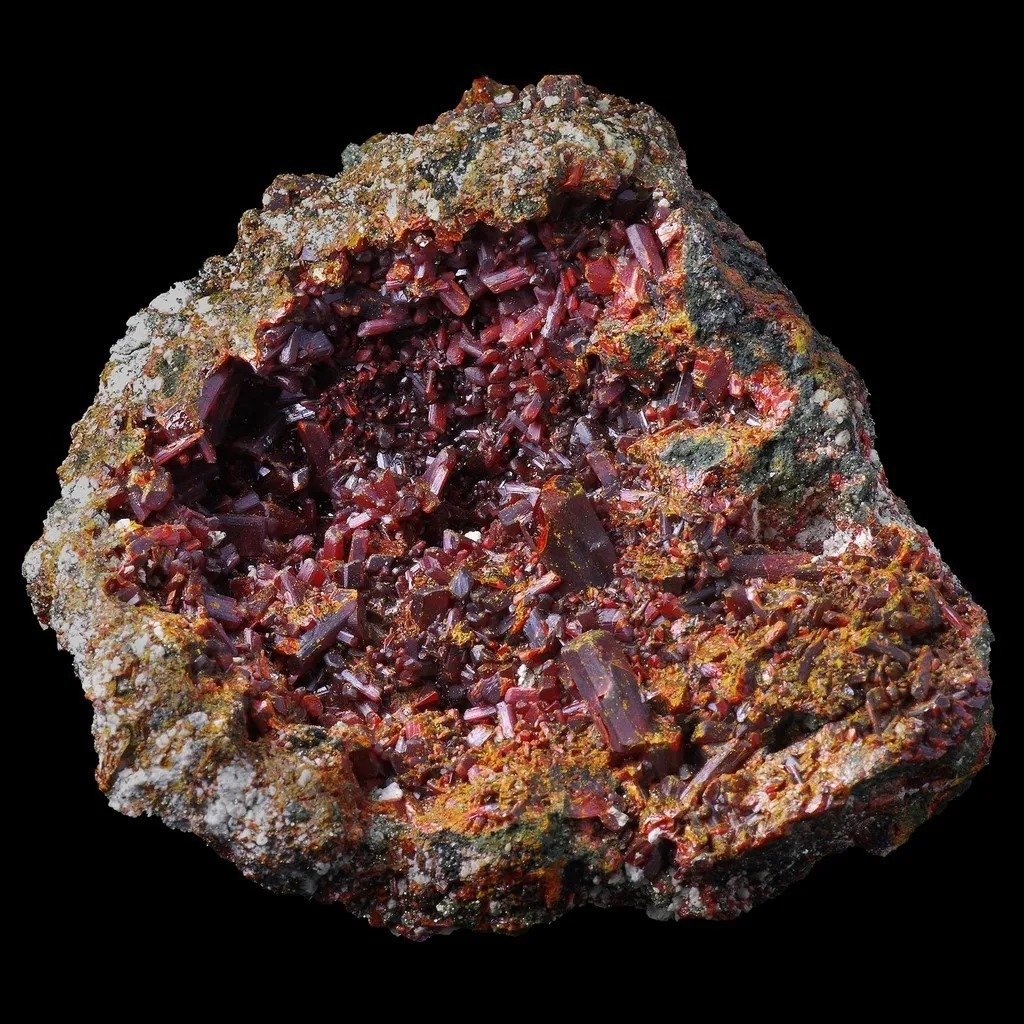
China is one of the most important sources of fine realgar specimens and has produced many well-known examples valued by mineral collectors. Several deposits in China contain abundant arsenic sulfide minerals, where realgar occurs as bright orange-red crystals, massive aggregates, or coatings associated with orpiment and other sulfide minerals. Some Chinese specimens are especially appreciated for their intense color, crystal quality, and attractive mineral associations. In Europe, notable occurrences have been reported from Romania, particularly in historic mining districts such as Baia Sprie and Cavnic, where realgar appears with other hydrothermal sulfide minerals. Switzerland’s Binn Valley is also recognized for producing alpine mineral specimens containing realgar, often associated with complex mineral assemblages.
In the United States, realgar has been found in several mining districts, especially in areas with arsenic-bearing hydrothermal deposits. Occurrences have been reported from states such as Nevada, Utah, and Idaho, where the mineral appears alongside other sulfide minerals in gold, silver, and base-metal deposits. Additional localities are known from countries including Italy, Peru, Japan, and Turkey, where volcanic and hydrothermal geological processes have created suitable conditions for realgar formation. These worldwide occurrences demonstrate the close relationship between realgar and arsenic-rich mineral systems, while also highlighting the mineral’s dependence on specific geological environments for crystallization.
Uses and Applications of Realgar
Historically, realgar was valued mainly for its intense orange-red color and unusual chemical properties. One of its earliest uses was as a natural pigment for paintings, manuscripts, decorative objects, and artistic materials, where its vivid color provided a distinctive red-orange tone. Ancient civilizations also used realgar in early chemical and alchemical studies because of its reactions when heated or combined with other substances. In some traditional practices, arsenic sulfide minerals such as realgar were used for specific preparations, although these applications have largely disappeared due to modern understanding of arsenic toxicity and safety concerns.
Today, realgar is primarily appreciated as a mineral specimen and a subject of scientific research rather than as an industrial material. High-quality crystals are sought after by mineral collectors because of their bright color, rarity, and unique crystal structure. Researchers study realgar to better understand arsenic sulfide chemistry, mineral alteration processes, and the effects of light exposure on mineral stability. Because realgar contains arsenic and can release harmful substances if improperly handled, it has limited practical applications and is generally preserved in controlled conditions for educational, scientific, and collection purposes. Its historical importance and unusual properties continue to make it one of the most interesting minerals in the sulfide group.