
Oregon Sunstone is a world-class, gem-quality variety of crystalline feldspar—specifically labradorite—celebrated for its extraordinary optical properties and vibrant color palette. While standard sunstones exhibit a glittery effect known as aventurescence, Oregon Sunstone is uniquely distinguished by the presence of microscopic, microscopic copper platelets suspended within the crystal lattice. This internal copper gives rise to a breathtaking phenomenon called “schiller,” a metallic, glowing shimmer that dances across the gemstone when it catches the light. Ranging in hue from water-clear and soft champagnes to intense bi-colors, deep greens, and fiery reds, it is widely considered one of the rarest and most coveted phenomenal gemstones in the world. In recognition of its unique beauty and local abundance, it was officially designated as the Oregon State Gemstone in 1987.
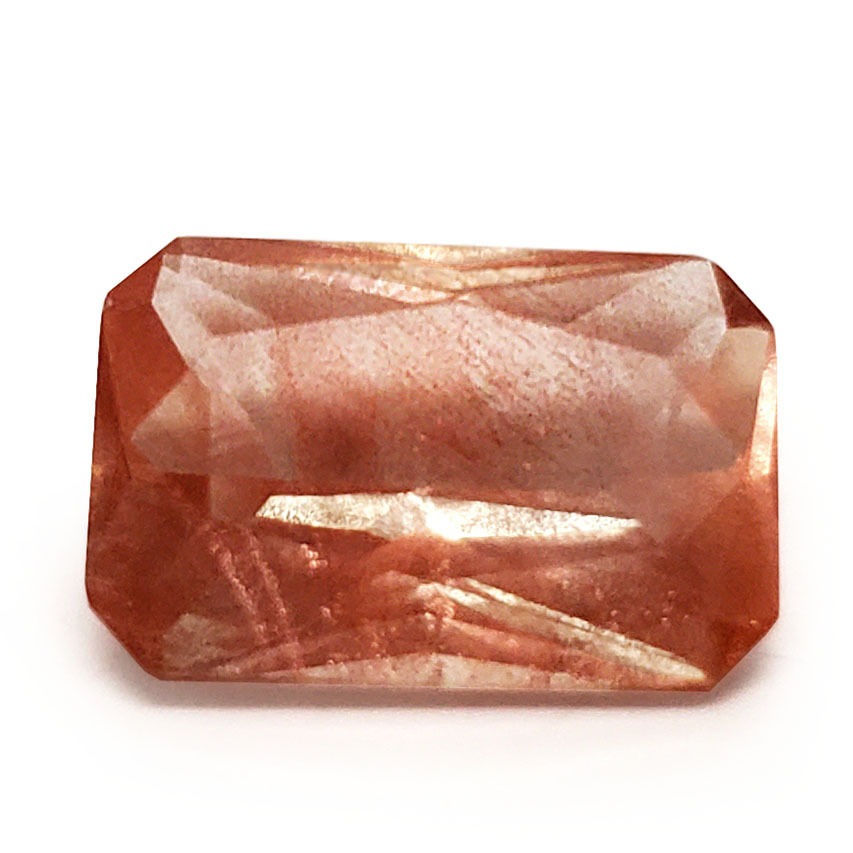
The legacy of the Oregon Sunstone spans centuries, deeply rooted in both indigenous culture and modern gemology. According to Native American legend—specifically of the Pacific Northwest tribes—a great warrior was wounded by an arrow, and his blood dripped onto the sunstones, staining them with the fiery red hues seen today. For generations, these stones were collected, treasured, and used for trade by indigenous peoples.The modern history of the gemstone began to take shape in the early 20th century when the plush, high-desert regions of Lake County, Oregon, caught the attention of geologists and miners. Tiffany & Co. even purchased mining claims in the area in the early 1900s, marketing the gem under the name “Plush Diamond.” Today, Oregon Sunstone is mined in remote, strictly regulated high-desert locales like the Rabbit Basin, maintaining a reputation as an ethically sourced, conflict-free gemstone that appeals heavily to artisanal jewelers and collectors worldwide.
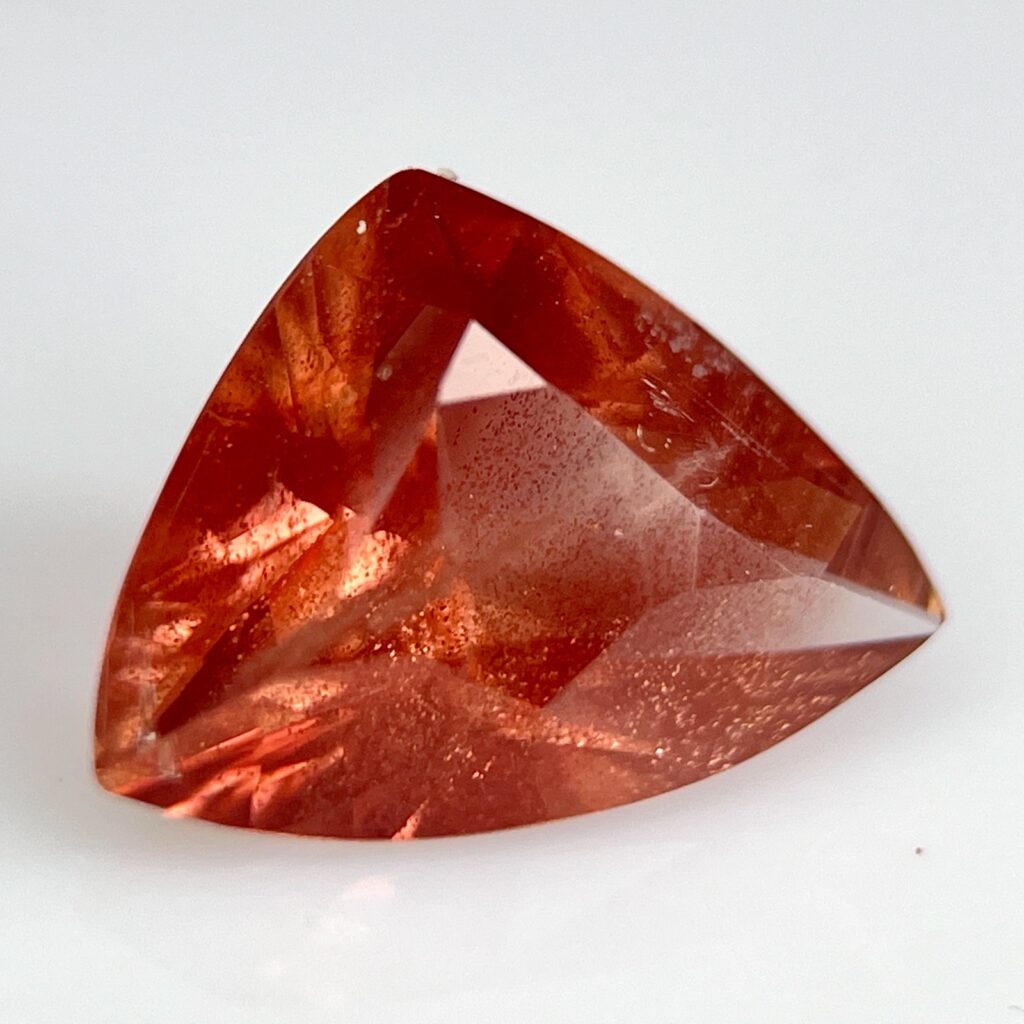
The formation of Oregon Sunstone is a fascinating geological tale that began roughly 13 to 15 million years ago during the Miocene epoch. The region was dominated by intense volcanic activity, characterized by massive outpourings of basaltic lava. As this copper-rich lava flowed across the ancient landscape, it began a slow cooling process. Within the cooling basalt, crystals of plagioclase feldspar began to grow.What makes Oregon’s geological environment unique is the high concentration of elemental copper in the magma. As the feldspar crystals formed, they trapped minute amounts of copper within their chemical structure. Over millions of years, weathering and erosion broke down the surrounding, softer basalt matrix, liberating the durable sunstone crystals and leaving them scattered across the desert floor or embedded in the remaining volcanic rock, waiting to be discovered.
Basaltic Lava Outpouring → Slow Cooling + Copper Infusion → Feldspar Crystallization → Weathering & Exposure
Color Mechanics and Optical Phenomena
The visual prestige of the Oregon Sunstone is rooted in its highly complex color palette and its signature optical phenomenon, known alternately as aventurescence or schiller. While typical sunstones from other global localities owe their glitter to iron oxide inclusions (such as hematite or goethite), the Oregon variety is uniquely distinguished by the presence of exsolved, microscopic platelets of elemental copper (Cu) suspended within the host crystal lattice. The gemstone exhibits an extraordinary range of hues, transitioning from completely water-clear, pale straw yellows, and rich peach champagnes to highly coveted bicolors, deep emerald greens, and intense, commanding reds. The mechanical driver behind the schiller effect—and much of the stone’s coloration—is the spatial orientation and density of these sub-microscopic copper crystallites. When light enters the gemstone, it interacts with these precisely aligned metallic platelets, scattering and reflecting to produce a metallic, shimmering glow that appears to shift dynamically across the facets as the stone is rotated. Depending on the concentration, distribution, and size of the copper inclusions, a single crystal can display dramatic color zoning. Dilute distributions of exceptionally fine copper nanoparticles yield a soft, reddish-pink body color often referred to in the trade as “peach” or “salmon.” Conversely, dense concentrations of larger copper platelets can completely dominate the stone, creating an opaque, metallic bronze or fiery red appearance, or through complex light absorption principles, rendering rare and highly prized pleochroic green and red color-shift variations.
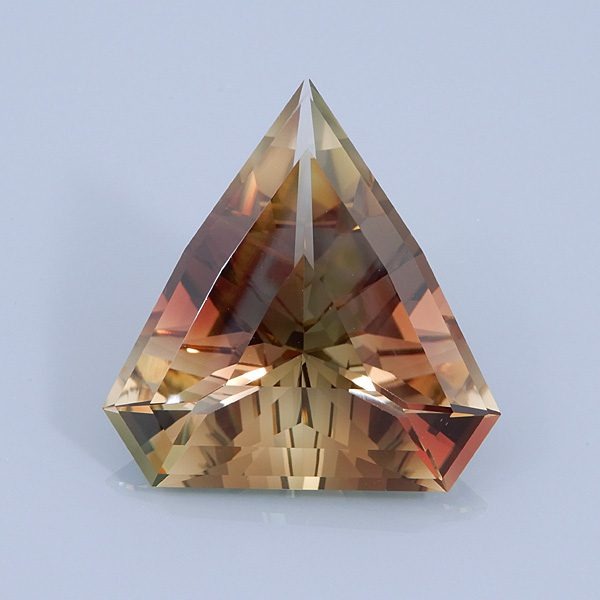
Physico-Chemical Properties and Crystallography
Oregon Sunstone is classified as a gem-quality variety of labradorite, which sits within the plagioclase series of the feldspar mineral group. Chemically, it is a calcium-sodium aluminum silicate, representing a solid solution series where the composition fluctuates between the albite (NaAlSi₃O₈) and anorthite (CaAl₂Si₂O₈) endmembers, typically maintaining an anorthite content (An) that firmly places it in the labradorite field (generally An₅₀ to An₇₀). The critical chemical anomaly that elevates this material above ordinary plagioclase is the trace infusion of native copper, a direct result of its formation within highly specific, copper-rich volcanic basalt flows. The overall chemical profile can be expressed as (Na,Ca)(Al,Si)₄O₈ with trace Cu. Crystallizing in the triclinic crystal system, Oregon Sunstone displays a vitreous luster and possesses a specific gravity ranging between 2.68 and 2.72. On the Mohs scale of mineral hardness, it registers a definitive 6.0 to 6.5, imparting a moderate durability that is well-suited for fine jewelry, though it demands sophisticated handling due to its structural vulnerabilities. Diagnostic of the feldspar family, the mineral exhibits two directions of perfect cleavage intersecting at approximately 90 degrees, meaning any sudden impact or improper mechanical pressure can cause the stone to split along these structural planes. Optically, Oregon Sunstone is anisotropic and biaxial positive (or occasionally negative, depending on the exact calcium-to-sodium ratio), with refractive indices spanning from 1.560 to 1.572 and a maximum birefringence of roughly 0.008 to 0.010.
What is Sunstone and How Does It Differ from Oregon Sunstone? [Sunstone]
Sunstone is a captivating, gem-quality variety of feldspar mineral known for its warm tones and unique, glittery optical phenomenon called aventurescence. This sparkling effect, often referred to in the gem trade as “schiller,” occurs when light reflects off thousands of tiny, microscopic mineral inclusions aligned within the stone’s crystal structure. In standard sunstones found in major global commercial deposits—such as those in India, Tanzania, and Norway—these metallic inclusions are typically made of iron oxide minerals like hematite or goethite, giving the stones their traditional, glittery golden-brown to bright orange appearance.
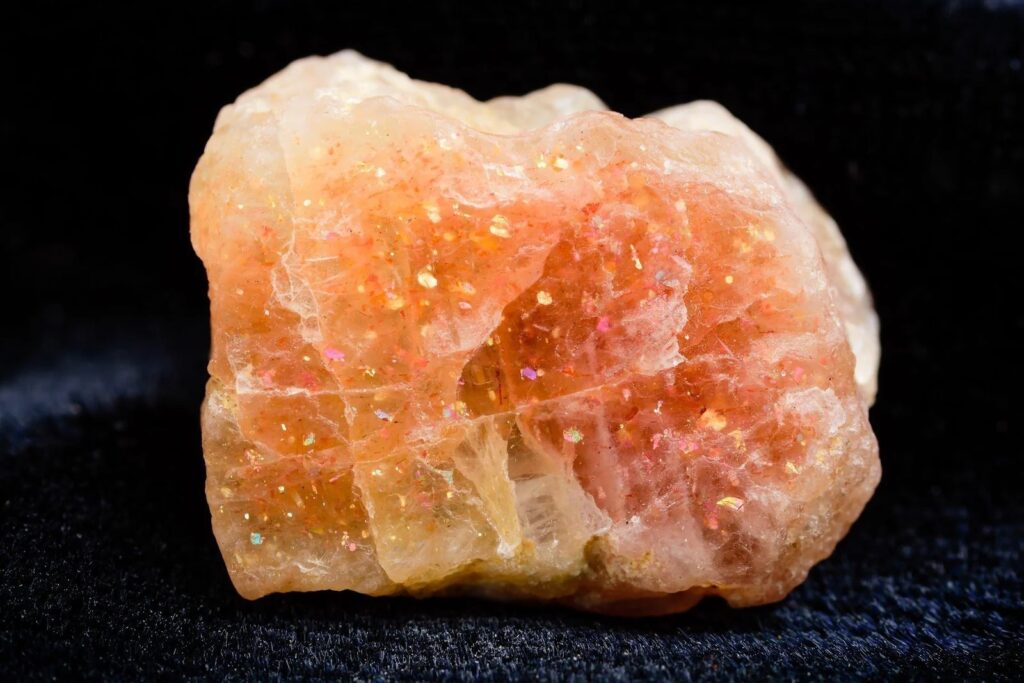
While ordinary sunstones are undeniably beautiful, the Oregon Sunstone stands in a prestigious elite class of its own due to a distinct geological anomaly. The fundamental difference lies in the exact chemical composition and nature of its internal inclusions: instead of iron oxide, the Oregon Sunstone owes its vivid colors and breathtaking internal glow exclusively to the presence of thousands of exsolved, sub-microscopic platelets of elemental copper (Cu). This unique infusion of native copper produces a much wider and highly coveted color palette—ranging from completely water-clear and soft champagnes to vibrant bi-colors, deep pleochroic greens, and fiery reds. Furthermore, while standard sunstones are often formed in different geological environments, the Oregon variety was born from intense, copper-rich volcanic basalt flows millions of years ago in the high deserts of western North America. This chemical distinctiveness, combined with the fact that Oregon Sunstones are globally celebrated for being completely untreated, ethically mined, and geographically exclusive, separates them from common iron-bearing sunstones on the luxury market.
Applications of Oregon Sunstone
Oregon Sunstone is primarily used as a premium gemstone in fine jewelry, custom lapidary art, and mineral collections, where its natural copper inclusions and distinctive schiller effect distinguish it from other feldspar varieties. Transparent, vividly colored crystals are commonly faceted into rings, pendants, earrings, and other high-end jewelry, while material with dense copper platelets is often fashioned into cabochons, carvings, and collector specimens that showcase its unique optical properties. Skilled gem cutters carefully orient the rough to maximize aventurescence and highlight natural bi-color or tri-color zoning, creating visually striking gemstones without the need for artificial enhancement. Beyond ornamental use, Oregon Sunstone is valued by museums, educational institutions, and gemological laboratories as an important example of copper-bearing labradorite and volcanic gemstone formation. Because it is mined almost exclusively from the high-desert basalt deposits of Lake County, Oregon, and is typically sold in a completely natural, untreated state, it occupies a specialized niche in the colored gemstone market. Its rarity, traceable origin, and distinctive geological characteristics make it highly desirable among collectors, artisan jewelry designers, and consumers seeking ethically sourced gemstones with exceptional natural beauty.