
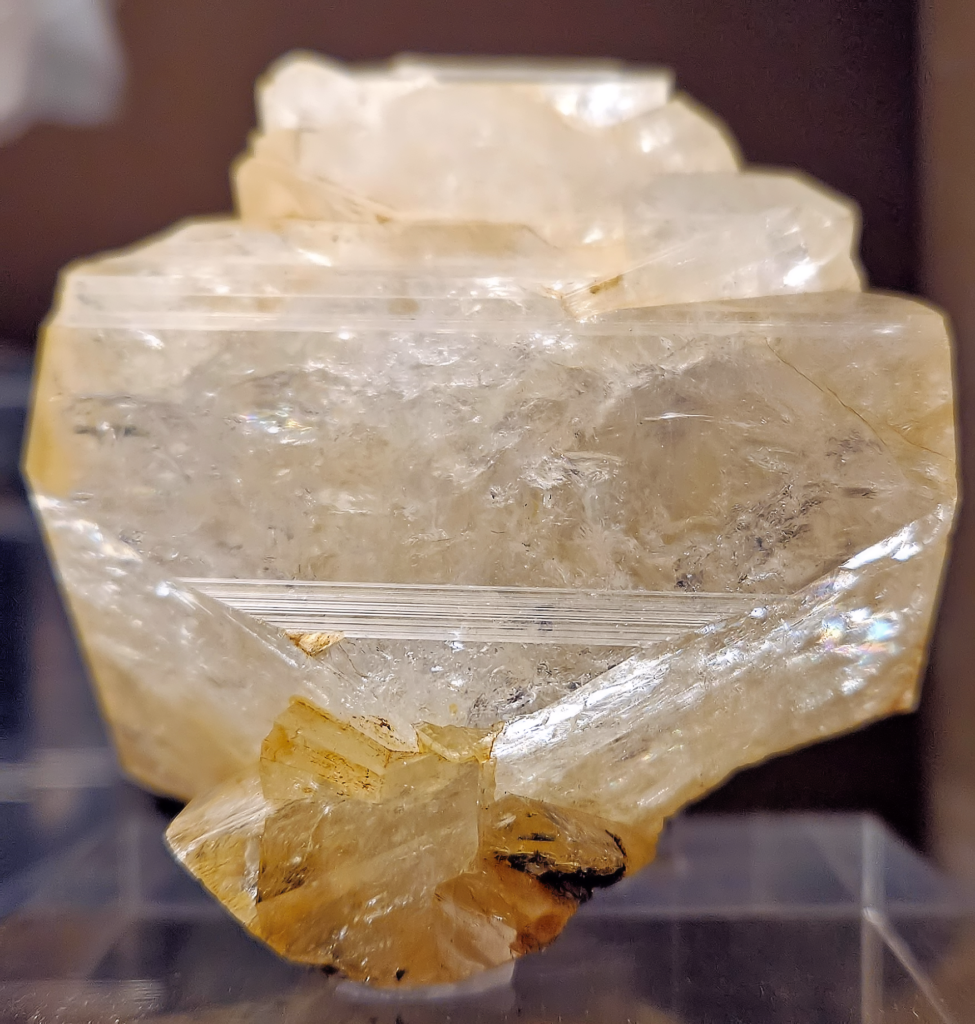
Hyalophane is a rare and intriguing silicate mineral belonging to the feldspar group. Often referred to as “barium-bearing adularia,” it represents an intermediate member of a solid solution series between potassium feldspar (orthoclase) and barium feldspar (celsian). Chemically, it is typically represented by the formula (K,Ba)[Al(Al,Si)Si₂O₈]. The name itself is derived from the Greek words hyalos, meaning “glass,” and phanos, meaning “to appear,” a tribute to its characteristic glass-like transparency and luster. While most feldspars are common and opaque, gem-quality hyalophane is prized by collectors for its clarity and its distinct pale yellow to colorless appearance.
The Formation of Hyalophane
The formation of hyalophane occurs primarily in metamorphic and hydrothermal environments where barium is present in significant concentrations. It is most commonly found in manganese-rich deposits or within dolomitic marbles that have undergone contact metamorphism. During these geological processes, barium ions substitute for potassium ions within the crystal lattice of the feldspar. Because the barium and potassium ions have different charges and sizes, this substitution requires a specific chemical balance, often involving the simultaneous replacement of silicon with aluminum. The resulting crystals are typically monoclinic and can range from small, grainy masses to large, well-formed transparent prisms.
The History of Hyalophane
Hyalophane was first formally described and named in 1855 by Wolfgang Sartorius von Waltershausen. The type locality for the mineral is the Lengenbach Quarry in the Binn Valley, Switzerland, a site world-renowned for its unique and complex mineralogy. Historically, hyalophane was often mistaken for other feldspars or even quartz until chemical analysis revealed its high barium content. While it has never been an ore of industrial importance, its history is deeply rooted in the world of mineralogy and gemstone collecting. In the late 20th century, the discovery of high-quality, transparent crystals in Bosnia and Herzegovina (specifically the Busovača region) put hyalophane on the map for gem cutters, shifting its status from a mere scientific curiosity to a sought-after collector’s gem.
Crystal Structure of Hyalophane
Hyalophane belongs to the monoclinic crystal system, specifically falling within the 2/m prismatic class. Its internal framework is a three-dimensional network of silica (SiO₄) and alumina (AlO₄) tetrahedra, a structure common to all tectosilicates. In hyalophane, these tetrahedra are linked by sharing oxygen atoms to form large, open cavities that house the larger cations. The defining characteristic of its structure is the disordered or partially ordered distribution of potassium (K⁺) and barium (Ba²⁺) ions within these interstitial sites.
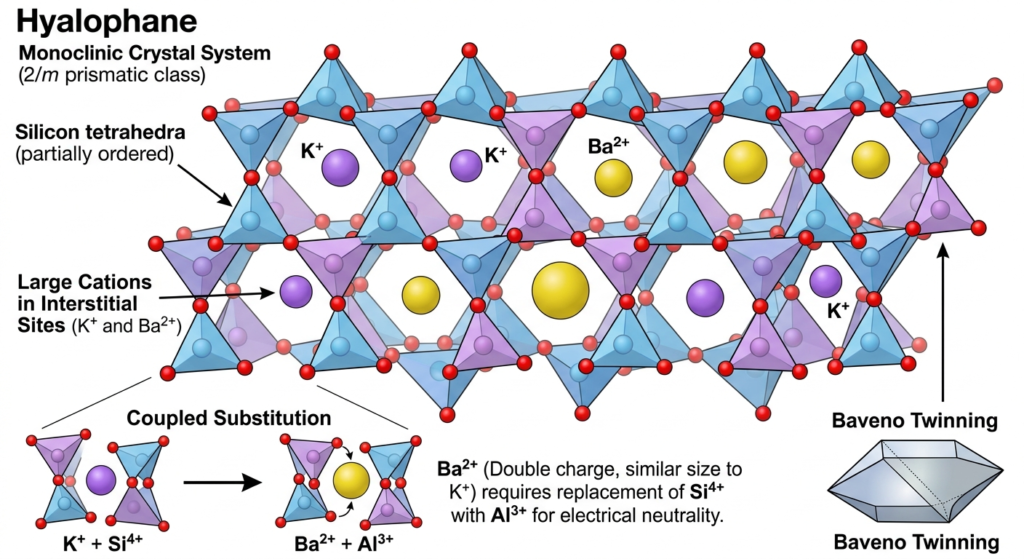
The incorporation of barium into the lattice is a primary focus of its crystallography. Because the barium ion has a similar ionic radius to potassium but carries a double positive charge, it requires a coupled substitution to maintain electrical neutrality. This is achieved by replacing some of the silicon (Si⁴⁺) in the tetrahedral sites with aluminum (Al³⁺). This structural adjustment results in a chemical formula—(K,Ba)(Al,Si)₄O₈—that bridges the gap between the monoclinic structures of orthoclase and celsian. Most hyalophane crystals exhibit a “Baveno” or “Manebach” twinning law, which are common growth patterns in the feldspar group that affect the external symmetry and physical appearance of the mineral.
Physical and Optical Properties of Hyalophane
Hyalophane exhibits a distinct set of physical characteristics that distinguish it from more common members of the feldspar group. It possesses a Mohs hardness of 6 to 6.5, making it relatively durable, though its perfect cleavage in two directions requires careful handling during cutting and setting. One of its most identifying physical traits is its specific gravity, which ranges from 2.7 to 2.9. This is notably higher than that of standard orthoclase due to the presence of heavy barium atoms within the crystal lattice.Optically, hyalophane is known for its vitreous, glass-like luster and exceptional transparency. While often colorless, it frequently appears in shades of pale yellow or creamy white. As a monoclinic mineral, it is biaxial with a refractive index typically falling between 1.520 and 1.545. In its highest quality, it displays a “water-drop” clarity that is highly prized by mineral collectors and gemologists alike. Under ultraviolet light, some specimens may exhibit a weak fluorescence, adding another layer of interest to its optical profile.
Identification & How It Differs from Other Feldspars
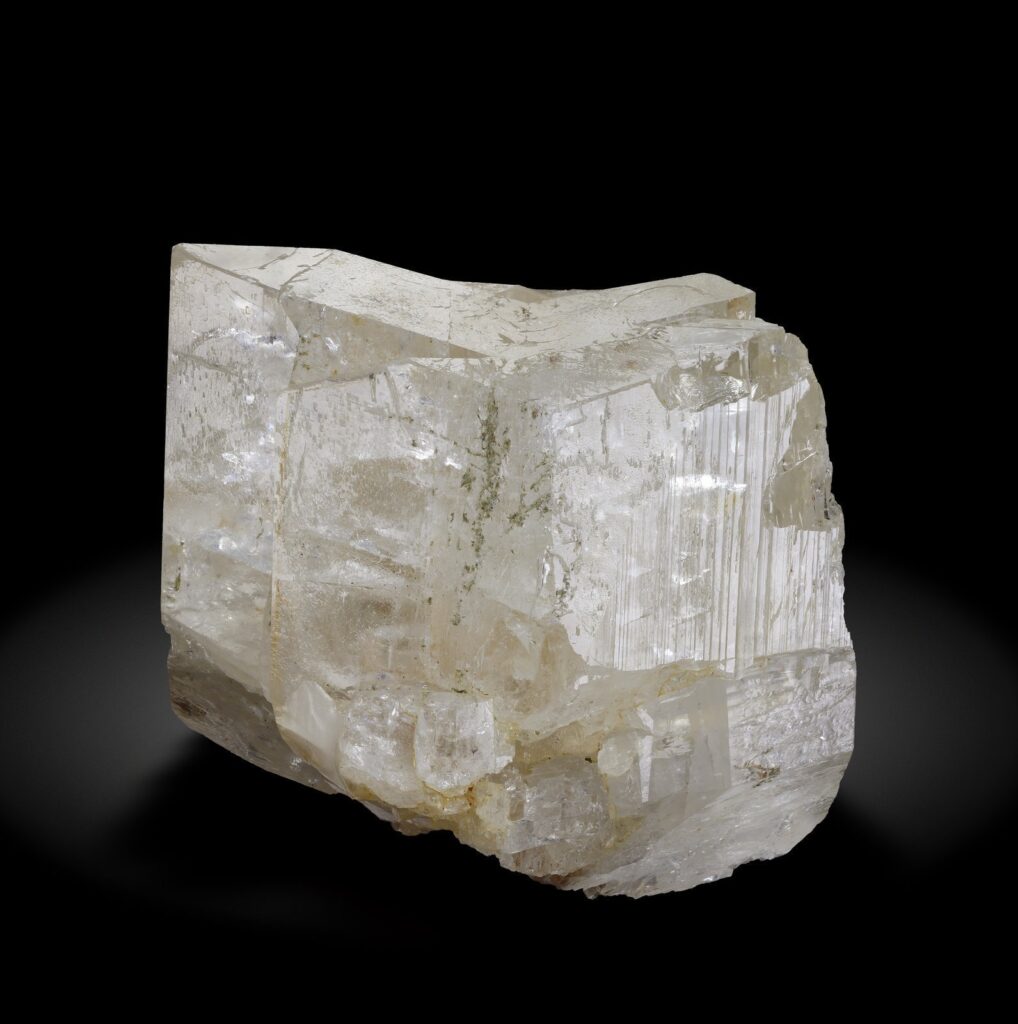
Identifying hyalophane accurately requires a focus on its unique chemical density and optical nuances that set it apart from its more common relatives like orthoclase or adularia. The most reliable field indicator is its specific gravity; because hyalophane contains significant amounts of barium, it feels noticeably “heavier” than other feldspars, with a density ranging from 2.7 to 2.9 compared to the typical 2.55 of orthoclase. While it shares the same monoclinic crystal system and perfect two-directional cleavage as other potassium feldspars, hyalophane is distinguished by its superior transparency and a distinct vitreous luster that can border on adamantine in high-quality specimens. In a laboratory setting, gemologists use refractive index measurements—which are slightly higher in hyalophane (1.520–1.545)—and chemical testing to confirm the barium content that defines the species. Unlike many other feldspars that exhibit phenomenal effects like labradorescence or adularescence, hyalophane is prized primarily for its exceptional “water-drop” clarity and its specific pale yellow to colorless palette.
Applications of Hyalophane
While hyalophane is not widely used as an industrial ore, its unique chemical and optical properties make it valuable in several specialized fields. In gemstone collecting, its rarity and exceptional “water-drop” transparency make gem-quality specimens highly prized by collectors, though they remain more of a collector’s item than a staple in mainstream jewelry. For the scientific community, hyalophane serves as an important subject for crystallographic research, offering insights into the coupled substitution of barium and potassium within tectosilicate structures. This helps mineralogists better understand feldspar minerals and their behavior in complex geological environments. In high-end craftsmanship, expert lapidaries occasionally facet high-quality specimens into custom jewelry, such as pendants and earrings, to highlight their distinct vitreous luster. However, due to its perfect cleavage, special care is required during cutting and setting to avoid damage. Additionally, hyalophane is often utilized in spiritual and metaphysical practices, where it is believed to aid in clear communication and the pursuit of truth, making it a popular tool in meditation and healing. Well-formed hyalophane crystals, especially those displaying characteristic Baveno or Manebach twinning, are highly sought after by museums and private collectors for professional mineral displays, further cementing the mineral’s value both scientifically and culturally.