
Whether you are a seasoned gemologist, an avid crystal collector, or a geology enthusiast, discovering rare minerals is always a thrill. Among the world’s most spectacular and sought-after natural wonders is Haüyne (often pronounced ah-WEEN or how-WEEN), a gemstone famous for its breathtaking, neon-blue hues. Also known as haüynite, it is a rare, complex tectosilicate mineral belonging to the sodalite mineral group. Characterized by its cubic crystal system, it is most famous for its electric, highly saturated blue color, though it can also be found in shades of green, yellow, grey, or even colorless varieties. Chemically, it is a sodium calcium aluminum silicate sulfate with the general formula Na₃Ca(Si₃Al₃)O₁₂(SO₄). Registering between 5.5 and 6 on the Mohs hardness scale, it is relatively brittle and features a vitreous to greasy luster, making it best suited for careful collectors rather than daily-wear jewelry. Interestingly, if you admire the famous semi-precious stone Lapis Lazuli, you are already a fan of Haüyne; it is actually one of the primary mineral constituents that gives Lapis Lazuli its iconic blue pigmentation. While massive, opaque specimens are commonly found embedded within Lapis Lazuli, standalone, gem-quality transparent Haüyne crystals are exceedingly rare and command premium prices on the global gemstone market.
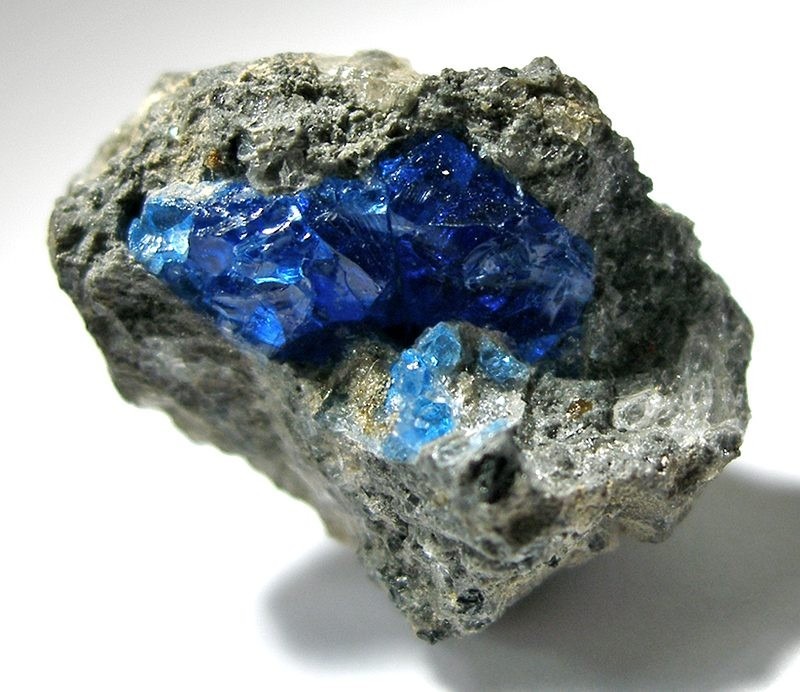
The history of Haüyne is deeply intertwined with the dawn of modern mineralogy in early 19th-century Europe. The mineral was first unofficially discovered in 1803 by the Italian mineralogist Carlo Giuseppe Gismondi in the volcanic lavas of Mount Somma, near Mount Vesuvius in Italy. Gismondi originally named the stone “latialite” but did not formally publish his findings. A few years later, in 1807, the Danish scholar and mineralogist Tønnes Christian Bruun-Neergaard officially described the mineral after studying specimens found along the shores of Lake Nemi in Italy. Bruun-Neergaard chose to name the new mineral “Haüyne” to honor the legendary French mineralogist and Catholic priest, Abbé René Just Haüy (1743–1822). Universally celebrated today as the “Father of Modern Crystallography” for his groundbreaking work in defining the geometric structures of crystals, naming this striking blue gem after Haüy was a fitting tribute to his monumental contributions to the Earth sciences.
Haüyne’s extreme rarity is largely due to the highly specific and volatile geological conditions required for its creation. It is a volcanic mineral that forms exclusively in alkali-rich, silica-poor igneous rocks. Haüyne crystallizes during the rapid cooling of magma that is deficient in silica but highly enriched with sodium, calcium, and sulfate. Because there isn’t enough silica present to form common quartz or standard feldspars, nature creates “feldspathoid” minerals like Haüyne instead, which are often found intergrown with other distinct volcanic minerals like nepheline, leucite, and titanite. Because it requires such a highly specific volcanic recipe, it is found in only a handful of locations worldwide. The Eifel Mountains in Germany remain the undisputed capital of gem-quality Haüyne, where ancient, extinct volcanoes act as the only consistent source of the highly transparent, facet-grade blue crystals. Meanwhile, historic localities in Campania and Lazio, Italy, continue to produce notable specimens, and recent minor discoveries in Tanzania and the Badakhshan province of Afghanistan have added new variations to the market. Ultimately, whether you are studying its unique chemical composition or marveling at its fiery volcanic birth, Haüyne remains one of the most mesmerizing and complex treasures of the mineral kingdom.
Varieties of Haüyne
While the electric, neon-blue gem is the undisputed flagship of the mineral, Haüyne actually exists in a diverse spectrum of varieties based on subtle chemical substitutions during its formation. It belongs to a complex solid solution series encompassing other closely related feldspathoids like nosean and sodalite. Depending on trace elements and the specific balance of calcium, potassium, and sulfate, Haüyne can form in variations of vibrant emerald green, sunny yellow, pale grey, brown, or even as completely colorless crystals.
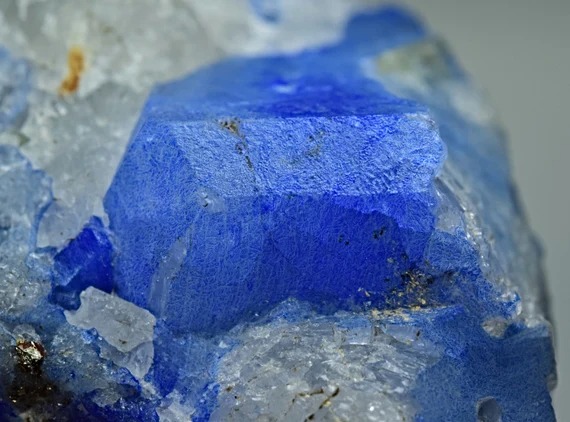
The deeply saturated blue variety owes its signature color to the presence of sulfur radical anions trapped within its highly symmetrical crystal lattice. Furthermore, lazurite—the primary blue component of lapis lazuli—is so chemically and structurally similar to Haüyne that mineralogists often describe them as two sides of the same coin, with lazurite essentially acting as a sulfide-dominant sibling to the sulfate-rich Haüyne.
Crystal Structure
Haüyne belongs to the isometric, or cubic, crystal system, meaning its internal atomic arrangement is perfectly symmetrical. It forms within a tectosilicate framework, typically crystallizing as dodecahedrons or octahedrons. However, perfect geometric crystals are incredibly rare; in nature, it is most frequently discovered as rounded grains or massive habits embedded directly within a host volcanic rock.
Physical and Chemical Properties
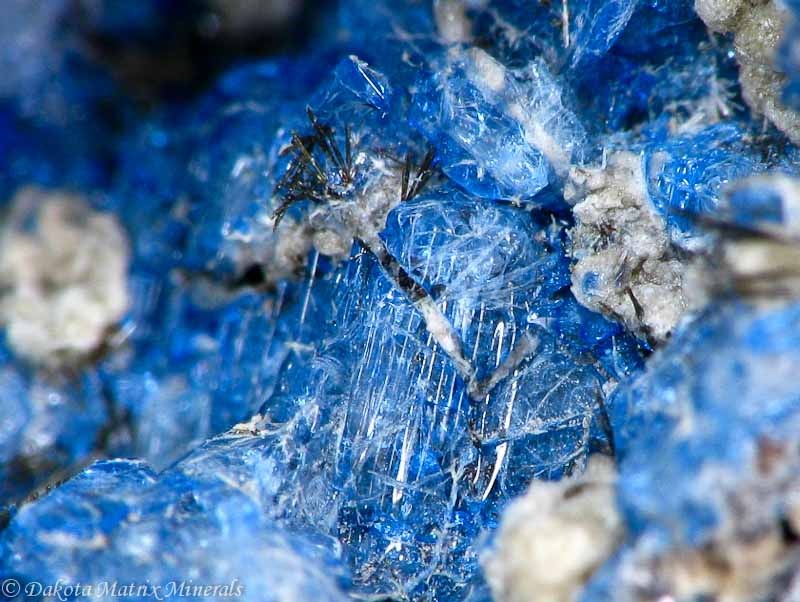
- Physical Traits: The mineral exhibits perfect cleavage in several directions and a distinct conchoidal fracture when broken. With a specific gravity of approximately 2.4 to 2.5 and a refractive index hovering near 1.50, it is optically isotropic, meaning it allows light to travel through it at the exact same speed in all directions.
- Chemical Reactivity: Chemically, Haüyne is highly reactive. When exposed to hydrochloric acid, it easily decomposes and gelatinizes—a classic identifying trait of many feldspathoid minerals.
- Fluorescence: Some specimens exhibit a fascinating optical phenomenon known as fluorescence, glowing a vivid orange or pinkish-red when exposed to long-wave ultraviolet (UV) radiation.
Uses and Applications
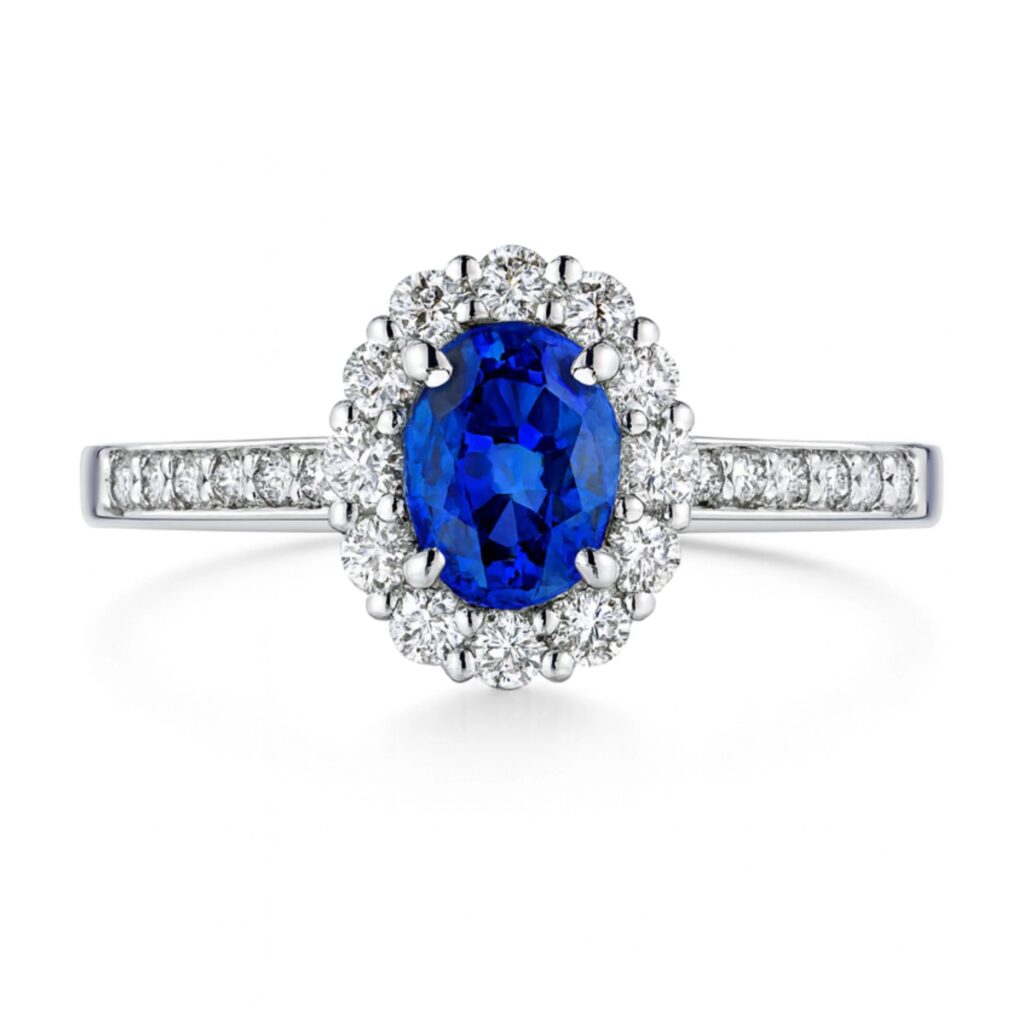
- Bespoke Jewelry and Collecting: Because it sits between 5.5 and 6 on the Mohs scale and possesses perfect cleavage, it is generally considered too fragile for mainstream, daily-wear commercial jewelry (such as standard engagement rings). Instead, its primary application lies firmly within the high-end collector’s market and the realm of bespoke gemology. Flawless, transparent, facet-grade Haüyne crystals are masterfully cut by expert lapidaries and mounted in highly protective settings for pendants and earrings meant for careful, occasional wear. These rare, faceted stones can command thousands of dollars per carat.
- Geological Science: Beyond the luxury gemstone trade, Haüyne holds significant scientific value for geologists and petrologists. Its presence in rock formations acts as a crucial indicator mineral, helping scientists map out historical volcanic activity and deeply understand the complex cooling history of alkali-rich magmas within the Earth’s crust.