
Hambergite is a rare beryllium borate mineral with the chemical formula Be₂BO₃OH. It belongs to the orthorhombic crystal system and commonly occurs as elongated prismatic crystals. Crystals may be colorless, white, or transparent to translucent, depending on the specimen and the presence of minor impurities or inclusions. Hambergite has a Mohs hardness of about 7.5 and a specific gravity of approximately 2.35, giving it a combination of relatively high hardness and low density.The mineral is composed of beryllium, boron, oxygen, and hydrogen. Its crystal structure and chemical composition account for several of its physical and optical properties, including its hardness, cleavage, and strong birefringence. Transparent crystals can be faceted as gemstones, although gem-quality material is uncommon. In mineral specimens, Hambergite is generally identified by its crystal form, hardness, low specific gravity, optical properties, and association with beryllium- and boron-bearing rocks.
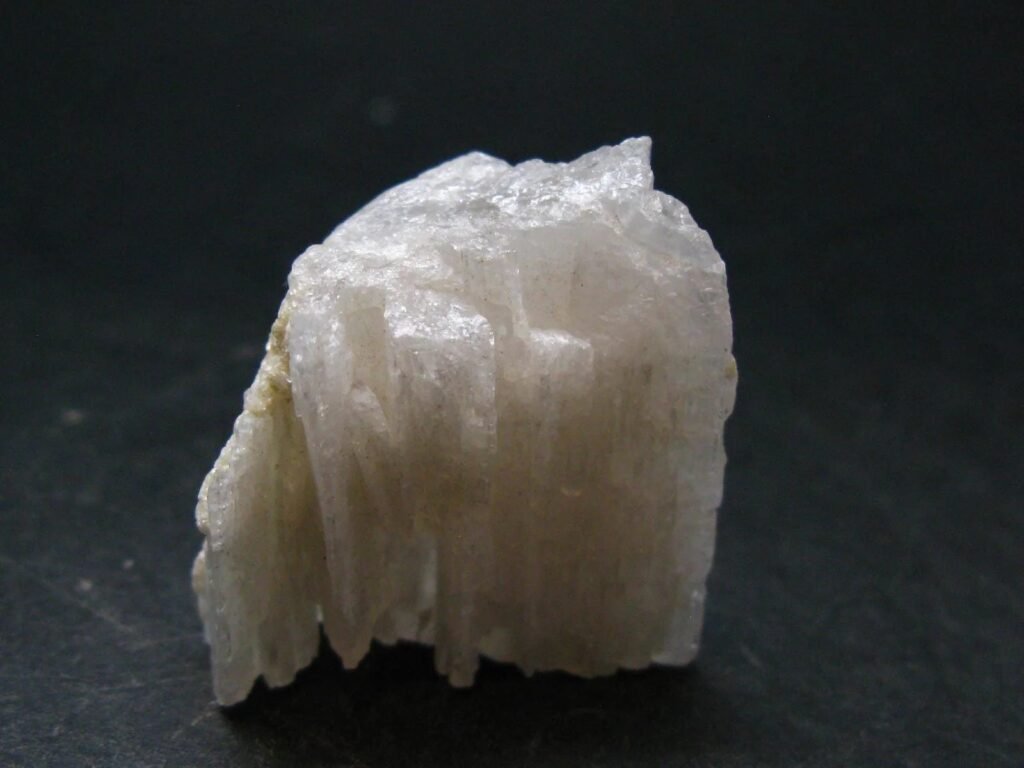
Hambergite is most commonly associated with alkaline rocks and rare-element pegmatitic environments where beryllium and boron are concentrated. It can occur together with other beryllium-bearing and borate minerals. Notable occurrences include localities in Norway, Madagascar, Myanmar, and several other regions. The mineral was first described from material found in Norway and was named after the Swedish mineralogist Axel Hamberg.
History and Discovery of Hambergite
Hambergite was first described from specimens collected in Norway and was named after Axel Hamberg (1863–1933), a Swedish mineralogist and geographer. The mineral was identified during the study of beryllium-bearing mineral assemblages and was subsequently recognized as a distinct mineral species based on its chemical composition and physical properties. Early specimens were associated with pegmatitic rocks, which commonly contain a variety of rare elements and minerals.
Later studies established the mineral’s distribution in other parts of the world, including Madagascar and Myanmar. Hambergite remains an uncommon mineral, and its occurrence is generally restricted to specific geological environments where beryllium and boron are sufficiently concentrated. Mineralogical investigations of Hambergite have focused on its crystal structure, chemical composition, optical properties, and relationships with other minerals occurring in the same deposits.
Formation and Geological Occurrence of Hambergite
Hambergite forms mainly in beryllium- and boron-rich geological environments, particularly in certain alkaline pegmatites and associated hydrothermal systems. Its formation generally takes place during late stages of magmatic crystallization, when elements that were not incorporated into earlier minerals become concentrated in residual melts and fluids. These fluids can move through fractures, cavities, and altered portions of the host rock, where changes in temperature, pressure, and chemical composition may allow Hambergite to crystallize. The mineral is commonly associated with other rare-element minerals, especially those containing beryllium, boron, lithium, or related elements.
Hambergite crystals may occur within pegmatitic rock or in open cavities where there is sufficient space for crystals to develop their characteristic elongated forms. Associated minerals can include feldspar, quartz, mica, and other uncommon beryllium-bearing phases, although the exact mineral assemblage varies between localities. Hambergite has been reported from Norway, Madagascar, Myanmar, and several other regions with suitable beryllium-rich geological settings. The size, transparency, crystal development, and mineral associations of Hambergite specimens can differ considerably depending on the geological conditions of each occurrence.
Crystal Structure of Hambergite
Hambergite crystallizes in the orthorhombic crystal system, meaning that its crystal structure has three mutually perpendicular crystallographic axes with different unit-cell dimensions. The structure is composed of beryllium, boron, oxygen, and hydroxyl groups arranged in a repeating three-dimensional framework. Beryllium is bonded to oxygen atoms, while boron occurs in borate groups that are incorporated into the overall structure. The arrangement and bonding of these structural units provide the mineral with its characteristic physical properties, including relatively high hardness and low specific gravity.
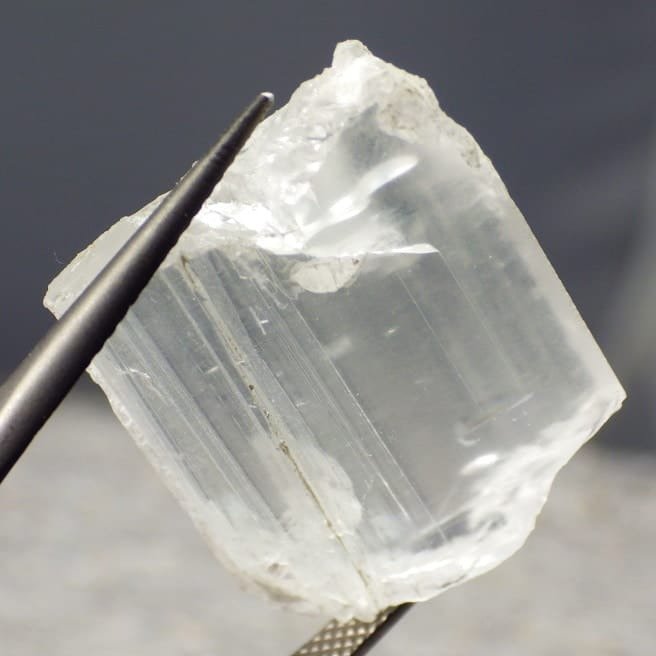
The internal arrangement of atoms also influences the external crystal form of Hambergite. It commonly develops as elongated prismatic crystals, with the shape and proportions of individual crystals depending on the conditions under which they formed. Differences in crystallographic direction can produce differences in physical and optical behavior, which is typical of minerals with an orthorhombic structure. Hambergite is optically anisotropic and shows noticeable birefringence, with its refractive properties varying according to the direction in which light travels through the crystal. These structural and optical characteristics can be examined using crystallographic and mineralogical methods and can assist in distinguishing Hambergite from minerals with similar appearance or chemical components.
Color, Luster, and Transparency of Hambergite
Hambergite is generally colorless, white, or colorless with a slight grayish or pale appearance. In well-developed crystals, the mineral may be transparent, allowing light to pass through the crystal with relatively little scattering, while other specimens are translucent because of internal fractures, inclusions, or structural imperfections. Its luster is typically vitreous, particularly on clean and freshly exposed crystal faces. The streak of Hambergite is white, and its color is usually not strongly influenced by the major elements of its chemical composition. Variations in appearance are more commonly related to impurities, inclusions, surface alteration, or associated minerals within the specimen.
The transparency and optical behavior of Hambergite are closely related to its crystal structure. As an anisotropic orthorhombic mineral, it has direction-dependent optical properties and exhibits noticeable birefringence. When viewed under polarized light, differences in refractive behavior along different crystallographic directions can be observed, making optical examination useful for mineral identification. Transparent crystals may also show differences in brightness and internal appearance depending on their orientation and the condition of their surfaces. In mineral specimens, these characteristics are normally evaluated together with crystal habit, cleavage, hardness, specific gravity, refractive properties, and chemical composition rather than being used as a single diagnostic feature.
Hardness, Cleavage, and Specific Gravity of Hambergite
Hambergite has a Mohs hardness of approximately 7.5, placing it within the harder range of non-metallic minerals. Its hardness is related to the strength and arrangement of chemical bonds within its crystal structure and provides a useful property for distinguishing it from softer minerals with a similar color or crystal habit. The mineral has distinct cleavage, which occurs along specific crystallographic planes where the internal structure provides comparatively weaker bonding. Cleavage surfaces may appear smooth and relatively even, while irregular fractures can occur where the crystal breaks in directions that do not correspond to its principal cleavage planes. Fresh surfaces commonly show a vitreous luster, although the appearance can vary with the quality and condition of the specimen.
The specific gravity of Hambergite is relatively low, generally around 2.35. This value is notable in comparison with its relatively high hardness and reflects the presence of lightweight elements, particularly beryllium, within its chemical composition. Specific gravity can be useful when examining transparent or colorless crystals because visual identification alone may be difficult when several minerals have similar appearances. In laboratory work, density, hardness, cleavage, optical properties, and crystallographic characteristics can be combined with chemical analysis to provide a more reliable identification of Hambergite.
Types and Varieties of Hambergite
Hambergite does not have a large number of formally recognized varieties based on differences in chemical composition or crystal structure. Natural specimens are generally classified as the same mineral species, while differences in appearance mainly result from crystal size, transparency, inclusions, impurities, and the geological environment in which the crystals formed. For mineralogical and collecting purposes, Hambergite specimens can therefore be described according to their physical characteristics rather than divided into numerous established varieties.
Common forms of Hambergite encountered in mineral collections include:
- Transparent Hambergite – Clear to nearly colorless crystals with relatively high transparency and few visible inclusions. These specimens may show well-defined crystal faces and are sometimes suitable for faceting.
- Translucent Hambergite – Material that allows light to pass through but contains enough internal imperfections, inclusions, or fractures to reduce transparency.
- White Hambergite – White or milky specimens that may contain microscopic inclusions or structural irregularities, giving the crystals a less transparent appearance.
- Prismatic Hambergite Crystals – Elongated crystals with a well-developed prismatic habit, representing one of the characteristic crystal forms of the species.
- Massive or Irregular Hambergite – Less commonly encountered material in which individual crystal forms are poorly developed or difficult to distinguish because of intergrowths or the surrounding host rock.
Physical and Chemical Properties of Hambergite
Hambergite is a beryllium borate mineral with the chemical formula Be₂BO₃OH. It crystallizes in the orthorhombic crystal system and commonly occurs as elongated prismatic crystals, although crystal form can vary according to the conditions of formation. The mineral is typically colorless or white and ranges from transparent to translucent. It has a vitreous luster, a white streak, and a Mohs hardness of about 7.5. Hambergite has distinct cleavage and a specific gravity of approximately 2.35, which is relatively low compared with many minerals of similar hardness. Its relatively high hardness combined with low density is characteristic of its beryllium-rich composition and crystal structure.
Chemically, Hambergite consists primarily of beryllium, boron, oxygen, and hydrogen, with the hydrogen occurring as hydroxyl (OH) within the structure. The mineral is generally considered a relatively simple beryllium borate phase, although minor elements or inclusions may occur in natural specimens. Its orthorhombic structure produces direction-dependent optical properties, and Hambergite shows strong birefringence as light passes through the crystal along different crystallographic directions. It is transparent to translucent and has refractive properties that can be examined using optical mineralogy. In mineral identification, its chemical composition, crystal system, hardness, specific gravity, cleavage, optical behavior, and characteristic crystal habit are normally considered together.
Optical Properties of Hambergite
Hambergite is an optically anisotropic mineral because of its orthorhombic crystal structure. It is generally transparent to translucent and has relatively strong birefringence, meaning that light traveling through the crystal can behave differently along different crystallographic directions. Under polarized light, this anisotropy can produce noticeable changes in brightness and interference effects as the crystal is rotated. The refractive behavior of Hambergite is therefore direction-dependent, and its optical properties are commonly examined in thin sections or polished and faceted material using standard mineralogical techniques.
The optical appearance of Hambergite also depends on the orientation, transparency, and internal condition of individual crystals. Clear crystals with few inclusions allow optical properties to be observed more readily, while fractures and inclusions can scatter light and reduce transparency. In gemological examination, refractive index, birefringence, optic character, and specific gravity can be considered together with hardness and crystal habit. These characteristics provide useful information for distinguishing Hambergite from other colorless or pale minerals with similar external appearances.
Occurrence and Notable Localities of Hambergite
Hambergite has been reported from a relatively limited number of localities, and its occurrence is generally associated with unusual beryllium- and boron-bearing geological environments. Norway is the type locality of the mineral, where it was first identified in association with pegmatitic rocks. Other reported occurrences include parts of Madagascar and Myanmar, as well as additional localities where alkaline rocks, rare-element pegmatites, or related mineralized systems provide suitable conditions for its formation. The geological setting is important because both beryllium and boron are relatively uncommon in ordinary rock-forming mineral assemblages and generally become concentrated only in particular magmatic or hydrothermal environments.The characteristics of Hambergite can vary between localities. Some deposits produce elongated, well-formed crystals, while material from other occurrences may consist of smaller crystals embedded in the host rock or associated with other rare minerals. Differences in crystal size, transparency, surface development, inclusions, and mineral associations are influenced by the chemical composition of the host rock and the temperature, pressure, and fluid conditions present during crystallization. Because Hambergite tends to occur in specific geological zones rather than being widely distributed, locality information and associated minerals can provide useful additional evidence when identifying natural specimens.
Uses of Hambergite
Hambergite has limited practical applications and is not an important industrial mineral. Its occurrence is generally too restricted, and natural material is not available in sufficient quantities for large-scale use as a source of beryllium or boron. Most specimens are therefore studied and collected for mineralogical purposes. Transparent crystals may also be cut as gemstones, although faceted Hambergite is uncommon because suitable rough material is limited and the mineral is not widely used in commercial jewelry.
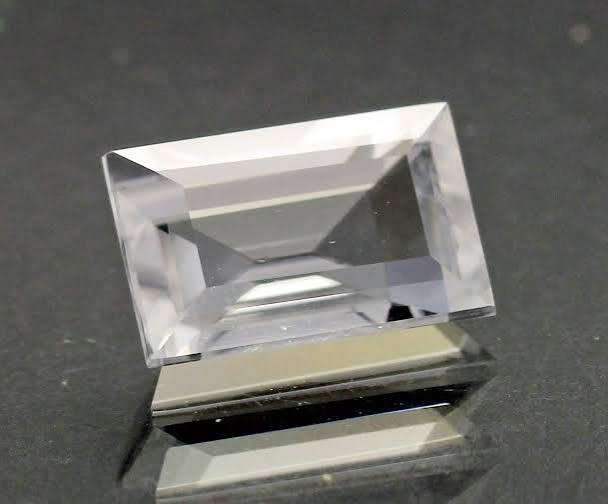
In mineral collections, Hambergite is primarily represented by natural crystals showing its characteristic prismatic habit, colorless to white appearance, and association with other minerals from beryllium- and boron-rich geological environments. Gemological examination of transparent material can also provide information about its hardness, specific gravity, refractive properties, and birefringence. These characteristics make Hambergite useful as a subject for mineral identification and crystallographic study rather than as a widely used commercial material.