
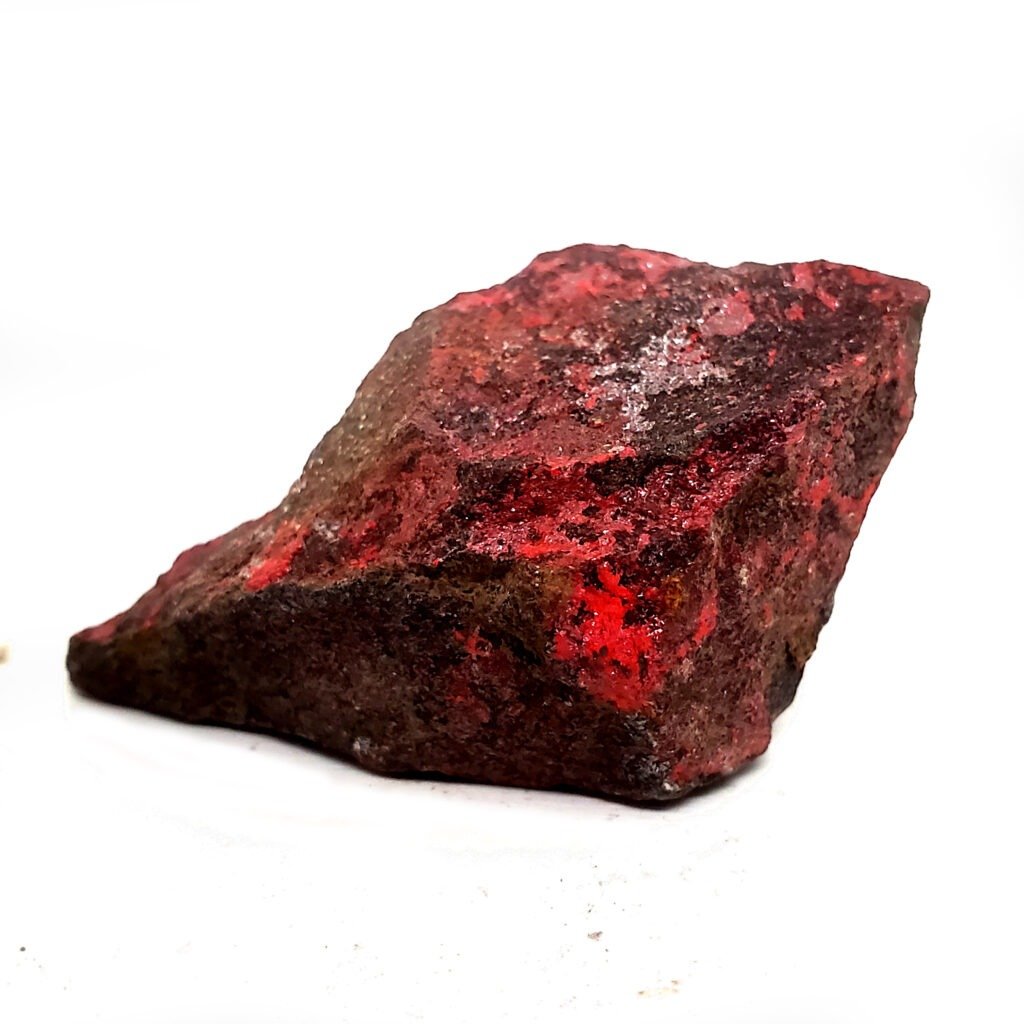
Cinnabar is a mercury sulfide mineral with the chemical formula HgS and is the principal natural ore of mercury. It is best known for its vivid scarlet to vermilion-red color, high specific gravity, and characteristic association with mercury-rich geological environments. Cinnabar typically forms in low-temperature hydrothermal deposits, particularly in areas influenced by volcanic activity, hot springs, faults, and other geological structures that allow mineral-rich fluids to circulate through rocks. It commonly occurs as massive, granular, earthy, or disseminated material, although well-developed crystals can also form and may show rhombohedral or prismatic forms. Cinnabar is frequently associated with minerals such as quartz, calcite, pyrite, barite, and other hydrothermal minerals, depending on the composition and temperature of the mineral-forming fluids. Its distinctive red color and unusually high density make it relatively easy to recognize, although its softness and mercury content are also important characteristics when handling and identifying specimens. Historically, cinnabar was processed as a major source of mercury and was also used to produce the red pigment vermilion. Today, it remains an important mineral in mineralogy and economic geology, particularly for understanding mercury deposits and the hydrothermal processes responsible for their formation.
History and Discovery of Cinnabar
Cinnabar has been known and used by human societies for thousands of years, largely because of its distinctive red color and its importance as the principal ore of mercury. Archaeological evidence indicates that cinnabar was used in ancient China, the Mediterranean region, and parts of the Americas as a mineral pigment and decorative material. In ancient China, finely processed cinnabar was used to produce vermilion pigment for paintings, lacquerware, ceramics, and other objects, while naturally occurring cinnabar was also incorporated into certain ritual and cultural practices. In the Mediterranean world, cinnabar deposits in regions such as Spain were exploited on a significant scale during the Roman period, particularly for recovering mercury and producing red pigment. These historical uses contributed to the recognition of cinnabar as both a mineral resource and a distinctive geological material.
The mineral’s importance increased further with the development of mercury extraction techniques. By heating cinnabar under controlled conditions, mercury can be separated from sulfur and collected as metallic mercury. This property made cinnabar the primary source of mercury for many centuries and led to the development of important mining districts around major deposits. Modern mineralogical studies have established cinnabar as a mercury sulfide mineral and have examined its crystal structure, formation conditions, chemical stability, and relationship to other mercury minerals. Its occurrence is now widely used in geological investigations of hydrothermal and epithermal mercury deposits, where cinnabar can provide evidence about the temperature and chemical conditions of the fluids from which the mineral formed.
Chemical Composition and Crystal Structure of Cinnabar
Cinnabar is composed primarily of mercury and sulfur in a 1:1 atomic ratio, giving it the chemical formula HgS. It is classified as a sulfide mineral and represents the most common and economically important natural form of mercury sulfide. In its stable form under ordinary surface conditions, cinnabar crystallizes in the trigonal crystal system and has a relatively compact structure in which mercury and sulfur atoms are arranged in a repeating three-dimensional pattern. The strong contribution of heavy mercury atoms to the mineral’s composition accounts for its exceptionally high specific gravity, which is typically around 8.0 to 8.2. This high density is one of the most useful physical characteristics for distinguishing cinnabar from many other red-colored minerals.
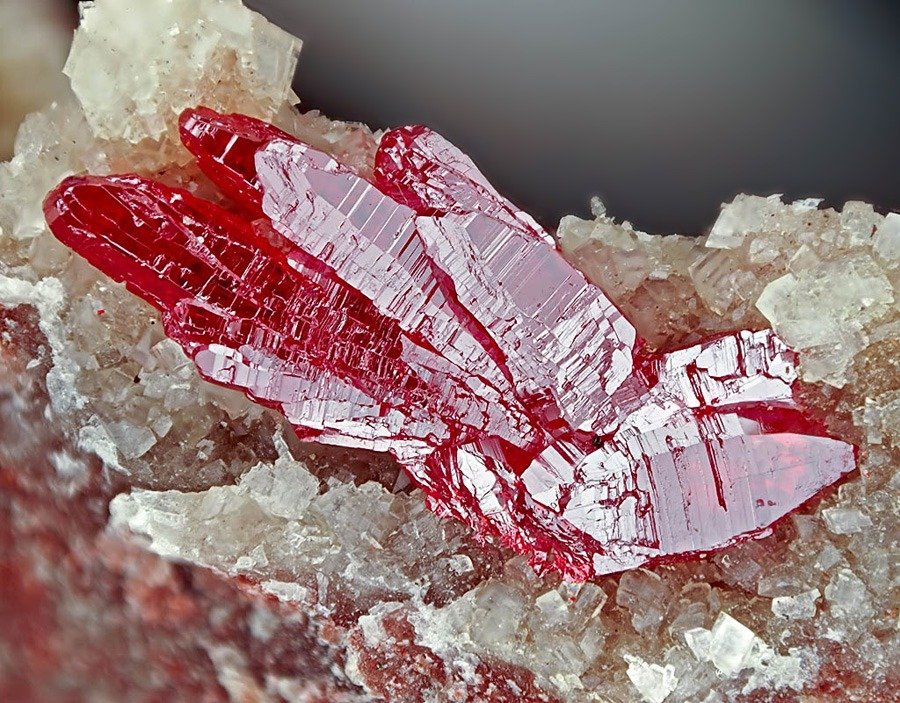
The crystal structure of cinnabar also influences its physical properties and typical crystal habits. Well-formed crystals are relatively uncommon compared with massive or granular material, but individual crystals can display rhombohedral forms and may occur in aggregates within hydrothermal veins and cavities. Cinnabar can undergo structural changes under different temperature conditions, and another crystalline form of HgS, known as metacinnabar, has a different crystal structure and generally appears black or dark gray rather than red. The distinction between cinnabar and metacinnabar is therefore based not only on color but also on their crystal structures and physical properties. In natural deposits, these mercury sulfide phases may occur together with other mercury minerals, providing useful information about the temperature and chemical conditions of the mineral-forming environment.
Types of Cinnabar
Cinnabar does not have many formally recognized mineral varieties, but natural specimens can be classified by their crystal habit, texture, and mode of occurrence:
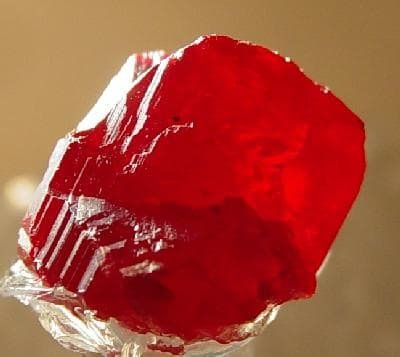
- Crystalline Cinnabar – Cinnabar occurring as well-developed individual crystals, commonly showing rhombohedral forms. Crystals may be transparent to translucent and are usually associated with hydrothermal veins or cavities.
- Massive Cinnabar – A common form consisting of compact, fine-grained aggregates without clearly visible individual crystals. It typically occurs as irregular masses within veins or altered host rocks.
- Granular Cinnabar – Composed of numerous small cinnabar grains that form a granular aggregate. The individual grains may be difficult to distinguish without magnification.
- Earthy Cinnabar – A soft, fine-grained form with a dull or earthy appearance. It may contain significant amounts of other minerals or altered rock material, resulting in less intense red coloration.
- Disseminated Cinnabar – Occurs as small grains or particles distributed throughout a host rock rather than forming a concentrated vein or massive body. This type is particularly important in the study of low-grade mercury mineralization.
- Vein Cinnabar – Forms within fractures and veins created by hydrothermal fluids. It commonly occurs together with quartz, calcite, barite, pyrite, or other hydrothermal minerals and may form narrow bands or irregular patches.
- Cinnabar Associated with Metacinnabar – Some deposits contain cinnabar together with metacinnabar, another structural form of HgS. The two phases can occur in the same mineralized system and reflect variations in the physical and chemical conditions during mineral formation.
Physical and Chemical Properties of Cinnabar
Cinnabar has several distinctive physical properties that make it relatively easy to distinguish from other red minerals. Its color commonly ranges from bright scarlet and vermilion to darker brick-red or brownish-red, depending on crystal size, impurities, and the form in which it occurs. The mineral typically has an adamantine to dull or earthy luster, while transparent to translucent crystals may show a stronger surface luster than massive material. Cinnabar is relatively soft, with a Mohs hardness of about 2 to 2.5, and it commonly has a specific gravity of approximately 8.0 to 8.2. Its streak is generally scarlet to red, and its cleavage can be distinct in several directions. These characteristics, particularly its combination of intense red coloration, high density, and low hardness, are useful for preliminary identification.
Chemically, cinnabar consists predominantly of mercury and sulfur, although natural specimens can contain minor amounts of other elements or associated mineral impurities. It is generally stable under ordinary conditions, but its mercury-bearing composition requires careful handling, especially when the mineral is crushed, powdered, heated, or processed. Cinnabar is also closely related chemically to metacinnabar, another crystalline form of mercury sulfide. Although both have the same chemical formula, their different crystal structures result in significant differences in appearance and physical properties. These characteristics make cinnabar an important mineral for both mineral identification and the geological study of mercury-bearing deposits.
Formation and Geological Occurrence of Cinnabar
Cinnabar forms primarily in low-temperature hydrothermal environments where mercury-bearing fluids migrate through fractures, faults, porous rocks, and volcanic structures. These fluids may originate from magmatic systems or from heated groundwater that has interacted with mercury-rich rocks at depth. As the fluids rise toward shallower levels, changes in temperature, pressure, chemical composition, and sulfur availability can cause mercury sulfide to precipitate as cinnabar. The mineral is particularly characteristic of epithermal environments, where mineralization commonly develops at relatively shallow depths and temperatures. Cinnabar may fill open fractures and cavities as veins or coatings, occur as disseminated grains within altered host rocks, or form massive aggregates in zones of intense hydrothermal alteration.
Cinnabar deposits are often associated with volcanic and tectonically active regions, especially areas containing faults that provided pathways for mineralizing fluids. Common associated minerals include quartz, calcite, dolomite, barite, pyrite, marcasite, and other sulfide or gangue minerals. The distribution and texture of cinnabar within a deposit can vary according to the permeability of the host rock and the changing conditions of the hydrothermal system. In some deposits, cinnabar occurs together with metacinnabar or other mercury minerals, reflecting differences in temperature and chemical conditions during mineral formation. These geological relationships make cinnabar an important indicator mineral for identifying and studying mercury-bearing hydrothermal systems.
Optical Properties and Appearance of Cinnabar
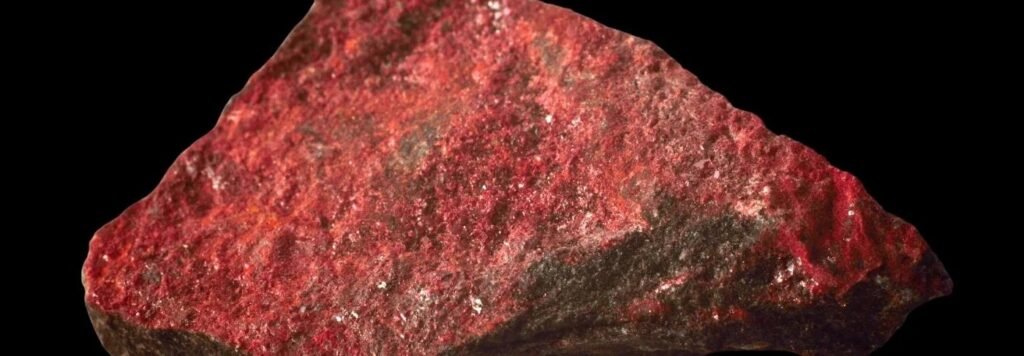
Cinnabar is most commonly recognized by its red coloration, which can range from bright scarlet and vermilion-red to deeper reddish-brown tones. The exact appearance depends on factors such as crystal size, surface condition, impurities, and the presence of associated minerals. Fine-grained or earthy cinnabar may have a relatively dull appearance, while well-developed crystals can be translucent and show a stronger adamantine luster. Massive specimens often occur as irregular red aggregates within lighter-colored host rocks, quartz veins, or hydrothermally altered material. In some cases, surface weathering or the presence of other minerals can make cinnabar appear darker or less intensely colored than fresh material.
Under transmitted light, sufficiently thin or transparent cinnabar crystals may display distinctive optical behavior related to their trigonal crystal structure. Cinnabar is anisotropic and has a relatively high refractive index, contributing to the strong interaction between light and well-formed crystal surfaces. Its color and red streak are among its most useful visible identification features, although appearance alone is not sufficient for a definitive identification because several other minerals can also display red or reddish-brown colors. Properties such as high specific gravity, low hardness, crystal form, streak, and geological association are therefore considered together when identifying cinnabar specimens.
Uses and Applications of Cinnabar
Historically, the primary economic use of cinnabar has been as the principal ore of mercury. Mercury can be recovered from cinnabar through thermal processing, in which the mineral is heated and decomposed to produce metallic mercury. Before modern environmental and occupational controls were established, this process supported mercury production in several major mining districts around the world. Mercury obtained from cinnabar was used in a variety of industrial, scientific, and technological applications, although many of these uses have declined substantially because of mercury’s toxicity and environmental persistence.
Cinnabar has also been used as a source of red pigment. When finely ground and processed, cinnabar produces a vivid red material historically known as vermilion. This pigment was used in paintings, manuscripts, lacquerware, ceramics, decorative objects, and other forms of artwork in different cultures. Today, natural cinnabar is primarily encountered in mineral collections, geological specimens, and educational displays. Collectors may value well-formed crystals, distinctive aggregates, and specimens showing clear associations with quartz or other hydrothermal minerals. Because cinnabar contains mercury, specimens should not be heated, powdered, or processed unnecessarily, and appropriate precautions should be taken when handling loose or damaged material.