
Sellaite is a comparatively rare, naturally occurring halide mineral strictly defined by the chemical formula MgF₂. Structurally isomorphic with the rutile group, it crystallizes within the tetragonal crystal system, typically manifesting as colorless, white, or occasionally pale yellow prismatic crystals, as well as dense, fibrous macroscopic aggregates. The mineral exhibits a distinct vitreous luster and possesses perfect cleavage along the {110} prismatic planes, a feature that distinguishes it mechanically from many other common halides. For a fluoride, sellaite demonstrates a remarkably high physical durability, registering approximately 5 on the Mohs scale of mineral hardness. Furthermore, it is characterized by exceptionally low refractive indices and notable positive birefringence. Beyond its natural occurrence, sellaite serves as the geological analogue to synthetic magnesium fluoride, a highly valued crystalline material engineered extensively in modern optics. Its broad transmission range—spanning from the vacuum ultraviolet to the deep infrared—and naturally low refractive index make the synthetic equivalent indispensable for specialized anti-reflective thin-film coatings, excimer laser windows, and advanced polarizing optical systems.
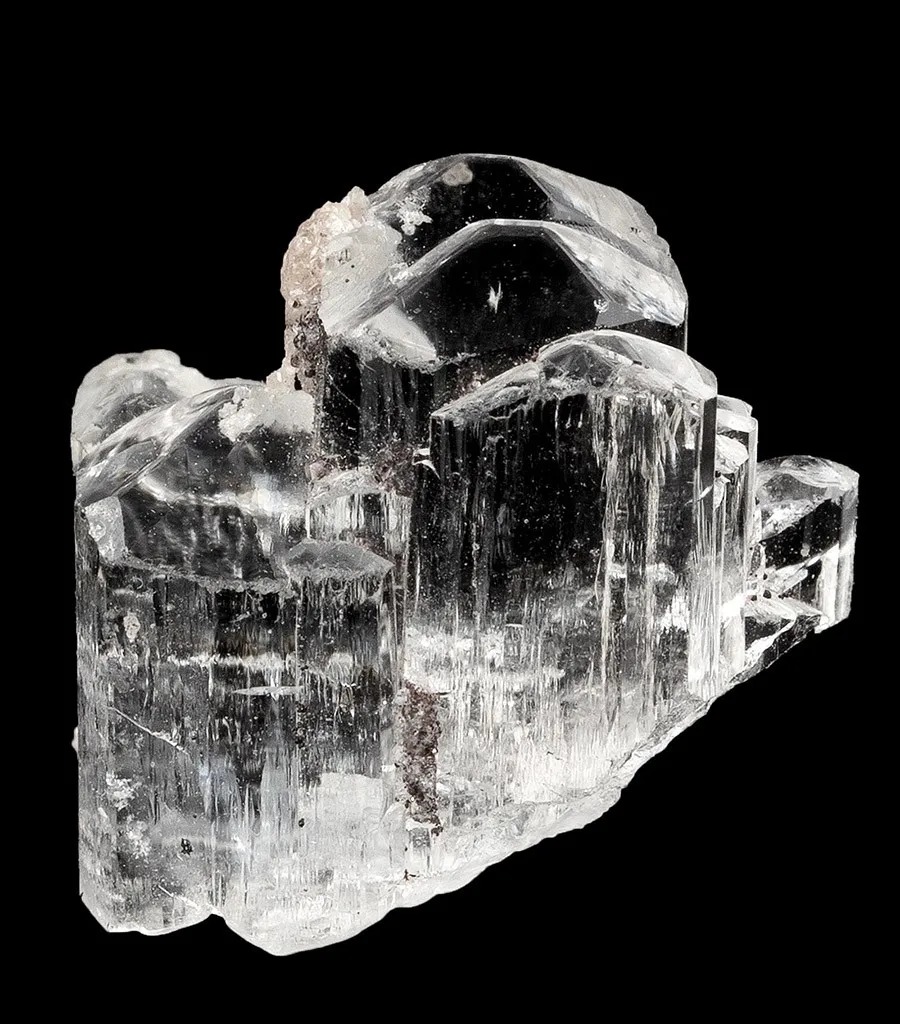
The historical documentation and nomenclature of sellaite date back to 1868, rooted deeply in the foundational era of modern systematic mineralogy. The mineral was initially discovered in the rugged alpine terrain of the Gava Glacier region in Piedmont, Italy, occurring as unusual crystalline inclusions within anhydrite-bearing evaporite deposits. The initial identification of this novel mineral phase was made by Quintino Sella (1827–1884), an eminent Italian scholar who uniquely bridged the demanding disciplines of the exact sciences and national politics. Sella was not only a preeminent crystallographer and professor of mineralogy but also a highly influential statesman who played a crucial role in the unification of Italy. Recognizing the profound importance of this discovery, his contemporary, the prominent mineralogist Luigi Bombicci, officially named the species “sellaite.” This designation was intended to honor Sella’s pioneering and mathematically rigorous crystallographic documentation of Italian mineral species, cementing his legacy within the geological sciences and acknowledging his profound impact on elevating the academic standards of mineralogical research in 19th-century Europe.
From a paragenetic perspective, the genesis of sellaite requires highly specialized and remarkably restricted geochemical conditions, primarily dictated by anomalous fluorine enrichment. It predominantly crystallizes within low- to moderate-temperature hydrothermal vein systems that traverse metamorphic terrains, particularly where fluorine-rich fluids permeate and metasomatically interact with magnesium-rich host rocks, such as dolomites or magnesite deposits. Alternatively, it can precipitate as an authigenic mineral within complex, highly fractionated bitter-lake evaporite sequences; in these hyper-arid hypersaline environments, magnesium-saturated marine brines interact dynamically with localized, concentrated sources of aqueous fluorine. Additionally, sellaite has been documented as a sublimate deposit in active volcanic settings, crystallizing directly from the rapid cooling of volatile, high-temperature gas emissions discharging from fumaroles. The overarching constraint on sellaite’s formation is the necessity for an exceptionally high magnesium-to-calcium ratio in the parent fluids. Under typical geochemical conditions, calcium aggressively acts as a natural sink for fluorine to precipitate the ubiquitous mineral fluorite (CaF₂). Therefore, sellaite can only form in environments where calcium is severely depleted or chemically stabilized, allowing the rarer pairing of concentrated magnesium and volatile fluorine to achieve thermodynamic stability and crystalize.
Locality and Occurrence
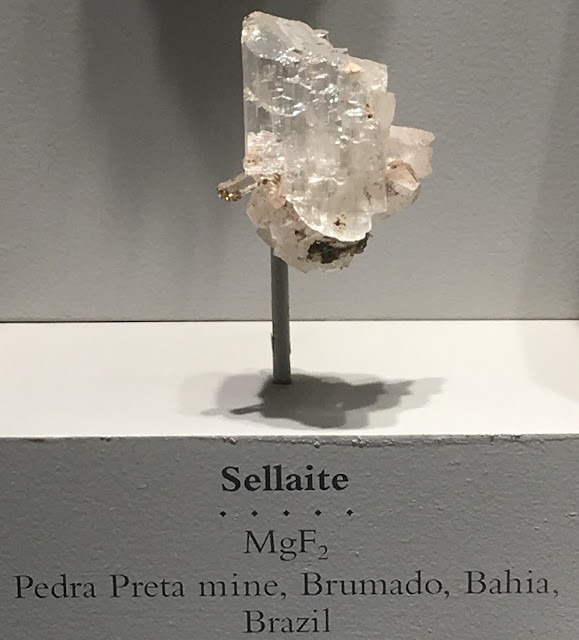
Sellaite was initially identified at its type locality near the Gava Glacier in the Piedmont region of Italy, where it was discovered deeply embedded within massive anhydrite-rich matrices. Beyond this foundational discovery in an alpine evaporite setting, notable global occurrences have been documented across highly specialized and geochemically diverse geological environments. These include the alkaline igneous massifs of the Kola Peninsula in Russia, which are renowned for their extraordinary concentration of rare halogens and incompatible elements. Similar geochemical anomalies host sellaite within the evaporite-associated magmatic complexes of the Siberian Murun Massif. In North America, exceptionally well-crystallized and structurally perfect specimens have been recovered from the Mount Saint-Hilaire alkaline intrusive complex in Quebec, Canada, an environment famous for its late-stage, volatile-rich pegmatitic fluids. Furthermore, sellaite is present as a secondary phase within the Permian Bleicherode potash deposits in Germany, highlighting its affinity for highly fractionated saline environments. Strikingly, it also manifests under entirely different thermal conditions as a distinct fumarolic sublimate at active volcanic sites, precipitating directly from hot, halogen-rich volcanic gases at Mount Vesuvius in Italy and the Kudriavy volcano in the Kuril Islands.
Varieties and Classifications
As a structurally distinct mineral species, sellaite does not possess widely recognized, chemically unique sub-species or structural varieties. Mineralogically, it is classified strictly under the simple anhydrous halides within both the Dana and Strunz systematic taxonomic frameworks. However, because its macroscopic presentation and crystal growth kinetics are heavily dictated by its specific formational environment, sellaite specimens are morphologically categorized based on their distinct environmental habits. These structural variations reflect the temperature, pressure, and saturation states of the parent fluids:
- Hydrothermal Habit: Characterized by macroscopically distinct, euhedral prismatic crystals that typically precipitate from highly evolved, slow-cooling fluids within hydrothermal vein systems. These crystals often display well-defined faces and a higher degree of optical clarity.
- Evaporite Habit: Defined by dense, fibrous, or compact microcrystalline aggregates. This habit characteristically forms within highly restricted, magnesium-saturated evaporite beds, where rapid precipitation from hypersaline marine brines precludes the growth of large, independent crystals.
- Fumarolic Habit: Distinguished by delicate, highly porous incrustations or fragile surface coatings. These structures crystallize nearly instantaneously as high-temperature sublimates around active volcanic vents, driven by the rapid cooling and depressurization of fluorine-bearing volcanic gases interacting with atmospheric conditions.
Crystal Structure
Sellaite crystallizes in the tetragonal crystal system, specifically occupying the highly symmetric space group P4₂/mnm. Its crystallographic architecture is strictly isostructural with that of rutile (TiO₂), a configuration that significantly influences its exceptional physical stability. Within this precise lattice configuration, each central magnesium cation (Mg²⁺) is coordinated by six fluorine anions (F⁻) positioned at the vertices of a slightly distorted octahedron. Conversely, each fluorine anion is surrounded by three magnesium cations in a nearly planar tricoordinate geometry. The fundamental MgF₆ octahedra share opposite horizontal edges to form robust, parallel linear chains extending strictly along the crystallographic c-axis. These parallel chains are further interconnected by sharing apical vertices with adjacent chains, ultimately generating a rigid, densely packed three-dimensional geometric framework. This dense atomic packing, combined with the strong ionic bonds between the relatively small magnesium and fluorine ions, directly dictates the mineral’s unusually high lattice energy and structural rigidity compared to other simple halides.
Physical and Chemical Properties
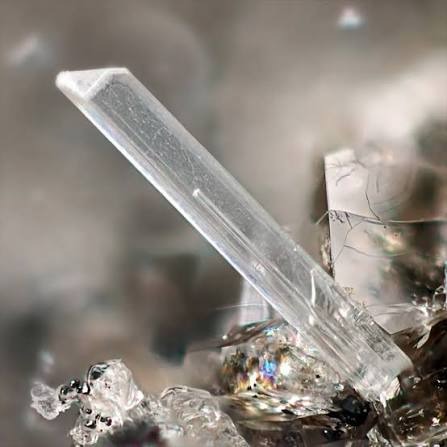
From a compositional and thermodynamic standpoint, sellaite is an exceptionally stable anhydrous halide, comprising approximately 39.0% magnesium and 61.0% fluorine by weight. It is notably inert, displaying negligible solubility in water and demonstrating significant resistance to most cold acids. Physically, it registers a hardness of 5 on the Mohs scale—an uncommonly high durability for a fluoride mineral, which typically ranges between 2 and 4—and possesses a calculated density of roughly 3.15 g/cm³. The mineral exhibits perfect basal cleavage along the {001} plane and distinct prismatic cleavage along {110}, rendering it somewhat brittle under mechanical stress. Optically, sellaite is uniaxial positive and is distinguished by exceptionally low refractive indices (n_ω ≈ 1.378, n_ε ≈ 1.390) alongside very weak birefringence. This lack of significant light refraction or splitting renders it nearly isotropic under cross-polarized light, appearing structurally homogenous. In macroscopic hand specimens, it typically appears entirely colorless or white, though trace impurities can impart faint tints of gray or pale yellow, always accompanied by a characteristic vitreous to slightly greasy luster.
Applications and Industrial Use
Although natural sellaite is far too geologically scarce to be commercially mined or utilized at scale, its synthetic counterpart, magnesium fluoride (MgF₂), is an absolutely indispensable material in advanced optics, photonics, and materials engineering. Defined by its extremely low refractive index, large electronic bandgap, and an exceptional optical transmission spectrum that spans seamlessly from the deep vacuum ultraviolet (120 nm) to the mid-infrared (8.0 μm), synthetic MgF₂ is the industry standard for thin-film optical coatings. It is extensively deposited via physical vapor deposition (PVD) as a single-layer or multi-layer broadband anti-reflective coating for precision optical elements, high-end camera lenses, astronomical telescopes, and high-efficiency photovoltaic panels to minimize surface reflection and maximize light transmission. Furthermore, robust crystalline boules engineered with the sellaite structure serve as critical optical windows for high-power excimer lasers and sensitive detecting components in space-borne atmospheric instrumentation. Beyond advanced optics, it functions as a highly effective, stable fluxing agent in the metallurgical processing of magnesium metal and advanced aluminum alloys, where it aids in lowering melting temperatures and removing impurities from the molten metal.