
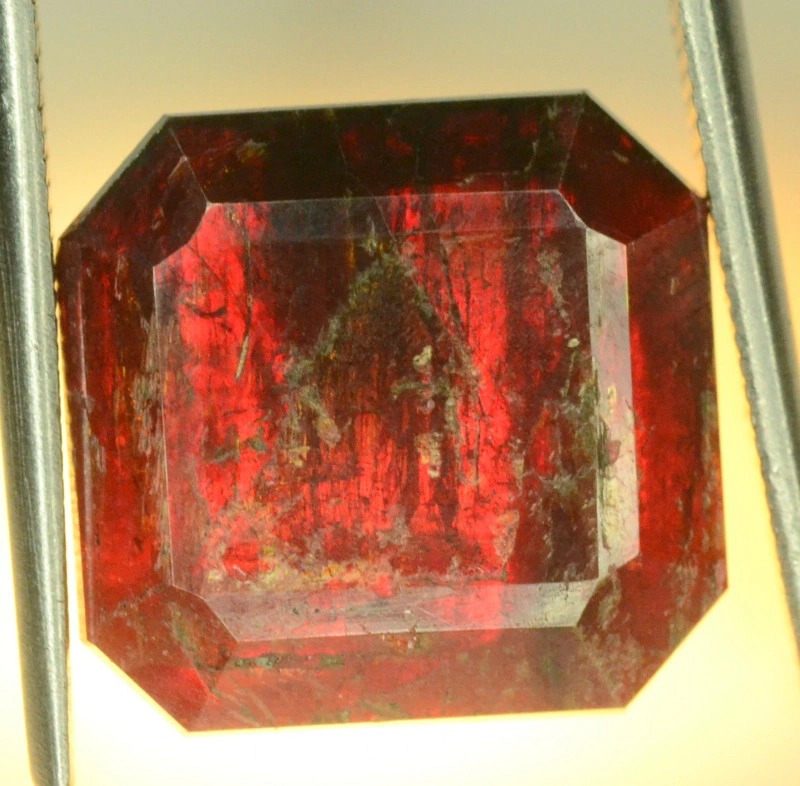
Manganotantalite is a rare oxide mineral of the columbite–tantalite group, commonly associated with tantalum-bearing pegmatite deposits that are often collectively referred to as “coltan” ores in the mining industry. It has the ideal chemical formula MnTa₂O₆ and represents the manganese-dominant member of the tantalite series. The mineral is typically dark reddish-brown, brownish-black, or nearly black in hand specimen, although transparent red to orange-red gem-quality crystals have been reported from a limited number of localities. Manganotantalite crystallizes in the orthorhombic crystal system and commonly occurs as prismatic, tabular, or striated crystals, as well as in massive or granular aggregates. It has a Mohs hardness of approximately 6–6.5 and a high specific gravity generally ranging from 7.5 to 8.0, reflecting its elevated tantalum content. These physical characteristics make it readily distinguishable from many associated pegmatite minerals.
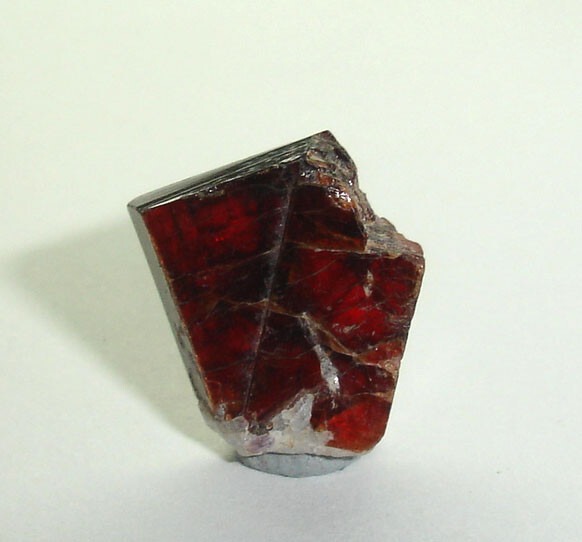
Manganotantalite forms primarily in highly fractionated granitic pegmatites, particularly Lithium–Cesium–Tantalum (LCT) pegmatite systems. During the progressive crystallization of granitic magma, major rock-forming minerals such as quartz, feldspar, and mica remove common elements from the melt, while relatively incompatible elements—including tantalum, niobium, manganese, lithium, and cesium—become increasingly concentrated in the residual magmatic fluids. As crystallization advances, these enriched fluids migrate into fractures and cavities within the pegmatite body, where manganotantalite may precipitate under late-stage magmatic to hydrothermal conditions. The mineral commonly occurs in association with spodumene, lepidolite, tourmaline, beryl, pollucite, and other rare-element minerals characteristic of evolved pegmatite environments. Major occurrences have been documented in Brazil, Mozambique, Madagascar, Afghanistan, Namibia, and several other tantalum-producing regions.
The name manganotantalite reflects its manganese-rich composition and its relationship to the tantalite mineral series. The term “tantalite” derives from tantalum, an element named after the mythological figure Tantalus. Advances in mineralogical and chemical analysis during the nineteenth and twentieth centuries enabled the distinction of manganotantalite from chemically related members of the columbite–tantalite group, particularly iron-dominant tantalite species. Historically, manganotantalite has been valued primarily as a source of tantalum, a strategic metal widely used in electronic components, superalloys, chemical processing equipment, and aerospace applications because of its corrosion resistance and high-temperature stability. In addition to its industrial importance, transparent crystals of exceptional quality are occasionally faceted for collectors, although gem-grade material remains uncommon compared with most commercial gemstone species.
Crystal Structure
Manganotantalite is an orthorhombic oxide mineral belonging to the columbite–tantalite group, a series characterized by extensive solid-solution relationships involving manganese, iron, tantalum, and niobium. Its ideal chemical formula is MnTa₂O₆, with manganese occupying octahedral sites coordinated by oxygen and tantalum residing in adjacent octahedral positions within the crystal lattice. The structure consists of chains of edge-sharing octahedra that extend parallel to the crystallographic c-axis, producing a compact and highly ordered framework. Partial substitution of niobium for tantalum and iron for manganese is common in natural specimens, generating compositional variations between manganotantalite, ferrotantalite, manganocolumbite, and ferrocolumbite. Well-formed crystals are typically prismatic, tabular, or short-columnar and frequently display prominent longitudinal striations resulting from their crystallographic growth patterns.
Physical and Chemical Properties
Manganotantalite is distinguished by its high density, typically ranging from approximately 7.5 to 8.0 g/cm³, a direct consequence of its substantial tantalum content. The mineral generally exhibits colors ranging from reddish-brown and dark brown to nearly black, although transparent red varieties occasionally occur. It possesses a Mohs hardness of about 6–6.5, a submetallic to resinous luster, and a brown to reddish-brown streak. Cleavage is generally poor or indistinct, while fracture is uneven to subconchoidal. Chemically, manganotantalite is relatively stable under surface conditions and exhibits resistance to many common weathering processes. The mineral commonly contains varying amounts of niobium, iron, titanium, tin, and trace rare elements that substitute within its crystal structure. These compositional variations can influence physical properties such as color, density, and refractive indices, making chemical analysis important for accurate species identification.
Applications and Uses
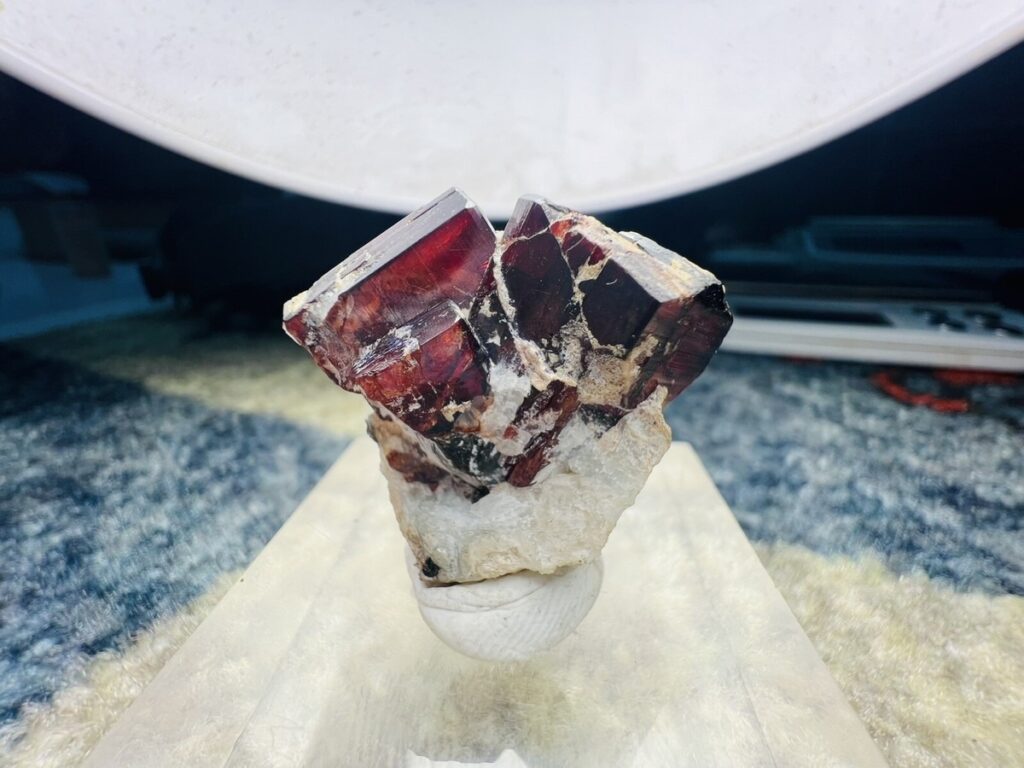
The primary economic significance of manganotantalite lies in its role as an ore of tantalum, a strategic metal valued for its exceptional corrosion resistance, high melting point, and electrical properties. Tantalum extracted from manganotantalite is widely used in the manufacture of capacitors for smartphones, computers, medical devices, telecommunications equipment, and other electronic systems. Additional applications include superalloys for aerospace components, chemical-processing equipment, vacuum furnaces, and specialized laboratory apparatus. Although industrial utilization represents its principal importance, transparent and inclusion-free crystals of manganotantalite may also be cut as collector gemstones. Such gem-quality material remains uncommon and is primarily sought by mineral collectors and specialized gem enthusiasts rather than the mainstream jewelry market. The mineral additionally serves as a valuable indicator of highly evolved rare-element pegmatite systems, assisting geologists in the exploration of tantalum-bearing deposits.
In metaphysical traditions, Manganotantalite is often associated with grounding, personal determination, and the transformation of long-term goals into practical action. Its exceptionally high density and manganese-rich composition have led some crystal practitioners to view it as a stone of stability and perseverance, believed to encourage focus during periods of sustained intellectual or creative work. Rather than being linked to emotional expression or spiritual transcendence, it is more commonly described as a mineral that supports discipline, organization, and resilience when facing complex challenges.