
Jasper is an opaque, impure variety of silica (SiO₂) that is classified mineralogically as a dense, cryptocrystalline aggregate of quartz, structurally transitional to chalcedony. Unlike pure chalcedony, however, jasper contains a significant volume of foreign particulate matter—frequently exceeding 20% by weight—which dictates its absolute opacity and vibrant coloration. It possesses a Mohs hardness ranging from 6.5 to 7.0, a vitreous to dull luster, and a characteristically uneven to conchoidal fracture. The variable colors exhibited by jasper are a direct function of embedded mineral chromophores; interstitial iron oxides such as hematite (Fe₂O₃) yield deep reds and pinks, whereas goethite (FeO(OH)) or limonite produces yellow and brown hues, and silicate inclusions like chlorite or detrital clays account for the green and grayish varieties. Consequently, rather than being classified as a distinct mineral species, petrologists define jasper as a rock-forming mineral aggregate whose specific gravity and optical properties are fundamentally altered by its internal sediment load.
The formation of jasper is an intricate geochemical process occurring within sedimentary, hydrothermal, or volcanic environments, driven primarily by the low-temperature precipitation of silica from aqueous solutions concurrent with the mechanical incorporation of local impurities. In Precambrian marine settings, jasper formed via hydrothermal sedimentation within Banded Iron Formations (BIFs), where submarine volcanic vents enriched seawater with dissolved silicic acid (H₄SiO₄). As changes in ambient pH or temperature forced this silica to polymerize into a colloidal gel, it settled rhythmically alongside precipitating iron phases, which underwent millions of years of compaction, dehydration, and eventual crystallization into microcrystalline quartz bands. Alternatively, many Phanerozoic jaspers originate from the diagenetic alteration of volcanic ash beds. As meteoric or hydrothermal fluids percolating through porous volcanic tuffs dissolve the highly reactive vitreous silica, the resulting saturated fluids migrate into surrounding fractures and voids, precipitating out while absorbing ambient manganese oxides, clays, and iron oxides to form complex, patterned matrices. Additionally, jasper can synthesize via the pseudomorphic replacement of organic matrices—a process known as silicification—wherein silica-bearing groundwater infiltrates buried organic material, replacing the cellular structures atom-for-atom to generate jasperized fossils and petrified wood.
Throughout human antiquity, jasper was highly prized not only for its distinct aesthetic properties but also for its mechanical utility, as its predictable conchoidal fracturing made it a valuable resource for prehistoric hominids knapping lithic tools. By the 4th millennium BCE, artisans in Mesopotamia and the Indus Valley Civilization utilized green and red jaspers for drilling sophisticated cylinder seals and lapidary beads, a practice that later extended to the Minoan Civilization, as evidenced by intricate glyptic seals recovered at the Palace of Knossos dating to 1800 BCE. The etymological lineage of the word traces back through Old French (jaspre) and Latin (iaspidem) to the Greek iaspis, which itself originates from Semitic roots, historically used as a broader umbrella term for an array of green, translucent gems. Beyond its utilitarian and decorative roles, jasper held profound ritualistic and amuletic significance across various ancient cultures; in pharaonic Egypt, red jasper was explicitly linked to the protective blood of Isis and frequently carved into the Thet amulet to safeguard the dead, while historical texts also record its integration into the ceremonial breastplate worn by the Judean High Priest.
Variety, Coloration, and Physicochemical Profiles
Jasper is broadly categorized by its geological provenance and structural patterns, yielding prominent varieties such as orbicular jasper (featuring concentric, spherical growth structures), picture jasper (characterized by dendritic patterns resembling landscapes), and jaspillite (banded hydrothermal varieties rich in iron). The exceptional color palette of jasper is a direct macro-expression of its heterogeneous mineral composition. While chemically dominated by silicon dioxide (SiO₂), true jasper accommodates a substantial internal matrix load—often between 5% and 20% by weight—of structural impurities and foreign mineral pigments. Microcrystalline hematite (Fe₂O₃) dictates the prevalence of deep reds, maroons, and pinks by absorbing short-wavelength visible light, while hydrous iron oxides like goethite (FeO(OH)) introduce warm yellow, ochre, and brown variants. Green jaspers owe their coloration to ferrous iron ions embedded within interstitial chlorite or actinolite grains, whereas pure white or gray layers signify a localized absence of metallic chromophores.
Optically, the defining attribute of jasper is its absolute opacity, a consequence of intense light scattering at the sub-micron grain boundaries between the quartz crystals and the densely packed, non-silicate mineral inclusions. Unlike its sister cryptocrystalline quartz, chalcedony, which exhibits varying degrees of translucency, jasper blocks light transmission completely, even when sliced into microscopic thin sections for petrographic analysis. When polished, its surface displays a luster that transitions from vitreous to a waxy, dull finish depending on the concentration of clay particles within the matrix. Physically, jasper is remarkably robust, characterized by a Mohs hardness of 6.5 to 7.0 and a specific gravity averaging between 2.58 and 2.91, varying strictly in accordance with the density of its embedded metallic oxides. The stone breaks along an uneven to conchoidal fracture path, producing sharp, curved edges that lack any crystallographic cleavage planes—a property driven by the isotropic, interlocking micro-arrangement of its structural grains. Chemically, it exhibits high stability, remaining highly resistant to mechanical weathering and acidic dissolution under standard ambient conditions, though it remains vulnerable to highly alkaline environments and hydrofluoric acid.
Kambaba Jasper or Kambaba Stone
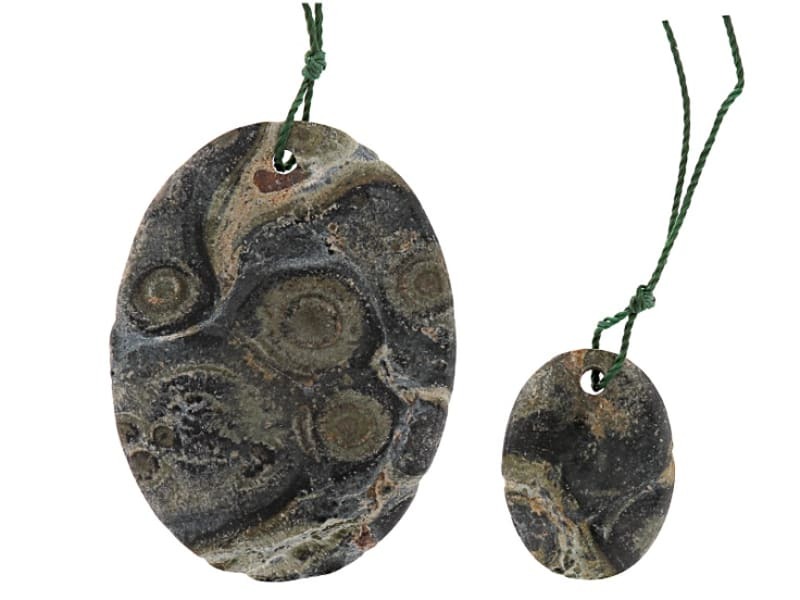
Kambaba Jasper, often traded as Kambaba Stone or Crocodile Jasper, is a striking dark-green volcanic rock from Madagascar, characterized by its distinctive black, swirling orbicular patterns. While frequently misidentified in the commercial market as a fossilized ancient stromatolite, geological and petrographic testing has confirmed that it is actually an extrusive igneous rock known as orbicular rhyolite. Its rich green coloration is primarily due to embedded aegirine (a sodium iron pyroxene), while the iconic black eyes are spherulites—radial clusters of amphibole-group minerals formed during rapid volcanic cooling. With a Mohs hardness of 6.0 to 6.5 and a dense, opaque structure, Kambaba Stone is a unique volcanic mineral aggregate rather than a fossil, prized for its complex igneous history and vivid aesthetic.
Bloodstone
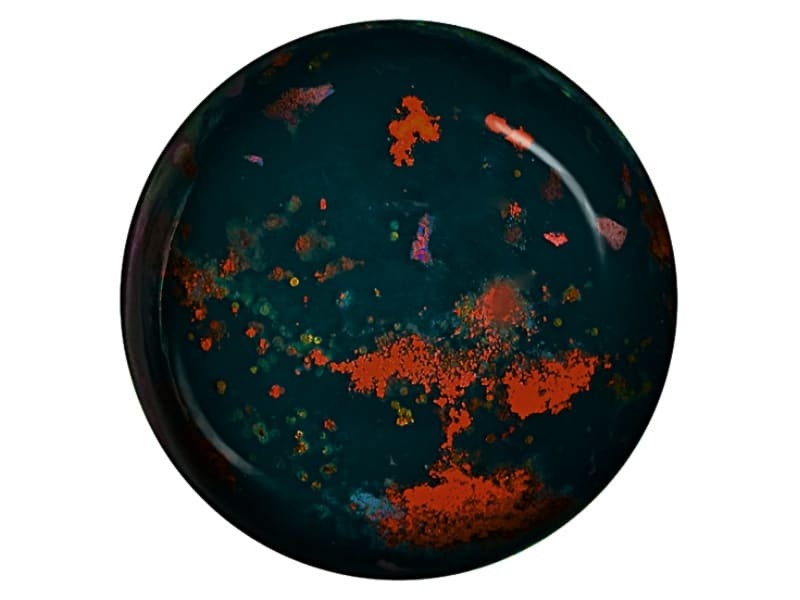
Bloodstone, historically known as heliotrope, is an opaque, deep-green variety of chalcedony that is characteristically flecked with vivid red inclusions of iron oxide. Geologically, it is a sedimentary or hydrothermal deposit primarily composed of microcrystalline quartz, categorized as a cryptocrystalline silicate mineral aggregate. The distinctive green groundmass is typically colored by chlorite, amphibole, or other silicate mineral impurities, while the iconic red spots are caused by inclusions of hematite (Fe₂O₃) or sometimes red jasper, which appear as splashes or droplets against the dark backdrop. Historically, the stone held significant cultural value, being called the sun stone in antiquity due to the belief that it turned the sun red when submerged in water, and it was widely utilized in religious artifacts and protective amulets. Physically, bloodstone shares the standard characteristics of chalcedony, possessing a Mohs hardness of 6.5 to 7.0 and a conchoidal fracture, though it is differentiated from other jaspers by its characteristic translucent-to-opaque green base and its specific pattern of hematite inclusions.
Porcelain Jasper
Porcelain Jasper, often referred to as “Moran Jasper” in specific lapidary contexts, is a remarkably dense and fine-grained variety of silicified material prized for its smooth, vitrified texture that resembles polished ceramic. Geologically, it is a cryptocrystalline quartz aggregate formed through the intense silicification of fine-grained volcanic ash or rhyolitic tuff. Its hallmark characteristic is its high degree of homogeneity and translucency at the edges, which differentiates it from the more common, coarser-grained jaspers. The material typically exhibits a creamy, white, or light-colored groundmass that is often streaked with delicate, flowing patterns of iron oxides, manganese, or clay minerals, creating an appearance similar to hand-painted fine china. Due to the high concentration of pure silica (SiO₂), it takes an exceptionally high, glass-like polish that exceeds the luster of most other jasper varieties. Physically, it retains the typical Mohs hardness of 6.5 to 7.0 and a conchoidal fracture, but its superior structural integrity and lack of vugs or impurities make it a highly sought-after material for intricate carvings and high-end cabochons.
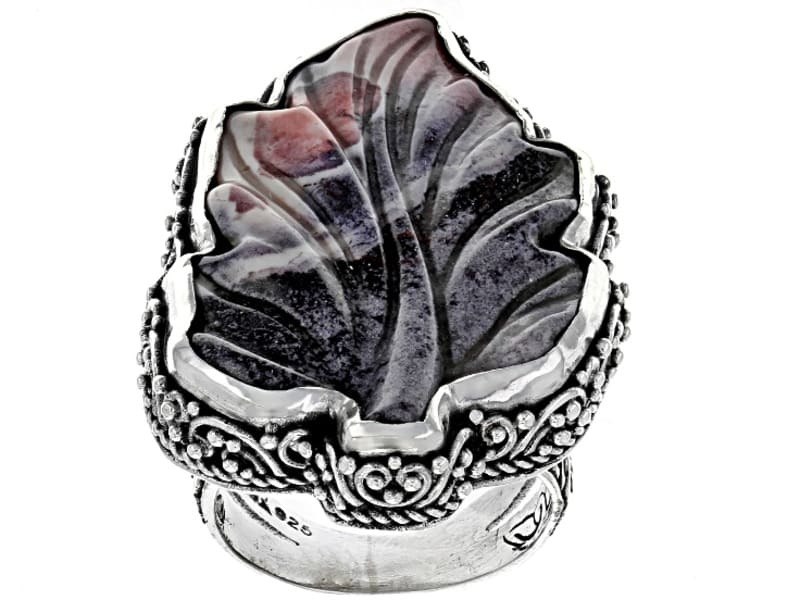
Brecciated Jasper
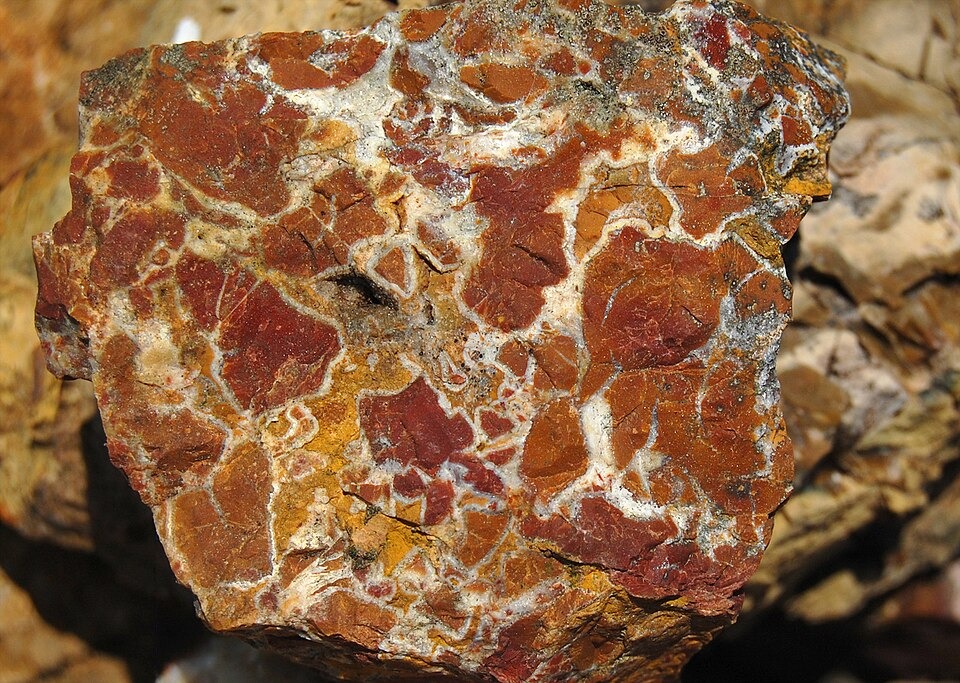
Brecciated Jasper is a distinct variety of jasper characterized by its fragmented, “broken” appearance, which is the result of natural geological fracturing and subsequent healing processes. Geologically, it originates when a solid mass of jasper is subjected to tectonic forces or seismic activity, causing the material to shatter into angular, sharp-edged fragments. Following this structural failure, silica-rich hydrothermal fluids or groundwater percolating through the fractured rock deposit secondary minerals, such as microcrystalline quartz (SiO₂) or hematite (Fe₂O₃), into the interstitial spaces. These secondary deposits act as a cementing agent, or matrix, that bonds the original, broken pieces back into a solid, cohesive mass. This process results in a striking mosaic pattern where angular, differently colored clasts are embedded within a contrasting vein-like framework. Because the composition of the fragments and the cementing matrix can vary significantly, Brecciated Jasper displays a wide range of colors—commonly reds, browns, yellows, and blacks—dependent on the iron oxide content of both the clasts and the cementing material. Physically, the stone maintains the standard properties of the jasper family, with a Mohs hardness of 6.5 to 7.0 and a tough, conchoidal fracture, making it both geologically fascinating and highly durable for lapidary use.
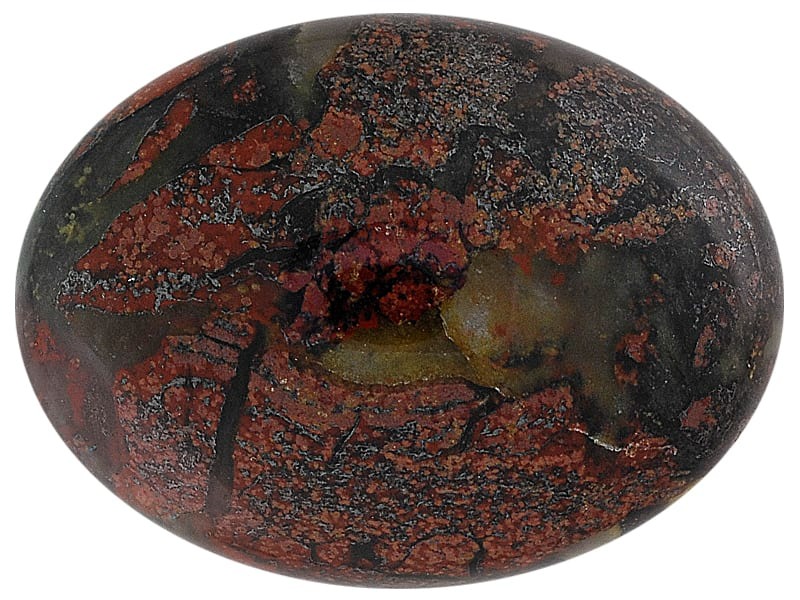
Orbicular Jasper
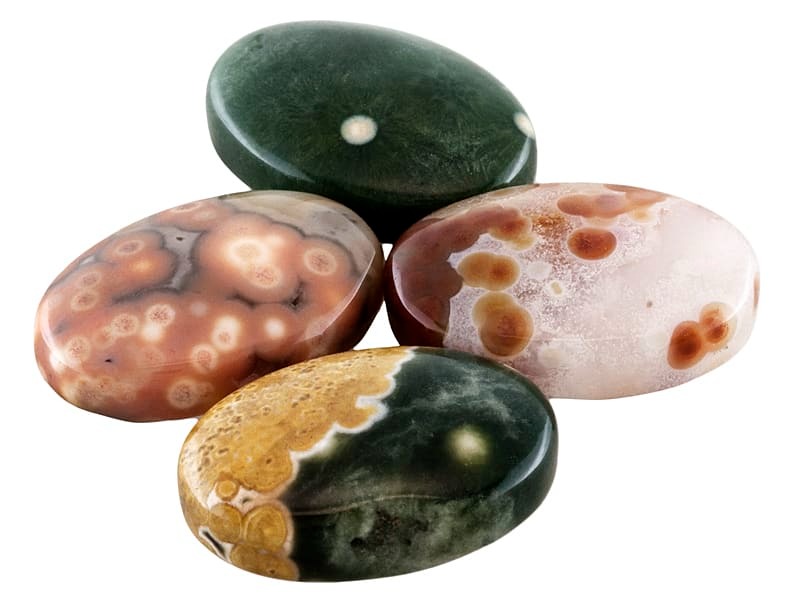
Orbicular Jasper is a visually striking variety of jasper defined by its distinct, concentric, spherical patterns known as orbs. Geologically, these orbs are the result of a process called spherulitic crystallization, which occurs within silica-rich volcanic or sedimentary environments. As the material forms, minerals—primarily quartz (SiO₂) and various inclusions like iron oxides (Fe₂O₃) or clay—nucleate around a central point, radiating outward to create layered, circular bands that vary in color and size. This unique texture often mimics the appearance of eyes or bubbles trapped within the stone. Because of the diverse mineral compositions present during the formation of these orbs, Orbicular Jasper can display an expansive color palette, ranging from soft creams and yellows to deep reds, greens, and browns. Physically, it shares the standard attributes of the jasper family, possessing a Mohs hardness of 6.5 to 7.0, an opaque to semi-opaque diaphanity, and a durable, conchoidal fracture. One of the most famous examples of this variety is Ocean Jasper, which forms in rhythmic, circular patterns through the alteration of volcanic rhyolite. Its intricate, multi-layered appearance and geological complexity make it a favorite among collectors and lapidary artists.
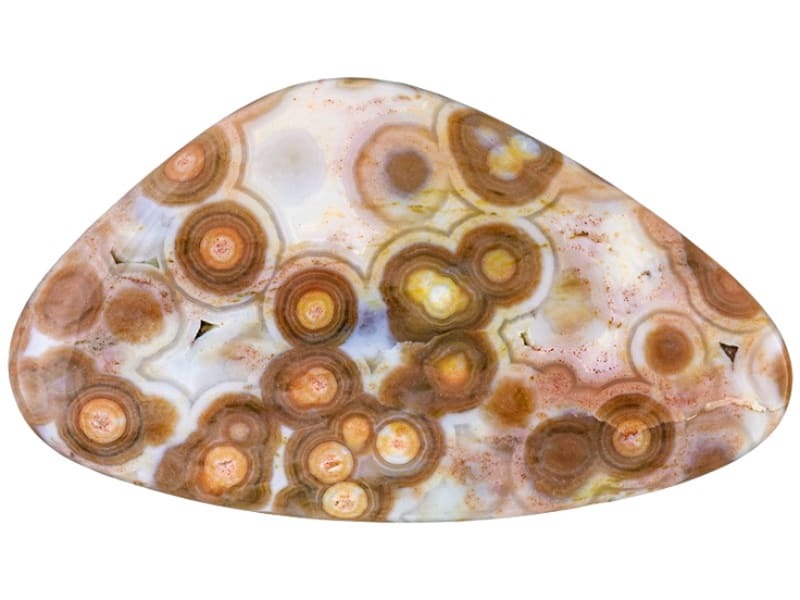
Ocean Jasper
Ocean Jasper is a highly distinct and sought-after variety of orbicular jasper, famously sourced from only a few specific coastal deposits in the northwestern Marovato region of Madagascar. Geologically, it is an orbicular rhyolite that formed through the complex alteration of silica-rich volcanic ash beds. Its defining features are the intricate, rhythmic, and multicolored orbs—often containing combinations of white, gray, green, yellow, pink, or red—that appear to bloom within the stone. These circular patterns are the result of spherulitic crystallization, where minerals such as quartz (SiO₂), feldspar, and various iron oxides (Fe₂O₃) nucleated around centralized points during the cooling of volcanic material. The stone is further enriched by late-stage hydrothermal activity, which fills interstitial spaces with microcrystalline silica, sometimes leading to the formation of internal druzy quartz pockets or clear chalcedony veins. Physically, Ocean Jasper possesses a Mohs hardness of 6.5 to 7.0 and a characteristically smooth, opaque to semi-translucent luster when polished. Due to the rapid depletion of the primary mining sites, authentic Ocean Jasper is considered a finite geological rarity, prized by collectors for its mesmerizing, sea-like patterns and its unique, multi-staged volcanic history.
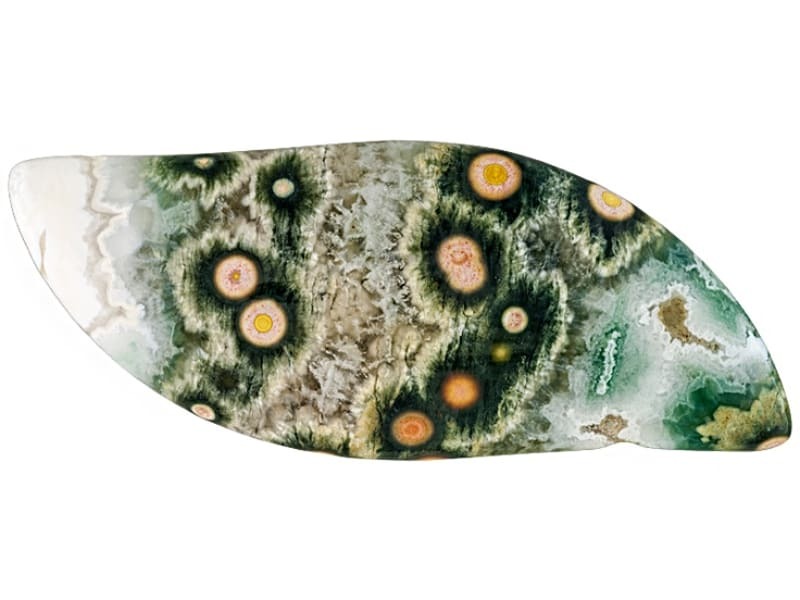
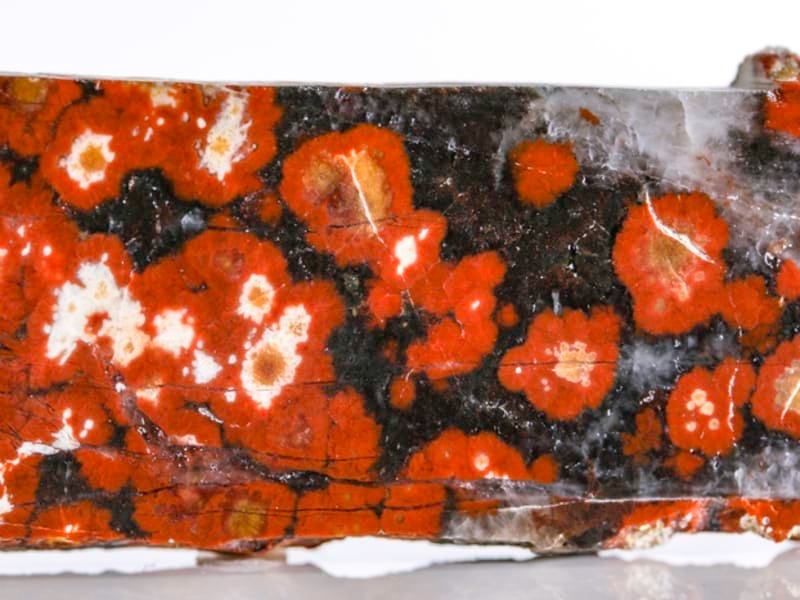
Poppy or Flower Jasper
jasper renowned for its intricate, floral-like patterns that resemble tiny poppy blossoms. Geologically, it is a dense, microcrystalline quartz aggregate formed through the silicification of volcanic rhyolitic tuffs. The hallmark “poppy” motifs are actually small, complex spherulites—spherical clusters of minerals that nucleated during the cooling phase of the host rock—typically colored in vibrant shades of red, orange, or yellow due to finely dispersed hematite (Fe₂O₃) and goethite (FeO(OH)) inclusions. These blossoms are often set against an earthy groundmass of cream, brown, or gray, creating a striking contrast that makes the stone highly desirable for lapidary arts. Most famously associated with deposits in California, the stone is exceptionally durable, maintaining a Mohs hardness of 6.5 to 7.0 and a characteristic conchoidal fracture, which allows it to take a high, vitreous polish that highlights the internal complexity of its volcanic origin.
Leopard or Leopard Skin Jasper
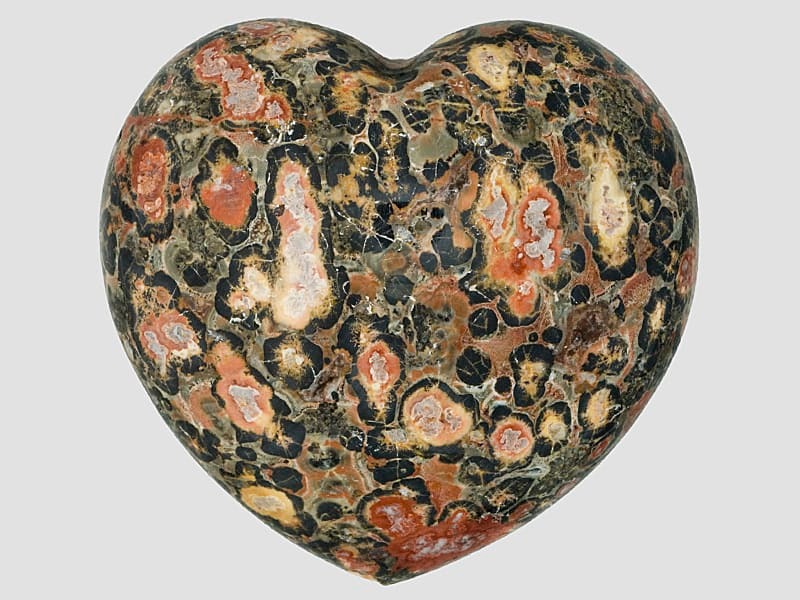
Leopard Skin Jasper, commonly known as Leopard Jasper, is a visually distinctive variety of patterned jasper characterized by its spotted, multi-colored appearance that mimics the coat of a leopard. Geologically, it is an igneous-derived, silicified volcanic rock—typically a rhyolite or tuff—that has undergone extensive hydrothermal alteration. The stone’s unique “spots” are caused by the localized concentration of iron oxides (Fe₂O₃) and other mineral impurities, such as manganese or clay, which nucleate during the cooling and silicification process. These inclusions create a varied matrix of creams, browns, yellows, and occasionally reds or blacks, often arranged in irregular, circular, or vein-like patterns. Physically, like other members of the jasper family, it possesses a Mohs hardness of 6.5 to 7.0 and a tough, conchoidal fracture, making it highly suitable for decorative lapidary applications. Its complex, chaotic patterning is a direct record of the uneven distribution of mineral solutions during its formation, resulting in a stone that is prized for its high aesthetic variability and robust physical durability.
Rainforest Jasper
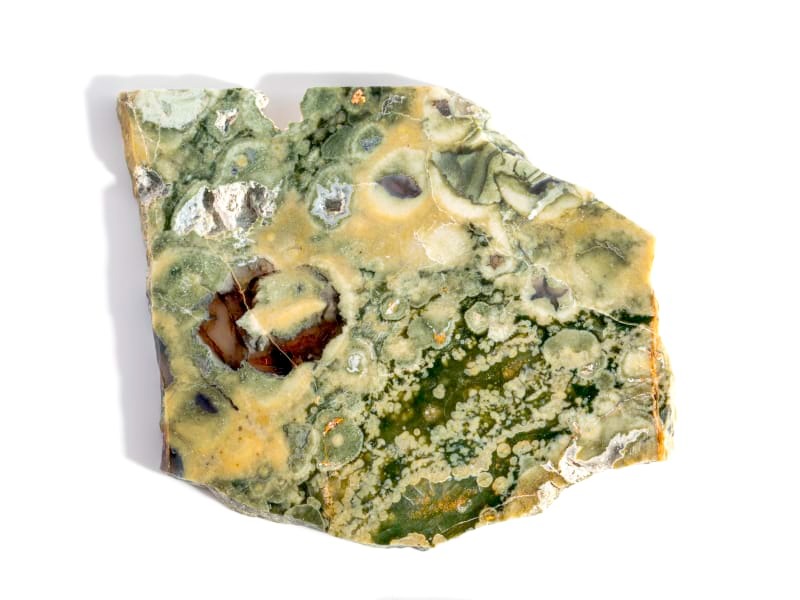
Rainforest Jasper, also known as Rainforest Rhyolite or Spherulitic Rhyolite, is a vibrant variety of volcanic rock famously sourced from Queensland, Australia. Despite the trade name “jasper,” it is petrologically classified as a rhyolitic lava that has undergone significant devitrification and hydrothermal alteration. Its characteristic aesthetic features a complex, mossy green groundmass mottled with creamy or golden-brown patterns, often containing quartz-filled vugs or small, orbicular inclusions. These unique markings are formed by the interaction of silica-rich fluids with the cooling volcanic matrix, resulting in a distinct, landscape-like appearance reminiscent of lush foliage. Physically, the stone maintains a Mohs hardness of approximately 6.0 to 7.0, and its high silica (SiO₂) content allows it to be polished to a durable, waxy luster, making it a popular choice for carving and cabochons.
Fossil Jasper
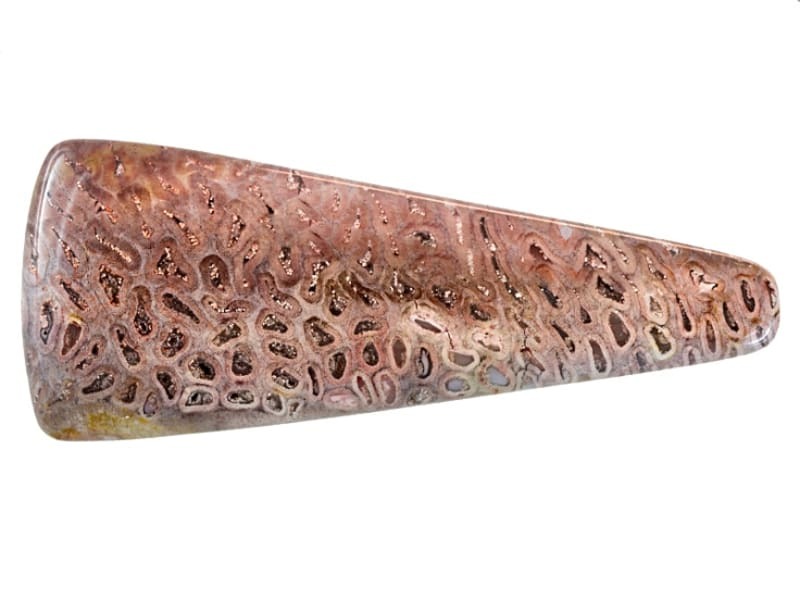
Fossilized jasper is often more commonly recognized in the lapidary and collector markets as petrified material. This transformation occurs through a rigorous geological process where the original organic structures—such as bone, coral, fern, shell, or wood—are gradually infiltrated and replaced at a molecular level by silica-rich hydrothermal fluids. As these mineral-laden solutions permeate the porous tissues, they deposit microcrystalline quartz (SiO₂) and various metal oxides, primarily hematite (Fe₂O₃), into the cellular voids. This process is so precise that it preserves the intricate biological architecture of the original specimen, such as tree rings or shell chambers, while converting the organic remains into a dense, cryptocrystalline silicate aggregate. With a Mohs hardness of 6.5 to 7.0, the resulting stone serves as a unique geological record that fuses organic history with the vibrant, variegated color palettes typical of jasper, making these specimens highly valued for both their scientific interest and their aesthetic appeal in lapidary art.
Applications of Jasper
The technical and artistic applications of jasper span across the lapidary arts, jewelry design, and decorative industries, largely driven by the stone’s exceptional structural integrity, fine-grained composition, and vast array of naturally occurring patterns. Possessing a Mohs hardness of 6.5 to 7.0 and exhibiting no distinct cleavage, this cryptocrystalline variety of quartz (SiO₂) can be meticulously sliced, carved, and polished to a rich, vitreous-to-waxy luster without splintering or fracturing. Because of its opaque nature and dense mineral matrix, jasper is rarely faceted; instead, it serves as a premier material for smooth, dome-shaped cabochons, calibrated beads, and intricate pendants. Its physical toughness and uniform texture allow artisans to execute highly detailed sculptures, figurines, and ornamental seals without the risk of shearing under modern diamond-tipped carving tools. Beyond personal adornment, larger, striking slabs of jasper—such as the mosaic-like Brecciated Jasper or the floral patterns of Poppy Jasper—are heavily utilized in high-end interior design for fabricating premium mosaic tiles, inlaid tabletops, bookends, and custom decorative accents. Ultimately, because the chaotic distribution of iron oxide (Fe₂O₃) and manganese inclusions ensures that no two specimens are identical, jasper remains a highly collectible resource, frequently cut into polished display slabs that act as standalone, organic centerpieces showcasing unique, natural landscapes and orbicular geometry.