
Gadolinite is a rare and chemically complex rare-earth-bearing sorosilicate mineral with the generalized formula (Ce,La,Nd,Y)₂FeBe₂Si₂O₁₀. It is one of the most historically important rare-earth minerals and has played a crucial role in the discovery and study of several lanthanide elements. The mineral commonly contains significant concentrations of yttrium, cerium, lanthanum, neodymium, and other rare earth elements, making it an important subject of mineralogical and geochemical research. Gadolinite typically occurs as prismatic crystals, granular aggregates, or massive forms displaying black, dark green, brownish-black, or greenish-black coloration. It possesses a vitreous to greasy luster, a hardness of approximately 6.5–7 on the Mohs scale, and a relatively high specific gravity due to its enrichment in heavy rare-earth elements.
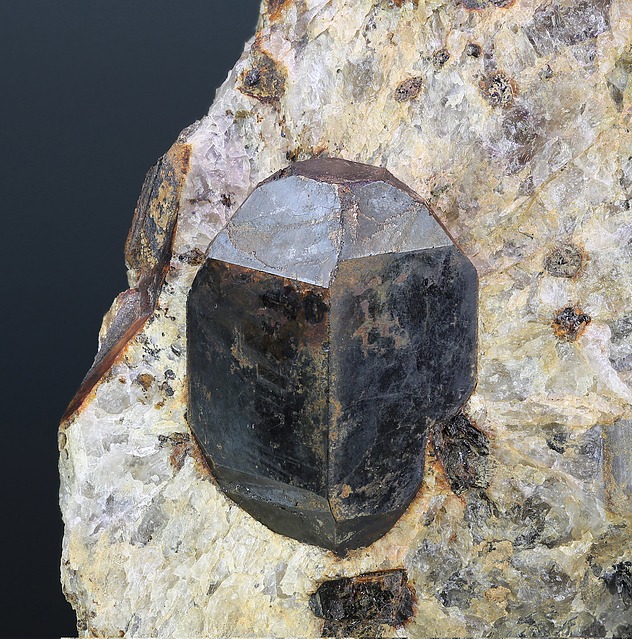
One of the most distinctive features of Gadolinite is its tendency to become metamict, a phenomenon caused by long-term exposure to internal radiation emitted by trace amounts of thorium and uranium incorporated within the crystal lattice. Over millions of years, this natural irradiation can partially or completely disrupt the original crystal structure, transforming the mineral into an amorphous state while preserving its external crystal shape. This unique characteristic has made Gadolinite an important mineral for studying radiation damage, crystal stability, and the geological behavior of rare-earth-bearing minerals.
Gadolinite forms primarily within highly evolved granitic pegmatites, alkaline igneous complexes, and other rare-element-enriched geological environments. These rocks represent the final stages of magma crystallization, during which incompatible elements such as rare earth elements, beryllium, zirconium, fluorine, and niobium become progressively concentrated within residual magmatic fluids. As these volatile-rich fluids cool slowly under favorable conditions, Gadolinite crystallizes alongside a diverse suite of accessory minerals, including zircon, fluorite, allanite, xenotime, monazite, and beryl.The mineral is most commonly associated with pegmatitic systems that have undergone extensive geochemical differentiation, allowing rare elements to accumulate to unusually high concentrations. Because many of these environments are enriched in radioactive elements such as thorium and uranium, Gadolinite frequently experiences structural alteration through metamictization after crystallization. Consequently, the mineral serves as a valuable indicator of rare-earth mineralization and provides geologists with important insights into the evolution of pegmatite systems, the mobility of rare earth elements, and the long-term effects of natural radioactivity on mineral structures.
Few minerals have had a greater impact on the development of modern chemistry than Gadolinite. The mineral was first discovered in 1787 by Swedish army officer and amateur mineralogist Carl Axel Arrhenius at the famous Ytterby quarry in Sweden, a locality that would later become legendary for yielding minerals responsible for the discovery of numerous rare-earth elements. Detailed chemical investigations of the specimen were carried out by Finnish chemist Johan Gadolin, who identified a previously unknown oxide component that became known as yttria. In recognition of his groundbreaking work, the mineral was formally named Gadolinite in 1800.
Crystal Structure of Gadolinite
Gadolinite, most commonly occurring as the species gadolinite-(Y) and gadolinite-(Ce), possesses a complex monoclinic crystal structure and belongs to the gadolinite group within the datolite subgroup of sorosilicate minerals. Its crystal framework is constructed from interconnected (SiO₄)⁴⁻ and (BeO₄)⁶⁻ tetrahedra that combine to form characteristic (Si₂Be₂O₁₀) groups, which are linked by octahedrally coordinated ferrous iron (Fe²⁺) cations and stabilized by large rare-earth-element-bearing sites occupied by yttrium, cerium, lanthanum, neodymium, and other lanthanides. This unique arrangement creates a three-dimensional silicate-beryllate framework that exhibits characteristics intermediate between neosilicates and sorosilicates, contributing to the mineral’s relatively high hardness, density, and chemical durability. Extensive substitution among rare-earth elements is common within the structure, resulting in significant compositional variability and influencing the mineral’s physical and crystallographic properties. Well-formed crystals are typically prismatic and may display internal zoning that reflects changing geochemical conditions during growth. Despite the inherent stability of its crystal framework, gadolinite is particularly notable for its susceptibility to metamictization, a process caused by the long-term radioactive decay of trace thorium and uranium incorporated within the mineral. Over millions of years, alpha-particle emissions progressively damage the crystal lattice, disrupting its atomic order and transforming originally crystalline material into a partially or completely amorphous state while preserving the external crystal shape. This phenomenon can alter the mineral’s optical behavior, density, and mechanical properties, making gadolinite one of the classic examples used in mineralogical research to investigate radiation-induced structural degradation, crystal-chemical evolution, and the long-term stability of rare-earth-bearing minerals in geological environments.
Color and Optical Properties
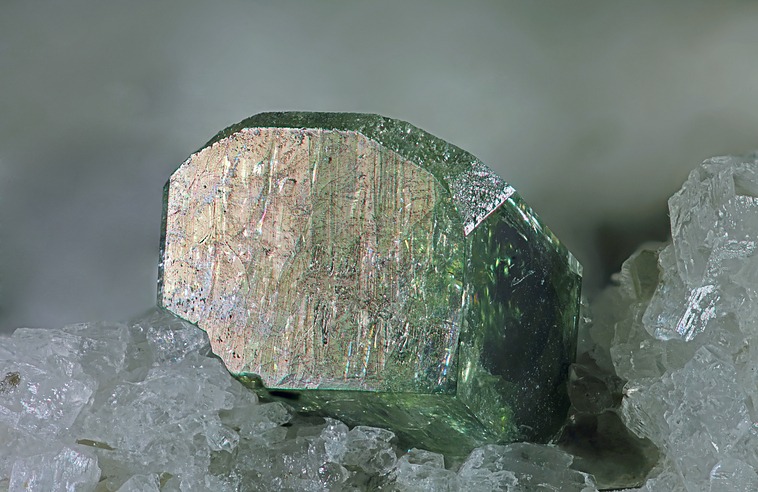
Gadolinite is typically recognized by its dark and often striking coloration, most commonly appearing in shades of black, greenish-black, brownish-black, dark brown, or deep olive green. Fresh, unaltered crystals may exhibit a subtle green tint when viewed under strong illumination, while weathered or metamict specimens generally appear darker and more opaque. The mineral possesses a vitreous to resinous luster that gives polished crystal faces a reflective, glass-like appearance. Although most hand specimens are opaque, thin fragments or crystal edges can be translucent to translucent-green, particularly in less altered material. Gadolinite produces a grayish-white to pale greenish-gray streak and lacks notable fluorescence under ultraviolet light. Optically, crystalline gadolinite is anisotropic due to its monoclinic symmetry and exhibits relatively high refractive indices, reflecting its abundance of heavy rare-earth elements and iron. However, because many specimens have undergone metamictization caused by internal radioactive decay, their optical properties are often partially degraded or irregular, resulting in reduced birefringence and diminished crystal order. Under microscopic examination, well-preserved crystals may display weak pleochroism and subtle color variations related to compositional zoning, while metamict specimens frequently appear isotropic or nearly isotropic despite originally belonging to a lower-symmetry crystal system. These distinctive optical characteristics, combined with its dark coloration and high density, make gadolinite readily distinguishable from many other rare-earth-bearing silicate minerals.
Physical and Chemical Properties
Gadolinite is a relatively hard and dense rare-earth-bearing mineral that exhibits a distinctive combination of physical and chemical characteristics. It typically has a Mohs hardness ranging from 6.5 to 7, allowing it to resist scratching by common materials while remaining brittle enough to fracture under strong impact. The mineral possesses poor to indistinct cleavage and commonly breaks with an uneven to subconchoidal fracture. Its specific gravity generally ranges between 4.0 and 4.7, significantly higher than that of most silicate minerals due to the presence of heavy rare-earth elements, iron, and occasionally trace amounts of thorium and uranium. Chemically, gadolinite is a complex iron-beryllium silicate enriched in rare earth elements, with yttrium, cerium, lanthanum, and neodymium often serving as major constituents. Extensive elemental substitution is common within its crystal structure, leading to considerable variations in composition among different localities. The mineral is relatively stable under normal geological conditions but may gradually alter to secondary rare-earth minerals through weathering and hydrothermal processes. Trace radioactive elements incorporated into the lattice frequently induce metamictization, causing a progressive breakdown of crystal order over geological time. This alteration can influence physical properties such as density, hardness, and optical behavior while preserving the mineral’s external crystal form. Due to its enrichment in rare earth elements and beryllium, gadolinite remains an important mineral for geochemical studies, rare-earth-element research, and investigations into crystal-chemical evolution in pegmatitic and alkaline rock environments.
Uses and Metaphysical Significance
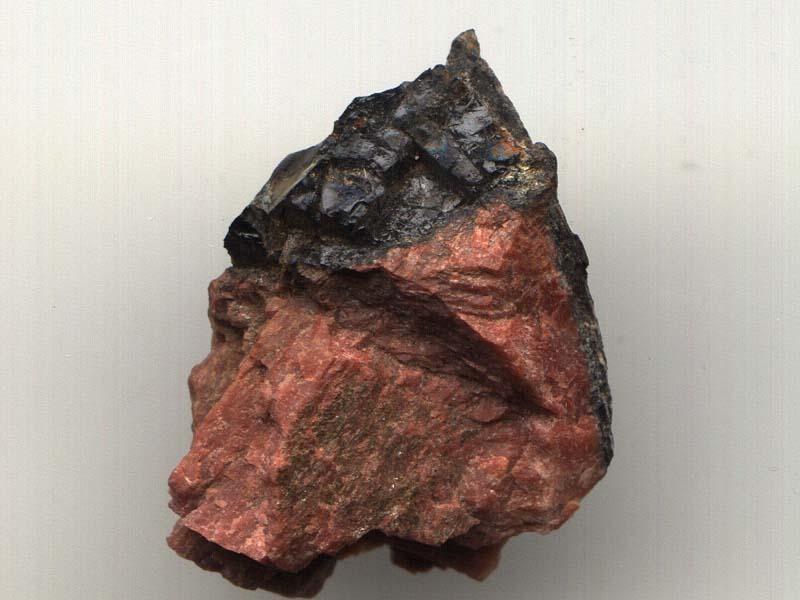
Although Gadolinite is not commonly mined as a major commercial ore, it holds considerable scientific and economic importance as a natural reservoir of rare earth elements (REEs), including yttrium, cerium, lanthanum, and neodymium. These elements are essential components in a wide range of modern technologies, such as high-performance magnets, rechargeable batteries, laser systems, fiber-optic communications, catalysts, and advanced electronic devices. Consequently, Gadolinite is of particular interest to geologists and mining companies exploring rare-earth-element deposits. In addition to its industrial relevance, the mineral is highly valued by mineral collectors due to its rarity, historical significance, and association with the discovery of several rare earth elements. Well-crystallized specimens from classic localities are especially sought after by museums and private collections, while researchers continue to study the mineral for insights into pegmatite evolution, rare-earth geochemistry, and radiation-induced structural alteration.
Within metaphysical and crystal-healing traditions, Gadolinite is often regarded as a stone of transformation, intellectual growth, and inner exploration. Practitioners believe that its strong association with rare earth elements and deep geological history symbolizes hidden knowledge, personal evolution, and the uncovering of latent potential. It is frequently associated with grounding energies while simultaneously encouraging higher awareness, intuition, and spiritual insight. Some crystal enthusiasts use Gadolinite during meditation to promote self-discovery, emotional balance, and the release of outdated thought patterns, viewing it as a catalyst for positive change and personal development. Due to its dark coloration and perceived stabilizing energy, the mineral is also sometimes linked to protection and energetic resilience. However, these metaphysical interpretations are based on spiritual beliefs and cultural practices rather than scientific evidence, and Gadolinite’s primary significance remains rooted in its mineralogical, geological, and historical importance.