
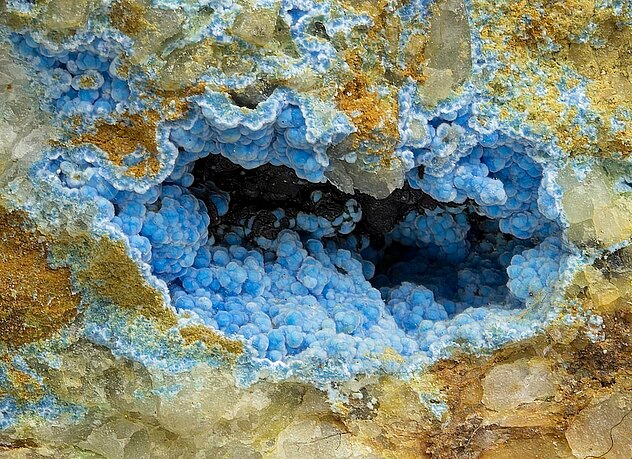
Ceruleite is a rare and visually striking copper aluminum arsenate phosphate mineral that occupies a specialized niche within the field of descriptive mineralogy and systematic mineral collecting. Its name is directly derived from the Latin word caeruleus, which translates to “sky-blue,” serving as a literal descriptor for the mineral’s most prominent diagnostic feature. Chemically, ceruleite possesses a highly complex hydrated structure, formally represented by the formula Cu₂Al₇(AsO₄)₄(OH)₁₃ · 11.5H₂O. Rather than developing into large, well-defined, transparent macro-crystals, this mineral almost exclusively manifests in microcrystalline states, typically forming compact, earthy, clay-like, or botryoidal (grape-like) masses and crusts. On the Mohs scale of mineral hardness, ceruleite rates between 5 and 6, which places its structural durability on par with minerals like turquoise and opal. It exhibits a light blue streak, an opaque transparency, and a luster that ranges from dull and chalky to weakly waxy when found in more compact aggregates. Due to its coloration and texture, it can easily be visually misidentified as turquoise, chrysocolla, or planerite without formal analytical verification such as X-ray diffraction or chemical testing.
The genesis of ceruleite is strictly bound to specific geochemical environments, classificationally categorizing it as a secondary mineral. Secondary minerals do not crystallize during the initial cooling of magmatic bodies or from primary deep-seated hydrothermal fluids; instead, they develop through the chemical alteration of pre-existing primary minerals. Ceruleite forms predominantly within the upper, oxygen-rich oxidation zones of base-metal deposits where both copper and arsenic are present in high concentrations. The formation process initiates when meteoric waters, carrying dissolved atmospheric oxygen, percolate through the upper layers of a mineral deposit, weathering primary copper- and arsenic-bearing sulfides. This process releases copper and arsenate ions into the localized groundwater solutions. For ceruleite to precipitate, these acidic, metal-bearing fluids must interact directly with aluminum-rich host rocks, such as altering feldspars or clay formations. Over extended geological periods, the precise neutralization of these fluids and the exact chemical ratio of copper, aluminum, and arsenic prompt the precipitation of ceruleite within fractures, cavities, and pore spaces. Because this exact convergence of elements and environmental conditions is uncommon, ceruleite remains a highly localized and globally scarce mineral species.
From a historical standpoint, ceruleite is a relatively modern discovery within the timeline of mineral sciences. The mineral was first identified, analyzed, and officially described in the year 1900 by the noted French chemist and mineralogist Henri Dufet. The type specimens used for its initial description were extracted from the Emma Louisa Mine, located within the high-altitude, arid terrain of the Coquimbo Region in Chile’s Atacama Desert. The extreme aridity of this region plays a critical role in preserving complex, hydrated secondary minerals that would otherwise dissolve or erode in more humid climates. Following its initial discovery in Chile, mineralogists have identified a limited number of other occurrences worldwide. Notable secondary deposits have been documented in the historic Cornwall mining district of England and the Cap Garonne Mine in France, both famous for their diverse suites of secondary copper minerals. Additional sparse occurrences have been confirmed in hyper-arid regions of Namibia and within specific oxidized ore zones in Western Australia.
Crystal Structure and Mineral Classification
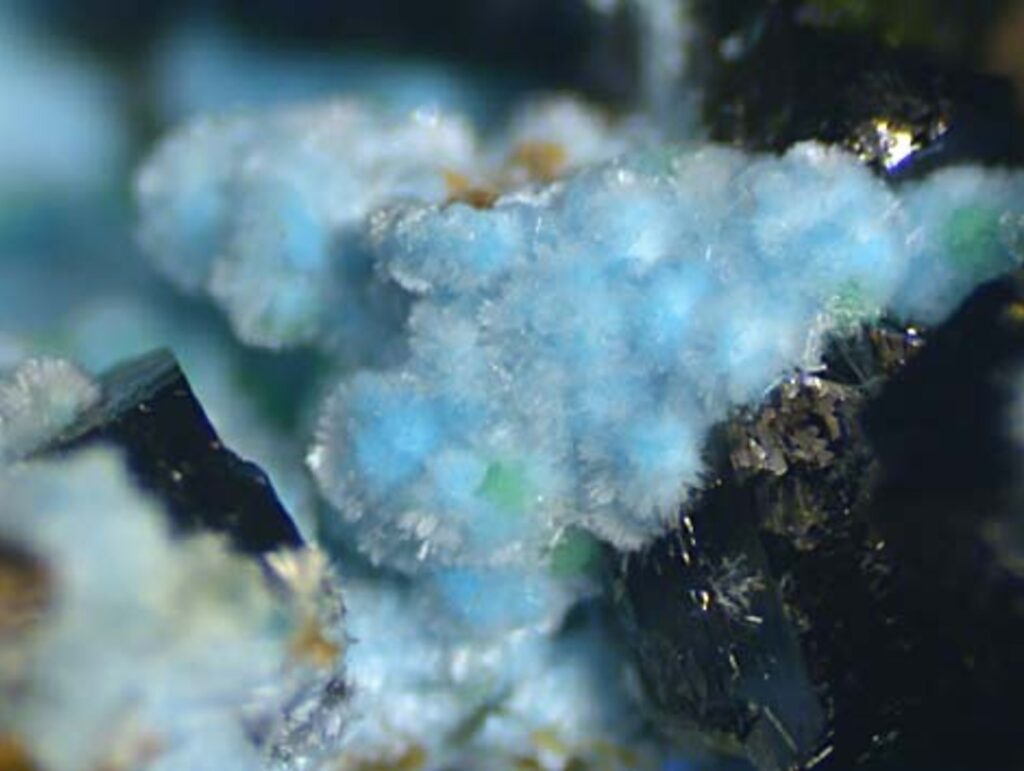
Ceruleite crystallizes within the trigonal crystal system, though the development of distinct, macrometric single crystals is exceedingly rare in nature. The mineral predominantly manifests as microcrystalline aggregates, fibrous masses, botryoidal crusts, or compact powdery coatings, meaning its internal structural symmetry is seldom visible to the naked eye. Due to this fine-grained, cryptocrystalline texture, standard optical crystallographic examination is often insufficient, requiring advanced analytical techniques such as X-ray powder diffraction (XRD) or transmission electron microscopy to properly map its lattice parameters and atomic positioning. Within systematic mineralogy, ceruleite is classified as a hydrated secondary arsenate phosphate mineral, uniquely grouped among complex arsenates that form in copper alteration zones. It shares close geochemical relationships with a distinct suite of secondary copper arsenate minerals, including clinoclase (Cu₃(AsO₄)(OH)₃), olivenite (Cu₂(AsO₄)(OH)), cornubite (Cu₅(AsO₄)₂(OH)₄), euchroite (Cu₂(AsO₄)(OH) · 3H₂O), and tyrolite (Cu₉Ca₂(AsO₄)₄(OH)₁₀ · 10H₂O). These species frequently coexist as paragenetic associates within the same oxidized ore systems, serving as environmental indicators of localized copper mobilization, arsenic redistribution, and specific pH-redox conditions over extended geological periods.
Optical and Color Characteristics
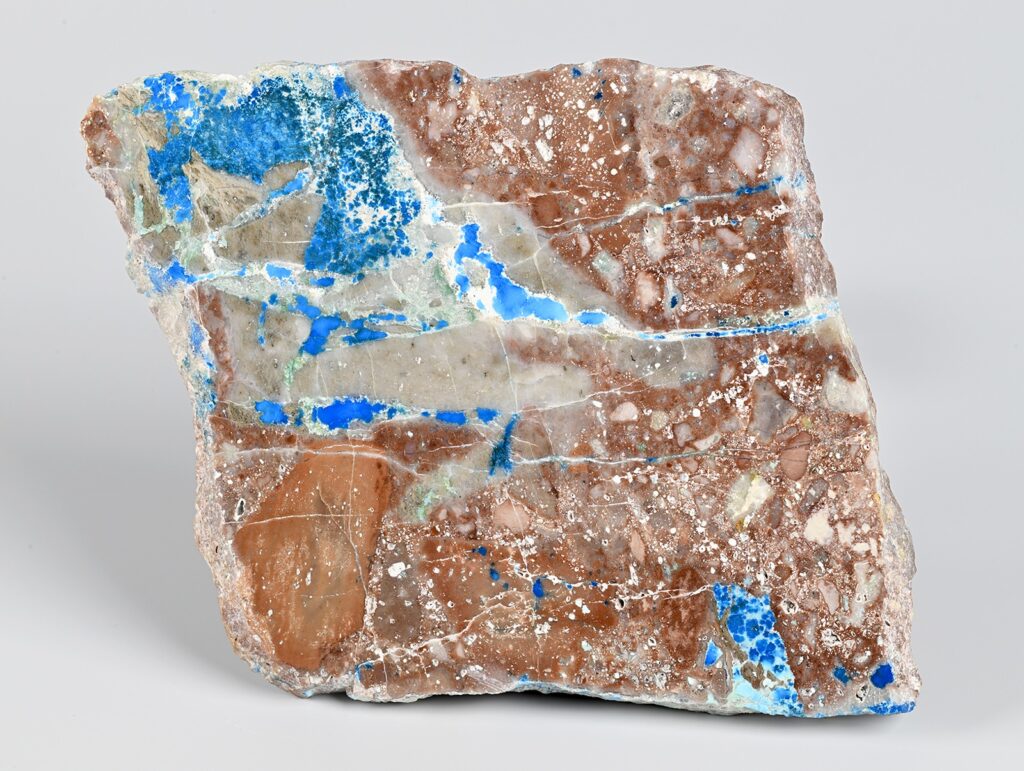
The most defining and diagnostic feature of ceruleite is its vibrant, intense blue coloration, which immediately distinguishes it within a mineral matrix. This striking chromatic appearance is directly driven by the presence of copper ions within its chemical structure; these ions undergo specific crystal field interactions and d-d electronic transitions that selectively absorb the red and yellow wavelengths of the visible light spectrum, while reflecting the characteristic bright blue and turquoise-blue wavelengths. Unlike azurite, which typically exhibits a deep, saturated royal-blue to midnight-blue tone due to its specific carbonate-bonded copper environment, ceruleite tends to display much lighter sky-blue, pastel-blue, or vibrant turquoise-blue shades, occasionally leaning toward a soft blue-green when trace impurities alter the localized chemistry. From a structural standpoint, the mineral’s micro-fibrous and tightly interwoven aggregate morphology can give its surfaces a distinctly silky or pearly visual texture under reflected light, particularly when compact masses are freshly fractured or lightly polished. However, because a vast array of secondary copper minerals—such as turquoise, chrysocolla, linarite, and chalcoalumite—exhibit a nearly identical spectrum of blue and green colors, visual inspection alone is insufficient for positive verification, making rigorous analytical testing essential to distinguish ceruleite from these visually similar species.
Physical and Optical Properties
The physical characteristics of ceruleite are heavily influenced by its aggregate nature and chemical composition. Visually, the mineral is distinguished by its intense sky-blue to turquoise-blue and bright blue-green coloration, which remains relatively consistent across different localities due to the constant presence of copper ions acting as the primary chromophore. It possesses an opaque transparency, with light only penetrating the thinnest edges of micro-crystalline flakes. The luster of ceruleite ranges significantly depending on the density of the aggregate; it typically exhibits a dull, earthy, or chalky appearance in porous crusts, but can display a weakly waxy or vitreous luster on freshly fractured surfaces of highly compact masses. It leaves a distinct light blue streak when rubbed across unglazed porcelain. In terms of mechanical properties, ceruleite features a Mohs hardness of 5 to 6, indicating a moderate resistance to scratching that prevents it from being easily marked by a steel knife, yet leaving it susceptible to harder materials like quartz. The mineral is brittle, breaking with an uneven, subconchoidal, or earthy fracture, and it lacks discernible cleavage due to the interwoven, micro-fibrous orientation of its structural components. Its specific gravity is calculated around 2.80, a density that is typical for hydrated minerals of this composition.
Chemical Properties and Reactivity
Chemically, ceruleite is a complex hydrated copper aluminum arsenate phosphate mineral with the structural formula Cu₂Al₇(AsO₄)₄(OH)₁₃ · 11.5H₂O, showcasing a high degree of hydration and a significant concentration of hydroxyl (OH) groups. The presence of both arsenic (in the form of arsenate complexes, AsO₄) and phosphorus within its framework makes it a highly specialized geochemical marker. Ceruleite is chemically unstable in strongly acidic or heavily alkaline environments; exposure to dilute mineral acids such as hydrochloric or nitric acid will prompt the breakdown of its crystalline matrix, causing the mineral to dissolve while releasing copper and arsenate ions into the solution. Under high thermal conditions, ceruleite undergoes a multi-stage dehydration process, readily losing its weakly bonded zeolitic water molecules (the 11.5H₂O component) at relatively low temperatures, which results in a structural collapse and a subsequent dulling of its vibrant blue color. Because it contains arsenic, the mineral is considered toxic if dust particles are inhaled or ingested during cutting and handling, requiring strict safety protocols during lapidary processing or academic sampling. It does not exhibit fluorescence under shortwave or longwave ultraviolet light, and it remains non-magnetic under standard laboratory conditions.
Geographic Distribution and Primary Localities
As a highly constrained secondary mineral, ceruleite is geographically restricted to a small number of scattered deposits worldwide, with few localities yielding specimens of significant size or quality. The premier and historically defining deposit for this species is its type locality: the Emma Luisa Mine within the Guanaco (Huanaco) gold mining district, situated roughly 100 kilometers east-northeast of Taltal in the Antofagasta Province of Chile. The hyper-arid environment of the Atacama Desert provides an ideal geologic preservation shield, allowing this water-sensitive, hydrated arsenate to persist without undergoing rapid dissolution. Beyond South America, notable European occurrences have been documented in classical mining districts known for complex polymetallic secondary alteration zones. Chief among these are the historic copper mines of Cornwall, England—specifically the Wheal Gorland, Wheal Maid, and Penberthy Croft mines—where ceruleite is found associated with other rare arsenate suites. Similarly, the Cap Garonne Mine near Le Pradet in the Var department of France has yielded microcrystalline specimens of high scientific interest. Other validated, minor global occurrences include the hyper-arid Tsumeb ore body in the Oshikoto Region of Namibia, isolated profiles in southern Bolivia, and the remote Anticline prospect located southwest of the Ashburton Downs homestead in the Capricorn Range of Western Australia.
Relationship to Other Copper Minerals
Ceruleite belongs to a broader family of secondary copper minerals formed through intricate near-surface oxidation processes. Within the field of systematic mineralogy, these minerals are highly valued because their presence records the complex chemical evolution, pH levels, and fluid history of ore systems as they interact with meteoric water and atmospheric oxygen over geological time.
To understand its standing in the mineralogical world, it is useful to compare ceruleite with more widely known secondary copper minerals. The table below outlines the primary color, chemical formulas, and physical hardness distinctions between them:
| Mineral | Primary Color | Chemical Formula | Hardness (Mohs) |
|---|---|---|---|
| Azurite | Deep royal blue | Cu₃(CO₃)₂(OH)₂ | 3.5 – 4.0 |
| Malachite | Vibrant green | Cu₂(CO₃)(OH)₂ | 3.5 – 4.0 |
| Turquoise | Blue-green | CuAl₆(PO₄)₄(OH)₈·4H₂O | 5.0 – 6.0 |
| Olivenite | Olive green to brown | Cu₂(AsO₄)(OH) | 3.0 |
| Ceruleite | Sky blue | Cu₂Al₇(AsO₄)₄(OH)₁₃·11.5H₂O | 5.0 – 6.0 |
Gemological & Analytical Distinction: Although ceruleite closely resembles turquoise in certain hand specimens, their fundamental geochemistry differs significantly. While turquoise is entirely phosphate-based, ceruleite is an arsenate-based mineral, requiring a unique geological environment rich in localized, oxidized arsenic systems to trigger its crystallization pathway.
Uses, Applications, and Metaphysical Interpretations
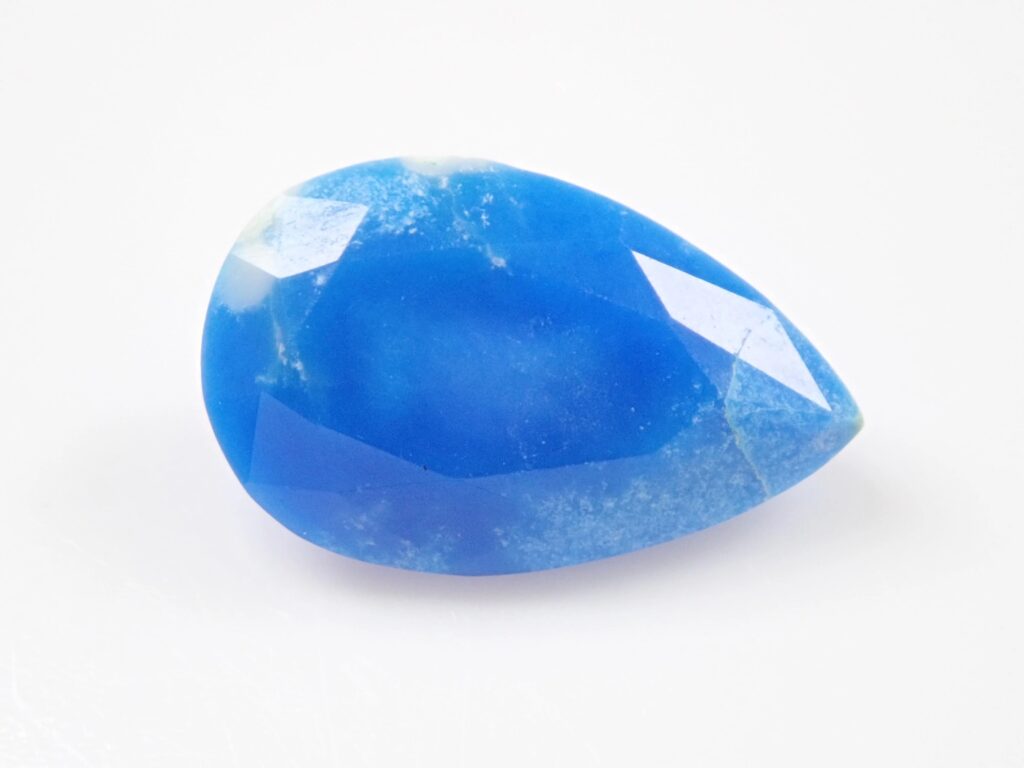
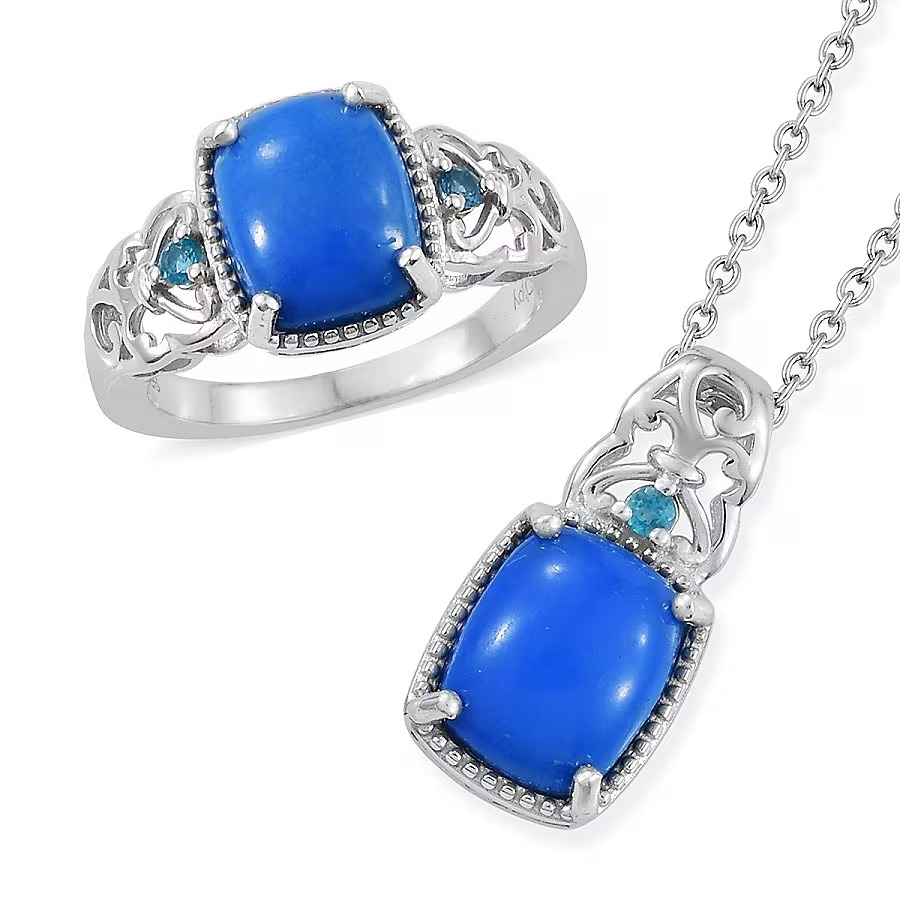
From a commercial and industrial standpoint, ceruleite holds no utility as an ore for copper or arsenic due to its extreme scarcity and highly localized occurrences. Its primary material distribution remains confined to academic research, institutional mineral repositories, and private systematic collections where natural, unaltered specimens are preserved for study. Within the lapidary and gemstone trades, ceruleite occupies a small, specialized niche. Because the mineral occurs exclusively as opaque, microcrystalline or fibrous aggregates rather than transparent macro-crystals, it cannot be faceted into traditional gemstone cuts. Instead, compact masses of sufficient density are occasionally cut into cabochons, polished into beads, or worked into small ornamental carvings. The finished material presents an intense sky-blue color, often patterned with a matrix of host rock. Given its Mohs hardness of 5 to 6 and its hydrated chemical framework, any finished ceruleite pieces require protective settings and careful handling, as they are susceptible to damage from physical impact, thermal shock, and exposure to acids or household chemicals.
In addition to its geological and gemological classification, ceruleite has been integrated into contemporary metaphysical philosophies and crystal healing frameworks. Within these belief systems, minerals are categorized largely by their visual properties; because of its distinct sky-blue hue, metaphysical practitioners commonly associate ceruleite with the throat chakra (Vishuddha) and the third eye chakra (Ajna). Literature within this community attributes properties of mental clarity, emotional calming, and enhanced communication to the mineral, suggesting that its presence aids in articulating thoughts or processing internal stress. Some holistic writers also draw a symbolic parallel to its chemical formation—noting that the mineral represents a natural stabilization of volatile copper and arsenic systems—and interpret the stone as a metaphor for personal transformation or the neutralization of negative psychological patterns. While these metaphysical attributes are widely discussed among collectors of esoteric stones, they belong strictly to alternative cultural traditions and lack empirical validation within the geological and physical sciences.