
Brazilianite is a phosphate mineral composed primarily of sodium, aluminum, hydrogen, oxygen, and phosphorus, with the chemical formula NaAl₃(PO₄)₂(OH)₄. It is best known for its yellow to yellow-green color and its well-developed orthorhombic crystals, which can occur as transparent to translucent specimens with strong vitreous luster. Brazilianite commonly forms in phosphate-rich pegmatites and related hydrothermal environments, where it is associated with minerals such as albite, quartz, muscovite, apatite, and other phosphate minerals. Its relatively high hardness, distinct crystal habit, and characteristic yellow coloration make it readily recognizable in well-formed specimens.
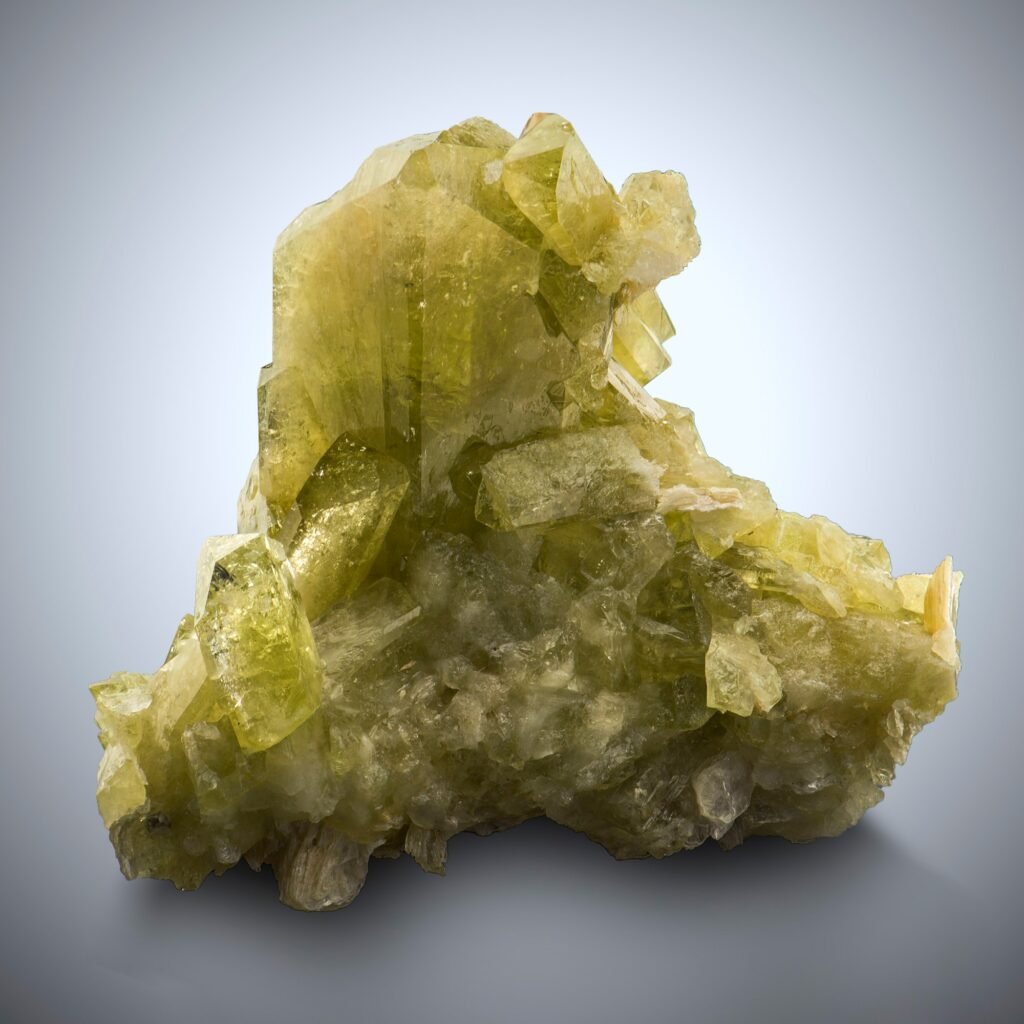
Brazilianite belongs to the phosphate mineral group and is structurally related to other aluminum phosphate minerals. It typically occurs as elongated prismatic crystals, often with sharply developed faces and well-defined terminations. Crystals may range from pale yellow and yellow-green to deeper greenish-yellow or nearly colorless varieties, depending on the specimen and the presence of minor chemical substitutions or structural variations. Brazilianite has a Mohs hardness of approximately 5.5, placing it in the intermediate hardness range, while its relatively high specific gravity reflects its aluminum- and phosphate-rich composition.
The mineral is particularly associated with granitic pegmatites, especially highly evolved pegmatitic systems in which late-stage fluids become enriched in phosphorus and other incompatible elements. Brazilianite can occur in cavities within these rocks, where the available space allows individual crystals to develop freely. Some specimens form clusters of well-developed crystals, while others occur as massive or compact aggregates. The mineral’s combination of crystal form, color, luster, cleavage, hardness, and geological association provides useful criteria for distinguishing it from visually similar yellow phosphate and silicate minerals.
History and Discovery of Brazilianite
Brazilianite was first described in 1944 from specimens found in the state of Minas Gerais, Brazil, an area well known for its granitic pegmatites and diverse phosphate mineral assemblages. The mineral was named Brazilianite in reference to Brazil, the country where it was first identified and where some of the most important occurrences are located. Its discovery added another phosphate mineral to the already extensive mineralogical record of the Brazilian pegmatite districts, which have produced numerous phosphate species and well-formed mineral specimens.
The original Brazilianite specimens were associated with phosphate-rich pegmatitic environments, particularly in the region of Conselheiro Pena in Minas Gerais. These pegmatites are highly evolved igneous bodies that formed during the final stages of crystallization of granitic magma. As crystallization progressed, elements and volatile components that were not readily incorporated into the major rock-forming minerals became concentrated in residual melts and fluids. Phosphorus, sodium, aluminum, lithium, beryllium, and other elements could become locally enriched, creating conditions favorable for the formation of unusual phosphate minerals such as brazilianite.
Following its original discovery in Brazil, brazilianite was identified at additional localities and became an important mineral for the study and classification of phosphate assemblages in granitic pegmatites. Although Brazil remains strongly associated with the species, occurrences have also been documented in other phosphate-rich geological environments around the world. Brazilianite is particularly valued by mineral collectors when it forms isolated, transparent to translucent crystals with sharp terminations and a uniform yellow coloration, but its scientific importance is primarily related to its distinctive chemical composition, crystal structure, and occurrence within highly evolved pegmatitic systems.
Formation and Geological Occurrence of Brazilianite
Brazilianite forms mainly in highly evolved granitic pegmatites and phosphate-rich zones associated with these rocks. Its formation is generally related to late-stage magmatic and hydrothermal processes, when residual fluids become concentrated in phosphorus, sodium, aluminum, and other elements. During the final stages of pegmatite crystallization, these components may react with previously formed minerals or precipitate directly from phosphate-bearing fluids in open cavities and fractures. Brazilianite is therefore commonly found in mineral assemblages representing the late evolutionary stages of pegmatitic systems rather than in the earlier, major rock-forming portions of the intrusion.
The mineral is especially characteristic of phosphate-rich pockets within complex pegmatites. In these environments, primary minerals such as quartz, feldspar, and mica may already have crystallized, leaving residual spaces where phosphate minerals can develop. Brazilianite may occur on cavity walls as isolated crystals, crystal clusters, or coatings associated with other secondary or late-stage phosphate minerals. Its crystals can become particularly well developed when sufficient open space is available and the growth rate is relatively slow, allowing distinct crystal faces and terminations to form.
One of the best-known occurrences is in the Conselheiro Pena district of Minas Gerais, Brazil, where brazilianite occurs in complex granitic pegmatites. The pegmatites of this region contain a diverse range of phosphate minerals and have produced specimens with well-formed brazilianite crystals. Other important Brazilian localities are also associated with phosphate-bearing pegmatites in Minas Gerais. Outside Brazil, brazilianite has been reported from several pegmatitic districts and phosphate-rich geological settings, although many occurrences are less notable for specimen quality than the classic Brazilian localities.
Brazilianite can occur together with minerals including albite, quartz, muscovite, apatite, triphylite, lithiophilite, and other phosphate species. The exact mineral association varies according to the chemical composition and evolutionary history of the host pegmatite. Alteration processes can also influence the phosphate assemblage, with later fluids modifying earlier phosphate minerals and producing new phases. Consequently, brazilianite is useful not only as a mineral species in its own right but also as part of the broader mineralogical record of late-stage phosphate crystallization in evolved pegmatitic systems.
Crystal Structure of Brazilianite
Brazilianite crystallizes in the orthorhombic crystal system and has a relatively complex phosphate structure composed primarily of sodium, aluminum, phosphorus, oxygen, and hydroxyl groups. Its ideal chemical formula is NaAl₃(PO₄)₂(OH)₄. Within the structure, phosphorus is coordinated by four oxygen atoms to form PO₄ tetrahedra, while aluminum occupies several oxygen- and hydroxyl-coordinated sites. These aluminum-centered polyhedra are linked with the phosphate tetrahedra to produce an interconnected structural framework. Sodium occupies larger structural sites within this framework and contributes to the overall electrical neutrality of the mineral. Hydroxyl groups are an important structural component rather than simply impurities, and their presence gives brazilianite a composition distinct from anhydrous aluminum phosphate minerals with related chemical characteristics. The relatively strong bonding between phosphate and aluminum-bearing structural units contributes to the mineral’s moderate hardness, stability, and characteristic physical properties.
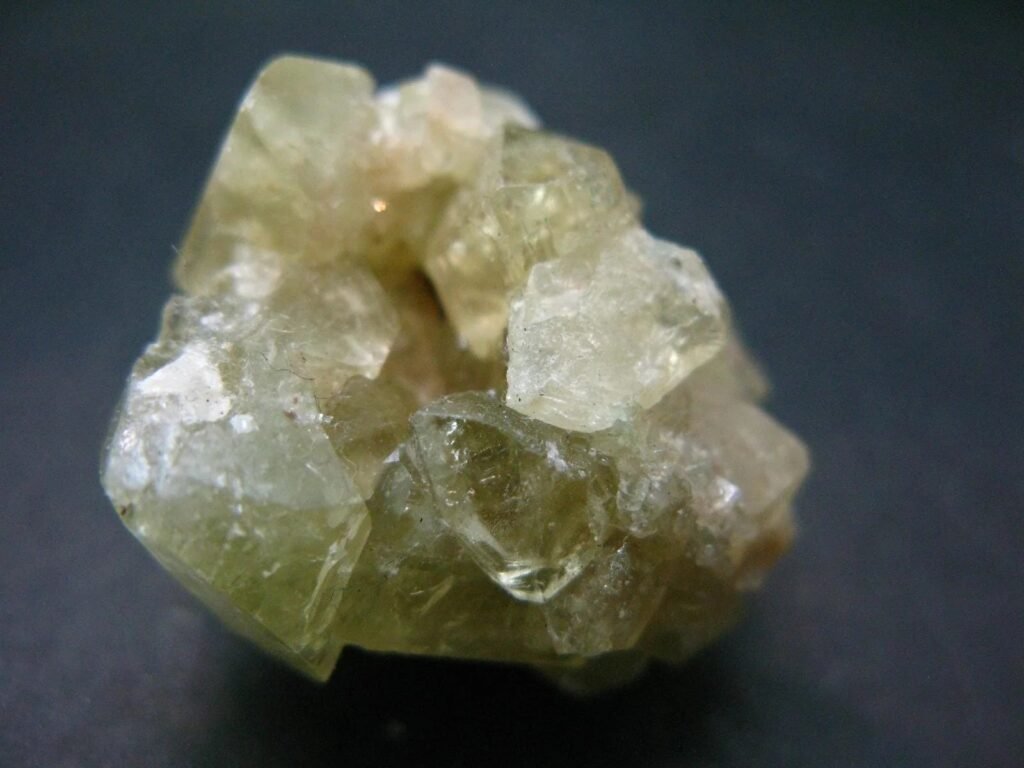
The orthorhombic symmetry of brazilianite means that its three crystallographic axes are mutually perpendicular but have different lengths, producing a structure with lower symmetry than cubic minerals. This crystallographic arrangement is reflected in the mineral’s typical elongated prismatic habit, with crystals commonly showing well-developed prismatic faces and sharply defined terminations. Brazilianite may also occur as intergrown crystals, crystal aggregates, or less commonly as compact and irregular masses when unrestricted crystal growth is not possible. Twinning and repeated intergrowths can further modify the external appearance of individual specimens. Because the atomic arrangement is directionally dependent, brazilianite is anisotropic and exhibits different optical and physical behavior along different crystallographic directions. Its cleavage, refractive indices, birefringence, and other optical characteristics are therefore related to its orthorhombic structure. In transparent or translucent crystals, these properties can be observed particularly clearly, while inclusions, fractures, structural imperfections, and minor chemical substitutions may affect transparency and the apparent distribution of color within individual crystals.
Color, Luster, and Optical Properties of Brazilianite
Brazilianite is typically yellow, yellow-green, pale greenish-yellow, or greenish in color, although some crystals may appear nearly colorless or very pale under certain lighting conditions. The yellow coloration is one of its most characteristic visual features and is particularly noticeable in transparent crystals from well-developed pegmatitic cavities. Color intensity can vary considerably between specimens and may be influenced by minor chemical substitutions, structural defects, inclusions, and the thickness of the crystal. Some crystals show relatively uniform coloration, while others may contain zones with differences in transparency or color. The streak of brazilianite is generally white, providing a useful distinction from minerals whose body color is accompanied by a strongly colored streak.
Brazilianite has a vitreous luster on fresh crystal surfaces, giving well-developed specimens a glass-like appearance when light reflects from their faces. Its transparency ranges from transparent to translucent, with the best crystals allowing light to pass through substantial portions of the specimen. Transparent crystals are especially useful for observing the mineral’s internal optical characteristics and crystal zoning. The refractive indices of brazilianite are relatively high for a mineral containing abundant aluminum and phosphate groups, contributing to its noticeable surface brightness. As an orthorhombic mineral, brazilianite is optically anisotropic and exhibits birefringence, meaning that light traveling through the crystal can be separated into rays with different refractive behavior depending on crystallographic direction.
Under polarized light, brazilianite can therefore display characteristic interference effects that help distinguish it from visually similar minerals. Its optical properties are also dependent on crystal orientation, which is consistent with its orthorhombic symmetry. In thin sections or polished fragments, these directional optical differences can be used together with refractive index, cleavage, hardness, and chemical composition to identify the mineral. For hand specimens, however, color, crystal habit, vitreous luster, transparency, and its occurrence in phosphate-rich pegmatites generally provide the first visual clues, while definitive identification requires more specific mineralogical testing.
Physical Properties of Brazilianite
Brazilianite has a Mohs hardness of approximately 5.5, placing it between apatite and orthoclase on the hardness scale. This moderate hardness allows the mineral to resist ordinary abrasion reasonably well, but it remains considerably softer than quartz and many common gemstone minerals. Its hardness can vary slightly depending on crystallographic direction, surface condition, and the presence of inclusions or structural defects. Brazilianite also has a specific gravity of approximately 2.98–3.00, which is consistent with its sodium-, aluminum-, and phosphate-rich composition. The mineral generally has a white streak and a vitreous luster, while its transparency may range from transparent to translucent. Well-formed crystals can have clean, relatively smooth surfaces, although fractures, inclusions, and alteration may reduce their transparency.
Brazilianite has distinct cleavage, commonly described as good in one or more directions, and its fracture is generally uneven to subconchoidal where cleavage does not dominate. The combination of moderate hardness and relatively distinct cleavage means that crystals can be damaged by strong mechanical impact, particularly along cleavage planes. Its crystal habit is commonly prismatic or elongated, with individual crystals sometimes occurring as isolated specimens in open pegmatite cavities. It may also form radiating groups, intergrown aggregates, and irregular masses when the available space or chemical conditions restrict the development of individual crystals. The mineral is not known for pronounced flexibility or elasticity and behaves as a typical brittle crystalline phosphate when subjected to mechanical stress.
The physical properties of brazilianite are closely related to its crystal structure and chemical composition. Its moderate density, hardness, cleavage, and optical anisotropy provide useful diagnostic characteristics when combined with its characteristic yellow to yellow-green color and occurrence in phosphate-rich pegmatites. Individual specimens can vary in appearance depending on crystal size, degree of transparency, surface alteration, and associated minerals. For mineral identification, no single physical property is normally sufficient on its own; hardness, specific gravity, cleavage, optical properties, crystal habit, and chemical composition are best considered together.
Chemical Composition and Chemical Properties of Brazilianite
Brazilianite has the ideal chemical formula NaAl₃(PO₄)₂(OH)₄ and belongs to the hydrated phosphate minerals. Its composition is dominated by sodium, aluminum, phosphorus, oxygen, and hydroxyl groups, with phosphorus occurring as phosphate (PO₄) structural units. The aluminum and phosphate components form much of the mineral’s structural framework, while sodium occupies larger sites within the crystal lattice. Hydroxyl groups are structurally bound within the mineral and are essential to maintaining its ideal chemical composition. Unlike minerals in which water is present mainly as loosely held molecular H₂O, the hydroxyl groups in brazilianite are incorporated directly into the crystal structure.
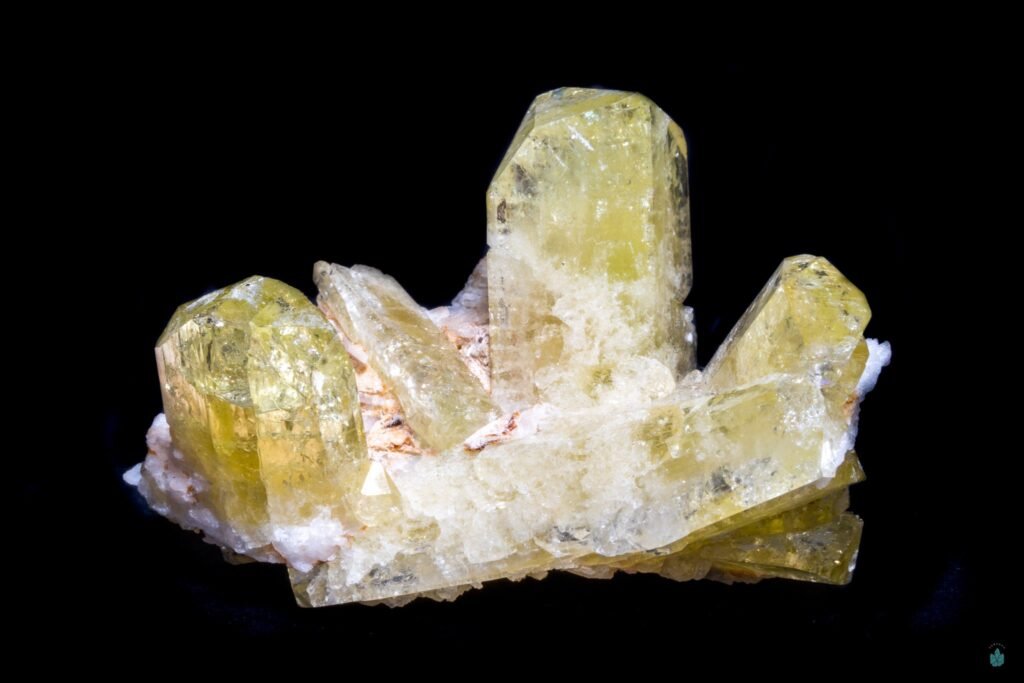
The ideal composition can be affected by minor elemental substitutions and natural variations during crystallization. Such substitutions may occur when chemically similar elements become incorporated into available structural sites during the late stages of pegmatite formation. The exact composition of an individual specimen can therefore differ slightly from the ideal formula without changing its identity as brazilianite. These minor variations, together with inclusions and structural defects, can influence physical characteristics such as color, transparency, and optical behavior. Chemical analyses are consequently useful when distinguishing brazilianite from other yellow or greenish phosphate minerals that may occur in the same geological environment.
Brazilianite is generally stable under the conditions in which it forms, particularly within the relatively evolved phosphate-rich zones of granitic pegmatites. However, exposure to later hydrothermal fluids or weathering processes can alter the mineral assemblage surrounding brazilianite and may result in the formation of secondary phosphate minerals. Because pegmatites can undergo multiple stages of fluid activity after their initial crystallization, brazilianite may occur together with both primary and secondary phosphate phases. Its chemical composition and mineral associations therefore provide information about the evolution of phosphate-rich portions of complex pegmatitic systems.
Types and Varieties of Brazilianite
Brazilianite is generally treated as a distinct mineral species rather than a mineral with a large number of formally recognized varieties. Differences among specimens are more commonly described according to crystal habit, color, transparency, size, and geological occurrence rather than by separate mineral names. Common forms encountered in mineral collections include:
- Prismatic Brazilianite: Well-developed elongated crystals with prominent prismatic faces and distinct terminations. These are characteristic of specimens formed in open cavities within evolved granitic pegmatites.
- Transparent Brazilianite: Clear to highly translucent crystals that allow light to pass through substantial portions of the specimen. Transparent crystals can display internal zoning, inclusions, fractures, and other features more clearly.
- Yellow Brazilianite: The most characteristic color form, ranging from pale yellow to stronger golden or yellow-green tones. The coloration is particularly noticeable on larger, well-formed crystals.
- Yellow-Green Brazilianite: Crystals showing a distinct greenish component in their yellow coloration. The exact appearance can vary with lighting, crystal thickness, inclusions, and minor chemical variations.
- Crystal Groups: Brazilianite commonly occurs as clusters of several intergrown or closely associated crystals. Individual crystals within a group may have different orientations and degrees of development depending on the available space during growth.
- Massive or Irregular Brazilianite: Brazilianite may also occur in compact, granular, or irregular aggregates where unrestricted crystal growth was not possible. These specimens generally show less clearly developed crystal faces than cavity-grown crystals.
These forms represent differences in appearance and mode of occurrence rather than formally established varieties with separate chemical identities. For mineralogical identification, the species is determined by its chemical composition and crystal structure together with diagnostic physical and optical properties. Geological setting and associated minerals are also important because brazilianite commonly occurs with other phosphate minerals that can produce similar colors or crystal habits.
Brazilianite Localities
Brazilianite is most strongly associated with the granitic pegmatites of Brazil, particularly those in the state of Minas Gerais. The pegmatite districts of Minas Gerais are among the most important sources of phosphate minerals and have produced numerous specimens with well-developed brazilianite crystals. The mineral commonly occurs in pockets and cavities within highly evolved pegmatites, where late-stage phosphate-rich fluids provide the chemical conditions required for its crystallization. Specimens from these localities may occur with albite, quartz, muscovite, apatite, and a range of other phosphate minerals.
The Conselheiro Pena region of Minas Gerais is particularly well known for brazilianite and has produced some of the most recognizable specimens of the species. In these complex pegmatites, brazilianite commonly develops as isolated or clustered crystals in open cavities, allowing relatively unrestricted growth. Other pegmatitic areas of Minas Gerais have also yielded brazilianite, although the morphology, color, transparency, and crystal size can differ considerably from one deposit to another. The mineralogical diversity of these pegmatites reflects their highly evolved chemical compositions and multiple stages of late-stage mineral formation.
Brazilianite has also been reported from localities outside Brazil, although Brazilian occurrences remain especially important in the mineralogical literature and specimen trade. Occurrences in other countries are generally associated with phosphate-rich granitic pegmatites or related geological environments. The presence of brazilianite outside its type region demonstrates that the mineral is not restricted to a single geological province, but its formation requires a relatively specific combination of phosphorus, aluminum, sodium, hydroxyl-bearing fluids, and suitable conditions during the late evolution of a pegmatitic system.
Because brazilianite is commonly concentrated in small pockets rather than distributed uniformly throughout its host rock, the quality of specimens can vary significantly even within the same mining district. Some locations produce small, opaque or fractured crystals, while others can yield larger transparent specimens with sharp terminations and well-developed faces. Associated minerals are useful for interpreting these differences because changes in the phosphate assemblage can reflect variations in temperature, fluid composition, oxidation state, and the availability of different chemical components during the later stages of pegmatite formation.
Brazilianite and Similar Minerals
Brazilianite can resemble several yellow, yellow-green, or pale-colored minerals, particularly when it occurs as transparent or translucent crystals. Its appearance may overlap with minerals such as apatite, chrysoberyl, prehnite, and certain yellow varieties of quartz or feldspar. However, differences in crystal system, hardness, cleavage, specific gravity, optical properties, and chemical composition provide useful criteria for distinguishing brazilianite from these visually similar species. Its occurrence in phosphate-rich granitic pegmatites is also an important geological clue.
| Mineral | Typical Color | Hardness | Crystal System | Distinguishing Features |
|---|---|---|---|---|
| Brazilianite | Yellow, yellow-green, pale greenish-yellow | 5.5 | Orthorhombic | Distinctive yellow to yellow-green prismatic crystals, phosphate composition, characteristic cleavage |
| Apatite | Green, yellow, blue, violet, colorless | 5 | Hexagonal | Commonly forms hexagonal prismatic crystals and has slightly lower hardness |
| Chrysoberyl | Yellow, yellow-green, green, brown | 8.5 | Orthorhombic | Much harder than brazilianite and typically has stronger durability and higher specific gravity |
| Prehnite | Pale green, yellow-green, yellow | 6–6.5 | Orthorhombic | Commonly occurs as botryoidal or radiating aggregates rather than the typical prismatic crystals of brazilianite |
| Quartz | Colorless, yellow, brown, violet, green | 7 | Trigonal | Higher hardness, no cleavage, and very different chemical composition |
| Feldspar | White, cream, yellow, pink, greenish | 6–6.5 | Monoclinic or triclinic | Strong cleavage and generally lower transparency; commonly associated with pegmatites |
Among these minerals, apatite is one of the more relevant comparisons because both apatite and brazilianite are phosphate minerals and can occur together in pegmatitic environments. Apatite commonly develops hexagonal prismatic crystals, whereas brazilianite is orthorhombic and more commonly forms elongated prismatic crystals with different terminations. Chrysoberyl can also resemble yellow brazilianite visually, particularly in transparent crystals, but its much greater hardness of approximately 8.5 makes it readily distinguishable through hardness testing. Quartz is similarly easy to separate when physical testing is possible because its hardness is higher and it lacks the characteristic cleavage of brazilianite.
For accurate identification, visual appearance alone is generally insufficient when dealing with small or poorly developed specimens. Hardness, cleavage, specific gravity, optical properties, crystal morphology, and chemical analysis provide more reliable methods. In a geological context, the association with highly evolved, phosphate-rich granitic pegmatites is also an important diagnostic feature because brazilianite commonly occurs alongside other late-stage phosphate minerals.
Uses of Brazilianite
Brazilianite has relatively limited industrial use compared with common phosphate minerals because it is generally found in small quantities and is not an important commercial source of phosphorus. Its primary importance is mineralogical and geological rather than industrial. Well-formed crystals are collected as mineral specimens, while transparent and sharply terminated examples are particularly useful for studying crystal morphology, optical properties, and the relationships between different phosphate minerals in complex pegmatitic environments.
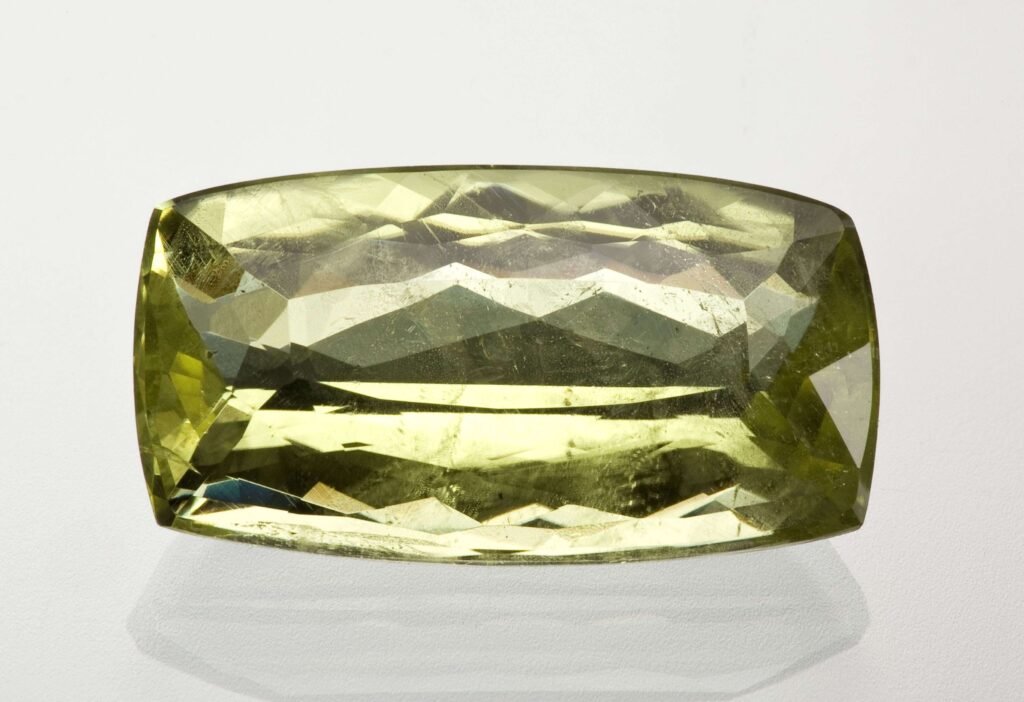
Brazilianite is also used as a reference mineral in mineralogical research and identification. Its distinctive chemical composition, orthorhombic crystal structure, moderate hardness, cleavage, optical properties, and characteristic yellow to yellow-green color provide a useful combination of diagnostic features. Researchers can examine brazilianite together with associated phosphate minerals to investigate the chemical evolution of pegmatites and the processes responsible for late-stage phosphate crystallization. Mineralogical studies may also use individual crystals for crystallographic, spectroscopic, and chemical analysis.
High-quality brazilianite specimens are of interest to mineral collectors and museums. Transparent crystals with strong yellow coloration, sharp terminations, good luster, and minimal damage are generally more desirable for collections than heavily fractured or poorly developed material. Specimens may be displayed as individual crystals, crystal groups, or matrix specimens showing the relationship between brazilianite and its host pegmatite minerals. Its importance in collections is primarily based on crystal quality, locality, morphology, and mineralogical significance rather than widespread practical applications.