
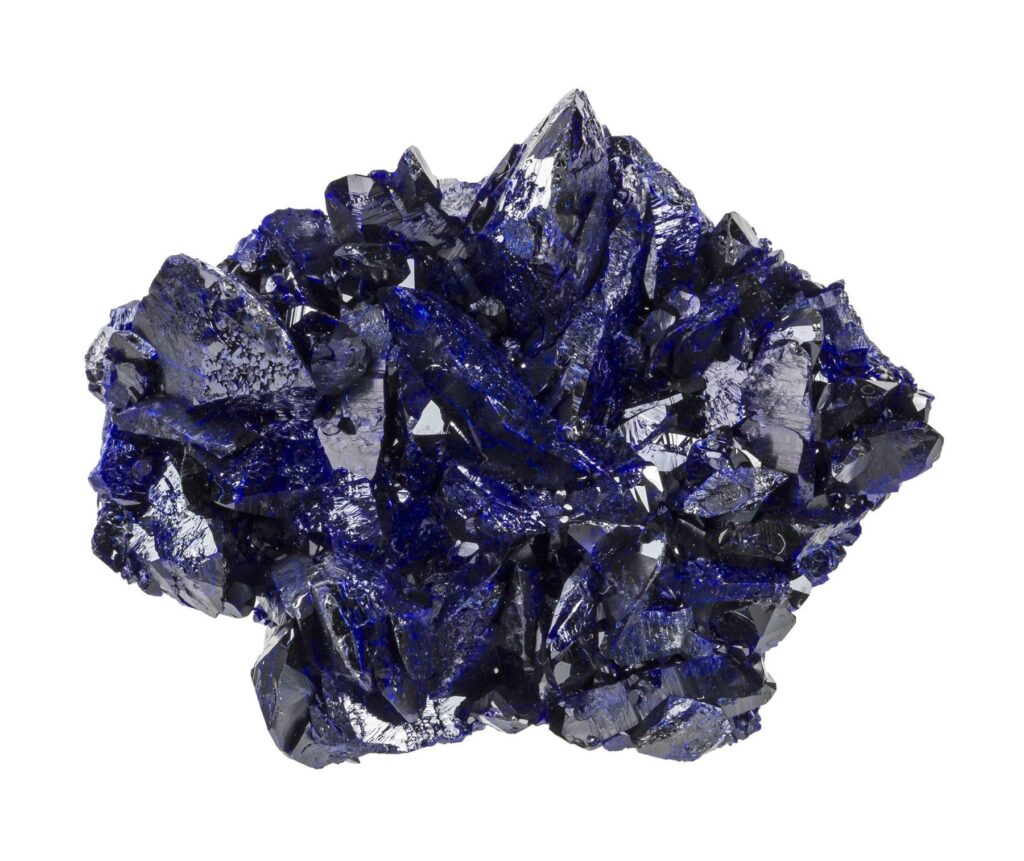
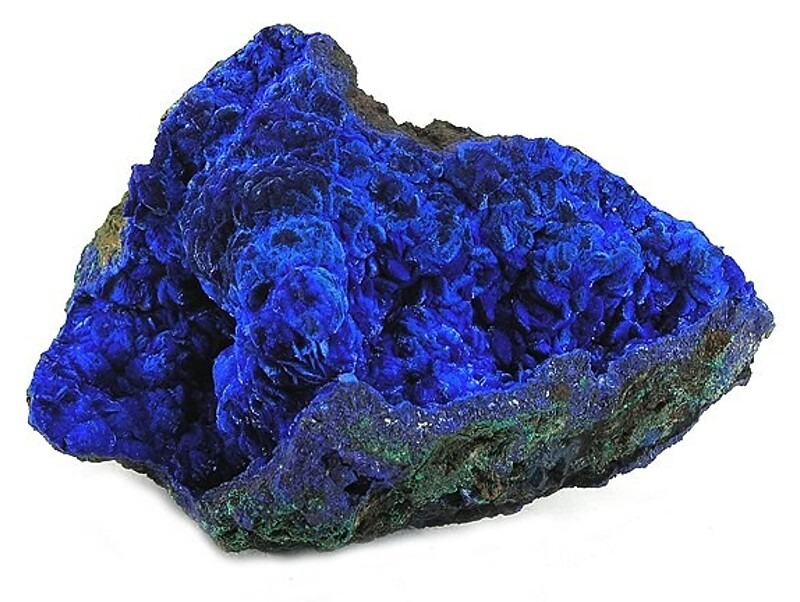
Azurite is a soft, deep-blue copper mineral produced by the weathering of copper ore deposits. It is a basic copper(II) carbonate with the chemical formula Cu₃(CO₃)₂(OH)₂. Renowned for its striking and intense azure-blue coloration, the mineral possesses a Mohs hardness ranging from 3.5 to 4.0 and a specific gravity between 3.77 and 3.89. Azurite crystallizes in the monoclinic system, frequently forming complex, prismatic, or tabular crystals. It is also commonly found in massive, nodular, botryoidal (grape-like), or stalactitic habits. When struck or scraped across an unglazed porcelain plate, azurite leaves a distinct light blue streak.
Formation and Occurrence
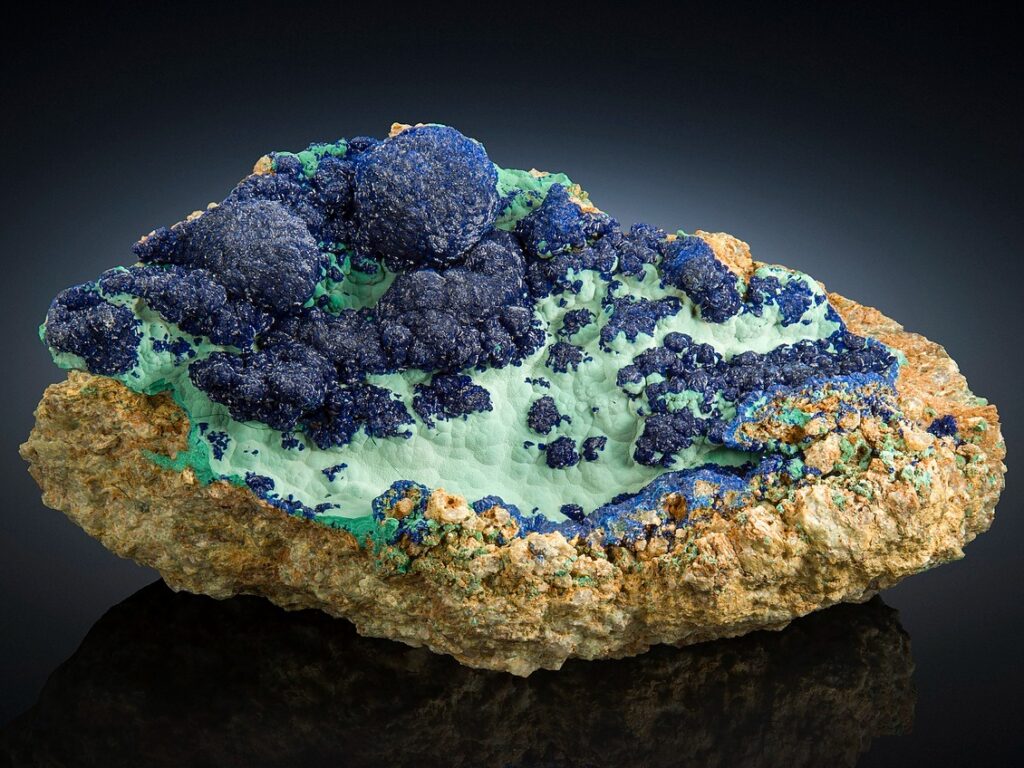
Azurite is classified as a secondary mineral that develops through the chemical alteration of pre-existing copper minerals rather than primary crystallization from cooling magma or high-temperature hydrothermal vents. Typically found in the upper oxidized zones of copper ore deposits, its formation process occurs when meteoric water, such as rainwater or groundwater containing dissolved carbon dioxide, percolates downward through the earth. When this carbonated water reacts with primary copper sulfide minerals like chalcopyrite or bornite under specific, low-temperature conditions, azurite precipitates. The mineral is intrinsically linked to malachite, another basic copper carbonate with the formula Cu₂CO₃(OH)₂. Because azurite is thermodynamically less stable than malachite in open-air environments, it often undergoes a chemical transition into malachite over geological time spans or when exposed to moisture and air. This alteration process, known as pseudomorphosis, involves the loss of some carbon dioxide and the addition of water, frequently resulting in mineral specimens that retain the precise physical crystal shape of azurite but have been entirely replaced by the green structure of malachite. Due to this chemical instability, azurite is generally less abundant in nature than malachite, though the two are routinely found coexisting in the same deposits.
Historical Significance and Use
The history of azurite is largely defined by its vivid optical properties, which made it an essential pigment in art and industry for millennia, with its name deriving from the Old French azur and tracing back to the Persian word lazhward, meaning “blue.” In antiquity, azurite was extensively mined in the Sinai Peninsula and the Eastern Desert of Egypt, where the ancient Egyptians ground it into a fine powder for cosmetics, particularly eye makeup, and for pigments in wall paintings and tomb decorations. Later documented by Pliny the Elder under the Greek name kuanos and the Latin caeruleum, azurite became the most prevalent blue pigment used in European art during the Middle Ages and the Renaissance. Because lapis lazuli was exceedingly expensive and required importation from Afghanistan, azurite served as the primary, more accessible alternative for illuminated manuscripts, tempera panel paintings, and frescoes, often referred to in historical texts as “mountain blue,” “blue bice,” or Azzurro della Magna. Exceptional specimens discovered in the 19th-century copper mines of Chessy, France, also led to the temporary name “chessylite” in English mineralogical literature. A notable artifact of azurite’s historical use in art is its chemical instability; because the pigment slowly weathers and hydrates into green malachite when exposed to moisture, many skies and blue garments in surviving Renaissance frescoes now exhibit a dark, greenish hue rather than the brilliant blue intended by the artist. The widespread use of natural azurite pigment declined rapidly in the 18th and 19th centuries following the invention of stable synthetic alternatives like Prussian blue and synthetic ultramarine, leaving azurite to be valued today primarily as a collector’s specimen and minor gemstone.
Crystal Structure and Habits
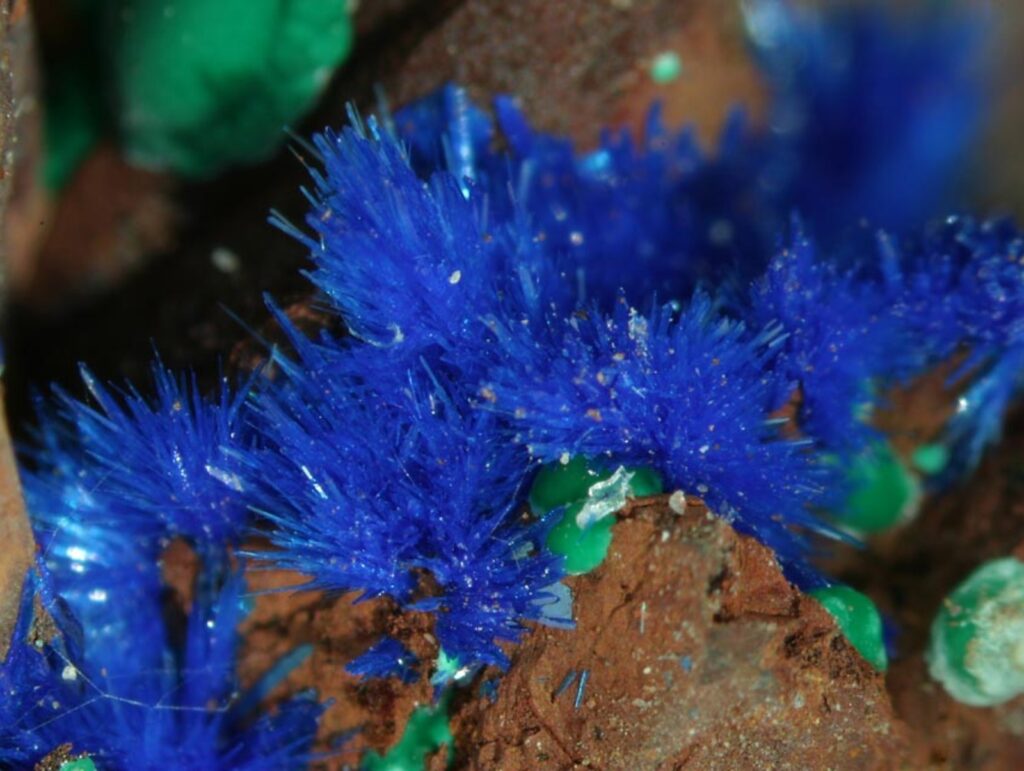
Azurite crystallizes in the monoclinic crystal system, specifically belonging to the space group P2₁/c. Its internal atomic architecture is characterized by copper (Cu²⁺) cations coordinated by both carbonate (CO₃²⁻) anions and hydroxyl (OH⁻) groups in a distorted square-planar configuration. These coordination polyhedra link together to form complex chains and layered networks throughout the lattice structure. On a macroscopic scale, this internal symmetry occasionally manifests as highly lustrous, well-developed prismatic or tabular crystals with sharp, distinct faces. More frequently, however, azurite occurs as finely crystalline aggregates, forming massive, stalactitic, or botryoidal (grape-like) habits, as well as radiating fibrous structures and earthy crusts that coat adjacent geological matrices.
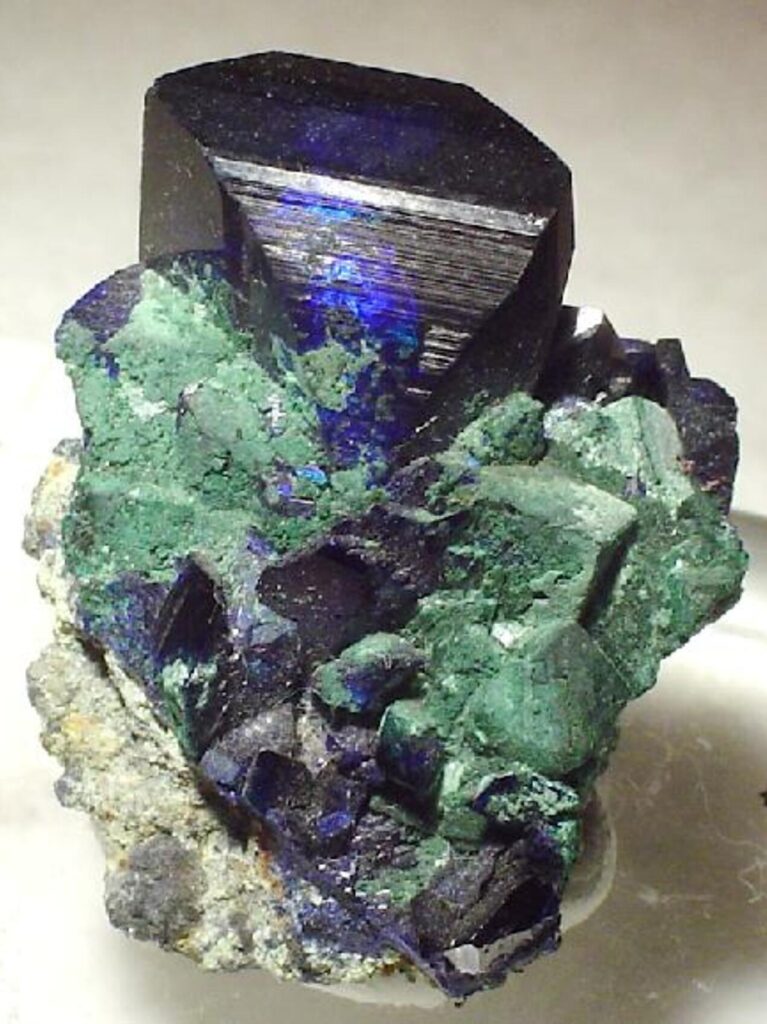
The most famous feature of azurite is its stunning, deep azure-blue color. This intense blue color comes directly from the copper (Cu²⁺) inside the mineral’s chemical structure, Cu₃(CO₃)₂(OH)₂. When light hits azurite, the copper atoms absorb the red and yellow parts of the light spectrum, while reflecting a powerful, vibrant blue back to our eyes. Because this color is a built-in part of the mineral’s chemical makeup (and not caused by random impurities), azurite is almost always the exact same rich blue, making it very easy to identify.When it comes to how it handles light, azurite has a very high refractive index, meaning it bends light sharply. This gives high-quality azurite crystals a beautiful, glass-like (vitreous) or even diamond-like shine on their surfaces. However, when azurite forms in rough, earthy crusts or dense clumps, it can look dull or velvety instead. Another fascinating optical trick of azurite is called pleochroism. If you hold a clear azurite crystal up to the light and rotate it, the color will visibly shift between dark Prussian blue, bright sky blue, and even a pale greenish-blue depending on the angle you are looking through.
Physical and Chemical Properties
Physically, azurite is distinguished by its intense, deep azure-blue coloration and a vitreous to dull luster. It is a relatively soft and fragile mineral, possessing a Mohs hardness of 3.5 to 4.0, and it breaks with an uneven to conchoidal fracture. Despite its low hardness, it exhibits a relatively high specific gravity between 3.77 and 3.89, an attribute directly resulting from the dense packing of heavy copper atoms within its crystal lattice. The mineral displays fair to perfect cleavage along the {012} and {100} planes and leaves a characteristic light blue streak when rubbed across an unglazed porcelain plate. Chemically, azurite is a basic copper carbonate with the stoichiometric formula Cu₃(CO₃)₂(OH)₂, containing approximately 55.3% elemental copper by weight. It is chemically unstable in moist, open-air environments, where it slowly hydrates and alters into the more stable green copper carbonate, malachite. One of its most diagnostic chemical test behaviors is its rapid and vigorous effervescence when exposed to dilute hydrochloric acid (HCl), a reaction that dissolves the mineral while releasing carbon dioxide (CO₂) gas.
Notable Localities and Deposits
Azurite is found globally, with historically significant and economically important deposits distributed across several continents. One of the most famous historical type localities is Chessy-les-Mines near Lyon, France, which produced exceptional, highly lustrous crystals in the 19th century and gave rise to the alternative mineral name “chessylite.” In North America, the southwestern United States—particularly Arizona—is renowned for yielding world-class specimens; notable locations include the Bisbee district (Cochise County), the Morenci mine, and the New Cornelia mine in Ajo, where azurite frequently occurs in spectacular combinations with malachite and chrysocolla.
Another premier global source is Tsumeb, Namibia, celebrated by mineral collectors for producing exceptionally large, sharp, and deep blue prismatic crystals from its deeply oxidized polymetallic orebody. In North Africa, the Touissit and Bou Bekker regions in Morocco are highly prolific, routinely supplying the global market with robust, high-quality crystal aggregates and nodules. Additionally, major deposits and fine crystalline specimens are documented in the massive copper mining districts of the Ural Mountains in Russia, the Shaba province in the Democratic Republic of the Congo, the Anhui and Guangdong provinces in China, and various copper-rich zones throughout Australia, such as the Broken Hill area in New South Wales.
Applications and Industrial Uses
Historically and chemically, azurite’s primary utility has been predicated on its high copper content and its intense optical properties. As a minor ore of copper, it contains approximately 55.3% elemental copper by weight; while rarely mined as a primary source due to its localized occurrence in upper oxidized zones, it serves as a valuable surface indicator or “guide” for miners seeking deeper, more massive primary copper sulfide deposits.
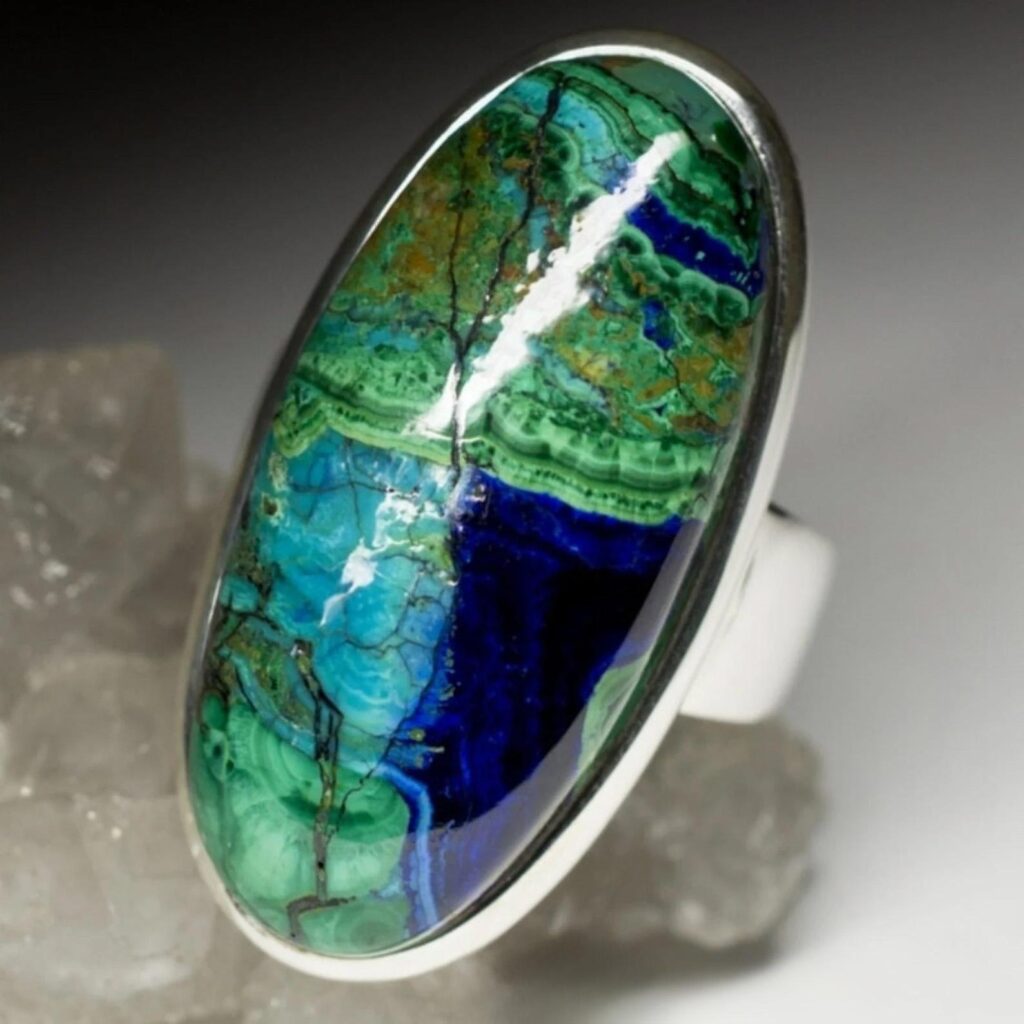
Beyond metallurgical extraction, azurite’s most prominent historical application was as a mineral pigment. From antiquity through the Renaissance, the mineral was mechanically processed—involving crushing, grinding, levigation, and washing—to produce a vibrant blue pigment known in various periods as Azzurro della Magna, mountain blue, or blue bice. Because the optical properties of the pigment depend significantly on particle size, coarse grinding yielded a deep, dark blue, whereas fine grinding produced a lighter hue, though excessive grinding could ruin the color entirely by introducing a greyish tint. Despite its widespread use in tempera, illuminated manuscripts, and frescoes, its long-term stability is compromised; in the presence of atmospheric moisture and binders, it undergoes a slow thermodynamic transition into the green copper carbonate malachite (Cu₂CO₃(OH)₂), a phenomenon visible in the altered green skies of many Renaissance paintings. In contemporary applications, natural azurite pigment is highly restricted, used almost exclusively in specialized art restoration. The mineral is also utilized in lapidary arts, where it is cut into cabochons or polished as ornamental stones, frequently alongside malachite to form a composite gemstone colloquially termed “azurmalachite.”
Metaphysical and Esoteric Significance
Within modern mineral lore, lithotherapy, and contemporary esoteric frameworks, azurite is conceptualized as a stone of cognitive enhancement, psychological insight, and spiritual alignment. Unlike its metallurgical applications, its metaphysical significance is interpreted through symbolic and phenomenological lenses, heavily influenced by its intense azure coloration—a hue traditionally associated with the higher cognitive and perceptive faculties in various esoteric traditions.In contemporary New Age belief systems and crystal healing practices, azurite is primarily aligned with the activation and balancing of the upper energy centers, specifically the Ajna (third-eye) and Vishuddha (throat) chakras. Practitioners attribute to the mineral the capacity to stimulate the central nervous system in a subtle manner, supposedly clearing mental fog, dissolving subconscious blocks, and enhancing intellectual clarity or linguistic expression. It is frequently employed in meditative practices where it is believed to facilitate altered states of consciousness, enhance intuitive or psychic perception, and foster deep self-reflection by bringing repressed emotional patterns into conscious awareness. Furthermore, within the framework of historical astrology and alchemy, due to its copper base, azurite is intrinsically linked to the planet Venus, symbolizing transformation, the refinement of raw matter into higher aesthetic or spiritual forms, and the synthesis of intellect with intuition. While these metaphysical attributes lack empirical validation within empirical material science, they remain a culturally and economically significant driver of the mineral’s demand in the global collector and lapidary markets.