
Apophyllite is a name used for a group of hydrous potassium- and calcium-bearing phyllosilicate minerals known for their vitreous luster, well-developed crystal faces, and commonly colorless, white, or pale green appearance. Apophyllite specimens frequently occur as transparent to translucent crystals lining cavities in basalt and other volcanic rocks, where they are often associated with minerals such as stilbite, heulandite, chabazite, and other zeolites. The crystals commonly develop square or rectangular prismatic forms with flat or pyramidal terminations, although their precise morphology depends on the mineral species and conditions under which they formed.
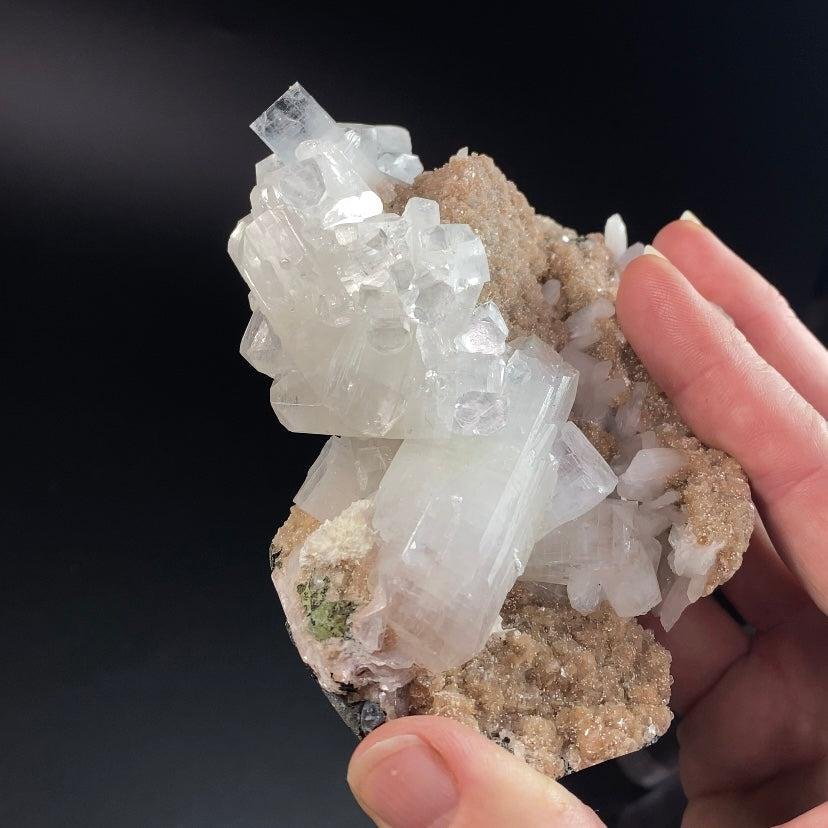
The name Apophyllite historically referred to a mineral species that was later divided into several distinct species based on chemical composition and crystal structure. In modern mineralogical classification, the principal members of the group include fluorapophyllite-(K), hydroxyapophyllite-(K), and fluorapophyllite-(Na). These minerals share related structural characteristics but differ in the chemical elements occupying specific positions within their crystal lattices. Apophyllite is not classified as a zeolite, despite its frequent occurrence alongside zeolite minerals in volcanic cavities. Its layered silicate structure and distinctive chemical composition distinguish it from the zeolite group.
Apophyllite is collected as a mineral specimen and is occasionally used as a decorative stone. Transparent crystals may display strong vitreous luster and well-defined internal reflections, while green varieties owe their coloration to trace chemical components or other factors affecting the crystal. Because the crystals can be relatively soft and possess perfect cleavage, apophyllite is less commonly used in conventional jewelry than harder gemstones. Its mineralogical importance lies primarily in its crystal structure, chemical variations, and occurrence in secondary mineral assemblages within volcanic rocks.
History and Naming of Apophyllite
The mineral now known as apophyllite has been recognized in mineralogical literature since the late eighteenth century. Early descriptions focused on its distinctive crystal forms, vitreous luster, and tendency to occur in cavities within volcanic rocks. As mineral classification developed, researchers began examining its chemical composition and physical properties more systematically, allowing apophyllite to be distinguished from minerals with similar appearances. Its well-formed crystals and frequent association with zeolites made it a recognizable component of many basalt-hosted mineral assemblages.
The name apophyllite was introduced by René Just Haüy in 1806. It derives from the Greek words apo, meaning “away from,” and phyllon, meaning “leaf.” The name refers to the mineral’s tendency to exfoliate or split into thin, leaf-like layers when heated, a behavior associated with the release of water from its structure and its characteristic cleavage. This naming reflects an observable physical property rather than its color or geological origin.
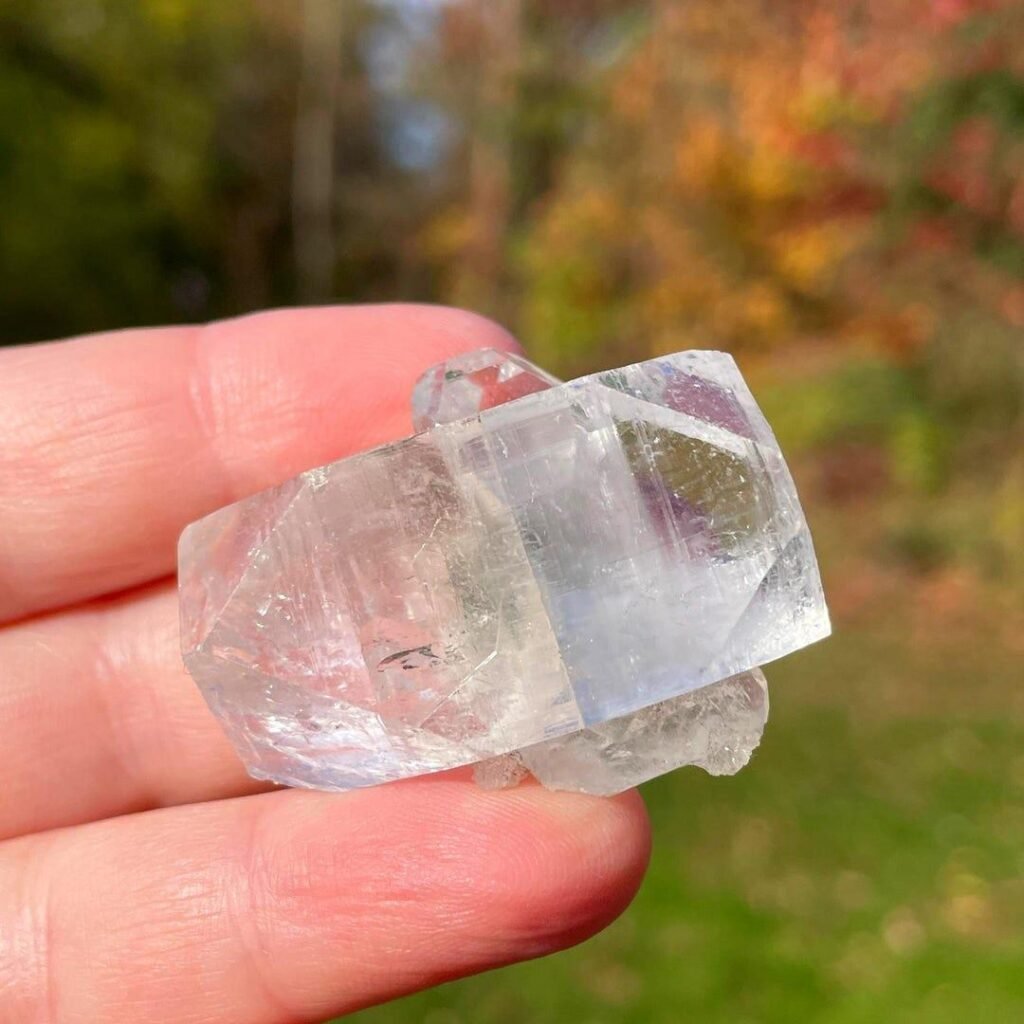
For much of its history, apophyllite was treated as a single mineral species, despite variations in composition among specimens. Subsequent chemical and crystallographic investigations established that materials historically grouped under this name represent several closely related species. Differences in the dominant anions and cations within their structures, particularly the presence of fluorine or hydroxyl and the relative proportions of potassium and sodium, provided a basis for more precise classification. The species names fluorapophyllite-(K), hydroxyapophyllite-(K), and fluorapophyllite-(Na) reflect these compositional distinctions.
The development of modern mineral classification has therefore changed the way apophyllite is described in scientific and collecting contexts. The term continues to be widely used for the mineral group and for specimens identified under the historical name, especially in mineral collecting and commercial specimen descriptions. In formal mineralogical writing, however, identifying the specific apophyllite species is preferable when sufficient chemical or crystallographic information is available.
Formation and Geological Occurrence of Apophyllite
Apophyllite most commonly forms as a secondary mineral in cavities, fractures, and vesicles within basalt and other volcanic rocks. These openings are often created when gas bubbles become trapped in cooling lava, leaving hollow spaces after the rock solidifies. Later, mineral-bearing fluids circulate through the openings and deposit crystals along their walls. As the fluids cool or undergo changes in temperature, pressure, pH, and chemical composition, dissolved elements may combine to form apophyllite and associated minerals.
The formation process depends on the availability of potassium, calcium, silicon, fluorine, and water, with the precise chemical requirements varying among apophyllite species. Hydrothermal fluids moving through volcanic rocks can dissolve and transport these components before depositing them under suitable conditions. Apophyllite may crystallize alongside zeolite-group minerals, calcite, quartz, and other secondary silicates or carbonates. These associated minerals provide useful information about the chemical environment and sequence of mineral deposition within a cavity.
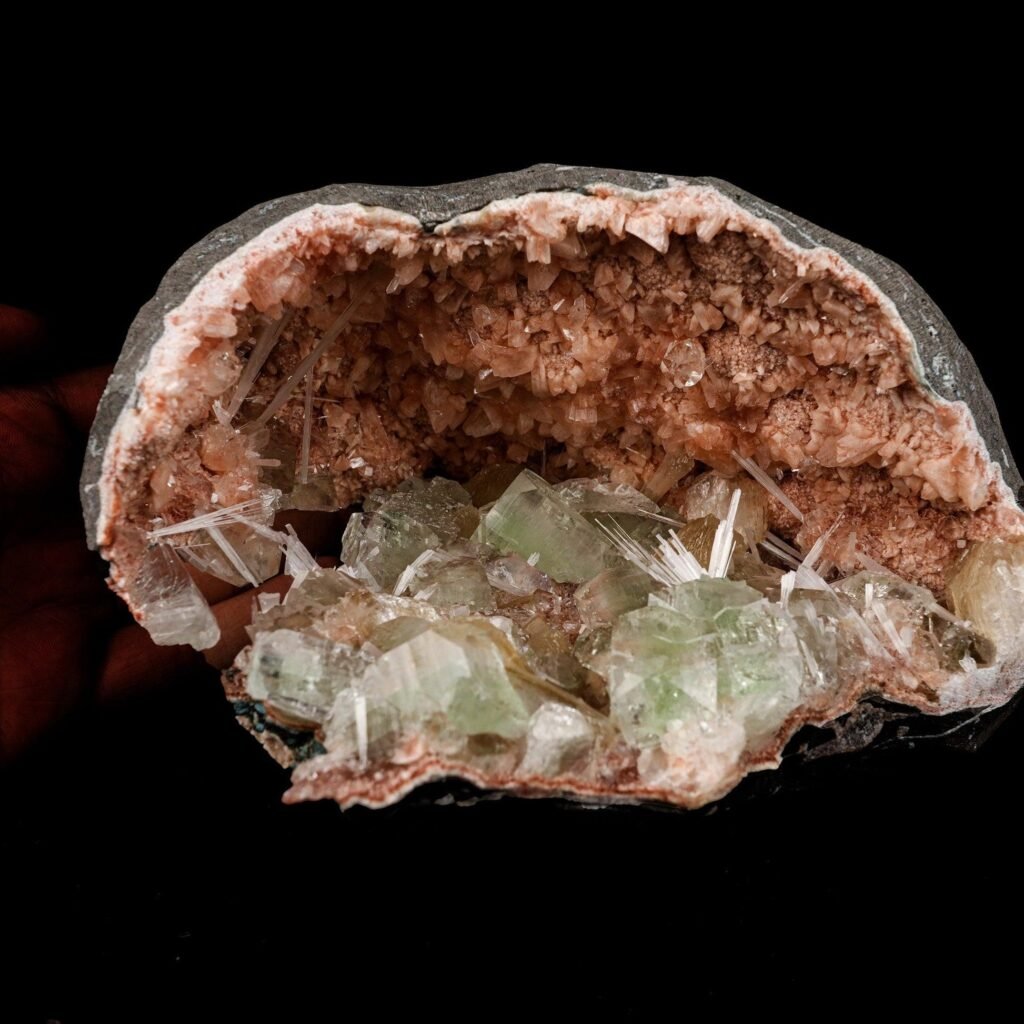
Crystal growth may occur in several stages. Initial mineral coatings can form on cavity walls, followed by the development of individual crystals as the supply of dissolved components continues. In some specimens, apophyllite crystals grow directly on basalt, while in others they develop over earlier generations of zeolites or other secondary minerals. Differences in fluid chemistry and available space influence crystal size, transparency, color, and morphology. Large, well-formed crystals are more likely to develop where cavities provide sufficient room for growth and fluid circulation remains favorable over an extended period.
Although basalt-hosted cavities are the best-known occurrence, apophyllite is not restricted to a single volcanic environment. It has also been reported in hydrothermal veins, fractures, and other mineral-bearing cavities where the necessary chemical conditions exist. Its association with low-temperature hydrothermal alteration is particularly characteristic, although the exact formation conditions vary by locality and species. In these environments, apophyllite commonly occurs as part of a complex secondary mineral assemblage rather than as an isolated mineral.
India is especially well known for producing collectible apophyllite specimens, particularly from the Deccan Traps, an extensive province of flood basalts in western and central India. Numerous basalt cavities in this region contain apophyllite crystals associated with stilbite, heulandite, and other zeolites. These deposits have produced specimens ranging from small clusters of colorless crystals to large, sharply terminated crystals with pale green coloration. Similar occurrences in other volcanic regions demonstrate that apophyllite formation is closely linked to fluid circulation and secondary mineral deposition in suitable host rocks.
Crystal Structure of Apophyllite
Apophyllite belongs to a group of phyllosilicate minerals characterized by layered silicate structures containing water molecules and additional chemical components. Although the individual species share closely related structural features, differences in chemical composition and the arrangement of atoms distinguish them within the group. Their structures contain silicate units linked into sheets, with potassium, calcium, sodium, fluorine, hydroxyl groups, and water occupying specific positions depending on the species. This combination of layered silicate components and hydrated structural elements contributes to apophyllite’s cleavage, thermal behavior, and other physical properties.
The silicate framework is built from silicon-oxygen tetrahedra arranged in interconnected layers. These tetrahedra contain a central silicon atom surrounded by four oxygen atoms, and their linkage creates the characteristic sheet-like arrangement associated with phyllosilicates. The layers are held together through interactions involving other structural components, including calcium and potassium ions, as well as fluorine or hydroxyl groups and water molecules. Variations in the occupancy of these positions account for differences in chemical formula and help define the individual apophyllite species.
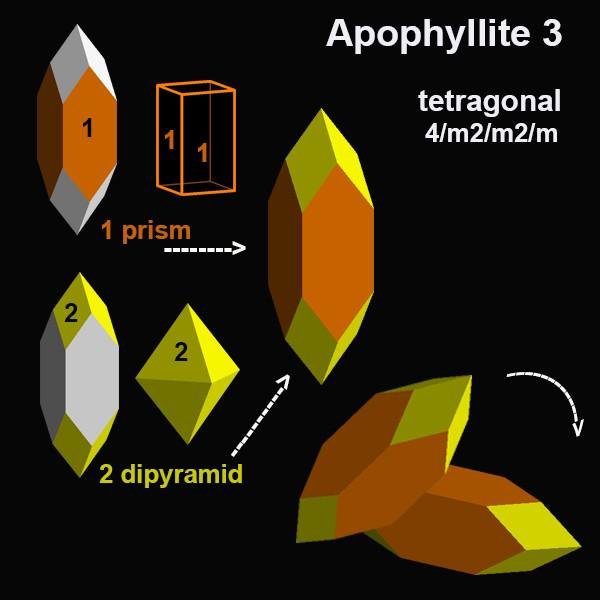
Apophyllite commonly crystallizes in the tetragonal crystal system, although the structural details depend on the particular species. Tetragonal symmetry is characterized by three crystallographic axes, with two horizontal axes of equal length intersecting at right angles and a third vertical axis of a different length. This symmetry is reflected in the square cross-sections and prismatic crystal forms frequently observed in apophyllite specimens. Crystals may develop flat basal faces, well-defined prism faces, and pyramidal terminations, producing forms that are often easily recognized in mineral collections.
The relationship between crystal structure and physical properties is particularly evident in apophyllite’s cleavage. The mineral typically exhibits perfect cleavage parallel to a prominent crystallographic plane, allowing it to split relatively easily along smooth surfaces. This structural weakness also contributes to its brittleness and limits its suitability for applications involving repeated impact or mechanical stress. The arrangement of water within the structure influences its behavior during heating, when dehydration can occur and may be accompanied by changes in appearance or the development of thin, flaky fragments.
Differences in crystal structure and chemical composition are important for distinguishing apophyllite species from one another. Fluorapophyllite-(K), hydroxyapophyllite-(K), and fluorapophyllite-(Na) share broad structural similarities but differ in the elements or anions occupying specific crystallographic sites. These differences may not be reliably identified through visual inspection alone. Chemical analysis, X-ray diffraction, and other mineralogical techniques can provide the information needed for accurate identification, particularly when specimens have similar colors and crystal habits.
Physical and Chemical Properties of Apophyllite
Apophyllite is generally colorless or white, although pale green, yellowish, pinkish, and other less common colors have been reported. Transparent and translucent specimens are both common, with transparency depending on crystal thickness, inclusions, fractures, and the presence of impurities. Colorless crystals may appear nearly water-clear, while green specimens can range from very pale shades to more noticeable green tones. Color alone is not sufficient to identify a particular apophyllite species because similar appearances can occur in specimens with different chemical compositions.
The mineral typically has a vitreous luster on its crystal faces and cleavage surfaces. Its streak is white, meaning that it generally produces a white powder when rubbed across an appropriate unglazed porcelain surface. Apophyllite has a Mohs hardness of approximately 4.5 to 5, making it softer than many common gemstone minerals, including quartz and beryl. This relatively low hardness means that crystal surfaces can be scratched by harder materials, while sharp edges and delicate terminations may be damaged during handling or cleaning.
Apophyllite has a specific gravity generally around 2.3 to 2.4, although reported values can vary with species and composition. Its crystals are commonly prismatic, tabular, or approximately equant, and many specimens exhibit square or rectangular outlines when viewed perpendicular to the principal crystal axis. Well-developed terminations and smooth crystal faces are characteristic features. Massive and granular aggregates occur less frequently than the sharply formed crystals that are most familiar to collectors.
Cleavage is one of the mineral’s most diagnostic physical characteristics. Apophyllite commonly displays perfect cleavage in one direction, allowing it to separate along relatively flat planes. Its fracture may be uneven or irregular where cleavage does not control the break, and the mineral is generally brittle. These properties are important when handling specimens because apparently solid crystals can split along internal planes if subjected to pressure, sudden impact, or careless mounting.
Chemically, apophyllite is a hydrous silicate group rather than a single compositionally uniform mineral. Its constituent elements include silicon, oxygen, hydrogen, and varying proportions of potassium, calcium, sodium, and fluorine. The specific chemical formula depends on the species. For example, fluorapophyllite-(K) is commonly represented by the formula KCa₄Si₈O₂₀F·8H₂O, whereas hydroxyapophyllite-(K) contains hydroxyl in place of fluorine. These compositional differences are central to the group’s modern classification.
The presence of structural water is another important chemical characteristic. Apophyllite may lose water when heated, and this dehydration can affect its physical integrity and appearance. The mineral’s behavior under heating historically contributed to its name, which refers to a tendency to separate into leaf-like fragments. Because its hardness is moderate and its cleavage is pronounced, apophyllite is generally more suitable for mineralogical study and specimen display than for jewelry exposed to frequent wear. Identification is most reliable when physical observations are considered alongside chemical composition and crystallographic data.
Types and Varieties of Apophyllite
Apophyllite was historically treated as a single mineral species, but modern mineralogical classification recognizes several distinct species within the group. These species share similar crystal habits and physical properties while differing in chemical composition, particularly in the elements and anions occupying specific structural positions. The principal species are fluorapophyllite-(K), hydroxyapophyllite-(K), and fluorapophyllite-(Na). Their identification generally requires chemical or crystallographic analysis, as their external appearance can overlap considerably.
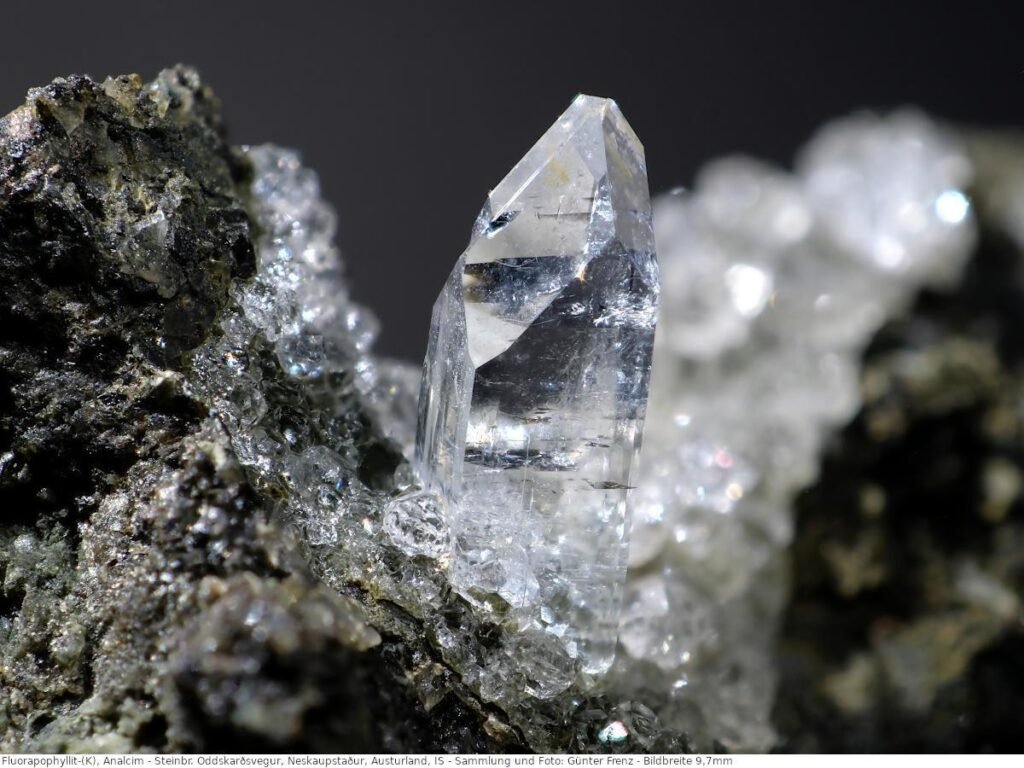
– Fluorapophyllite-(K): Fluorapophyllite-(K) is a potassium- and calcium-bearing hydrous silicate in which fluorine occupies a characteristic structural position. Its commonly cited chemical formula is KCa₄Si₈O₂₀F·8H₂O. It typically forms colorless, white, or pale green crystals with vitreous luster and well-developed prismatic or tabular forms. This species is particularly familiar in mineral collections because of its frequent occurrence in basalt cavities, especially in the Deccan Traps of India. Crystals may occur individually or in clusters, sometimes associated with stilbite and other zeolite minerals.
– Hydroxyapophyllite-(K): Hydroxyapophyllite-(K) is a potassium-bearing member of the group in which hydroxyl occupies the structural position occupied by fluorine in fluorapophyllite-(K). Its idealized formula is KCa₄Si₈O₂₀(OH)·8H₂O. It shares many physical characteristics with other apophyllite species, including a vitreous luster, relatively low hardness, and pronounced cleavage. Because its color and crystal habit may resemble those of fluorapophyllite-(K), chemical analysis is often necessary to distinguish the two reliably.
– Fluorapophyllite-(Na): Fluorapophyllite-(Na) is the sodium-dominant member of the group, distinguished by sodium occupying the relevant structural site rather than potassium. Its composition and crystal structure are closely related to those of other apophyllite species, but the differences in cation occupancy provide the basis for its classification. It is less commonly encountered in ordinary mineral-collecting descriptions than fluorapophyllite-(K). As with the other members, external appearance alone is not sufficient to establish its identity.
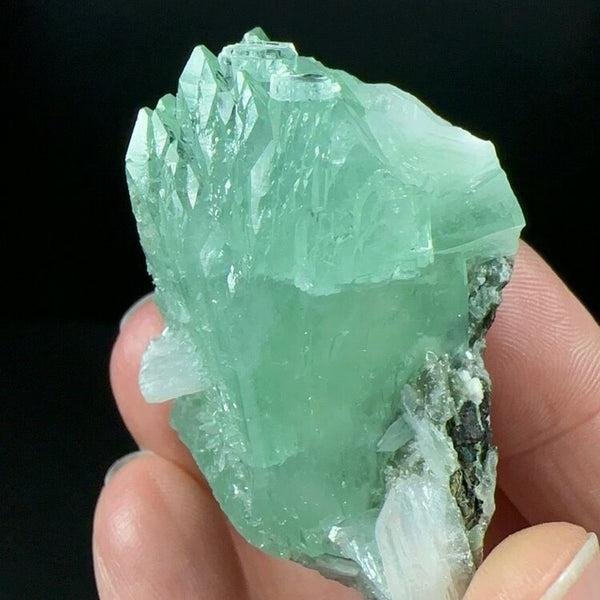
In commercial mineral collecting, specimens are also frequently described using color-based terms such as green apophyllite, white apophyllite, or clear apophyllite. These descriptions refer to visible characteristics rather than formally recognized mineral species or varieties. Green apophyllite is particularly popular among collectors, while transparent colorless crystals are valued for their clarity and well-defined crystal faces. Such labels can be useful for describing specimens, but they should not be confused with the chemical classification used in mineralogical research.
Major Apophyllite Localities
India is one of the most important sources of apophyllite specimens, particularly the basaltic regions of Maharashtra and neighboring parts of the Deccan Traps. These extensive volcanic formations contain numerous cavities in which secondary minerals crystallized from circulating fluids after the original lava solidified. Apophyllite commonly occurs alongside stilbite, heulandite, scolecite, mesolite, and calcite. The region has produced a wide range of specimens, including colorless crystals, pale green crystals, radiating mineral aggregates, and large clusters attached to dark basalt matrices.
The Pune region, historically known in mineral literature and collecting circles as Poona, is particularly associated with collectible apophyllite. Cavities in local basalt have yielded sharply formed crystals with square or rectangular outlines, flat terminations, and highly reflective surfaces. Specimens from this region often display strong visual contrast between pale crystals and their darker host rock. Other localities in Maharashtra have also produced apophyllite in association with zeolite minerals, making western India a major source for both scientific specimens and decorative mineral collections.
Outside India, apophyllite has been reported from a variety of volcanic and hydrothermal environments. Occurrences in Iceland and other regions with basaltic rocks illustrate the relationship between the mineral and secondary crystallization in volcanic cavities. Apophyllite may also occur in mineralized fractures and cavities in other geological settings where fluids supply the required chemical components. The size, color, and quality of crystals vary according to local geological conditions, including cavity dimensions, fluid composition, and the duration of crystal growth.
Apophyllite occurrences are also documented in several other countries, including Germany, Canada, Japan, and the United States. In these regions, the mineral may be found in hydrothermal veins, altered volcanic rocks, or other mineral-bearing environments. The geological setting and associated minerals differ between deposits, and not every occurrence produces specimens suitable for display or detailed crystallographic study.
The identification of a locality can provide useful geological context, but geographic origin alone does not establish the species or quality of a specimen. Closely related apophyllite species can share similar appearances, and specimens from the same deposit may differ in composition and crystal characteristics. Accurate mineral identification therefore relies on the combined evidence of locality records, physical properties, chemical composition, and, where necessary, crystallographic analysis.
Uses and Applications of Apophyllite
Apophyllite is used primarily as a mineral specimen for collecting, education, and geological research. Its well-developed crystal faces, vitreous luster, and frequent occurrence in attractive clusters make it a recognizable mineral in private collections, museum displays, and mineral exhibitions. Transparent crystals may display sharp geometric outlines and distinct internal reflections, while pale green specimens provide variation in color. Many specimens are preserved on their original basalt matrix, allowing collectors and researchers to examine the relationship between apophyllite and the minerals that formed alongside it.
In mineralogical education, apophyllite is useful for demonstrating the characteristics of hydrous phyllosilicates, including crystal morphology, cleavage, and the relationship between chemical composition and mineral classification. Specimens can be compared with associated zeolite-group minerals such as stilbite and heulandite to illustrate the differences between minerals that frequently occur in the same geological environment. Apophyllite also provides examples of how historical mineral names may be revised as chemical and crystallographic research improves the classification of closely related materials.
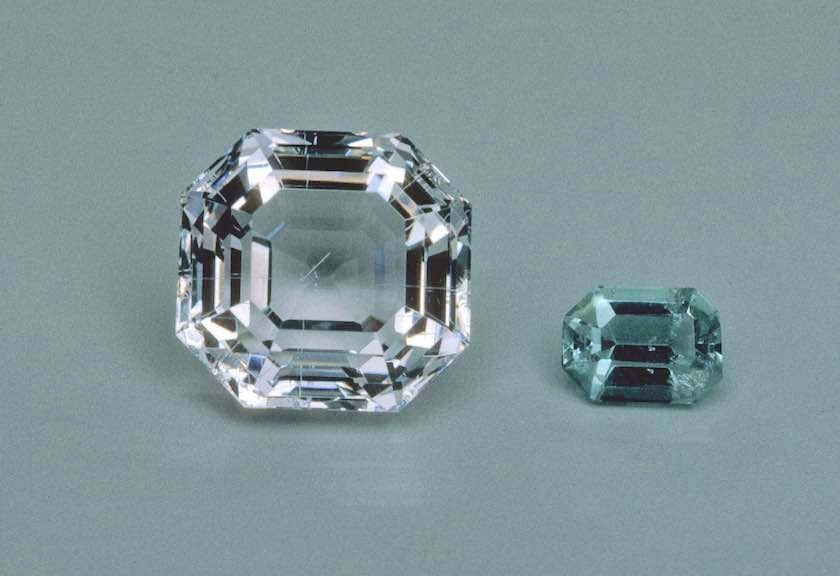
Apophyllite has a limited role in jewelry and ornamental stone applications. Although transparent crystals may appear suitable for faceted gemstones, their moderate hardness, brittleness, and perfect cleavage make them vulnerable to scratching, chipping, and splitting during cutting or everyday wear. These characteristics restrict their use in rings and other jewelry exposed to repeated impact. Selected crystals may occasionally be faceted or incorporated into pendants and other low-impact jewelry, but such applications are less common than specimen collecting. The mineral is also sometimes used in decorative arrangements, display pieces, and mineral-themed interior decorations.
In geological research, apophyllite can help document the conditions under which secondary minerals form in volcanic cavities and hydrothermal environments. Its occurrence alongside zeolites, calcite, and other silicates provides evidence of fluid circulation and mineral deposition after the formation of the host rock. Chemical and crystallographic studies of apophyllite species can also contribute to understanding how variations in elemental composition relate to structural differences and mineral stability.
Apophyllite is sometimes marketed in the crystal trade for spiritual or metaphysical purposes, with claims that it promotes clarity, relaxation, or other personal benefits. These claims are not established by scientific evidence and should be distinguished from the mineral’s documented physical and chemical properties. From a mineralogical perspective, its principal value remains its distinctive crystal structure, geological occurrence, and suitability for collection and study.
How to Identify Apophyllite
Apophyllite can often be recognized by a combination of crystal habit, luster, color, cleavage, and geological association. Typical specimens contain colorless, white, or pale green crystals with a vitreous surface and well-defined faces. Many crystals are prismatic or tabular, with square or rectangular cross-sections and flat or pyramidal terminations. Specimens frequently occur as clusters attached to basalt or as crystals lining cavities in volcanic rocks. However, these characteristics are not unique to apophyllite, so identification should consider several properties rather than relying on appearance alone.
One of the most useful distinguishing features is its crystal morphology. Apophyllite commonly develops crystals with a square outline when viewed along the principal crystallographic axis, reflecting its tetragonal symmetry. The crystal faces may appear smooth and reflective, and individual crystals can be transparent enough to reveal internal fractures or inclusions. In contrast, many associated zeolite minerals, including stilbite and heulandite, often develop bladed, sheaf-like, or tabular aggregates. These differences can help narrow down an identification, although overlapping habits and complex mineral associations can make visual assessment uncertain.
Cleavage provides another useful diagnostic characteristic. Apophyllite has perfect cleavage in one direction, allowing it to split along relatively smooth surfaces. The mineral is also brittle and has a Mohs hardness of approximately 4.5 to 5. A hardness test may help distinguish it from harder minerals such as quartz, but testing should be performed cautiously because scratching a valuable specimen can damage its surface. Cleavage and hardness should therefore be assessed alongside crystal form, luster, and occurrence rather than used as independent confirmation.
The geological setting can provide additional evidence. Apophyllite is especially common in cavities within basaltic rocks, where it may occur with stilbite, heulandite, scolecite, calcite, and other secondary minerals. A specimen consisting of transparent or pale green tetragonal crystals attached to a dark volcanic matrix is consistent with a common apophyllite occurrence. Nevertheless, the presence of associated zeolites does not prove that a specimen is apophyllite, since several other minerals can form in the same cavities.
Distinguishing individual apophyllite species requires more detailed analysis. Fluorapophyllite-(K), hydroxyapophyllite-(K), and fluorapophyllite-(Na) may look very similar, and color, transparency, and crystal habit generally cannot establish which species is present. Laboratory techniques such as X-ray diffraction can characterize the crystal structure, while chemical analysis can determine the elemental composition needed for classification. For scientific records, museum collections, or specimens sold under a specific species name, these methods provide a more reliable basis for identification than visual inspection alone.
When examining a specimen, it is also important to distinguish natural crystal features from damage or alteration. Cleavage surfaces may appear unusually flat, while fractures can interrupt otherwise well-developed crystal faces. Surface coatings and inclusions may affect color or transparency, and a mineral matrix can conceal part of the crystal form. Recording the specimen’s locality, associated minerals, crystal habit, and observable physical properties provides a useful starting point before more specialized testing is considered.