
Anorthoclase is a sodium-dominant member of the alkali feldspar solid-solution series, classified as a framework silicate (tectosilicate) with the generalized formula (Na,K)AlSi₃O₈. It occupies an intermediate compositional range between albite (NaAlSi₃O₈) and orthoclase (KAlSi₃O₈), typically comprising approximately 60–90 mol% albite component and 10–40 mol% orthoclase component. Crystallographically, anorthoclase belongs to the triclinic system; however, owing to its formation at elevated temperatures, it commonly exhibits pseudo-monoclinic symmetry in hand specimens and optical analysis. The mineral is distinguished by its vitreous luster, two good cleavages, and a Mohs hardness of 6 to 6.5. It is most often colorless, white, or faintly tinted (e.g., pale gray, yellow, or green), though rare specimens may display subtle optical phenomena such as schiller or weak opalescence, which are of particular interest to collectors.
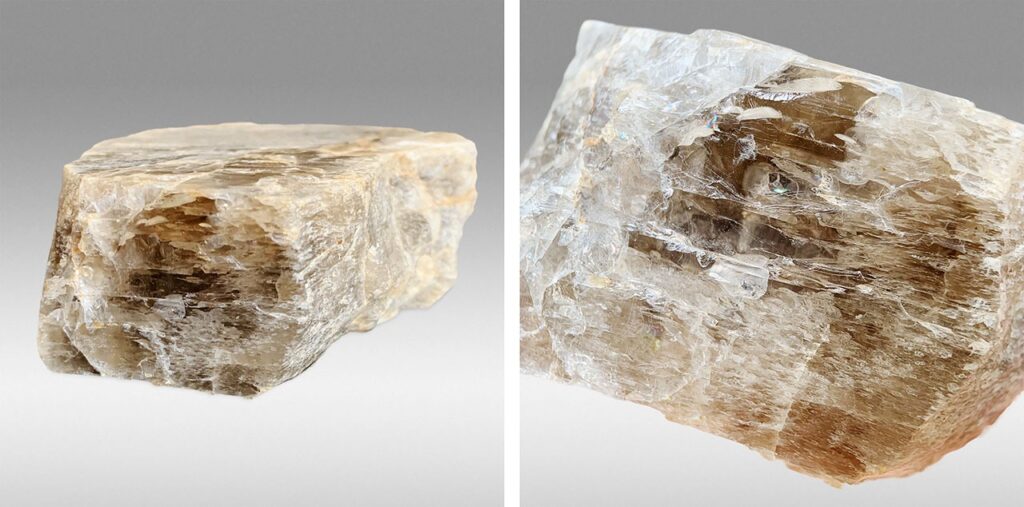
Anorthoclase forms under high-temperature conditions in alkaline volcanic environments, crystallizing from sodium- and potassium-rich, silica-undersaturated to moderately silica-saturated magmas. It is characteristically associated with volcanic rocks such as trachyte, phonolite, and related alkaline suites, including rhomb porphyry. The stability of anorthoclase at or near the Earth’s surface is strongly dependent on rapid cooling (quenching) of the host magma. Under slower cooling conditions, the homogeneous high-temperature solid solution becomes unstable and undergoes exsolution, producing intergrowths of albite and potassium feldspar that result in perthitic or cryptoperthitic textures. This process reflects the thermodynamic re-equilibration of feldspar phases at lower temperatures. Well-developed crystals are relatively uncommon but have been documented in several notable localities, including Mount Erebus in Antarctica, where they may be ejected as phenocrysts during volcanic activity, as well as in the alkaline volcanic provinces of Mount Kilimanjaro (Tanzania) and Pantelleria Island (Italy).
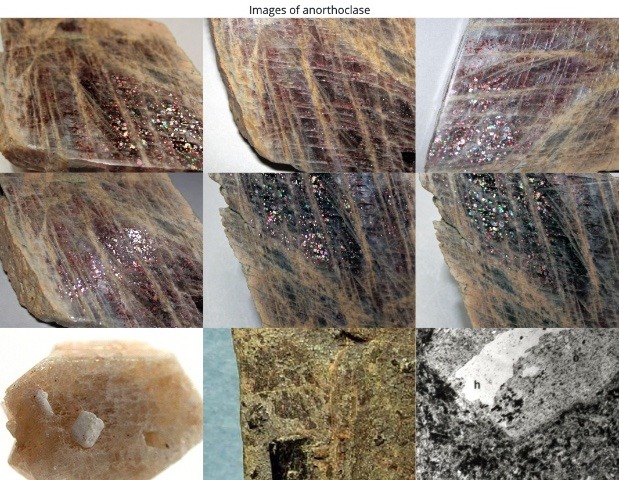
The mineral was formally described in 1885 by the German petrographer Karl Heinrich Ferdinand Rosenbusch, a pioneer in microscopic petrography. Its name is derived from the Greek words an- (“not”), orthos (“straight”), and klasis (“cleavage”), referring to the obliquity of its cleavage angles in contrast to the nearly right-angle cleavage of monoclinic orthoclase. Throughout the development of igneous petrology in the twentieth century, anorthoclase has been recognized as an important petrogenetic indicator. Its compositional and structural characteristics are sensitive to temperature, pressure, and cooling rate, making it a valuable mineral for interpreting magmatic evolution. In particular, its presence in volcanic rocks can provide insights into crystallization conditions, magma ascent dynamics, and the thermal history of alkaline magmatic systems.
Applications of Anorthoclase
Although anorthoclase is not widely utilized on an industrial scale compared to more abundant feldspars, it holds specialized significance in both scientific research and niche gemological applications. In igneous petrology, anorthoclase serves as an important mineralogical indicator for reconstructing magmatic conditions, particularly in alkaline volcanic systems. Its composition and structural state can be used to constrain crystallization temperatures, cooling histories, and magma evolution pathways, making it a valuable tool in geothermometry and phase equilibrium studies. Additionally, the presence or absence of exsolution textures in anorthoclase provides insight into post-eruptive cooling rates and subsolidus re-equilibration processes.
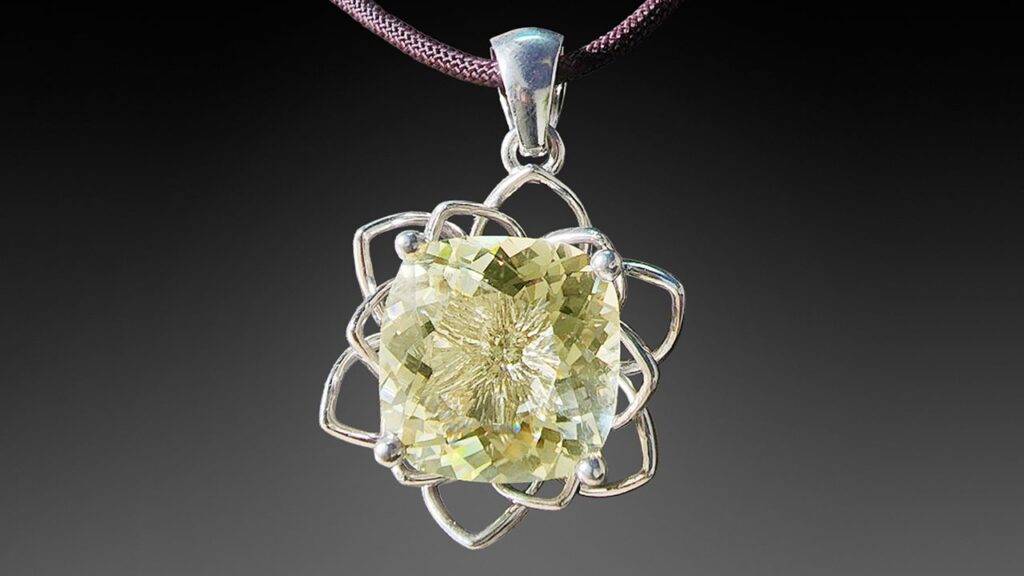
In gemology and mineral collecting, anorthoclase is regarded as a rare and specialized collector’s mineral rather than a mainstream gemstone. Transparent, well-formed crystals may be faceted for collectors, though their relative softness and perfect cleavage limit their durability in jewelry. Of particular interest are rare varieties exhibiting optical effects such as schiller or subtle adularescence, sometimes marketed under trade names like “anorthoclase moonstone,” though such terminology is used cautiously in professional contexts to avoid confusion with true orthoclase or adularia moonstone. Furthermore, due to its occurrence in geologically unique environments, high-quality specimens are sought after by museums and advanced collectors as representative examples of high-temperature alkali feldspar crystallization.