
Epidote is a calcium aluminium iron silicate mineral with the chemical formula Ca₂(Al,Fe)₃(SiO₄)₃(OH). It belongs to the epidote group of minerals and is widely recognized by its pistachio-green to yellow-green color, although specimens may also occur in shades of yellow, brown, gray, black, and reddish brown. The green coloration is commonly related to the presence of iron in the crystal structure. Epidote typically crystallizes in the monoclinic crystal system and commonly forms elongated prismatic crystals, granular aggregates, columnar masses, or coatings on fractures and cavities. Its crystals may show well-developed faces and strong longitudinal striations, while massive and granular specimens are also common in metamorphic and hydrothermal environments.
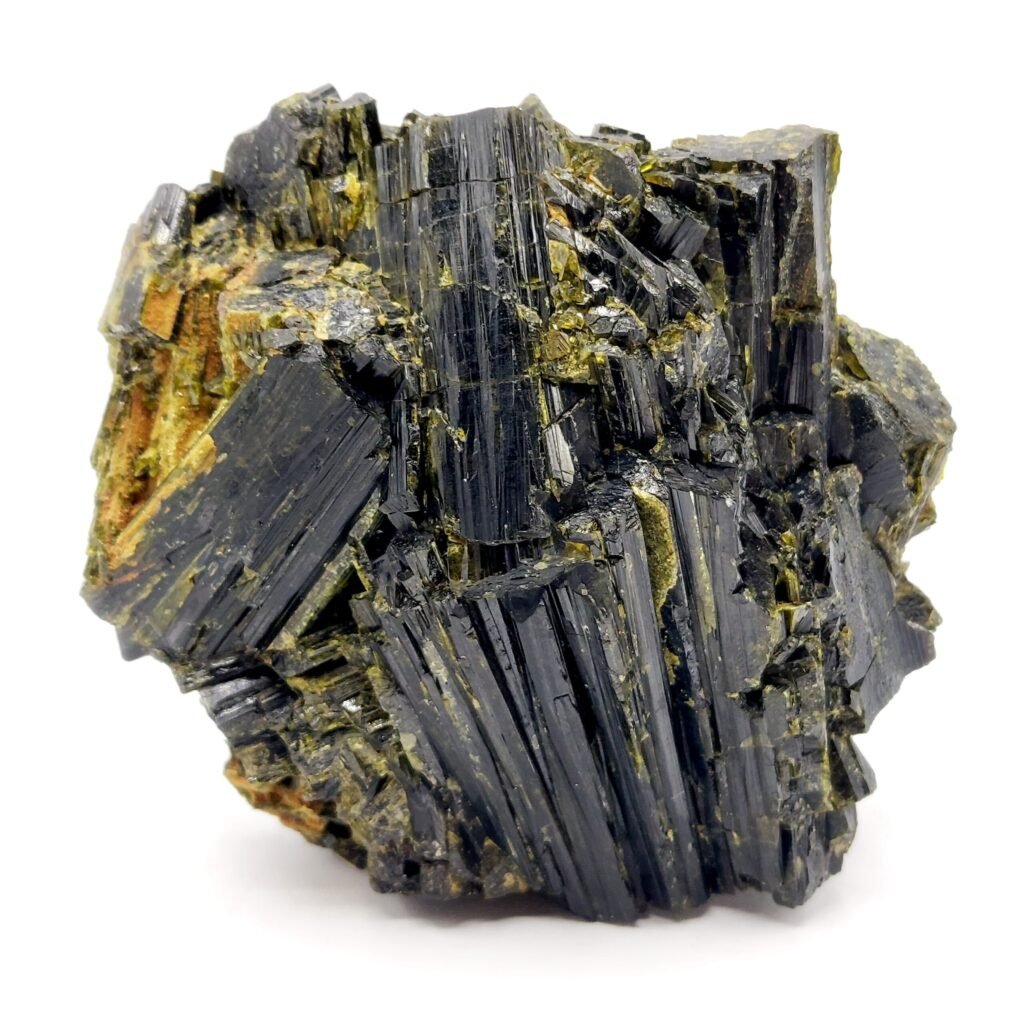
Epidote is an important rock-forming and alteration mineral and occurs in a wide range of geological settings. It is particularly characteristic of metamorphic rocks formed under low- to medium-grade conditions, where it commonly develops through the alteration of calcium-rich silicate minerals such as plagioclase, pyroxene, and amphibole. Epidote may occur as a major constituent of epidote-rich rocks or as a secondary mineral within schists, amphibolites, metabasalts, greenschists, and altered igneous rocks. It is also frequently associated with hydrothermal alteration and can occur in veins together with quartz, calcite, chlorite, albite, and other secondary minerals.
The mineral’s composition is variable because Fe³⁺ can substitute for Al³⁺ within its crystal structure, producing a compositional series between epidote and the iron-poor mineral clinozoisite. As the iron content increases, the color and some physical properties of epidote may change. This chemical variability is significant for understanding the conditions under which epidote forms and the geological processes that affect the rocks in which it occurs. Epidote can therefore provide useful mineralogical information about metamorphic reactions, hydrothermal alteration, and the chemical environment of its host rocks.
History and Discovery of Epidote
Epidote was recognized as a distinct mineral in the late eighteenth century, although epidote-bearing rocks and green mineral specimens had been known and collected before its formal scientific description. The mineral was named by French mineralogist René Just Haüy in 1801. The name comes from the Greek word epidosis, meaning “increase” or “addition,” referring to the unequal development of the mineral’s crystal faces. Haüy used crystallographic observations to distinguish epidote from visually similar minerals and incorporated it into the developing systematic study of mineral crystallography.
The identification of epidote was part of a broader period in mineralogy when crystal form, cleavage, hardness, density, and chemical composition were increasingly being used to distinguish mineral species. Early specimens of epidote were sometimes confused with other green minerals because of their characteristic color and similar occurrence in metamorphic rocks. As mineralogical methods became more precise, its monoclinic crystal symmetry, characteristic cleavage, chemical composition, and optical properties provided more reliable criteria for identification.
Epidote subsequently became an important mineral for the study of metamorphic and hydrothermal processes. Its occurrence in altered mafic and intermediate rocks, particularly in association with amphibole, chlorite, albite, quartz, and calcite, helped establish its role as both a primary metamorphic mineral and a product of mineral alteration. Modern mineralogy also recognizes epidote as part of a compositional relationship with clinozoisite, reflecting the substitution of Fe³⁺ for Al³⁺ in the crystal structure. This variation allows epidote compositions to record changes in temperature, pressure, fluid composition, and bulk-rock chemistry during geological processes.
Formation and Geological Occurrence of Epidote
Epidote forms under a relatively broad range of geological conditions, but it is especially common in metamorphic environments and in rocks affected by hydrothermal alteration. Its formation is strongly controlled by the availability of calcium, aluminium, iron, silica, and water, as well as by temperature, pressure, and the chemical composition of the host rock. In metamorphic systems, epidote commonly develops when pre-existing calcium-rich minerals react with fluids or with newly established mineral assemblages during recrystallization. It is particularly characteristic of low- to medium-grade metamorphism and is frequently associated with the greenschist and epidote-amphibolite facies.
In mafic volcanic and intrusive rocks, epidote commonly forms through the alteration of calcium-rich plagioclase, pyroxene, and amphibole. Basalt, gabbro, and related rocks may develop epidote as their mineral assemblage changes during burial, regional metamorphism, or interaction with hydrothermal fluids. Plagioclase is particularly important because calcium released during its alteration can contribute to the formation of epidote together with aluminium and iron from the original silicate minerals. Epidote may occur as fine grains distributed throughout the rock, as larger individual crystals, or as aggregates along fractures and grain boundaries.
Hydrothermal systems are another important environment for epidote formation. Hot, chemically active fluids circulating through fractures and permeable zones can alter pre-existing minerals and precipitate epidote in veins, cavities, and replacement zones. In these settings, epidote is commonly found with quartz, chlorite, calcite, albite, actinolite, prehnite, and sulfide minerals. Epidote-bearing veins are particularly common in altered volcanic and plutonic rocks and may form during the cooling and chemical evolution of hydrothermal systems.
Epidote can also occur in contact metamorphic rocks near igneous intrusions, where heat and chemically reactive fluids modify the surrounding country rock. In calcium-rich rocks, including some limestones and calcareous sediments, epidote may develop together with other calcium-bearing metamorphic minerals. Its presence and composition can therefore vary considerably depending on the original rock composition and the physical and chemical conditions during metamorphism. In some deposits, epidote forms well-developed crystals in open cavities, while in others it occurs mainly as fine-grained aggregates or as a replacement product within the host rock.
Crystal Structure of Epidote
Epidote crystallizes in the monoclinic crystal system and has a relatively complex crystal structure consisting of interconnected silicate groups, aluminium and iron cations, calcium, and hydroxyl groups. Its structure can be described as a framework of SiO₄ tetrahedra combined with chains and coordination polyhedra containing calcium, aluminium, and ferric iron. The arrangement of these structural units produces the characteristic monoclinic symmetry and strongly influences epidote’s cleavage, crystal habit, optical properties, and chemical variability.
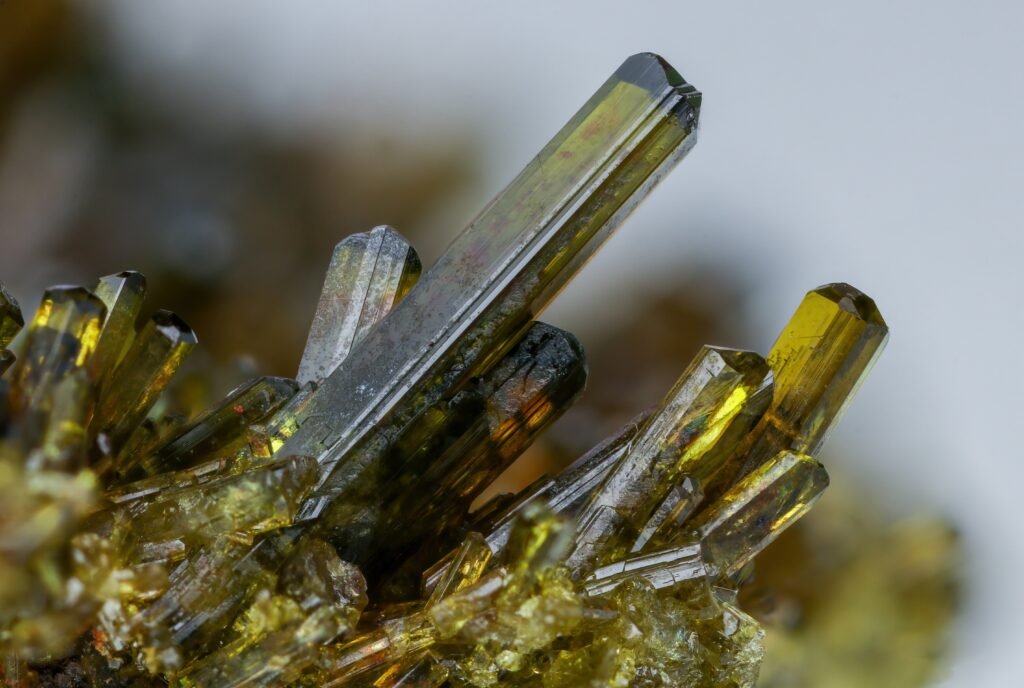
The idealized chemical formula of epidote is Ca₂(Al,Fe)₃(SiO₄)₃(OH), although natural specimens commonly show variation in the relative proportions of aluminium and ferric iron. Fe³⁺ can substitute for Al³⁺ without requiring a change in the overall charge balance because the two ions have the same valence. This substitution is one of the principal reasons for the compositional range observed in natural epidote. As the Fe³⁺ content increases, the mineral generally becomes more strongly colored, particularly in green and yellow-green varieties, although color is also affected by crystal defects, impurities, and other factors.
The silicate portion of epidote contains isolated SiO₄ tetrahedra rather than the continuous silicate chains or sheets found in minerals such as pyroxenes and amphiboles. These tetrahedra are linked to the larger cation sites through oxygen atoms, producing a three-dimensional structural arrangement. Calcium occupies relatively large coordination sites, while aluminium and ferric iron occupy smaller sites with different coordination environments. Hydroxyl groups are also an integral part of the structure and contribute to the stability of epidote under the geological conditions in which it commonly forms.
The crystal structure also accounts for epidote’s well-developed cleavage. Epidote commonly shows perfect to good cleavage in two directions, with cleavage planes related to weaker bonding within the crystal lattice. Well-formed crystals are typically elongated and prismatic, and crystal faces may be strongly developed along the length of the crystal. Longitudinal striations can occur on some crystal faces and, together with color, luster, hardness, cleavage, and optical characteristics, can assist in distinguishing epidote from visually similar green minerals.
Physical and Chemical Properties of Epidote
Epidote has a Mohs hardness of approximately 6 to 7, making it harder than many common rock-forming minerals but generally softer than quartz. Its specific gravity is relatively high for a silicate mineral, commonly around 3.3 to 3.5, with the exact value influenced by its iron content and overall chemical composition. Epidote typically has a vitreous to resinous luster, although massive or fine-grained material may appear less lustrous. Its streak is generally white to grayish-white, and its transparency ranges from transparent to translucent, with well-formed crystals sometimes showing considerable internal clarity.
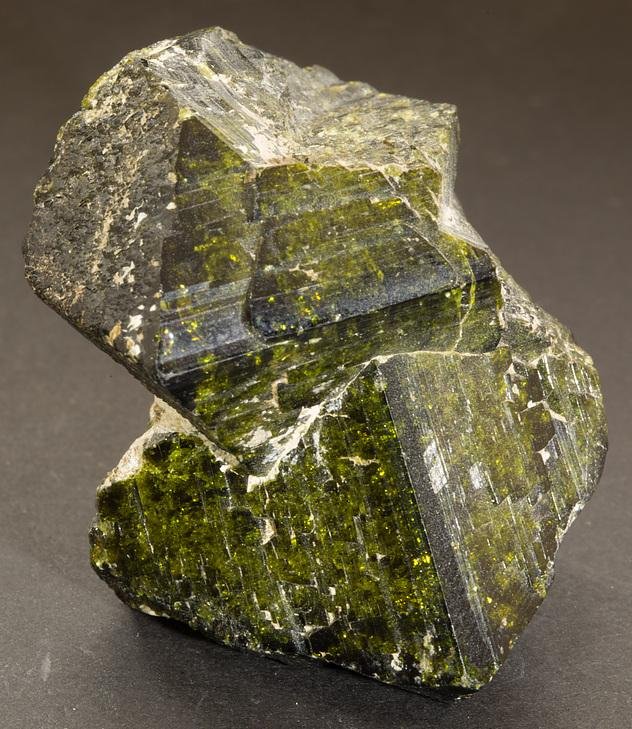
The color of epidote varies considerably, but green and yellowish green are the most characteristic. Pistachio-green is particularly associated with well-crystallized specimens, while darker green, yellow-green, brownish green, gray, and nearly black material can also occur. The intensity of the color is commonly related to Fe³⁺ substitution for Al³⁺ within the structure. Some crystals show noticeable pleochroism, appearing different shades of green, yellow, or brown when viewed in different crystallographic directions under polarized light. This optical behavior is an important diagnostic feature in thin-section and gemological examination.
Epidote generally has a white to grayish-white streak and displays good cleavage, commonly described on two planes. Fracture may be uneven to subconchoidal. Crystals are frequently elongated and prismatic, sometimes forming slender or somewhat flattened crystals with distinct longitudinal striations. Epidote can also occur as granular, massive, fibrous, radiating, or compact aggregates depending on the geological environment in which it formed.
Chemically, epidote is a calcium aluminium iron silicate containing hydroxyl. Its composition can be represented by Ca₂(Al,Fe)₃(SiO₄)₃(OH), reflecting the substitution of Fe³⁺ for Al³⁺. This substitution produces a compositional range rather than a single fixed ratio between iron and aluminium in all natural specimens. The relationship between epidote and clinozoisite is particularly important in mineralogy: clinozoisite is the Fe-poor member of the epidote structural group, while increasing Fe³⁺ substitution produces compositions characteristic of epidote. Other minor elements may also occur in natural specimens, depending on the geological environment and the composition of the fluids or parent rocks involved in its formation.
Color, Luster, and Optical Properties of Epidote
Epidote is most commonly recognized by its green to yellow-green coloration, with pistachio green being one of its characteristic colors. The color can range from pale yellowish green to dark green, brownish green, and nearly black in strongly iron-rich specimens. Yellow, gray, and reddish-brown material is less common but can also occur. Color variation is primarily related to the amount of Fe³⁺ substituting for Al³⁺ in the crystal structure, although trace elements, structural defects, and the geological environment can also influence the final appearance of individual crystals.
The luster of epidote is generally vitreous, giving fresh crystal faces a glass-like appearance. Some specimens may show a slightly resinous luster, particularly where the surface is uneven or contains abundant inclusions. Transparent to translucent crystals are known, while massive and granular aggregates are usually more translucent or opaque. The combination of relatively high refractive indices and strong coloration can give transparent crystals a noticeable depth of color, especially when viewed along the length of a well-formed crystal.
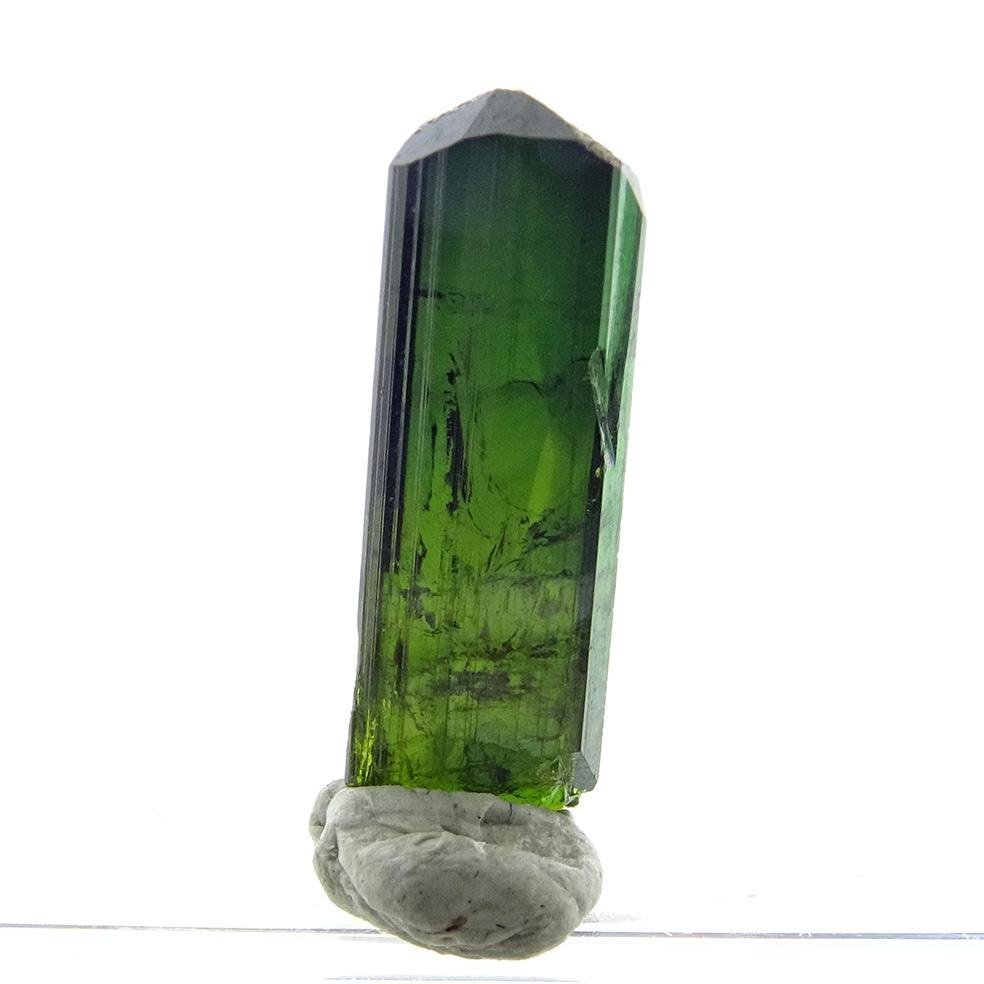
Epidote is strongly pleochroic, an optical property that is particularly useful for its identification under a polarizing microscope. Depending on the crystallographic direction, a single crystal may display different shades ranging from yellow-green to green, yellow, or brownish green. The strength and exact colors of pleochroism vary with chemical composition, especially the Fe³⁺ content. This property results from the anisotropic interaction between light and the mineral’s crystal structure.
Under crossed polarizers, epidote commonly exhibits high interference colors because of its relatively strong birefringence. Its refractive indices are also relatively high for a silicate mineral, contributing to its pronounced optical relief in thin sections. In geological microscopy, these optical characteristics, together with cleavage, crystal habit, pleochroism, and association with other metamorphic minerals, allow epidote to be distinguished from minerals such as chlorite, amphibole, zoisite, and other green silicates.
Types and Varieties of Epidote
Epidote does not have a large number of officially recognized varieties based solely on color, but natural specimens can show considerable differences in composition, crystal habit, color, and geological occurrence. Some names used in mineral collecting and gemology describe particular appearances or compositional characteristics rather than separate mineral species.
- Common Epidote: The typical form of epidote is yellow-green to pistachio-green and occurs as prismatic crystals, granular aggregates, or massive material. It is widespread in metamorphic and hydrothermally altered rocks.
- Iron-Rich Epidote: Epidote commonly contains significant Fe³⁺ substituting for Al³⁺. Higher iron contents generally produce deeper green, yellow-green, or brownish-green colors and can influence density and optical properties.
- Pistachio-Green Epidote: This is a descriptive term frequently used for epidote specimens with a characteristic light to medium yellowish-green or pistachio-green color. It is particularly common among well-crystallized specimens collected for mineralogical study and mineral collections.
- Gem-Quality Epidote: Transparent to translucent, relatively clean epidote crystals with attractive green to yellow-green color may be cut as gemstones. Gem-quality material is uncommon compared with ordinary massive or opaque epidote and is generally limited by inclusions, fractures, cleavage, and strong pleochroism.
- Epidote-Group Minerals: Epidote belongs to a structurally related group that includes clinozoisite, zoisite, piemontite, allanite, and several other minerals. These minerals share related structural characteristics but differ in chemical composition and, in some cases, crystal chemistry. They should not be treated simply as color varieties of epidote.
Because epidote has a continuous range of Fe³⁺ and Al³⁺ substitution, boundaries between compositionally related members of the epidote group can be important when identifying specimens. Mineralogical classification therefore relies on chemical composition and crystal structure rather than color alone.
Epidote Localities and Notable Occurrences
Epidote is widely distributed and has been reported from metamorphic, igneous, and hydrothermal environments on many continents. Because it can form through several different geological processes, its occurrence is not restricted to a single type of deposit. Epidote is particularly common in regions affected by regional metamorphism, contact metamorphism, and hydrothermal alteration of mafic and intermediate rocks. In many localities it occurs as a relatively minor rock-forming mineral, while some deposits produce well-developed crystals suitable for mineral collections.
In Austria, the Knappenwand area in the Untersulzbach Valley is particularly well known for fine epidote crystals. The locality has produced sharply formed green epidote crystals, often associated with quartz and other Alpine-type minerals. The specimens from this region are important examples of epidote occurring in Alpine fissures, where mineral-rich fluids circulated through fractures in metamorphic rocks and deposited well-developed crystals in open spaces.
Pakistan is another important source of attractive epidote specimens. Deposits in the northern mountainous regions have produced green epidote crystals associated with quartz and other metamorphic minerals. Some Pakistani material occurs as well-developed prismatic crystals, while other specimens consist of epidote aggregates embedded in the host rock.
In the United States, epidote occurs in numerous metamorphic and hydrothermal environments. Significant occurrences are known from states including Alaska, California, Colorado, Connecticut, Maine, Montana, New York, North Carolina, and Washington. Epidote may be found in metamorphosed basaltic rocks, amphibolites, schists, hydrothermal veins, and contact-metamorphic zones. The mineral is particularly useful in interpreting the metamorphic history of rocks because its presence and composition can reflect the temperature, pressure, and fluid conditions under which alteration occurred.
Other important occurrences have been documented in Norway, Switzerland, Italy, France, Mexico, Brazil, Madagascar, Russia, and Japan. Alpine regions of Europe are especially well known for epidote-bearing fissures and cavities containing sharply developed crystals. In volcanic and hydrothermal terrains, epidote may occur together with quartz, chlorite, calcite, albite, actinolite, and prehnite. The mineral is therefore encountered in a wide range of geological associations, from regional metamorphic belts to altered volcanic sequences and mineralized hydrothermal systems.
Epidote in Metamorphic Rocks
Epidote is an important mineral for interpreting metamorphic rocks because its stability is closely related to temperature, pressure, bulk-rock composition, and the availability of water. It is particularly common in rocks that have undergone low- to medium-grade metamorphism, where minerals in the original rock are recrystallized or chemically altered into new mineral assemblages. Epidote is frequently associated with chlorite, actinolite, albite, amphibole, quartz, and calcite, although the exact assemblage depends on the composition of the original rock and the metamorphic conditions.
In metamorphosed basalt and other mafic rocks, epidote commonly develops through reactions involving calcium-rich plagioclase and ferromagnesian silicates. During metamorphism, the original minerals may become unstable as temperature and pressure increase, allowing calcium, aluminium, iron, and silica to be redistributed and incorporated into new minerals. Epidote may occur as fine grains throughout the rock or as larger crystals concentrated along fractures, grain boundaries, and areas where fluids have facilitated mineral reactions.
Epidote is particularly characteristic of the greenschist facies and can continue to occur in higher-grade assemblages under suitable chemical conditions. In greenschist-facies rocks, it commonly occurs with chlorite, albite, actinolite, and quartz. With increasing metamorphic grade, epidote may participate in reactions that produce amphibole and other calcium-bearing minerals. Its stability is not determined by temperature and pressure alone, however, because the bulk chemical composition of the rock and the composition of metamorphic fluids also exert an important influence.
Epidote can also form through retrograde metamorphism, in which rocks that were previously subjected to higher temperatures and pressures undergo mineralogical changes during cooling and decompression. In such circumstances, epidote may develop from the alteration of calcium-bearing minerals that become unstable as geological conditions change. This makes epidote a common component of rocks that preserve evidence of multiple stages of metamorphic history.
The presence of epidote can therefore provide useful information when combined with other minerals in a rock. Mineralogists examine epidote together with its associated phases, chemical composition, zoning, and textural relationships to determine the sequence of mineral-forming reactions. Compositional zoning within individual epidote crystals may also preserve changes in the chemical environment during crystal growth, particularly variations in the relative availability of iron and aluminium.
Epidote in Hydrothermal and Igneous Environments
Epidote is also widespread in hydrothermal systems, where hot aqueous fluids interact with pre-existing igneous and metamorphic rocks. These fluids can transport calcium, aluminium, iron, and silica and promote reactions between the original minerals and the surrounding fluid. Epidote may then form as a replacement mineral, fill fractures and cavities, or occur together with quartz and other hydrothermal minerals. Its abundance and composition can vary substantially depending on fluid temperature, pressure, chemical composition, and the permeability of the host rock.
In altered volcanic rocks, epidote commonly occurs as part of propylitic alteration, an alteration assemblage typically associated with the circulation of relatively low- to moderate-temperature hydrothermal fluids. Epidote may occur with chlorite, calcite, albite, and pyrite, with the exact mineral assemblage depending on the composition of the host rock and the hydrothermal fluid. In some systems, epidote replaces calcium-rich plagioclase or occurs along fractures that provided pathways for fluid circulation.
Epidote can also form in and around intrusive igneous bodies. When magma crystallizes beneath the surface, residual fluids may circulate through fractures in the intrusion and the surrounding country rock. These fluids can alter feldspar, pyroxene, amphibole, and other primary minerals, producing epidote as a secondary phase. In some cases, epidote occurs within quartz-rich veins cutting the igneous rock, while in other cases it forms irregular replacement zones within the original mineral grains.
Within hydrothermal veins, epidote crystals may occur as elongated prismatic crystals projecting into open cavities or as compact aggregates intergrown with quartz, calcite, chlorite, and amphibole. Well-developed crystals from such environments can show strong green coloration, distinct crystal faces, and longitudinal striations. The presence of epidote in veins can provide information about the temperature and chemical conditions of the fluid system, particularly when it is studied together with the complete mineral assemblage and the textures of the altered host rock.
Epidote may also occur in skarn and contact-metamorphic environments where calcium-rich rocks interact with fluids associated with an intrusive body. In these settings, epidote can form together with garnet, diopside, wollastonite, vesuvianite, calcite, and other calcium-bearing minerals. The exact assemblage depends strongly on the original composition of the host rock and the composition of the metasomatic fluids. Consequently, epidote is found in a diverse range of geological environments rather than being restricted to a single deposit type.
Uses and Applications of Epidote
Epidote has relatively limited industrial use compared with common rock-forming silicate minerals, but it is important in mineralogy, petrology, geological research, and mineral collecting. Because its formation is associated with particular metamorphic and hydrothermal conditions, epidote is frequently examined as an indicator mineral when interpreting the geological history of rocks. Its chemical composition, crystal textures, and relationships with minerals such as chlorite, amphibole, albite, quartz, and calcite can provide information about mineral-forming reactions and the conditions under which alteration occurred.
Epidote is also collected as a mineral specimen. Well-formed crystals with sharp faces, strong green coloration, and good transparency can be attractive additions to systematic mineral collections. Specimens from localities such as the Austrian Alps and other Alpine-type fissure environments are particularly valued for their well-developed crystals. However, most naturally occurring epidote is not transparent or sufficiently clear for cutting and is instead encountered as granular, massive, or rock-forming material.
Some transparent epidote is used as a gemstone, although it remains relatively uncommon in the gem trade. Facetable material is generally yellow-green to green and may display strong pleochroism, producing different colors depending on the direction of observation. The relatively high refractive index can give cut stones considerable optical character, but epidote’s cleavage, inclusions, fractures, and generally dark body color can limit the availability of clean faceting rough. Epidote gemstones are therefore mainly of interest to collectors and specialists rather than being a major commercial gemstone.
In geological laboratories, epidote is also useful for petrographic and mineralogical analysis. Thin sections of epidote-bearing rocks can be examined under polarized light to determine its optical properties, grain relationships, zoning, and association with other minerals. Chemical analysis using techniques such as electron microprobe analysis can measure the proportions of aluminium and iron and help characterize compositional variations within individual crystals. These data can be combined with experimental and thermodynamic models to investigate metamorphic reactions and hydrothermal alteration.
Because epidote commonly forms through the alteration of earlier calcium-bearing minerals, it can also serve as a record of secondary mineralization. Its occurrence in fractures, veins, and replacement textures may reveal pathways followed by hydrothermal fluids. For this reason, epidote is encountered not only as a mineral specimen but also as a component of geological studies involving metamorphism, fluid-rock interaction, alteration zones, and the evolution of igneous and metamorphic terrains.