
Kernowite is a rare green mineral and a hydrated copper arsenate phosphate mineral that was first recognized from the famous mineral-producing region of Cornwall, England. It is closely associated with the mineral group surrounding clinoclase and other secondary copper minerals that develop in the oxidized zones of copper-bearing hydrothermal deposits. Kernowite is particularly notable for its attractive green color, rarity, and geological association with the historic copper mines of Cornwall. The name Kernowite is derived from “Kernow,” the Cornish name for Cornwall, reflecting the mineral’s type locality and strong connection with the region.
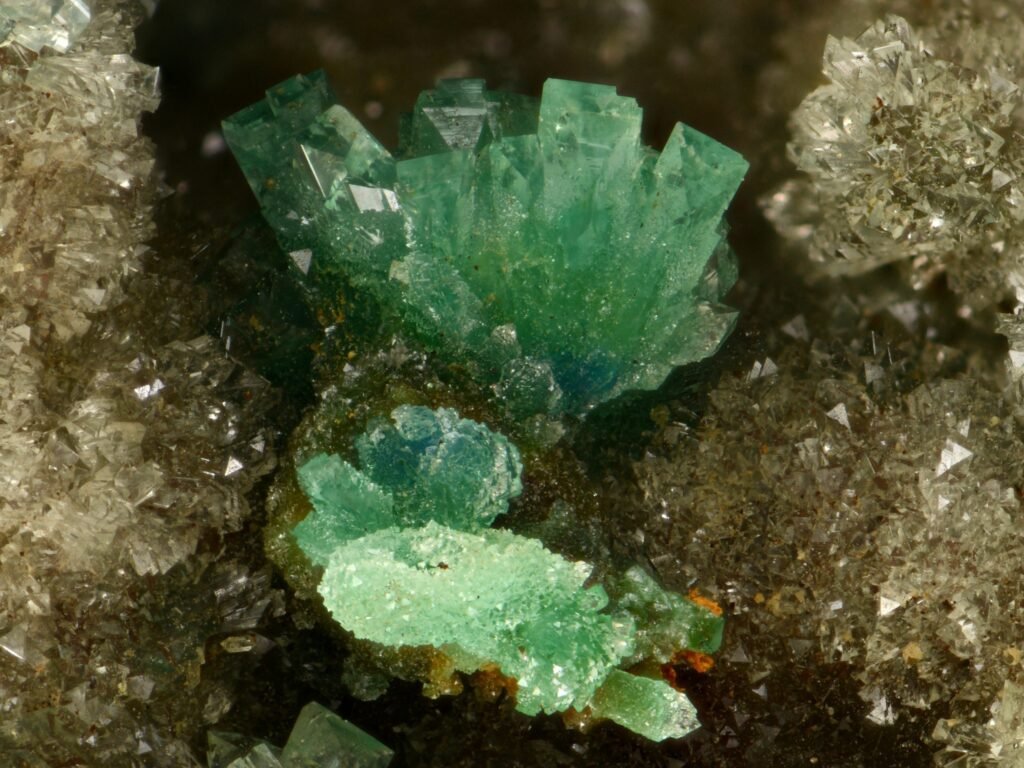
Kernowite typically occurs as a secondary mineral formed through the alteration of primary copper-bearing sulfide minerals near the surface of mineralized zones. Its formation requires the interaction of copper-bearing solutions with arsenic-, phosphate-, and water-rich components under suitable conditions of oxidation. Specimens are generally found as small crystals, crusts, coatings, or aggregates associated with other secondary minerals. Because of its scarcity and limited occurrence, Kernowite is primarily of interest to mineral collectors, museums, and mineralogical researchers rather than as an economically important source of copper or other elements.
From a mineralogical perspective, Kernowite is important because it records complex chemical processes taking place during the weathering and oxidation of copper deposits. Its green coloration and association with other secondary copper minerals can make it visually appealing, while its rarity makes well-characterized specimens particularly desirable for systematic mineral collections. Although Kernowite has little practical industrial use, it contributes valuable information to the study of secondary mineral formation, the geochemistry of oxidized ore deposits, and the mineralogical heritage of Cornwall.
History and Discovery of Kernowite
Kernowite is a relatively recent addition to the recognized mineral species compared with many of the classic minerals discovered in the historic mining districts of Cornwall. Its identification is closely connected with the mineralogical investigation of specimens from the St Day area of Cornwall, England, a district renowned for its exceptionally diverse assemblage of copper, arsenic, phosphate, and other secondary minerals. The mineral was formally described after detailed examination demonstrated that the material represented a distinct mineral species rather than simply an unusual variety or altered form of another copper mineral. Its name honors Cornwall, using the traditional Cornish name “Kernow,” and emphasizes the mineral’s geological and historical connection with the region.
The discovery of Kernowite is particularly significant because Cornwall has been studied by mineralogists for centuries and remains one of the world’s classic localities for secondary copper minerals. The region’s extensive historic mining activity exposed numerous mineralized zones and created opportunities for collectors and researchers to examine unusual alteration products. Kernowite occurs in association with minerals such as clinoclase and other copper-bearing secondary phases, reflecting the complex chemical conditions that developed as ancient copper deposits were exposed to oxygenated groundwater. Because confirmed occurrences are scarce, Kernowite remains a collector-oriented mineral whose importance lies primarily in its scientific rarity, distinctive composition, and connection with the mineralogical history of Cornwall.
Formation and Occurrence of Kernowite
Kernowite forms as a secondary mineral in the oxidized portions of copper-bearing mineral deposits. Its formation takes place after primary copper minerals, particularly sulfide minerals, are exposed to oxygen-rich groundwater and undergo chemical weathering. During this process, copper and other elements are released from the original ore minerals and transported through fractures, cavities, and porous zones in the surrounding rock. When these solutions encounter suitable concentrations of arsenic, phosphate, and water under favorable chemical conditions, new secondary minerals can crystallize. Kernowite therefore represents the result of a relatively complex low-temperature alteration process rather than a primary mineral that crystallizes directly from molten rock.
The mineral is especially associated with the historic copper-mining districts of Cornwall, where extensive hydrothermal mineralization was later modified by oxidation and weathering. In these environments, Kernowite may occur with other secondary copper minerals, including green and blue copper arsenates and phosphates. It can develop on fracture surfaces, within small cavities, or as coatings and aggregates on earlier minerals. The presence of several secondary mineral species in the same specimen reflects changing conditions during oxidation, including variations in groundwater chemistry, acidity, oxygen availability, and the concentrations of dissolved metals and anions. These associations make Kernowite useful to mineralogists studying the evolution of oxidized copper deposits.
Because Kernowite is extremely rare, its known occurrence is limited compared with more widespread secondary copper minerals. Well-preserved specimens are consequently valuable for mineralogical research and systematic collections. Its occurrence in Cornwall also illustrates the remarkable diversity produced by the weathering of ancient ore deposits, where relatively small changes in chemical conditions can produce different and highly specialized mineral phases.
Crystal Structure of Kernowite
Kernowite has a complex crystal structure characteristic of a hydrated copper-bearing arsenate phosphate mineral. Its structure incorporates copper cations together with arsenate and phosphate groups, while hydroxyl groups and water molecules contribute to the hydrated nature of the mineral. The arrangement of these chemical components at the atomic scale controls many of Kernowite’s observable properties, including its crystal morphology, cleavage, hardness, density, and interaction with light. As a secondary mineral formed under relatively low-temperature oxidizing conditions, its structure reflects the chemical environment in which copper, arsenic, phosphorus, oxygen, and water were able to combine into a stable crystalline phase.
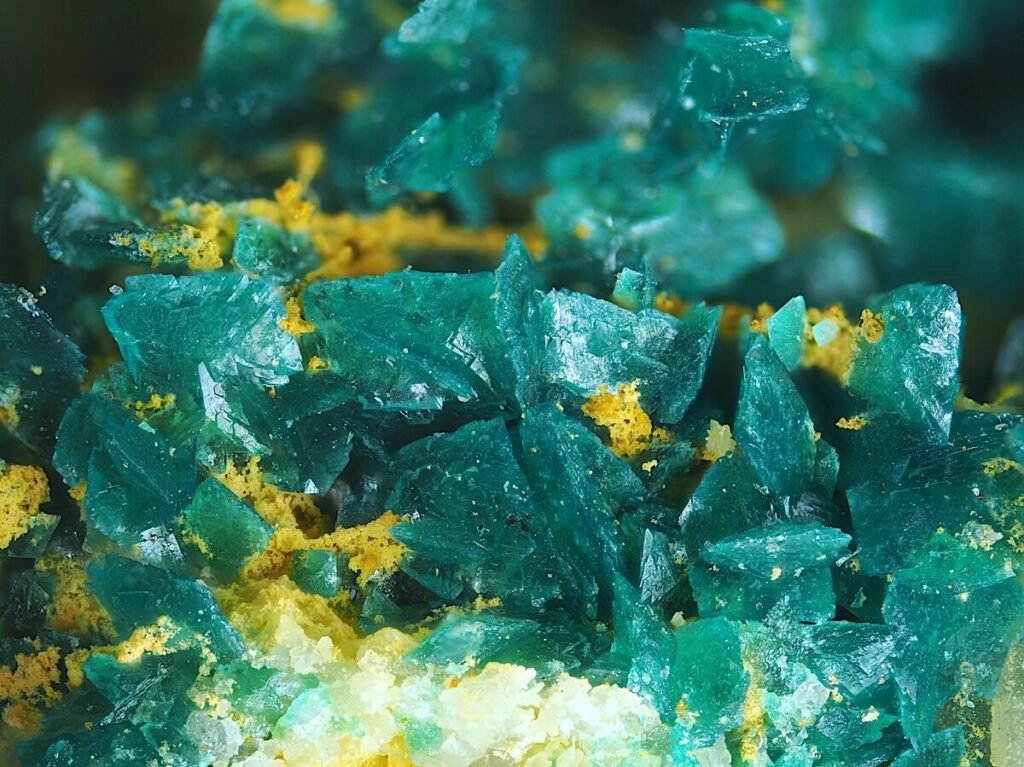
The structural chemistry of Kernowite is also important for understanding its relationship with other secondary copper arsenate and phosphate minerals. Arsenate (AsO₄) and phosphate (PO₄) groups can participate in extensive networks with copper and oxygen, while hydroxyl and water components help stabilize the structure. Minor chemical substitutions may occur in natural specimens depending on the composition of the mineral-forming fluids and the surrounding host rock. These variations can influence the exact appearance and physical characteristics of individual specimens. Studying the crystal structure of Kernowite therefore provides useful information about mineral stability and element mobility within the oxidized zones of copper deposits, particularly in environments where arsenic- and phosphorus-bearing fluids interact with pre-existing copper mineralization.
Physical and Chemical Properties of Kernowite
Kernowite is recognized by its characteristic green coloration, which can range from pale to relatively deep green depending on crystal size, surface condition, and the presence of minor impurities. It generally occurs as small crystals, coatings, crusts, or aggregates rather than as large, well-developed crystals. The mineral has a vitreous to somewhat resinous appearance on fresh surfaces, while finely crystalline or massive material may appear more earthy or dull. Its relatively limited occurrence and small crystal size mean that individual specimens can show considerable differences in appearance. The green color, secondary-mineral habit, and association with other copper minerals are useful initial clues when examining suspected Kernowite specimens, although visual identification alone is not sufficient for reliable mineral determination.
Chemically, Kernowite is a hydrated copper arsenate phosphate mineral containing copper, arsenic, phosphorus, oxygen, and water-related components within its crystal structure. The coexistence of arsenate and phosphate groups is an important feature of its composition and distinguishes it from many more common secondary copper minerals. Like other minerals formed in oxidized ore zones, Kernowite develops through the interaction of mineral-bearing groundwater with previously existing copper-rich minerals. Its physical properties are controlled by its complex hydrated structure and chemical composition, while its stability depends strongly on the temperature, acidity, oxidation state, and chemical composition of the surrounding environment.
Kernowite is rare and commonly occurs in small quantities, detailed mineralogical identification may require analytical techniques rather than simple field observations. Optical microscopy, chemical analysis, X-ray diffraction, and related methods can be used to distinguish it from visually similar green copper minerals. This is particularly important for collector specimens, since several secondary copper arsenates and phosphates can display similar colors and habits. Its distinctive chemistry and crystallographic characteristics provide a much more reliable basis for identification than color alone.
Types and Varieties of Kernowite
Kernowite is recognized as a distinct mineral species and does not have a broad range of officially recognized varieties in the conventional sense. However, natural specimens can display different habits and appearances depending on the conditions under which they formed. Differences in crystal size, degree of crystallization, surface alteration, and association with other secondary minerals may produce noticeable variations between specimens.
- Crystalline Kernowite – Crystalline material consists of recognizable individual crystals or groups of crystals. Because Kernowite is extremely rare, well-developed crystals are particularly significant to mineral collectors and mineralogical researchers. Small crystals may occur on the surfaces of cavities or together with other secondary copper minerals, allowing the specimen to display a more distinct crystalline texture.
- Aggregated Kernowite – Kernowite may occur as groups or aggregates of closely associated crystals. In this form, individual crystal boundaries can be difficult to distinguish without magnification, producing a compact green mineral coating or cluster. Aggregated specimens can develop when mineral-forming solutions repeatedly deposit material within small fractures or cavities.
- Crusts and Coatings – Thin crusts or coatings can form when copper-rich mineralizing fluids interact with exposed surfaces during oxidation. These specimens may cover portions of the host rock or earlier minerals and can show an intense green surface coloration. Such occurrences are useful for demonstrating Kernowite’s secondary origin and its relationship with the weathering environment.
- Kernowite Associated with Other Secondary Minerals – Some specimens contain Kernowite together with other copper-bearing arsenates, phosphates, and related oxidation-zone minerals. These associations are particularly valuable because they record changing chemical conditions during the alteration of the original copper deposit. The contrasting colors and crystal habits of associated minerals can also make such specimens visually distinctive.
These forms should generally be understood as occurrence or morphological variations rather than formally established mineral varieties. The exact appearance of Kernowite depends heavily on its geological environment, and laboratory identification is recommended when distinguishing it from visually similar secondary copper minerals.
Where Is Kernowite Found?
Kernowite is an exceptionally rare mineral, and its occurrence is strongly associated with Cornwall in southwestern England. The mineral is particularly linked to the historic mining districts around St Day, an area that forms part of the famous Cornish mining landscape. Cornwall has long been recognized for its diverse assemblages of copper, arsenic, and phosphate minerals, and the oxidation of its historic copper deposits has produced numerous unusual secondary mineral species. Kernowite is one of the minerals that reflects this highly specialized geological environment.
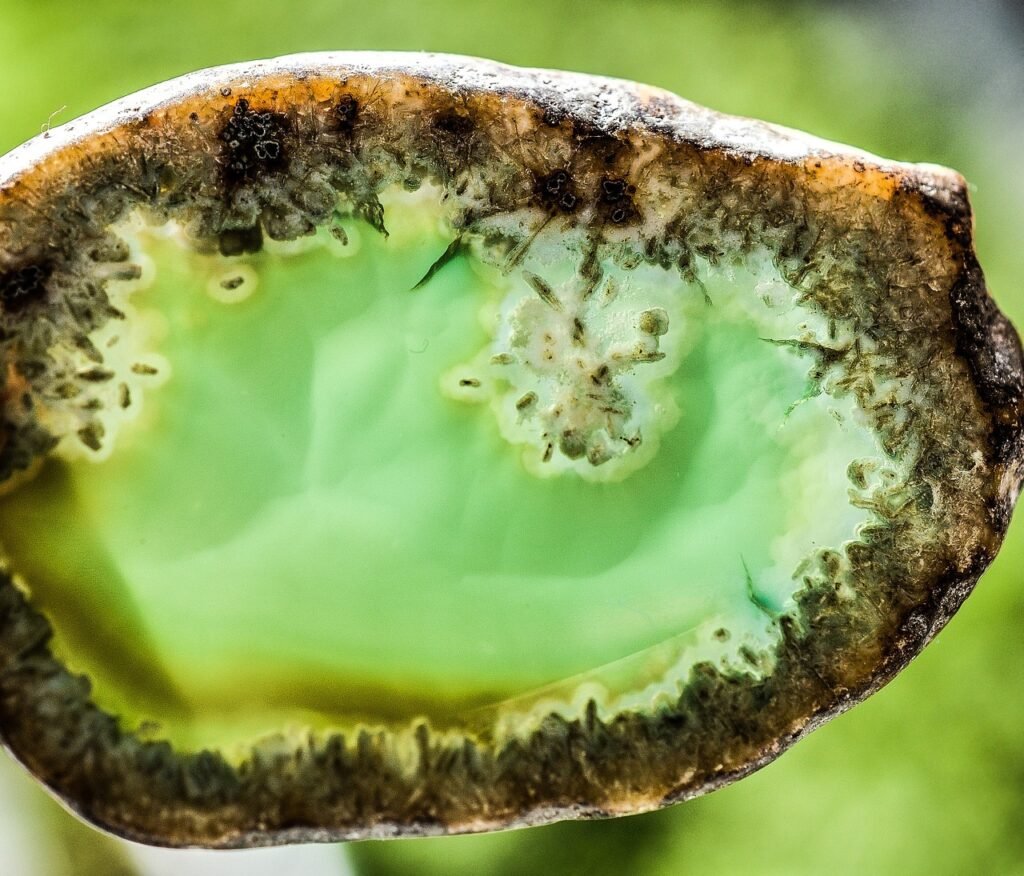
The Cornish occurrence is significant because the region contains extensive hydrothermal mineralization that developed during the geological history of southwestern England. Copper-bearing veins were later exposed to weathering and circulating groundwater, creating oxidized zones where secondary minerals could form. Within these altered areas, copper was mobilized and combined with elements such as arsenic and phosphorus under suitable chemical conditions. The resulting mineral assemblages can contain several uncommon species occurring together in cavities, fractures, and on the surfaces of earlier minerals. Kernowite is therefore closely tied to the complex geochemistry of these oxidized copper deposits.Kernowite specimens are not commonly encountered in commercial mineral markets because confirmed material is scarce and individual occurrences can be extremely localized. The mineral’s rarity gives specimens from its Cornish locality particular importance to systematic mineral collections. More broadly, its occurrence contributes to the scientific value of Cornwall as a classic mineralogical region, where centuries of mining and subsequent geological study have revealed an unusually diverse range of secondary minerals. For collectors, locality information is especially important when evaluating Kernowite, since provenance and analytical confirmation can help distinguish genuine specimens from visually similar green copper minerals.
How to Identify Kernowite
Identifying Kernowite requires careful consideration of its color, crystal habit, mineral associations, locality, and chemical composition. Its green color is one of the most noticeable features, but color alone cannot provide a reliable identification because numerous secondary copper minerals can display similar shades of green. Kernowite commonly occurs as small crystals, aggregates, crusts, or coatings associated with copper-bearing minerals in oxidized zones. Specimens may show a combination of green crystalline material and contrasting minerals on a mineralized host rock, providing useful clues about its geological origin.
Locality is another important factor when examining a suspected Kernowite specimen. Material attributed to the historic copper-mining districts of Cornwall, particularly the St Day area, is especially significant because of the mineral’s known association with this region. However, locality by itself does not prove identification, since minerals with similar appearances may occur in the same geological environments. Mineral collectors should therefore consider the specimen’s complete paragenesis, including associated arsenate, phosphate, and copper minerals, rather than relying on a single visual characteristic.
For scientifically reliable identification, analytical methods are preferred. Optical examination under magnification can reveal crystal morphology and associations, while chemical analysis can establish the presence and relative proportions of the characteristic elements. X-ray diffraction is particularly useful because it examines the mineral’s crystal structure and can distinguish Kernowite from chemically or visually similar species. Combining crystallographic, chemical, and locality information provides a much stronger identification than appearance alone and is especially important for rare specimens that may have significant scientific or collector value.
Applications of Kernowite
Kernowite has very limited practical or industrial applications because it is an exceptionally rare mineral and normally occurs only in small quantities. It is not considered an economically important source of copper, arsenic, or phosphorus, and there is no significant commercial industry based on the extraction of these elements from Kernowite. Its primary value is instead associated with mineralogical research, geological education, and the collection and preservation of rare mineral specimens.In mineralogical research, Kernowite can provide information about the chemical processes responsible for the formation of secondary minerals in oxidized copper deposits. Its association with copper, arsenic, and phosphate minerals helps researchers investigate how elements are transported by groundwater and redistributed during the weathering of ore deposits. Studying these mineral assemblages can also improve understanding of mineral stability under changing oxidation, acidity, and hydration conditions.
Kernowite is also of interest to mineral collectors and museums because of its rarity and connection with Cornwall’s historic mining districts. Well-documented specimens can serve as reference material for systematic collections and mineralogical education. Museums and geological institutions may use such specimens to illustrate the diversity of secondary copper minerals and the geological history of the Cornish mining region. For collectors, the combination of rarity, distinctive green appearance, and historical locality makes authenticated Kernowite specimens particularly interesting.From an educational perspective, Kernowite demonstrates how complex mineral species can develop through relatively subtle interactions between pre-existing ores, groundwater, and surrounding rocks. Although it has little direct technological or industrial importance, its scientific and collection value makes it a useful example of the mineral diversity produced by the oxidation and alteration of ancient copper deposits.