
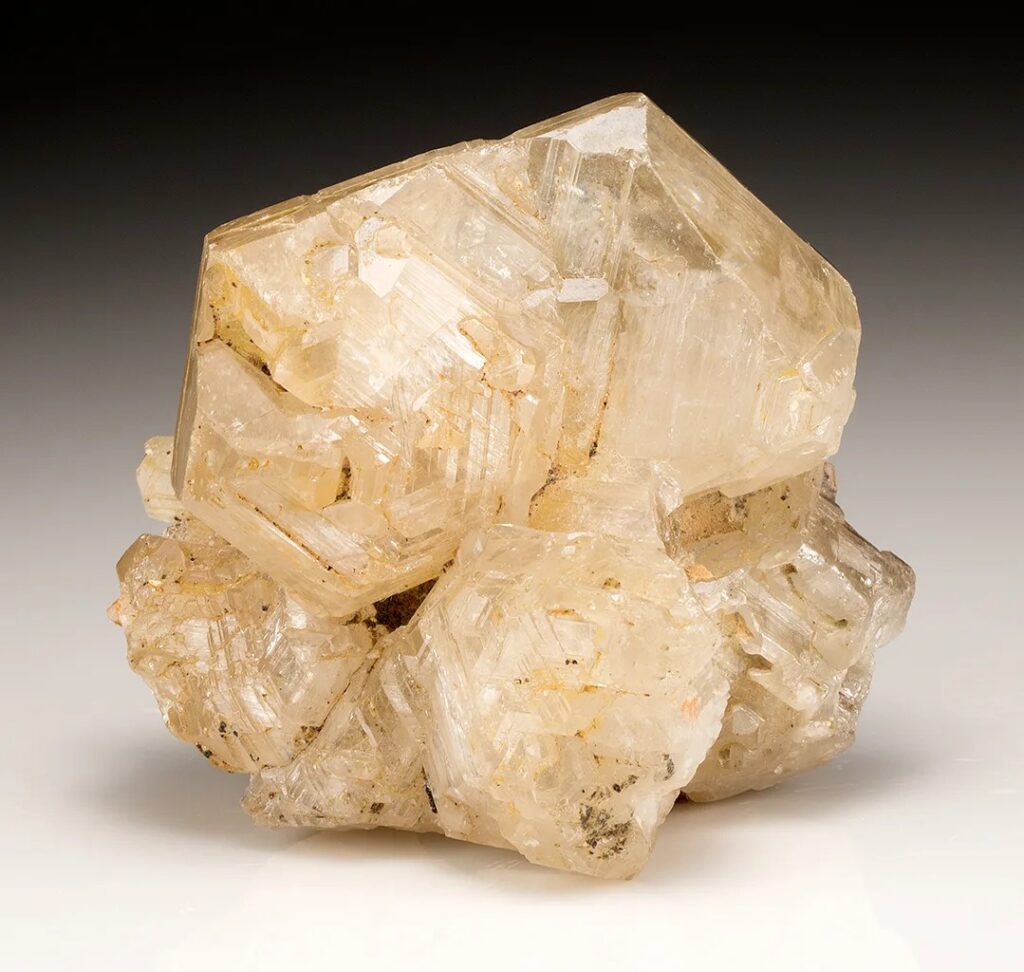
Cerussite is a lead carbonate mineral with the chemical formula PbCO₃. As one of the most important secondary lead minerals, it commonly forms as a weathering product of galena (PbS), the primary ore mineral of lead. Belonging to the carbonate mineral group, cerussite is recognized for its high specific gravity, brilliant luster, and well-developed crystal forms. The name is derived from the Latin word “cerussa,” meaning white lead, which refers to the mineral’s characteristic white color and its historical association with lead carbonate pigments. Although cerussite is usually colorless or white, natural specimens may display gray, yellow, blue-gray, greenish, or brownish tones due to impurities or inclusions of other minerals. It is widely distributed in oxidized zones of lead ore deposits around the world, typically found above primary sulfide deposits where oxygen-rich groundwater interacts with lead-bearing minerals. Because of its distinctive crystal habits and optical properties—such as a high refractive index, strong dispersion, and crystal transparency—cerussite is highly valued among mineral collectors, especially specimens showing complex twinning or unusual formations. Unlike many common carbonate minerals like calcite or aragonite (both CaCO₃), cerussite contains the heavy element lead, giving it an unusually high density that allows it to be easily distinguished from other white carbonate minerals.
History and Discovery of Cerussite
Known since ancient times due to the historical use of lead carbonate compounds in white pigments, cerussite was first described scientifically during the eighteenth-century development of mineralogy, when researchers began separating naturally occurring mineral species from manufactured lead compounds. The modern name “cerussite” was introduced in the early nineteenth century as mineralogists detailed its chemical composition and crystal structure, distinguishing the true lead carbonate mineral species from the artificial materials widely used in paints and cosmetics. Historically important as both a minor ore of lead and a key indicator of weathering processes affecting lead deposits, cerussite typically occurs alongside other secondary minerals such as anglesite (PbSO₄), mimetite (Pb₅(AsO₄)₃Cl), pyromorphite (Pb₅(PO₄)₃Cl), and wulfenite (PbMoO₄). During the nineteenth and twentieth centuries, exceptional specimens from iconic localities like Tsumeb in Namibia captivated museums and collectors by showcasing the mineral’s intricate twinning habits and striking optical properties, securing its status as a highly sought-after collector mineral. Today, cerussite remains a vital subject of mineralogical research, offering deep insights into secondary mineral formation, zone oxidation, and the complex geochemical behavior of lead in natural environments.
Formation and Geological Occurrence of Cerussite
Cerussite is primarily a secondary mineral that forms through the oxidation and alteration of lead sulfide minerals, especially galena, within the upper weathered zones of lead-bearing ore deposits where primary sulfides break down upon contact with oxygen-rich groundwater. During this chemical transformation process, sulfur is removed from the original galena (PbS) while the lead reacts with carbonate-bearing fluids above the water table to yield cerussite (PbCO₃) and other secondary lead minerals. Consequently, cerussite commonly occurs in close association with minerals formed under similar environmental conditions, including galena, anglesite, mimetite, pyromorphite, wulfenite, smithsonite, malachite, calcite, quartz, and limonite. The local geological environment strongly influences its final structural development; open cavities and fractures within host rocks provide the necessary space for well-formed, transparent crystals to grow, whereas restricted spaces result in massive, granular, or crust-like formations. These occurrences are most frequent in hydrothermal ore deposits, particularly limestone-hosted deposits, carbonate rocks, and veins associated with metallic mineralization.
Types and Varieties of Cerussite
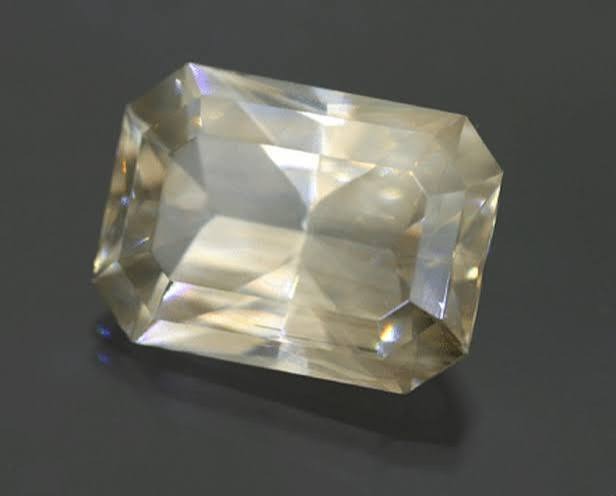
- Transparent Crystal Specimens: Highly coveted, water-clear, gem-like crystals that exhibit intense adamantine luster and serve as choice faceting rough or premium collector pieces.
- Twinned Cerussite: Exceptional crystal aggregates displaying distinct penetration or cyclic twinning patterns, frequently interlocking to create iconic star-shaped, cross-like, or reticulated snowflake geometries.
- Acicular Cerussite: Delicate, needle-like crystal clusters or sprays that form dense, interwoven networks within open rock cavities.
- Massive Cerussite: Compact, fine-grained, or earthy aggregates that lack visible individual crystal faces, commonly forming dense industrial ore zones or heavy crusts.
- Colored Cerussite: Specimens containing trace impurities or mineral inclusions that tint the naturally colorless lattice into distinct shades of smoky grey, pale yellow, rich brown, or pastel green.
Crystal Structure of Cerussite
Cerussite crystallizes in the orthorhombic crystal system, possessing an internal atomic framework that is closely related and structurally analogous to that of aragonite, another prominent orthorhombic carbonate mineral. Within this structural lattice, heavy lead ions are tightly coordinated with planar carbonate groups, creating a stable but relatively complex, dense arrangement that directly accounts for the mineral’s exceptional physical properties. This specific orthorhombic symmetry allows cerussite to develop a rich variety of distinct crystal habits, commonly manifesting as elongated prismatic, flattened tabular, or delicate needle-like acicular crystals depending on the localized geochemical growth conditions.
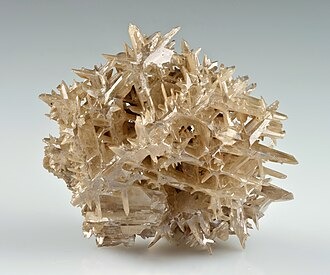
One of the most remarkable and visually defining features dictated by this structural geometry is the mineral’s frequent and spectacular occurrence as complex twins. Cerussite crystals regularly form elaborate penetration and cyclic twins, where multiple individual crystals intergrow at precise angles to create distinctive, highly symmetrical shapes resembling multi-pointed stars, crosses, or intricate, reticulated snowflake-like patterns. These geometric twinned formations are prized by mineralogists and collectors alike for their unique aesthetic appeal. Furthermore, this specific underlying crystal architecture directly contributes to cerussite’s extraordinary optical properties, yielding a remarkably high refractive index and strong birefringence. When transparent, well-developed cerussite crystals are properly illuminated, this structural design allows them to exhibit an intense, adamantine brilliance and vibrant internal reflections that rival or exceed those of most other secondary metallic minerals.
Physical and Chemical Properties of Cerussite
As a lead carbonate mineral (PbCO₃), cerussite exhibits a unique combination of chemical traits heavily influenced by its heavy metal content. Chemically, it belongs to the aragonite mineral group and is composed of approximately 77.5% lead oxide and 22.5% carbon dioxide. When exposed to dilute acids, particularly nitric acid, cerussite reacts easily and dissolves with noticeable effervescence, releasing carbon dioxide gas—a crucial diagnostic chemical test that distinguishes it from non-carbonate heavy lead minerals like anglesite (PbSO₄). While it is stable under typical surface conditions, prolonged exposure to hydrogen sulfide gas in the atmosphere can cause a chemical reaction that darkens the mineral’s surface, creating a thin coating of lead sulfide. Furthermore, under long-wave ultraviolet light, many cerussite specimens exhibit a distinct yellow, cream-colored, or light pink fluorescence, which is frequently used by geologists and collectors for rapid identification in the field.
Physically, cerussite is characterized by its extraordinary density and outstanding optical properties, making it instantly recognizable despite its deceptively light appearance. It possesses an exceptionally high specific gravity ranging from 6.5 to 6.6, giving it an unusually heavy, substantive feel when held in hand—a stark contrast to common, lighter carbonate minerals like calcite. On the Mohs hardness scale, cerussite ranks relatively low between 3 and 3.5, meaning it is quite soft and highly brittle, showing distinct prismatic cleavage and a conchoidal fracture when broken. Its optical properties are among the most impressive of any non-silicate mineral; it features an exceptionally high refractive index varying between 1.80 and 2.07, alongside strong birefringence, which imbues transparent specimens with a brilliant adamantine (diamond-like) to resinous luster. While a chemically pure specimen is completely colorless or white with a white streak, natural variations and trace mineral inclusions frequently tint the crystals into beautiful shades of smoky grey, pale yellow, rich brown, or even light green.
Major Occurrences and Localities of Cerussite
Cerussite is widely distributed throughout many of the world’s prominent lead-mining regions, with certain specific localities gaining international renown for yielding museum-quality specimens. Chief among these is the legendary Tsumeb Mine in Namibia, universally regarded by mineralogists as the premier source for collectible cerussite due to its production of exceptionally transparent, large crystals that exhibit world-class cyclic twinning and breath-taking, reticulated snowflake-like habits. Another highly significant Southern Hemisphere locality is the Broken Hill mining district in New South Wales, Australia, a massive orebody celebrated for producing vast quantities of high-grade cerussite, often found intricately associated with a diverse suite of other beautifully oxidized secondary lead and zinc minerals.
In addition to these southern strongholds, diverse mining regions across Africa, North America, and Europe have historically supplied the global mineral market with outstanding cerussite specimens. Several mining districts in Morocco are famous for producing highly aesthetic, sharply formed crystal clusters associated with regional lead-zinc mineralization. In the United States, important occurrences are heavily tied to historic base-metal mining districts across Arizona, New Mexico, and Idaho, where well-crystallized specimens are recovered from the upper oxidation zones of ancient hydrothermal veins. Meanwhile, historic European lead-mining centers in England (such as Cumbria), Germany, Austria, and Spain have provided essential reference specimens central to the development of early mineralogical science. Other notable global deposits capable of producing fine cerussite include localized lead-zinc operations across Mexico, China, Russia, Kazakhstan, and the Democratic Republic of the Congo.
Applications of Cerussite
Cerussite has historically been used as a minor source of lead because of its high lead content, especially in oxidized zones of lead ore deposits where it occurs in association with galena and other secondary lead minerals. In the past, naturally occurring cerussite and artificially produced lead carbonate compounds were used in the manufacture of white pigments, although these applications have largely declined due to concerns related to lead toxicity and environmental regulations. Today, cerussite has limited industrial use and is mainly valued as a mineral specimen for collectors, museums, and educational displays. Its distinctive crystal forms, high density, strong luster, and complex twinning make it an important mineral for studying crystal growth, oxidation processes in ore deposits, and the geochemical behavior of lead in natural environments. Cerussite specimens are also used in mineralogical research to investigate carbonate mineral structures and secondary mineral formation in weathered mining regions.