
Moldavite is an incredibly rare, naturally occurring glass known scientifically as a tektite. Tektites are born from cataclysmic events: they are formed when a massive meteorite strikes the Earth with such force that it instantly melts the surrounding terrestrial rock, fusing it completely with extraterrestrial material. This superheated, liquid mixture is violently ejected high into the Earth’s upper atmosphere, cooling rapidly as it falls back to the surface to create unique glass formations.
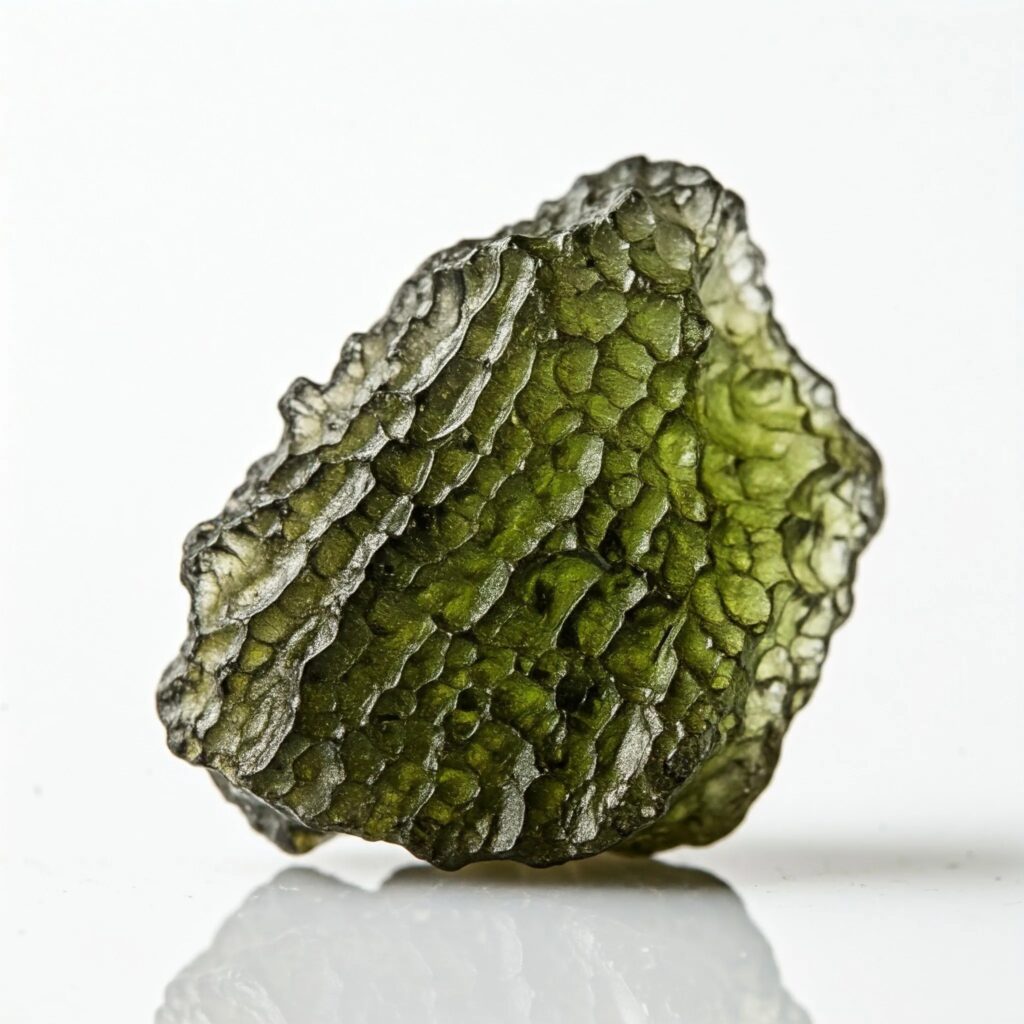
What truly sets Moldavite apart from all other tektites found across the globe is its extraordinary translucent green color. While most tektites (like Australites or Indochinites) are opaque and range from pitch black to dark brown, Moldavite shines in brilliant shades ranging from pale olive and vivid emerald to a deep, mysterious forest green. This exceptional clarity and color make it the only tektite widely cut, polished, and faceted as a mainstream gemstone. Furthermore, if you examine Moldavite closely under a loupe, you will often find microscopic gas bubbles and distinct swirling, wire-like inclusions known as lechatelierite (high-temperature silica glass), which are absolute hallmarks of its violent, otherworldly origin. Because it requires a highly specific, singular cosmic event to form, Moldavite is a finite resource, adding immense allure to its striking physical beauty.
The Fascinating History of Moldavite
The history of Moldavite is deeply intertwined with human civilization, bridging the gap between ancient survival and modern spirituality. Its official name is derived from the Vltava River (known as the Moldau in German) in the Czech Republic. It was near this river that the first officially recorded pieces were introduced to the scientific community in 1787 by Professor Josef Mayer of Prague University, who initially misidentified the strange green fragments as a type of chrysolite.
However, human interaction with Moldavite dates back much further than the 18th century. Archaeological discoveries have revealed that Paleolithic humans prized Moldavite for its sharp edges and glassy nature, utilizing it for crafting cutting tools, arrowheads, and spiritual amulets. The most famous historical example is the discovery of worked Moldavite fragments found alongside the Venus of Willendorf, an iconic fertility statue unearthed in Austria dating back approximately 25,000 years.Beyond its practical uses, Moldavite has long been steeped in folklore and legend. In Eastern Europe, it was traditionally treated as a potent stone of good fortune and fertility. For centuries, it was customarily given as a betrothal gift to bring harmony and prosperity to marital relations. Some historians and esoteric scholars even suggest that Moldavite could be the stone of the legendary Holy Grail, which was sometimes described in medieval texts as an emerald that fell from the sky, rather than a golden chalice. Today, its historical pedigree has only amplified its popularity, cementing it as a gemstone wrapped in millennia of human fascination.
How is Moldavite Formed?
The genesis of Moldavite is a breathtaking tale of cosmic violence and immense geological transformation. Approximately 14.8 million years ago, during the middle of the Miocene epoch, a massive asteroid—estimated to be nearly a mile in diameter—crashed into what is now the Bavarian region of southern Germany. Traveling at cosmic speeds, the impact unleashed energy equivalent to thousands of nuclear bombs. This catastrophic collision created the massive Nördlinger Ries crater, which currently measures roughly 15 miles across.
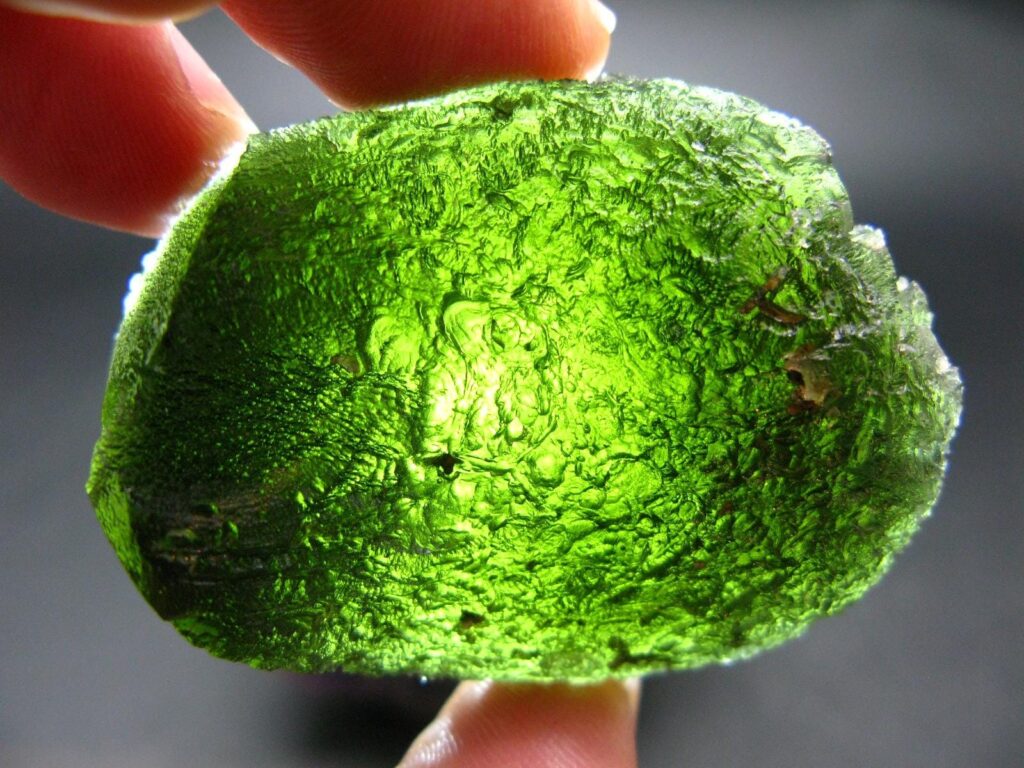
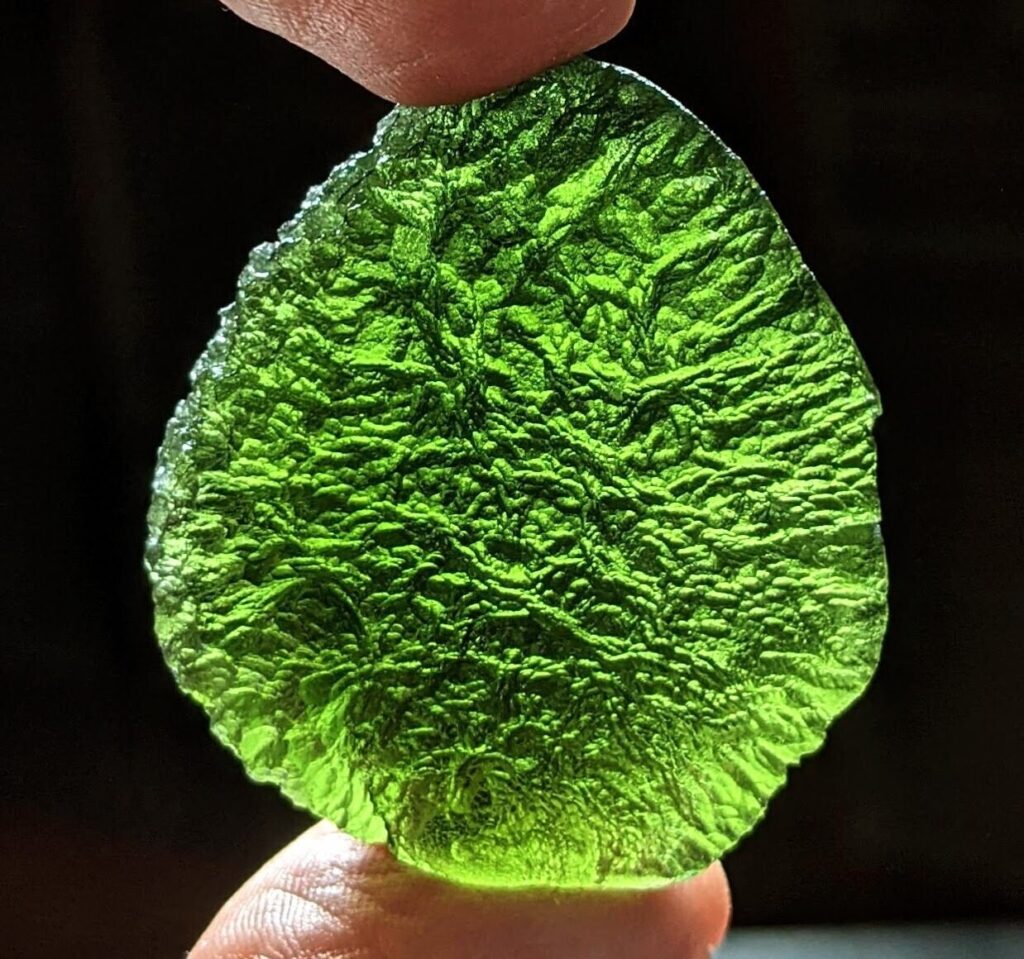
The intense heat of the impact, reaching temperatures exceeding 30,000 degrees Celsius, instantly vaporized the meteorite and melted the local quartz-rich sedimentary soil and sand. This molten silicate material was blasted upwards at supersonic speeds, escaping the immediate atmosphere and entering the near-vacuum of the upper stratosphere. As the liquid glass soared through the frigid upper atmosphere, it cooled rapidly. The aerodynamics of this flight shaped the molten drops into distinct forms: spheres, teardrops, dumbbells, and flattened discs.These hardened glass projectiles then rained down over a massive “strewn field” hundreds of miles away, primarily landing in the specific geographical basins of the modern-day Czech Republic. But the formation process did not end there. Over the next 15 million years, these buried glass fragments were subjected to slightly acidic groundwater and shifting soils. This prolonged chemical weathering ate away at the glass, creating the deeply etched, heavily textured, and deeply grooved surfaces—often referred to as “sculpturing” or “wrinkles”—that are the defining visual characteristic of raw Moldavite today.
Types of Moldavite
While all Moldavite shares the same celestial origin, the variations in soil composition, flight paths, and landing environments have resulted in several distinct types. The classification is largely based on the specific locality where the stones are mined.
- South Bohemian Moldavites: These are the most highly sought-after and classic examples of the stone. They are typically characterized by a lighter, vibrant emerald-to-bottle-green color. They often feature deep, dramatic texturing (known as sculpturing or “wrinkles”) caused by millions of years of natural acidic etching in the soil.
- Moravian Moldavites: Found in the eastern part of the Czech Republic, these tektites tend to be larger and heavier. Their color is usually a darker, brownish-green or olive tone. Moravian Moldavites generally have a smoother surface with less pronounced etching compared to their Bohemian counterparts.
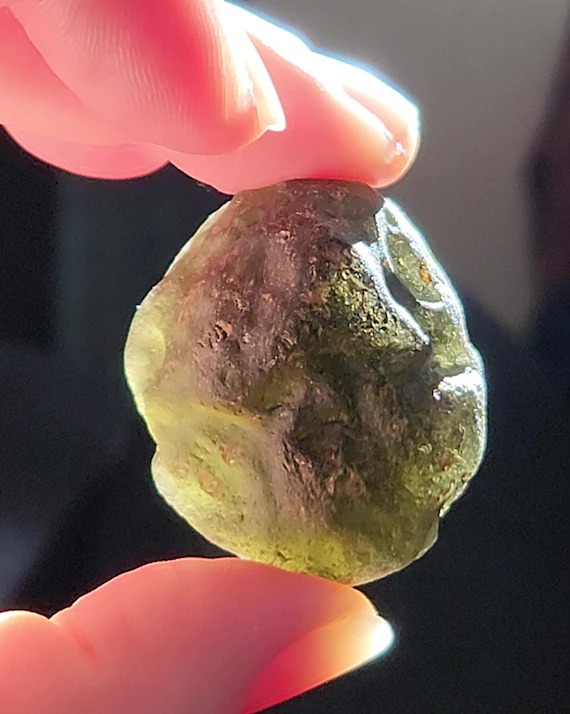
- Besednice Moldavites: Hailing from the Besednice field in South Bohemia, these are widely considered the most beautiful and valuable raw Moldavites. They are famous for their extreme, spiky textures, earning them the nickname “hedgehogs.” The intricate lacework of these stones makes them highly prized among collectors.
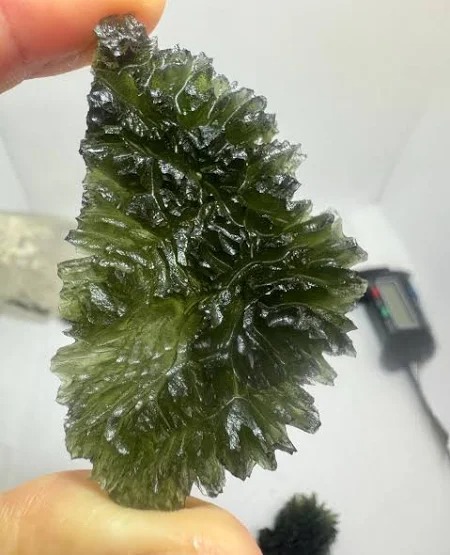
- Chlum Moldavites: Mined from the Chlum area, these stones are relatively abundant and are frequently used in commercial jewelry. They offer a balanced, classic green color and often possess a pleasant, moderate texture that appeals to both collectors and gem cutters.
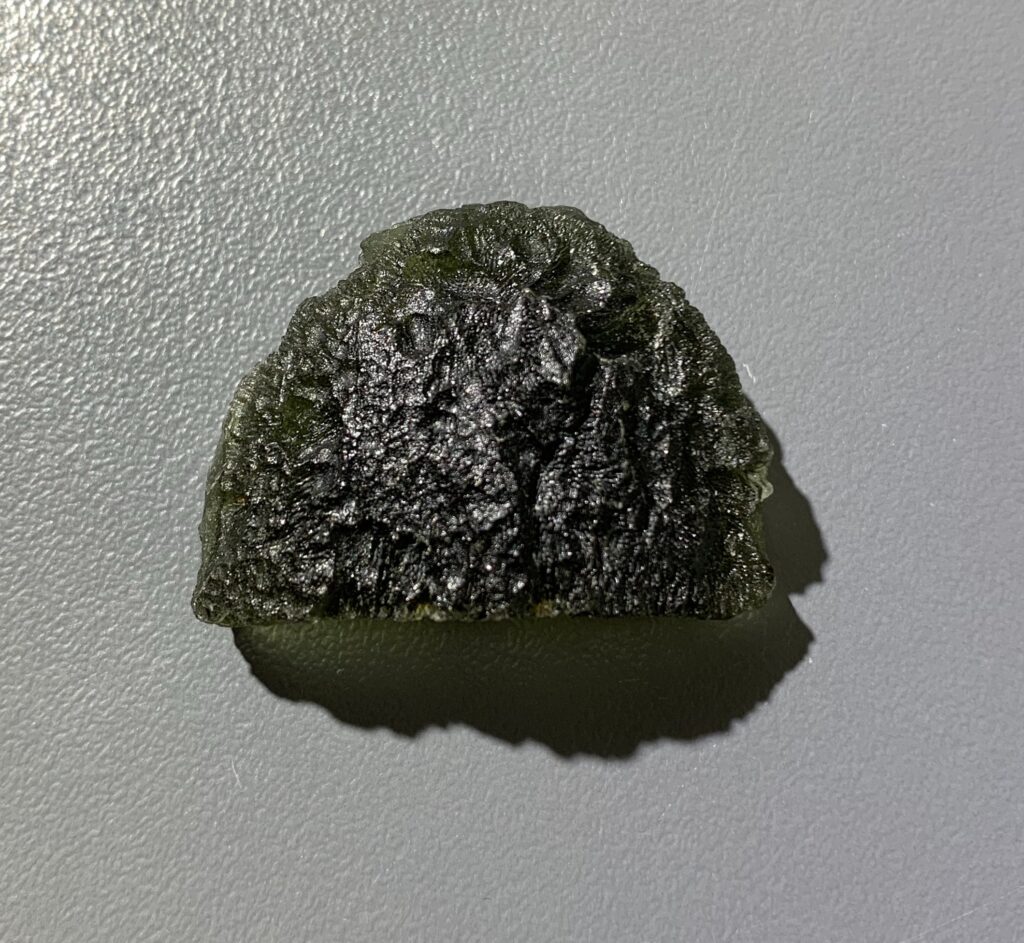
- Poison Green Moldavites: This is not a geographic location but a color classification. These rare pieces exhibit an exceptionally bright, neon-like yellow-green hue. Because of their striking and uncommon coloration, they command a premium price on the gemstone market.
Crystal Structure, Physical, and Chemical Properties
From a mineralogical perspective, Moldavite is incredibly unique. Because it cooled so rapidly as it fell through the atmosphere, it never had the time to develop a crystalline structure. Therefore, Moldavite is classified as amorphous, meaning it lacks a defined, internal crystal lattice; it is a true glass.
Chemically, Moldavite is a silica-rich glass (lechatelierite). Its composition is predominantly silicon dioxide (SiO₂), usually making up about 80% of its mass. The remaining 20% is a complex blend of aluminum oxide (Al₂O₃), potassium oxide (K₂O), calcium oxide (CaO), and trace amounts of iron, which is primarily responsible for its signature green color. One of the most fascinating chemical features of Moldavite is the presence of microscopic, trapped gas bubbles. The pressure inside these bubbles is remarkably low—about one-half to one-third of sea-level atmospheric pressure—confirming that the glass cooled in the upper atmosphere.
Physically, Moldavite ranks between 5.5 and 6 on the Mohs scale of hardness, making it similar to ordinary window glass. It has a specific gravity ranging from 2.27 to 2.40 and an intricate surface texture—ranging from pitted and deeply grooved to smooth and aerodynamic—caused by both its flight and millions of years of groundwater etching.
Origins and Mining Locations
The primary geographical origin of Moldavite is exclusively tied to the strewn field created by the Ries impact. Over 99% of all Moldavite in the world is found in the Czech Republic, specifically within the regions of South Bohemia and Moravia. Very small, trace amounts have occasionally been discovered in neighboring areas of Austria (Waldviertel) and Germany (Lusatia), but these are incredibly rare.
Mining Moldavite is a labor-intensive process. The stones are typically found buried deep within tertiary and quaternary gravel sands. Over the decades, heavy commercial mining and aggressive illegal digging have severely depleted the natural reserves. Today, many of the original commercial mines have been exhausted and closed. Because it is a finite resource born from a singular cosmic event, Moldavite is becoming increasingly rare, driving up its value significantly year after year.
Applications and Uses of Moldavite
Today, Moldavite serves several distinct purposes across different fields. Its primary commercial application is in fine jewelry. Because of its beautiful color and cosmic origin, raw pieces are often wire-wrapped or set in silver and gold, while larger, cleaner stones are faceted into stunning gems for rings, pendants, and earrings. However, due to its relatively low hardness (5.5 on the Mohs scale), jewelers often recommend setting Moldavite in pendants and earrings rather than rings to protect it from scratches and impacts.Moldavite holds immense value in the metaphysical and spiritual communities. It is widely regarded as a “stone of transformation.” Crystal healers and enthusiasts believe that its high vibrational energy can accelerate spiritual awakening, facilitate deep personal change, and clear energy blockages. This reputation has caused a massive surge in its popularity in recent years.
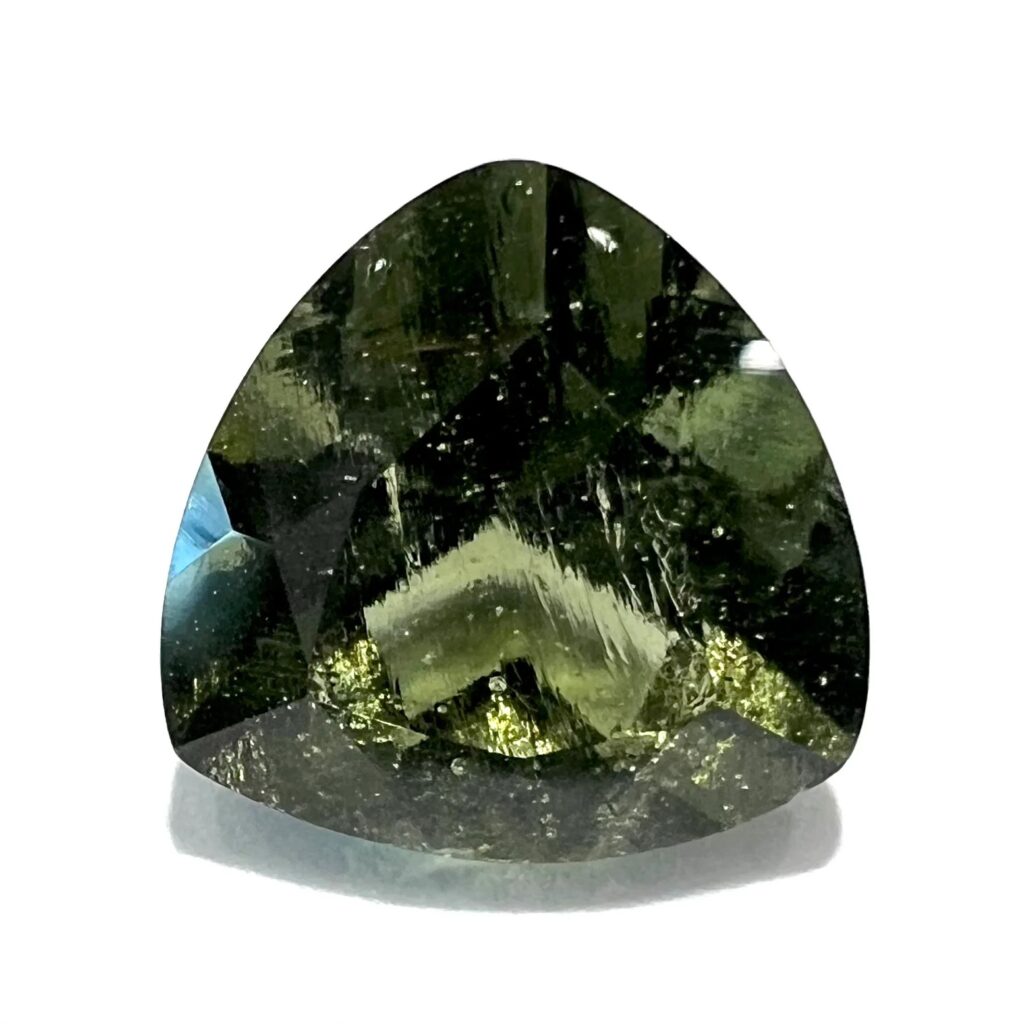
Finally, Moldavite is highly sought after by mineral collectors and scientific researchers. For scientists, these tektites provide invaluable data regarding meteorite impacts, atmospheric entry dynamics, and the geological history of the Miocene epoch. For collectors, owning a piece of Moldavite is akin to holding a frozen piece of a cosmic collision—a beautiful, green fragment of Earth’s violent and awe-inspiring geological past.