
Mordenite is a highly siliceous natural zeolite mineral with the idealized chemical formula (Ca,Na₂,K₂)Al₂Si₁₀O₂₄·7H₂O. Belonging to the aluminosilicate framework family, it is characterized by its high ratio of silicon to aluminum, which grants it remarkable thermal stability and resistance to acidic environments compared to other zeolites.
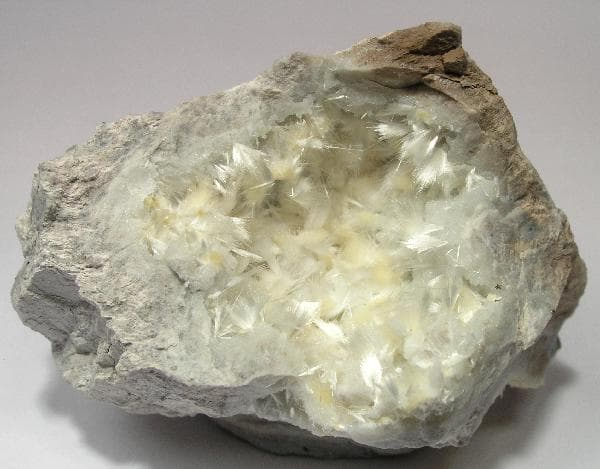
Structurally, mordenite crystallizes in the orthorhombic crystal system. In its natural state, it rarely forms large, distinct individual crystals; instead, it typically aggregates into fibrous, acicular (needle-like), or cottony masses. These fibrous networks are porous at the molecular level, containing parallel channels that allow the mineral to trap and exchange specific cations (like calcium, sodium, and potassium) and water molecules. This microscopic “cage-like” architecture makes mordenite an exceptionally effective natural adsorbent and catalyst, highly sought after in the petrochemical industry, agriculture, and environmental remediation.
The History and Discovery of Mordenite
The history of mordenite dates back to the mid-19th century during the golden age of descriptive mineralogy. The mineral was first discovered and officially described in 1864 by Henry How, a prominent British-Canadian chemist and mineralogist who served as a professor at King’s College in Nova Scotia.How discovered the unfamiliar, fibrous mineral along the rugged basaltic coastlines of the Bay of Fundy. He named the mineral “Mordenite” after its type locality: Morden, a small coastal community in Kings County, Nova Scotia, Canada.For decades following its discovery, mordenite remained a geological curiosity—a fascinating specimen for academic study but with little practical use. However, in the mid-20th century, scientists began to unravel the complex micro-porous structure of zeolites. When the synthetic chemical industry realized that mordenite’s high-silica framework could withstand harsh industrial acids and extreme temperatures, it transitioned from a museum specimen to a highly valued industrial commodity, prompting global surveys to locate major natural deposits.
Geological Formation and Occurrence
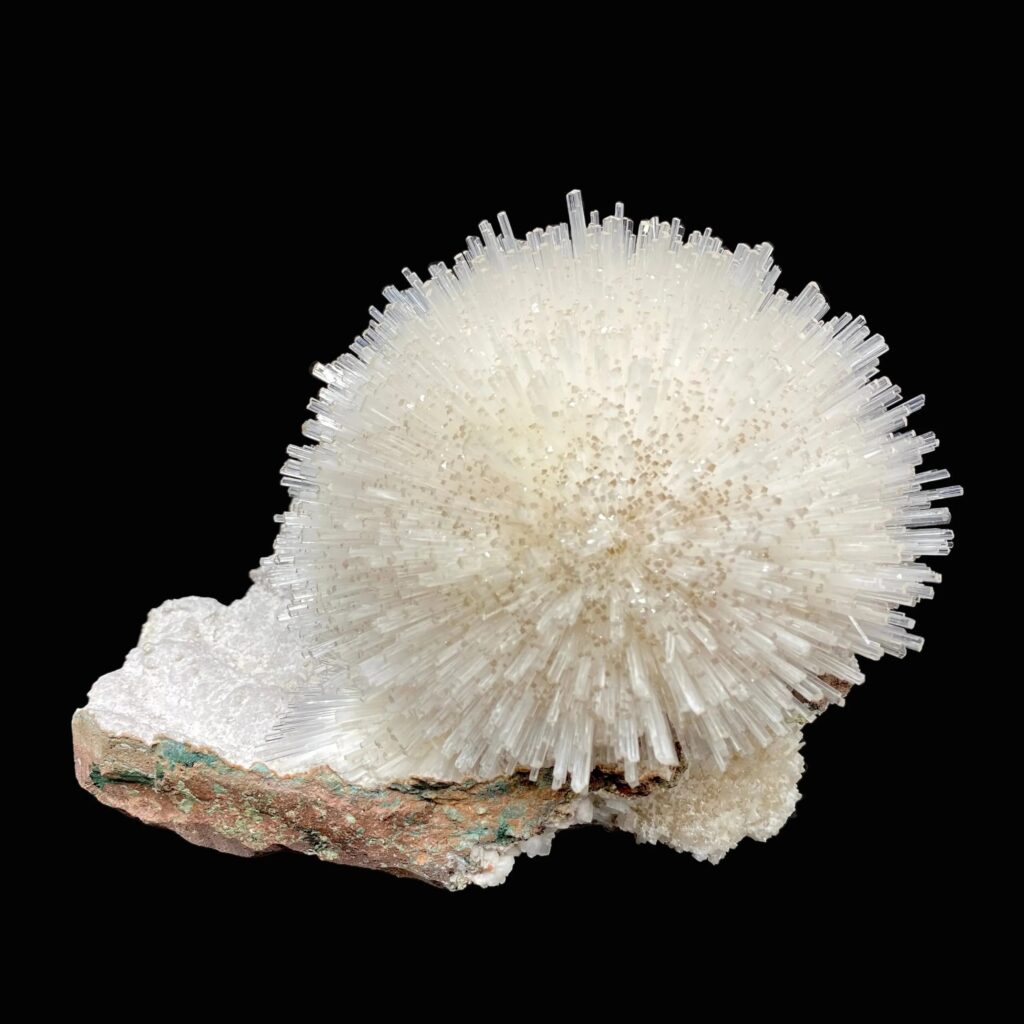
The formation of mordenite is an intricate geological process deeply tied to volcanic activity and hydrothermal alteration. As a secondary mineral, mordenite does not crystallize directly from molten magma. Instead, it forms through the alteration of glassy volcanic rocks over thousands to millions of years.
- Hydrothermal Alteration of Volcanic Rocks: Mordenite is most frequently found in the vesicles (gas cavities) and fractures of igneous rocks such as basalts, andesites, and rhyolites. When superheated, mineral-rich groundwater (hydrothermal fluids) percolates through these cooling volcanic rocks, it reacts with the volcanic glass. The resulting chemical precipitation slowly fills the cavities with mordenite crystals, often alongside other secondary minerals like quartz, calcite, and various other zeolites (e.g., heulandite or stilbite).
- Diagenesis of Volcanic Ash in Marine Environments: Massive, commercially viable beds of mordenite often form through diagenesis—the physical and chemical changes occurring during the conversion of sediment to sedimentary rock. When thick layers of volcanic ash settle into saline, alkaline lakes or shallow marine environments, the ash reacts with the pore waters. Over time, under relatively low temperatures and moderate pressure, the ash beds are chemically transformed into vast deposits of high-purity mordenite tuff.
- Geothermal Fields: Modern mordenite formation can be actively observed in active geothermal areas, such as those in Iceland, New Zealand, and the western United States, where high geothermal gradients drive the continuous alteration of shallow rock formations.
Types and Varieties of Mordenite
Natural vs. Synthetic Mordenite
Found in geological deposits, natural mordenite often contains impurities and various trapped alkaline cations (like calcium, potassium, and sodium). While excellent for agriculture, bulk adsorbents, and water treatment, its natural state often features restricted pore channels.
Manufactured in laboratories via organic-free hydrothermal synthesis using precise mixtures of Na₂O, SiO₂, and Al₂O₃. Synthetic mordenite offers ultra-high purity and customizable crystalline morphologies (e.g., fibrous, rod-like, or thin nanosheets), making it the standard for strict catalytic requirements in chemistry.
Small-Port vs. Large-Port Mordenite
Generally characteristic of natural mordenite. In small-port varieties, the channel pathways are partially blocked by naturally occurring cations, debris, or stacking faults. Molecules larger than 4.5 Å generally cannot enter these pores.
Most synthetic mordenites are engineered as “large-port.” The channel structures are clear and unblocked, allowing larger molecules (up to ~7.0 Å) to enter, react, and exit, functioning as a highly efficient molecular sieve.
High-Silica vs. Low-Silica
The ratio of SiO₂ to Al₂O₃ heavily dictates the mineral’s characteristics. High-silica mordenite (often achieved through chemical treatments like dealumination) provides superior acid resistance and exceptional thermal stability compared to its low-silica counterparts.
Geological Formation and Global Localities
The geological genesis of natural mordenite is an intricate, multi-stage process fundamentally tied to low-grade metamorphism and volcanic activity. As a secondary mineral, mordenite does not crystallize directly from a cooling magmatic melt; instead, it develops extensively within hydrologically closed systems, alkaline desert lakes, and marine basins through the hydrothermal alteration of highly siliceous, glassy volcanic rocks such as rhyolite, pumice, andesite, and basalt. Over spans of thousands to millions of years, as superheated, mineral-rich groundwater or alkaline pore fluids percolate through thick blankets of cooling volcanic ash or fractured tectonic igneous formations, a profound chemical transformation occurs. This pervasive diagenetic process breaks down the unstable volcanic glass, triggering the slow chemical precipitation of aluminosilicate frameworks and ultimately transforming entire stratal layers into vast, consolidated beds of high-purity mordenite tuff.
On a global scale, these complex geological environments have yielded significant deposits, beginning with the historic type locality in Canada, where mordenite was first discovered and officially documented in 1864 within the coastal community of Morden, Nova Scotia. Here, the mineral typically occurs as delicate fillings inside the gas vesicles of ancient basaltic lava flows along the rugged cliffs of the Bay of Fundy. Beyond this historic Canadian site, the United States boasts massive, economically viable, and highly localized deposits of mordenite-rich zeolitic tuff, which are actively quarried across the arid western states, most notably throughout the volcanic regions of Nevada, Idaho, and California. Across the Pacific, Japan hosts some of the world’s most significant and exceptionally high-purity natural mordenite reserves, seamlessly integrating the mined material into its advanced domestic environmental filtration and agricultural sectors. Meanwhile, the European continent offers a diverse mineralogical spread, characterized by high-quality industrial-grade deposits and stunning, display-grade museum specimens carefully documented throughout the volcanic terrains of Italy, Hungary, and Russia, as well as within the world-famous, pristine vesicular basalts of Iceland.
Crystal Structure and Framework
The intricate microscopic architecture of mordenite is precisely what makes it an object of profound scientific fascination and a cornerstone of modern molecular engineering. Officially assigned the unique framework type code MOR by the International Zeolite Association, its crystalline layout functions at the atomic level as a highly ordered, microscopic sponge or a rigid molecular sieve designed to selectively trap specific cations and volatile gases while permitting other compounds to pass through unhindered. This highly complex, porous structure belongs to the orthorhombic crystal system, and its overarching structural skeleton is built from a dense network of cross-linked silicate and aluminate tetrahedra that arrange themselves into characteristic chains of five-membered rings.
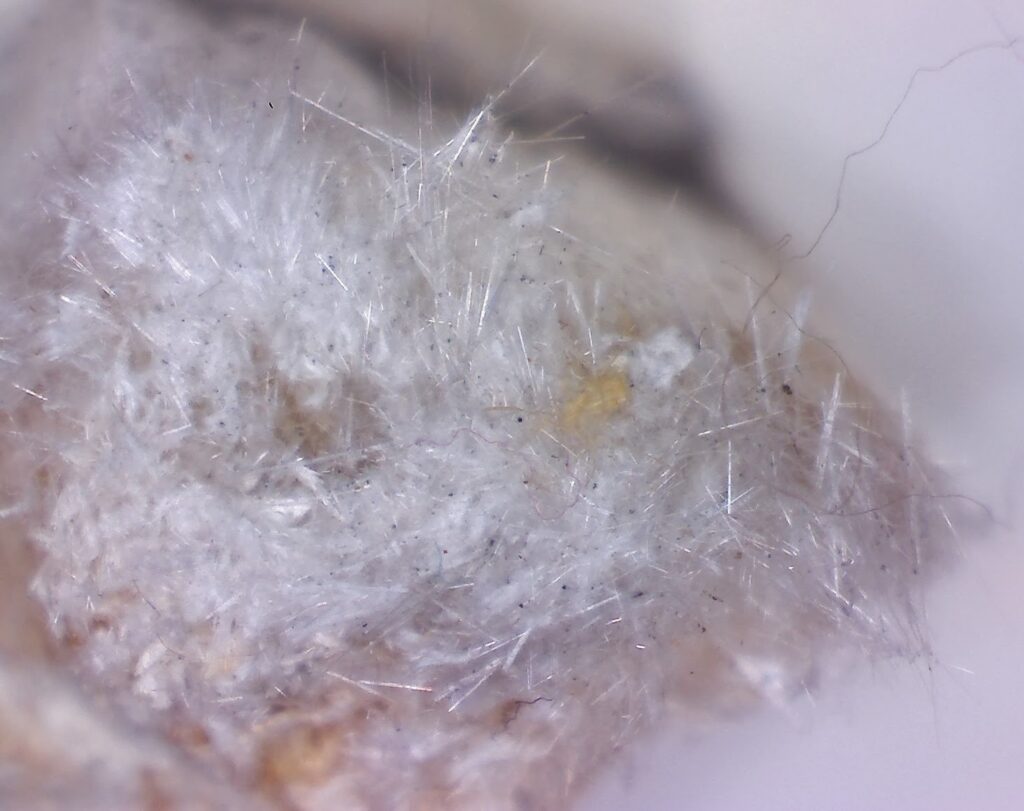
Unlike many other common zeolites that feature highly interconnected, three-dimensional channel pathways, the MOR framework is distinctly characterized by a predominantly one-dimensional (1D) pore system. The primary highway for molecular diffusion consists of large, linear main channels formed by twelve-membered oxygen rings, which possess an internal elliptical diameter measuring approximately 6.5 × 7.0 Å and run completely parallel to the crystal’s c-axis. These spacious, primary channels are intricately intersected by smaller, eight-membered oxygen rings measuring roughly 2.6 × 5.7 Å, creating restricted structural recesses known in advanced chemistry as “side pockets.” Because these narrow side pockets terminate prematurely and fail to completely cross-connect the parallel main channels, passing molecules cannot bypass structural blockages by shifting sideways; instead, they are forced to travel in a strict, linear fashion directly through the primary one-dimensional pores, giving mordenite its highly specialized shape-selective catalytic profile.
Physical and Chemical Properties
Mordenite stands out remarkably among the broader zeolite mineral group due to its exceptional physical durability and chemical resilience under extreme environmental stress. This innate stability is fundamentally dictated by its idealized chemical formula, (Ca,Na₂,K₂)Al₂Si₁₀O₂₄·7H₂O, which reveals a characteristically high ratio of silicon to aluminum atoms within its underlying framework. This elevated silica content grants the mineral a remarkably robust chemical profile, providing it with the unique structural fortitude required to survive highly aggressive, corrosive environments that would completely dissolve or degrade more sensitive aluminosilicate minerals. Physically, it exhibits a hardness rating of 4 to 5 on the Mohs scale—making it notably harder and less brittle than most other natural zeolites—and possesses a relatively low specific gravity and density of approximately 2.1 g/cm³ due to its extensive internal porosity.
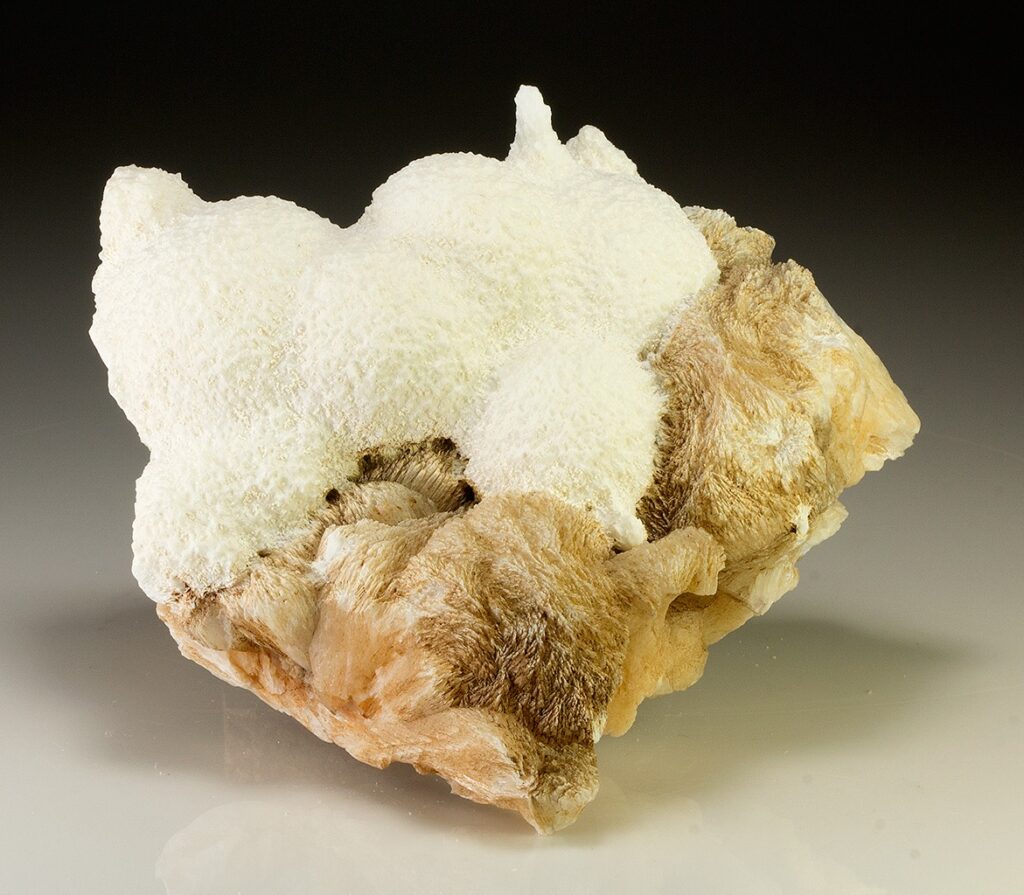
Chemically, mordenite boasts a virtually unparalleled thermal stability profile, allowing its rigid atomic crystal lattice to safely withstand intense industrial processing temperatures up to 800°C without suffering structural collapse or dehydration-induced degradation. Furthermore, its unique high-silica composition makes it highly resistant to harsh acid attacks, which serves as a vital operational trait when the mineral is deployed in demanding petrochemical reactions and acidic wastewater environments. When observed in its natural state, mordenite is typically colorless, stark white, or shaded with a pale, faint yellow hue. Rather than forming large, isolated, and well-defined prismatic crystals, it almost exclusively manifests as striking, densely aggregated masses of fibrous, acicular needle-like arrays, or as delicate, cotton-like mineral puffs nestled safely inside protective rock cavities.
Modern Industrial Applications
Because of its large pore size, strong solid acidity, and structural stability, mordenite—commonly referred to simply as MOR zeolite in commercial sectors—is recognized as one of the fundamental materials in global industry. It has transitioned from a mere geological curiosity to a cornerstone of green chemistry and petroleum refining.
- Petrochemical Catalysis: Synthetic mordenite is extensively utilized in hydrocracking heavy fuel oils, the alkylation of aromatics, and the isomerization of light alkanes, which is crucial for producing high-octane, cleaner-burning gasoline.
- Gas Separation (PSA Technology): Acting as a precise molecular sieve, mordenite is used in Pressure Swing Adsorption systems to separate oxygen and nitrogen from ambient air, generating high-purity medical and industrial oxygen.
- Environmental Remediation: Its strong ion-exchange capacity makes it an excellent adsorbent for treating industrial wastewater. It captures toxic heavy metals (like lead) and traps dangerous radioactive isotopes (such as cesium and strontium) from nuclear waste.
- Agriculture and Animal Husbandry: Crushed natural mordenite is added to animal feed to improve digestion and absorb harmful gastrointestinal mycotoxins. It also serves as a slow-release fertilizer matrix and an effective soil conditioner for moisture regulation.