
Olivenite is a relatively uncommon secondary copper arsenate hydroxide mineral with the chemical formula Cu₂AsO₄(OH). Structurally, it belongs to the monoclinic crystal system (though it is pseudo-orthorhombic) and forms an isomorphous series with other minerals like adamite (Zn₂AsO₄OH) and libethenite (Cu₂PO₄OH). The mineral is highly regarded by collectors for its striking diversity in crystal habits. It can present as small, brilliant prismatic crystals, needle-like (acicular) sprays, globular aggregates, or velvety coatings. Its name is directly derived from its characteristic olive-green coloration, though its actual palette ranges significantly from deep blackish-green and yellowish-brown to a pale, grayish-white hue. On the Mohs hardness scale, olivenite registers at a moderate 3, with a specific gravity fluctuating between 4.1 and 4.5 depending on chemical impurities.
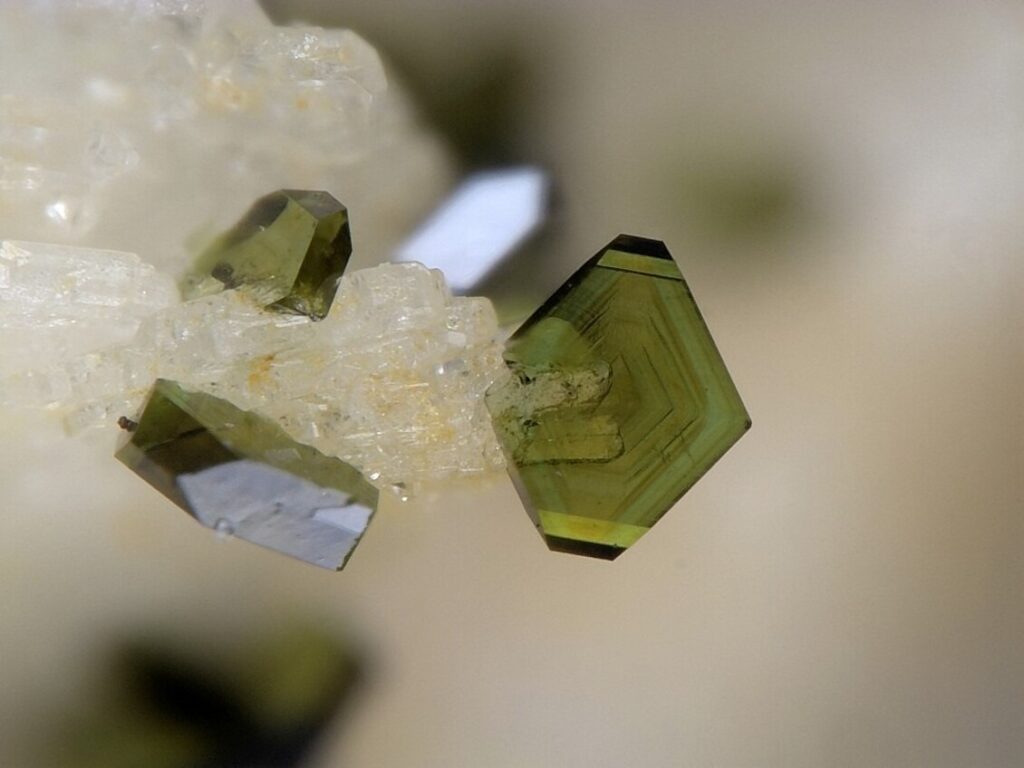
Olivenite is fundamentally a mineral of secondary origin, meaning it does not crystallize directly from primary magmatic or hydrothermal fluids. Instead, it forms within the upper oxidized zones (often referred to as the “gossan”) of copper ore deposits that are notably rich in arsenic-bearing primary minerals, such as enargite, tennantite, or arsenopyrite. When these primary sulfide ores are exposed to weathering, oxygenated meteoric water (rainwater) breaks them down, releasing copper and arsenic ions into solution. As these acidic, mineral-laden fluids slowly percolate through surrounding rocks and neutralize, olivenite precipitates out of solution into cavities, fractures, and vugs. It frequently occurs alongside a suite of associated secondary minerals, including malachite, azurite, conichalcite, clinoclase, and iron oxides like limonite. A distinct, finely fibrous, radiating variety of olivenite—traditionally called “wood copper”—resembles the grain of wood due to concentric color banding caused by alternating environmental conditions during its slow precipitation.
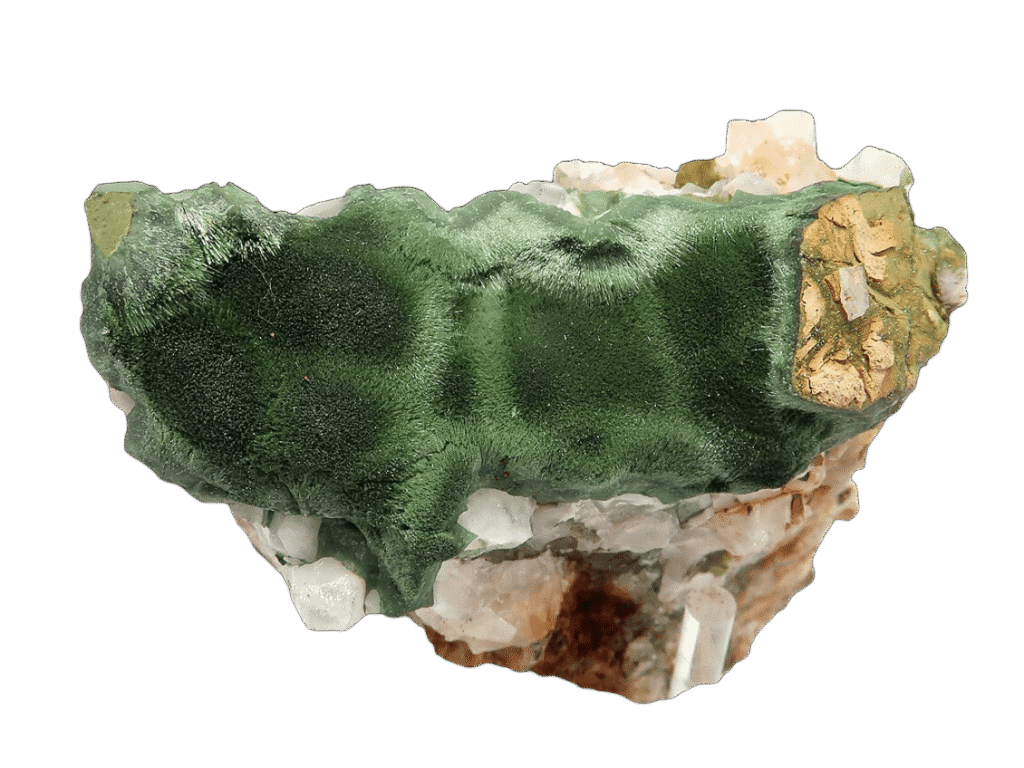
The history of olivenite dates back to the golden era of European mineralogy and analytical chemistry in the late 18th century. In 1786, the renowned German chemist Martin Heinrich Klaproth—celebrated as the father of analytical chemistry—isolated and analyzed an unusual olive-green mineral retrieved from the Carharrack and Wheal Virgin mines in the Cornwall district of England. He documented it objectively as a “copper mineralized by the acid of arsenic,” though he did not officially name it. A few years later, in 1789, the prominent geologist Abraham Gottlob Werner officially introduced the mineral to scientific literature under the German name Olivenerz (olive ore), explicitly highlighting its distinctive color. The nomenclature underwent its final major evolution in 1820 when the Scottish mineralogist Robert Jameson anglicized Werner’s term, shifting the suffix to establish the modern name “olivenite.” Historically, the premier source for world-class specimens was the St Day mining district in Cornwall, though remarkable localities have since been developed globally, most notably the Tsumeb Mine in Namibia and the Tintic Mining District in Utah, USA.
Crystal Structure and Symmetry
Olivenite is a secondary copper arsenate mineral that crystallizes in the monoclinic crystal system and belongs to the prismatic crystal class (2/m), with the space group P2₁/n. Although formally monoclinic, the mineral displays a pronounced pseudo-orthorhombic character because its crystallographic beta angle lies extremely close to 90°, while the axial parameters (a = 8.59 Å, b = 8.21 Å, c = 5.93 Å) approximate the proportions of an orthorhombic lattice. This pseudo-symmetry has historically complicated its crystallographic interpretation and contributed to earlier misidentifications with related arsenate minerals. The monoclinic distortion, however, remains structurally significant, particularly in relation to the ordering of copper coordination polyhedra and hydroxyl groups within the framework.
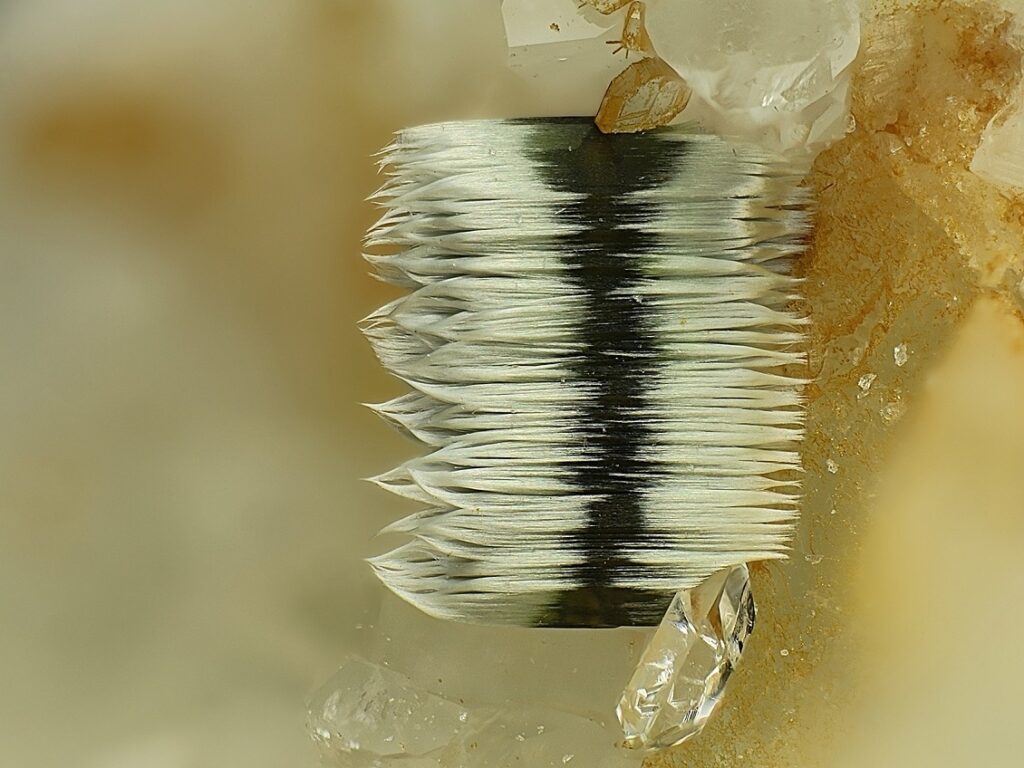
At the atomic scale, the structure of olivenite is dominated by infinite chains of edge-sharing CuO₄(OH)₂ octahedra extending parallel to the crystallographic c-axis. These octahedral chains form the backbone of the crystal architecture and are interconnected laterally by isolated arsenate tetrahedra (AsO₄) together with five-coordinated copper polyhedra that can be described as CuO₄OH triangular bipyramids. The resulting framework is relatively compact and strongly bonded, accounting for the mineral’s comparatively high density among secondary arsenates. Structural distortions are largely governed by the Jahn–Teller effect associated with Cu²⁺ ions, which elongates specific copper–oxygen bonds and contributes to the anisotropic optical and physical behavior observed in the mineral.
Olivenite also possesses considerable mineralogical significance because of its structural relationships with other members of the adamite mineral group. It forms a complete solid-solution series with adamite, Zn₂AsO₄OH, in which zinc progressively substitutes for copper within the crystal lattice. Intermediate compositions are commonly referred to as cuproadamite and exhibit gradual transitions in color, density, and optical properties. In addition, olivenite is dimorphous with paradamite, meaning both minerals share the same chemical composition but crystallize in different structural arrangements. Whereas olivenite adopts a monoclinic framework, paradamite crystallizes in the triclinic system, demonstrating how variations in atomic ordering and symmetry can produce distinct mineral species despite identical chemistry. These crystallographic relationships make olivenite an important reference mineral in studies of polymorphism, isomorphous substitution, and low-temperature supergene mineral formation.
Physical and Chemical Properties
Chemically, olivenite is classified as a basic copper arsenate with the idealized formula Cu₂AsO₄(OH). Its composition consists predominantly of copper, arsenic, oxygen, and hydrogen, with copper accounting for nearly half of the mineral’s total mass. Minor elemental substitutions, particularly involving zinc, phosphorus, or occasionally iron, may occur within the lattice and can slightly modify both physical appearance and measurable properties. The mineral typically forms in the oxidized zones of copper ore deposits, where arsenic-bearing hydrothermal minerals undergo secondary alteration under near-surface conditions. Because of its arsenate chemistry, olivenite is commonly associated with other secondary copper minerals such as malachite, azurite, adamite, and conichalcite.
One of the defining chemical characteristics of olivenite is its reactivity with acids. The mineral dissolves readily in hydrochloric acid and nitric acid, releasing copper and arsenic ions into solution. This behavior sharply contrasts with the greater chemical resistance shown by many silicate minerals and reflects the comparatively weaker bonding environment of arsenate groups under acidic conditions. Such solubility is important both mineralogically and environmentally, as arsenate-bearing minerals can contribute to arsenic mobility in oxidized mining environments. Thermal stability is also relatively limited; under elevated temperatures, olivenite may dehydrate or decompose into other copper arsenate phases.
From a physical perspective, olivenite is considered moderately soft, possessing a Mohs hardness of approximately 3. The mineral is brittle and fractures unevenly to subconchoidally when subjected to stress, indicating limited resistance to mechanical deformation. Cleavage is distinct though imperfect, particularly along the {120} and {010} crystallographic planes, where structural weaknesses occur between linked polyhedral chains. The specific gravity generally ranges between 4.1 and 4.4, reflecting the substantial contribution of heavy copper and arsenic atoms to the crystal structure. Variations in density are commonly linked to compositional substitutions, especially the partial replacement of copper by lighter zinc ions. Morphologically, olivenite may occur as short prismatic crystals, fibrous aggregates, botryoidal crusts, or radiating acicular masses, with crystal habit often depending on the geochemical conditions of formation.
Color and Optical Characteristics
The most recognizable feature of olivenite is its characteristic olive-green coloration, from which the mineral derives its name. This coloration originates primarily from electronic crystal-field transitions involving divalent copper ions (Cu²⁺) situated within distorted coordination polyhedra. The interaction between incident light and the partially filled d-orbitals of copper produces selective absorption in the visible spectrum, generating the distinctive green hues associated with the mineral. Nevertheless, olivenite exhibits a remarkably broad color range depending on crystal habit, impurities, and degree of alteration. Well-formed prismatic crystals are frequently deep olive-green to nearly black, while fibrous or acicular varieties may appear yellowish-brown, straw-yellow, or pale green. Finely fibrous aggregates historically known as “wood copper” can even display grayish-white tones with only faint green coloration.
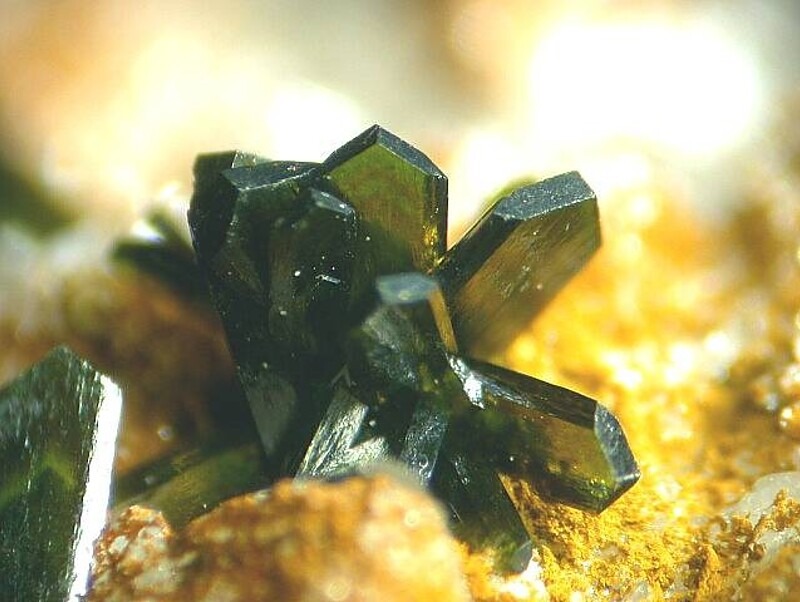
The streak of olivenite is typically olive-green to brown, providing a useful diagnostic feature in hand-specimen identification. Luster varies considerably according to crystal morphology and surface condition. Fresh crystal faces commonly exhibit a vitreous or glassy appearance, whereas compact aggregates may display an adamantine brilliance approaching a diamond-like sheen. Fibrous specimens often develop silky or pearly lusters caused by light scattering across parallel crystal fibers. Transparency ranges from transparent in thin crystals to translucent or opaque in massive aggregates, particularly when impurities or microscopic inclusions are present.
Optically, olivenite is a biaxial mineral with exceptionally high refractive indices (α = 1.772, β = 1.820, γ = 1.863), values that reflect the strong interaction of light with its dense copper-arsenate framework. The mineral exhibits pronounced birefringence (δ = 0.091), producing vivid interference colors when examined under crossed polarized light in thin section. Another notable optical property is its strong pleochroism: depending on crystallographic orientation, transmitted light may vary from greenish-yellow to deep verdigris-green. This intense directional color change is directly related to anisotropic absorption caused by the distorted copper coordination environment. Under petrographic examination, these optical behaviors provide valuable criteria for distinguishing olivenite from visually similar secondary copper minerals and contribute to its importance in mineralogical and crystallographic research.
Applications, Scientific Significance, and Jewelry Suitability
Although olivenite has virtually no large-scale commercial use due to its relative rarity, brittleness, and arsenic content, it holds considerable value within mineralogy, geochemistry, and advanced materials research. In the commercial mineral market, well-crystallized specimens—particularly those exhibiting distinct prismatic habits or unique structural variations like the fibrous “wood copper” from classic localities such as Cornwall or Tsumeb—are highly prized by international museums and private collectors for their aesthetic and crystallographic significance. Academically, olivenite serves as a vital geochemical indicator for field exploration, signaling the presence of deeper primary copper sulfide ore bodies. Furthermore, because it effectively immobilizes toxic heavy metals within its monoclinic crystal lattice under specific near-surface conditions, environmental mineralogists study its stability and dissolution behavior to monitor acid mine drainage and develop groundwater remediation strategies. Additionally, its complex pseudo-orthorhombic symmetry, structural copper coordination, and solid-solution relationship with adamite make it a valuable subject for comparative structural analysis in crystallographic research.
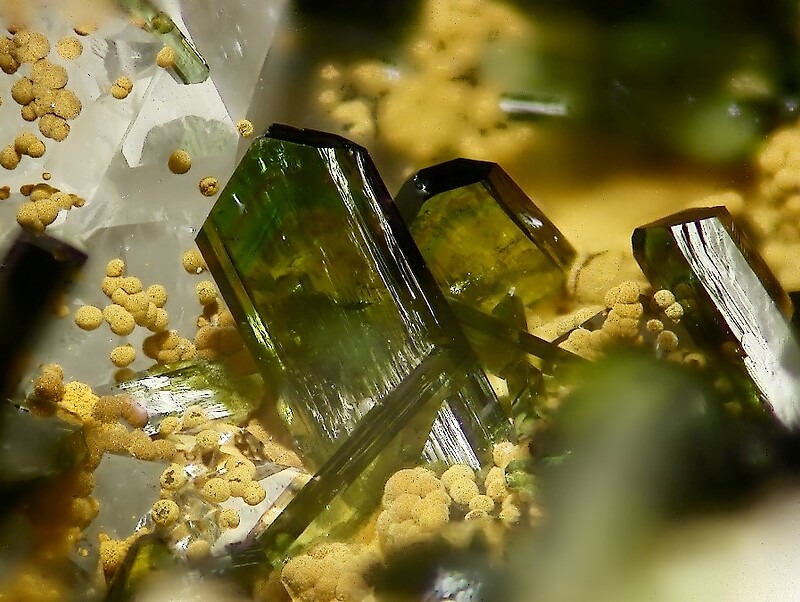
From a gemological and physical standpoint, olivenite is fundamentally unsuitable for conventional jewelry, though exceptional transparent crystals are occasionally faceted as niche collectors’ pieces. With a low Mohs hardness of only 3, an uneven to subconchoidal fracture, and a brittle tenacity, the mineral scratches and chips easily, making it highly vulnerable to daily wear and tear. More importantly, its chemical composition as a basic copper arsenate, Cu₂AsO₄(OH), introduces strict safety considerations; lapidary processing requires rigorous dust control to prevent the inhalation of toxic arsenic-bearing particles. Consequently, direct prolonged skin contact is generally discouraged, and its use in personal adornment is strictly limited to protective, low-contact artisan settings or exhibition-only specimen jewelry. Similarly, while cultural and metaphysical traditions symbolically associate its olive-green coloration with themes of emotional balance or transformation, modern practitioners handle olivenite strictly as a contemplative or display object, prioritizing safety protocols due to its elemental toxicity.