
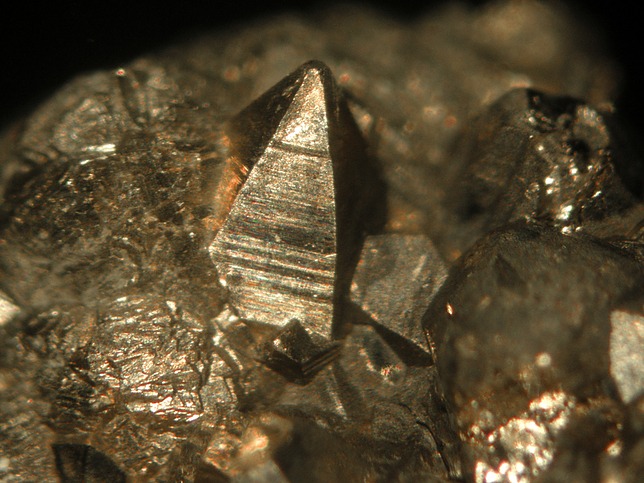
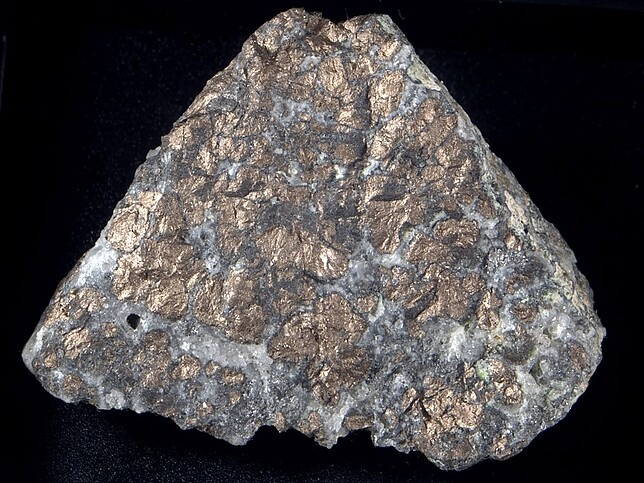
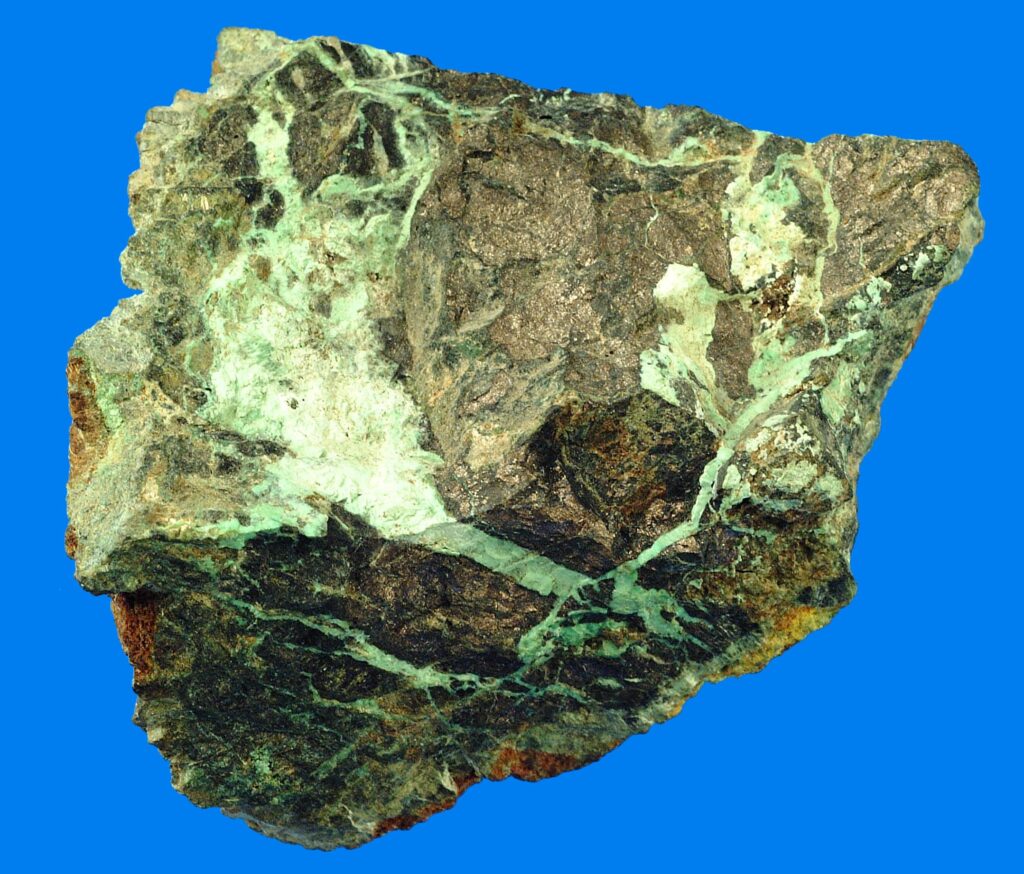
Niccolite, scientifically designated as Nickeline, is a significant mineral species consisting of nickel arsenide. Within the classification of minerals, it serves as the type member of the Nickeline group, crystallizing in the hexagonal crystal system. Chemically, the mineral is defined by a consistent ratio of nickel and arsenic, though in natural specimens, arsenic is occasionally substituted by small fractions of antimony, while nickel may be replaced by trace amounts of iron or cobalt.From a physical standpoint, Niccolite is distinguished by its opaque, metallic luster and a characteristic pale copper-red or “salmon-pink” hue. Despite its aesthetic similarity to copper, it is chemically unrelated; it possesses a Mohs hardness of 5 to 5.5 and a high specific gravity of approximately 7.8, making it notably dense. It lacks discernible cleavage and typically exhibits an uneven or conchoidal fracture. While it rarely forms distinct terminal crystals, it is most commonly found in massive, arborescent (tree-like), or reniform (kidney-shaped) habits. In a professional mineralogical context, its diagnostic features include its high density and its tendency to develop a dark, grayish tarnish or a green coating of Annabergite (nickel bloom) when subjected to prolonged oxidation.
How is Niccolite Formed?
The formation of Niccolite is primarily linked to high-temperature hydrothermal systems. It precipitates from mineral-rich fluids circulating through fractures in the Earth’s crust, typically in environments where nickel and arsenic are concentrated. These hydrothermal veins are often situated within or near basic to ultrabasic igneous rocks. Niccolite also occurs as a product of magmatic segregation, where it settles from cooling silicate melts in deposits such as norite. Geologically, it is frequently found in complex ore assemblages alongside other arsenides and sulfides, including skutterudite, safflorite, rammelsbergite, and native silver. Its presence often indicates specific geochemical conditions, particularly those involving arsenic-rich mineralization within nickel-cobalt-silver deposit types.
History of Niccolite
The history of Niccolite is fundamentally connected to the isolation of nickel as a chemical element. In the 17th century, miners in the Erzgebirge mountains of Germany encountered a reddish ore that resembled copper. When smelting attempts failed to produce copper and instead released toxic arsenic fumes, the miners named the substance Kupfernickel, which translates to Copper-Demon or False Copper, implying the ore was cursed. In 1751, Swedish chemist Axel Fredrik Cronstedt investigated specimens of the mineral and succeeded in isolating a new metal, which he named nickel after the mineral’s traditional nickname. The mineral was formally named Nickeline in 1832 by François Sulpice Beudant, while the name Niccolite was later proposed by James Dwight Dana in 1868. Both terms remain in use today within geological and industrial literature.
Industrial and Scientific Applications of Niccolite
Niccolite serves as a specialized ore of nickel, containing approximately 43.9% of the metal, which is eventually utilized in the production of stainless steel, high-strength alloys, and lithium-ion battery components. Due to its high arsenic content, it is typically extracted as a secondary mineral within silver-cobalt-nickel deposits rather than as a primary mining target, requiring specialized metallurgical processing to manage toxic byproducts. Beyond its role as a raw material, Niccolite is a critical diagnostic tool in economic geology; it acts as a pathfinder mineral, where its presence in hydrothermal veins signals the potential proximity of high-grade silver or cobalt. In the scientific community, it is recognized as the prototype for the “Nickeline structure,” a specific hexagonal atomic arrangement (B81) used as a reference in crystallography to develop synthetic semiconductors and magnetic materials. Additionally, Niccolite finds niche applications in archaeometallurgy for tracing the provenance of ancient artifacts and in materials research as a natural model for studying transition metal pnictides and their electronic properties.