
Streak testing is one of the oldest and most reliable techniques used in mineral identification. It reveals the true color of a mineral in powdered form rather than its surface appearance. Although this method is widely used in geology and mineralogy, it is classified as a destructive gemstone test and is rarely performed on finished gemstones because it can scratch or permanently damage their surfaces.
In mineral identification, streak often provides more consistent diagnostic information than visible color. Surface color can vary due to impurities, oxidation, lighting, or crystal structure. However, when a mineral is reduced to powder, its streak color more directly reflects its chemical composition.
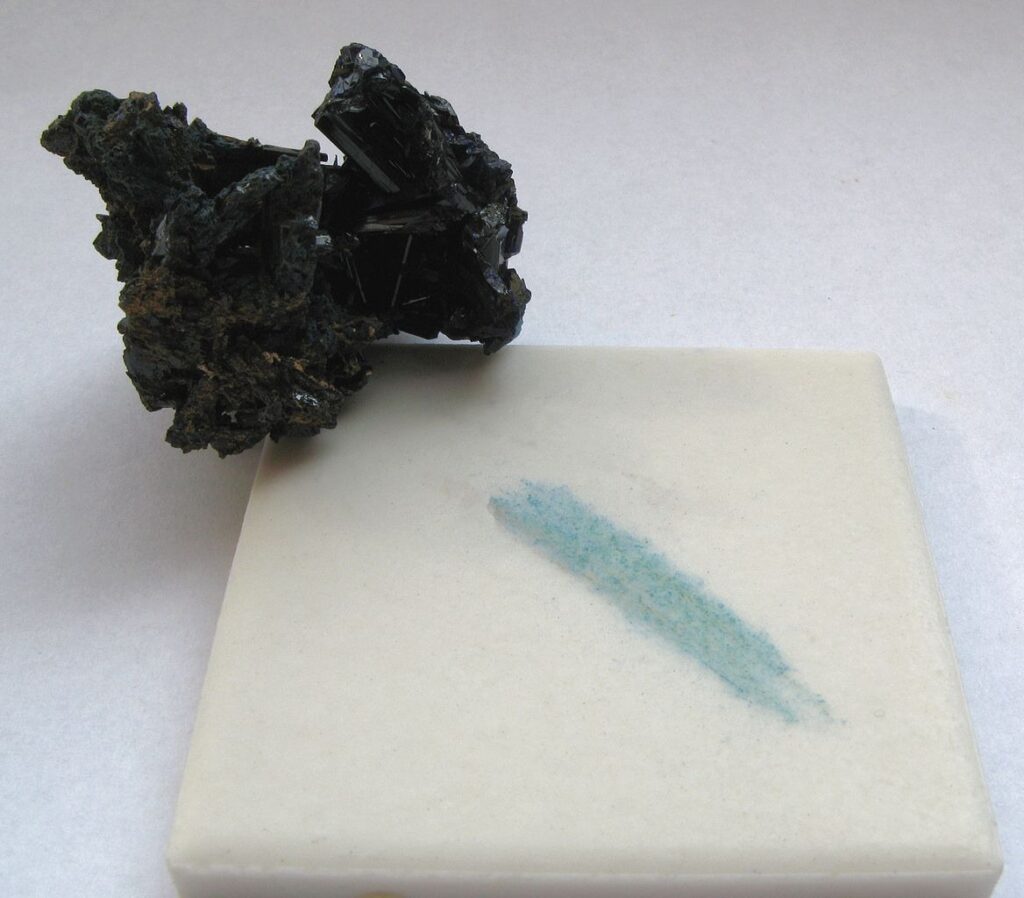
How the Streak Test Works
Streak testing is performed using an unglazed porcelain plate known as a streak plate. The plate typically has a hardness of about 6.5 to 7 on the Mohs scale. To perform the test, a mineral specimen is firmly dragged across the plate, leaving behind a line of powdered material.
If the mineral is softer than the streak plate, it will produce a visible powder trail. If it is harder than the plate, it will scratch the porcelain instead of leaving a streak. In such cases, the result is recorded as “no streak.”
The key principle is simple: the streak represents the mineral’s powdered color, which is often more diagnostic than the external crystal color.
Streak Color Identification Chart
| Gem / Crystal | Mohs Hardness | Chemical Formula | Typical Color | Streak Color | Notes |
|---|---|---|---|---|---|
| Quartz | 7 | SiO₂ | Various | White | Most common crystal |
| Amethyst | 7 | SiO₂ | Purple | White | Iron causes color |
| Citrine | 7 | SiO₂ | Yellow | White | Often heat-treated |
| Rose Quartz | 7 | SiO₂ | Pink | White | Usually massive form |
| Smoky Quartz | 7 | SiO₂ | Brown | White | Color from radiation |
| Garnet | 6.5–7.5 | (Fe,Mg,Ca,Mn)₃Al₂(SiO₄)₃ | Red / Various | White | Rarely leaves streak |
| Peridot | 6.5–7 | (Mg,Fe)₂SiO₄ | Olive green | White | Idiochromatic |
| Topaz | 8 | Al₂SiO₄(F,OH)₂ | Various | White | Hardness 8 |
| Aquamarine | 7.5–8 | Be₃Al₂Si₆O₁₈ | Blue | White | Same species as emerald |
| Emerald | 7.5–8 | Be₃Al₂Si₆O₁₈ | Green | White | Brittle despite hardness |
| Ruby | 9 | Al₂O₃ | Red | White | Chromium trace |
| Sapphire | 9 | Al₂O₃ | Blue / Various | White | All colors except red |
| Diamond | 10 | C | Colorless | None (too hard) | Hardness 10 |
| Opal | 5.5–6.5 | SiO₂·nH₂O | Various | White | Amorphous structure |
| Turquoise | 5–6 | CuAl₆(PO₄)₄(OH)₈·4H₂O | Blue-green | White to pale blue | Porous |
| Tanzanite | 6–7 | Ca₂Al₃(SiO₄)(Si₂O₇)O(OH) | Violet-blue | White | Usually heat-treated |
| Spinel | 8 | MgAl₂O₄ | Various | White | Often confused with ruby |
| Moonstone | 6–6.5 | (K,Na)AlSi₃O₈ | Milky white | White | Feldspar group |
| Alexandrite | 8.5 | BeAl₂O₄ | Green to red | White | Color-change effect |
| Malachite | 3.5–4 | Cu₂CO₃(OH)₂ | Bright green | Light green | Soft copper carbonate |
| Azurite | 3.5–4 | Cu₃(CO₃)₂(OH)₂ | Deep blue | Light blue | Often with malachite |
| Chrysocolla | 2–4 | (Cu,Al)₂H₂Si₂O₅(OH)₄·nH₂O | Blue-green | Pale green to blue | Very soft |
| Cuprite | 3.5–4 | Cu₂O | Dark red | Brownish-red | Dense copper oxide |
| Bornite | 3 | Cu₅FeS₄ | Brown to iridescent purple | Grayish-black | Peacock ore |
| Chalcopyrite | 3.5–4 | CuFeS₂ | Golden yellow | Greenish-black | Tarnishes easily |
| Native Copper | 2.5–3 | Cu | Copper-red | Copper-red | Metallic, malleable |
| Tenorite | 3.5–4 | CuO | Black | Black | Secondary copper mineral |
Allochromatic and Idiochromatic Gems and Streaks
When discussing streak testing in mineral identification, it’s important to understand the difference between allochromatic and idiochromatic gemstones. These two categories explain why some minerals show streak colors that differ from their surface appearance.Allochromatic gems get their color from trace impurities rather than their main chemical structure. The base mineral itself is usually colorless or white in pure form. For example, Quartz can appear purple, yellow, or smoky depending on trace elements or radiation exposure, yet its streak is white because the powdered form reflects the underlying silicon dioxide composition.
Another example is Corundum. Even though ruby and sapphire varieties display intense red or blue colors due to chromium or iron impurities, the streak of corundum is white.In contrast, idiochromatic gems derive their color from essential elements within their chemical formula. The color is fundamental to the mineral’s identity. Malachite is green because copper is part of its structure, and it leaves a green streak. Azurite is blue for the same reason and leaves a pale blue streak.In general, allochromatic minerals often produce a white streak, while idiochromatic minerals are more likely to produce a colored streak consistent with their chemical composition—provided they are soft enough to leave one.
Streak Testing Procedures
Streak testing is performed using an unglazed porcelain plate, commonly called a streak plate. The plate typically has a hardness of about 6.5 to 7 on the Mohs scale.
The standard procedure involves the following steps:
- Select a clean, unglazed streak plate (usually white for better contrast).
- Hold the mineral specimen firmly.
- Drag one edge of the specimen across the plate with steady pressure.
- Observe the color of the powder line left behind.
If the mineral is softer than the plate, it will leave a visible streak. If it is harder, it will scratch the plate instead of producing powder. In that case, the result is recorded as “no streak.”
Because this method can scratch polished surfaces, it is considered a destructive test when applied to finished gemstones.
What Is the Difference Between Gemology and Mineralogy for Streak Testing?
Although streak testing is fundamental in mineralogy, its role in gemology is very limited.
In mineralogy, streak testing is a common and valuable identification tool. Mineralogists often work with rough, opaque specimens where slight surface abrasion does not significantly reduce value. The streak color can quickly distinguish between minerals with similar outward appearances, especially metallic minerals.
In gemology, however, preservation is a priority. Gemologists typically examine faceted, polished stones that may have significant financial value. Scratching the surface of a gemstone can permanently damage its polish and reduce its market price. Therefore, gemologists rely on non-destructive techniques such as refractive index testing, magnification, spectroscopy, and specific gravity measurements instead of streak testing.
In summary, streak testing remains essential in mineral science but is rarely appropriate in professional gemstone evaluation due to its destructive nature.