
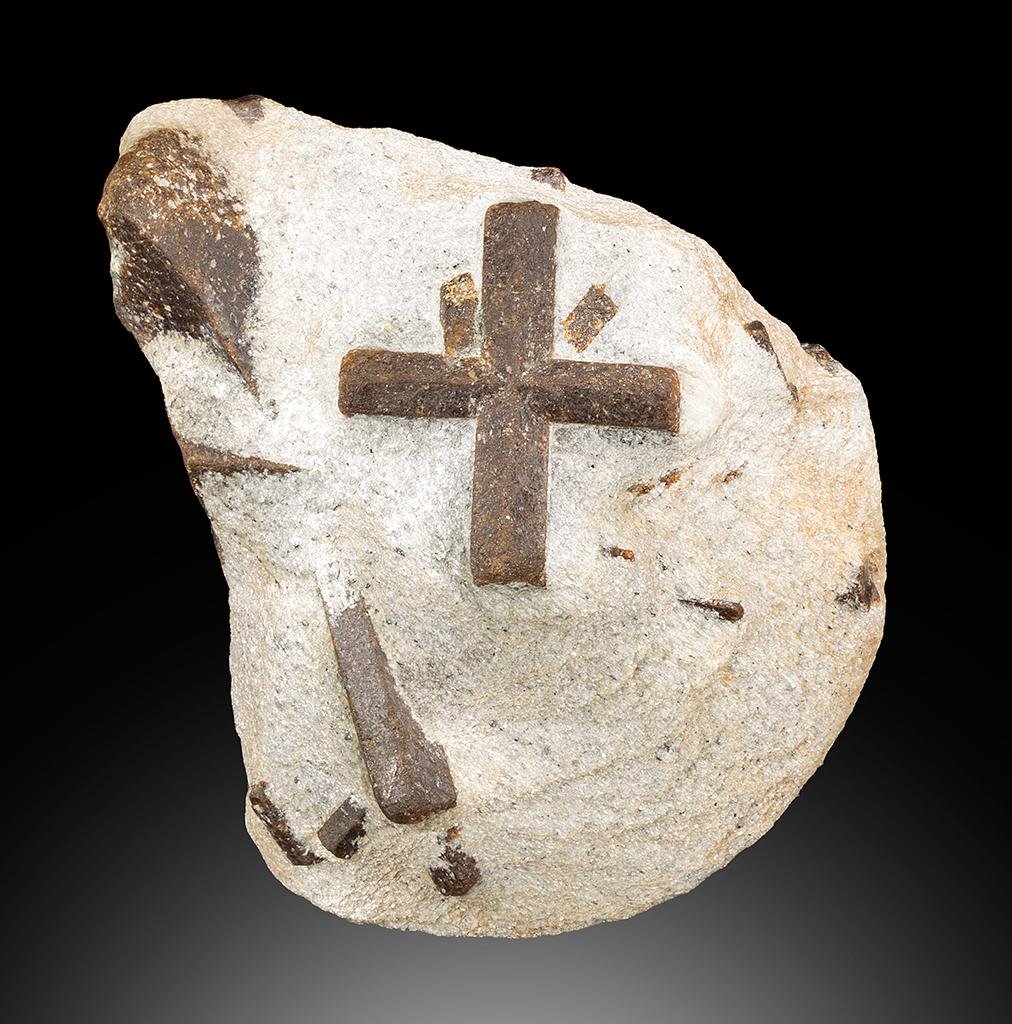
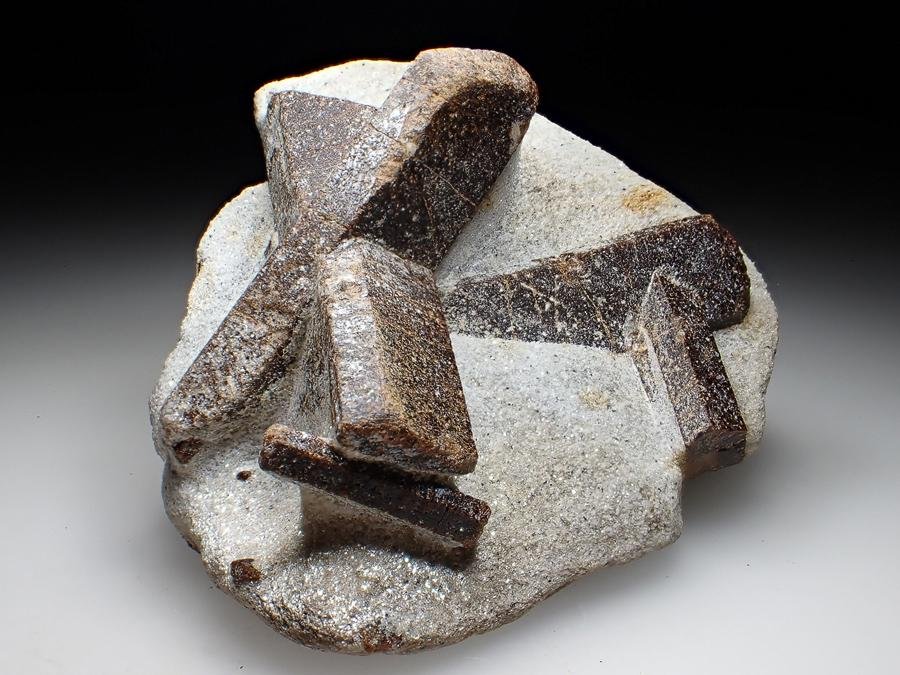
Staurolite is an iron- and aluminum-bearing silicate mineral that forms primarily during the metamorphism of clay-rich sedimentary rocks, particularly shale and other aluminous rocks. Its chemical composition, crystal structure, and characteristic occurrence in metamorphic environments distinguish it from other silicate minerals. Staurolite commonly develops reddish-brown, yellowish-brown, or dark brown crystals, which are typically prismatic and may occur individually or as intergrown crystal groups. One of its most recognizable features is the formation of cross-shaped twins, in which two crystal individuals intersect at characteristic angles, commonly around 60 or 90 degrees. However, not all staurolite crystals exhibit this form, and many specimens occur as isolated crystals embedded in schist or gneiss. The mineral is frequently associated with garnet, kyanite, quartz, muscovite, and biotite, depending on the composition of the host rock and the conditions under which metamorphism occurred. Staurolite is particularly relevant to metamorphic petrology because its formation and stability are related to specific combinations of temperature, pressure, and chemical composition. For this reason, it is used in the study of metamorphic mineral assemblages and the geological processes that transform sedimentary rocks into metamorphic rocks. In addition to its scientific applications, staurolite is collected as a mineral specimen, especially when it displays well-developed crystal forms or cross twinning. Its physical appearance and geological significance are therefore closely connected to its crystallographic characteristics and the conditions of its formation.
Chemical Composition and Crystal Structure of Staurolite
Staurolite is a complex iron- and aluminum-rich silicate mineral containing silicon, oxygen, hydrogen, and variable amounts of other elements. Its commonly cited idealized chemical formula is Fe²⁺₂Al₉Si₄O₂₃(OH), although formula representations in mineralogical references may differ according to the structural model and the way elemental substitutions are expressed. Iron is an important constituent of typical staurolite, but magnesium can replace part of the iron within the crystal structure. Smaller amounts of zinc, manganese, cobalt, lithium, and other elements may also occur in natural specimens. The proportions of these elements depend on the chemical composition of the original rock, the conditions of metamorphism, and the mineral assemblage with which staurolite forms. These substitutions can influence its color, optical properties, density, and other measurable characteristics. Aluminum occupies several structural positions, while silicon occurs in silicate tetrahedra that form part of the mineral’s three-dimensional atomic arrangement. Hydroxyl groups are also incorporated into the structure, distinguishing staurolite from anhydrous silicate minerals with otherwise comparable elemental constituents.
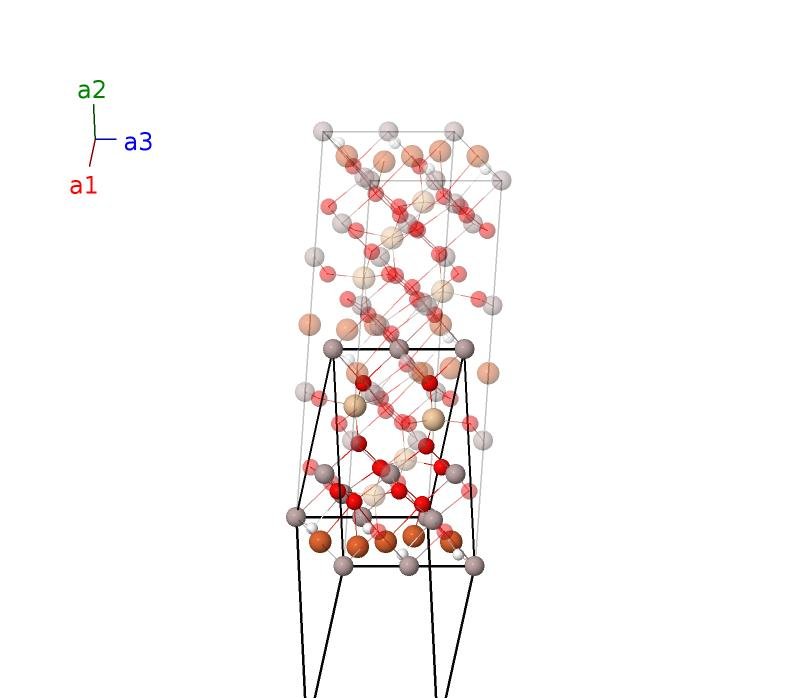
Staurolite crystallizes in the monoclinic crystal system, although its crystallographic geometry can appear close to orthorhombic because one of its interaxial angles is near 90 degrees. Its structure consists of interconnected aluminum- and iron-bearing polyhedra and silicate tetrahedra arranged in a relatively complex framework. This arrangement influences the mineral’s characteristic crystal morphology, cleavage, optical behavior, and mechanical properties. Individual crystals commonly develop elongated prismatic forms with relatively well-defined faces, although their outlines may become irregular when growth is restricted by surrounding minerals. Twinning is an important crystallographic feature of staurolite and occurs when two crystal individuals develop in a specific, systematic orientation relative to one another. Depending on the twin relationship, the individuals may intersect at approximately 60 or 90 degrees, producing the cross-shaped forms commonly associated with the mineral. These structures result from crystallographic relationships rather than from the simple physical attachment of unrelated crystals. Nevertheless, twinning is not universal, and the external appearance of a specimen depends on its growth conditions, available space, and subsequent geological history. The relationship between chemical composition and crystal structure is important for understanding the mineral’s stability, its variation between geological environments, and its use in studies of metamorphic rocks.
Formation and Geological Occurrence of Staurolite
Staurolite forms primarily through regional metamorphism of aluminum-rich sedimentary rocks, particularly shale, mudstone, and other fine-grained rocks derived from clay-rich sediments. During metamorphism, these rocks are subjected to elevated temperatures and pressures as a result of burial, crustal thickening, and tectonic deformation. Their original minerals become unstable and react to produce new mineral assemblages that reflect the changing physical and chemical conditions. Staurolite commonly develops at intermediate stages of regional metamorphism, particularly under conditions associated with parts of the amphibolite facies. Its formation depends not only on temperature and pressure but also on the bulk chemical composition of the host rock, especially the availability of aluminum, iron, magnesium, and other constituent elements. Water-bearing fluids may also influence mineral reactions and the movement of chemical components within the rock. As metamorphism progresses, staurolite may grow as individual crystals within a fine-grained matrix or become incorporated into coarser-grained metamorphic rocks. Its presence can indicate a particular range of metamorphic conditions, although the precise conditions under which it forms vary according to the composition of the rock and the minerals present alongside it. Consequently, staurolite is generally interpreted as part of a broader mineral assemblage rather than as an independent indicator of a single temperature or pressure value.
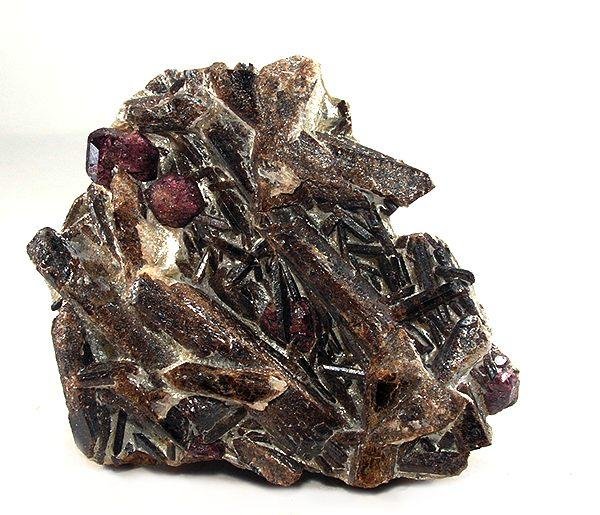
Staurolite is most commonly found in mica schist and gneiss, where it occurs with minerals such as garnet, kyanite, quartz, muscovite, and biotite. These associated minerals reflect the chemical composition of the original rock and the metamorphic conditions experienced during its geological history. In suitable aluminous rocks, staurolite may develop alongside garnet during progressive metamorphism, while changes in temperature, pressure, or chemical composition can eventually favor reactions that consume staurolite and produce other minerals. Its stability is therefore limited to particular conditions rather than extending across the full range of metamorphic environments. The relationships between staurolite and neighboring minerals can help geologists identify metamorphic zones, reconstruct the sequence of mineral-forming reactions, and interpret the evolution of mountain belts. In some rocks, crystals are distributed relatively evenly throughout the matrix, while in others they occur as isolated porphyroblasts that are larger than the surrounding mineral grains. Their size and shape depend on factors such as the duration of metamorphism, the rate of crystal growth, the availability of chemical components, and the space available within the rock. The preservation of staurolite in a metamorphic rock may also reflect the subsequent cooling and deformation history, particularly where later geological processes did not completely transform the original mineral assemblage.
Physical and Chemical Properties of Staurolite
Staurolite typically occurs in shades of reddish brown, yellowish brown, dark brown, and nearly black, with its color influenced partly by iron content and other chemical substitutions. Crystals are commonly prismatic, with longitudinal faces that may show striations or irregularities caused by growth conditions and interactions with surrounding minerals. Its luster is generally vitreous to resinous, while the streak is white to grayish white. Staurolite ranges from transparent in thin fragments to translucent or opaque in larger specimens, depending on crystal thickness, inclusions, fractures, and internal structure. It has relatively high refractive indices and commonly exhibits pleochroism, an optical property in which the observed color varies with the direction of light transmission through the crystal. Under polarized light, this characteristic can assist in distinguishing staurolite from other minerals in metamorphic thin sections. Its cleavage is distinct in one direction but may be difficult to observe in specimens with irregular surfaces or numerous inclusions. Fracture is typically uneven to subconchoidal, and the mineral is brittle under mechanical stress. Staurolite has a Mohs hardness of approximately 7 to 7.5 and a specific gravity generally around 3.6 to 3.8, making it harder and denser than many common silicate minerals. These properties contribute to its persistence in weathered rocks and explain why staurolite grains can sometimes survive transport into sedimentary environments.
Chemically, staurolite is a complex hydroxyl-bearing silicate whose composition is dominated by iron and aluminum, with silicon and oxygen forming the silicate components of its crystal structure. Magnesium may substitute for iron, while smaller quantities of zinc, manganese, cobalt, lithium, and other elements can occur depending on the geological environment. The extent of these substitutions varies between localities and may influence the mineral’s optical and physical characteristics. Staurolite is generally stable under the metamorphic conditions in which it forms, but its stability is controlled by temperature, pressure, bulk-rock composition, and the presence of other minerals and fluids. When these conditions change sufficiently, chemical reactions may cause staurolite to break down and form different mineral assemblages. Its relatively high hardness and resistance to ordinary weathering allow it to remain intact after its host rock has been exposed at the surface and eroded. However, prolonged weathering, chemical alteration, and mechanical abrasion can eventually modify or destroy individual crystals. The combination of its chemical composition, optical behavior, hardness, density, and characteristic crystal habit provides a useful basis for identifying staurolite and investigating the metamorphic history of the rocks in which it occurs.
Types and Varieties of Staurolite
Staurolite is generally treated as a distinct mineral species rather than a mineral with numerous formally recognized varieties. Differences between specimens are primarily described in terms of chemical composition, crystal habit, color, and twinning. Variations in iron, magnesium, zinc, and other elements reflect differences in the geological environments where the mineral forms. Although these compositional differences are relevant to mineralogical research, most staurolite specimens encountered in collections are identified simply as staurolite rather than assigned to separate varieties. The most commonly discussed forms include iron-rich staurolite, magnesium-bearing compositions, zinc-bearing compositions, and crystals displaying characteristic cross twinning.
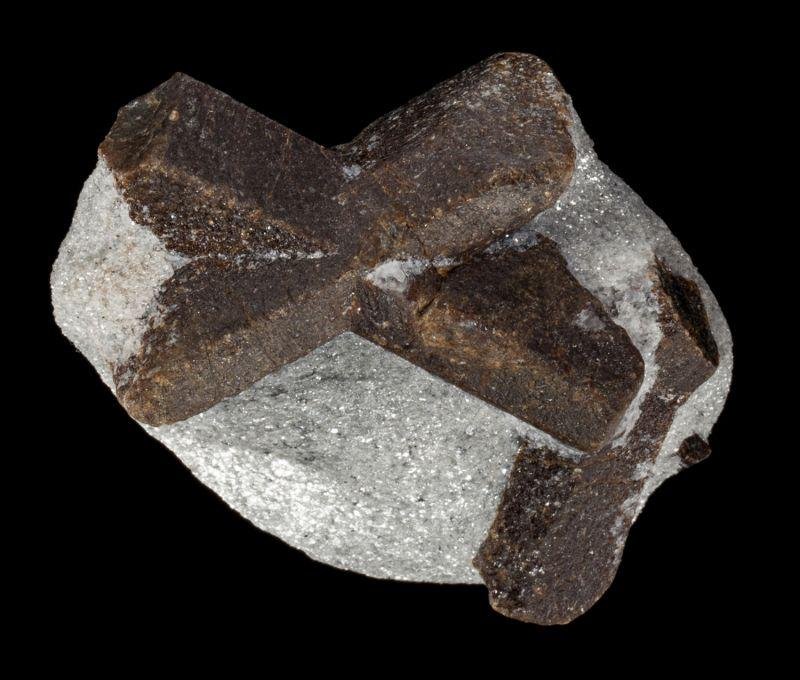
Iron-rich Staurolite: Iron-rich staurolite represents the typical composition of the mineral and is widely encountered in metamorphic rocks, particularly mica schists. Its crystals are commonly reddish brown, yellowish brown, or dark brown, and they may occur as isolated prisms or as intergrown crystals within a quartz-mica matrix. Iron is a major constituent of its crystal structure and contributes to the mineral’s characteristic coloration and relatively high density. The precise iron content varies according to the composition of the host rock and the conditions of metamorphism.
Magnesium-bearing Staurolite: Magnesium can substitute for iron within the staurolite crystal structure, producing compositional variations that reflect the chemical environment in which the mineral formed. The degree of substitution depends on factors such as the availability of magnesium in the host rock and the composition of coexisting minerals. Magnesium-bearing staurolite remains part of the same mineral species when its composition falls within the accepted range for staurolite. Such variations are mainly of interest in mineral chemistry and studies of metamorphic reactions.
Zinc-bearing Staurolite: Zinc may occur as a minor or locally significant constituent of staurolite, replacing other elements at suitable structural sites. The amount of zinc incorporated into the mineral depends on its availability during crystal growth and the chemical conditions of the surrounding rock. Zinc-bearing compositions are useful for investigating elemental substitution and the distribution of trace and minor elements among metamorphic minerals. The presence of zinc does not automatically establish a separate mineral species; classification depends on the mineral’s composition and the applicable mineralogical nomenclature.
Cross-twinned Staurolite: Cross-twinned staurolite refers to crystals in which two individuals are joined according to a specific crystallographic relationship, producing a cross-shaped form. The angle between the individuals is commonly approximately 60 or 90 degrees, depending on the type of twin. These crystals are frequently associated with metamorphic rocks and are especially recognizable when the intersecting individuals have well-developed crystal faces. Cross twinning describes the mineral’s crystallographic habit rather than a separate chemical variety, and many staurolite specimens occur without this feature.
Major Staurolite Localities
Staurolite occurs in metamorphic terrains on several continents, particularly in regions where aluminum-rich sedimentary rocks have undergone regional metamorphism. Its distribution is closely associated with mica schists, gneisses, and other metamorphic rocks formed under suitable pressure and temperature conditions. The quality and appearance of crystals vary between localities, depending on the composition of the host rock, the degree of metamorphism, and the space available for crystal growth. Some occurrences produce distinct prismatic crystals, while others contain small, irregular grains dispersed throughout a metamorphic matrix. Cross-twinned specimens are known from several regions, although the development of this habit is not consistent across all deposits.
In the United States, staurolite is found in several metamorphic regions, including parts of Georgia, Virginia, and New Hampshire. Georgia is particularly associated with staurolite crystals that occur in metamorphic rocks and loose surface deposits derived from their weathering. In some areas, the crystals have become separated from the original host rock and can be recovered from soil or sediment. New Hampshire also contains staurolite-bearing metamorphic rocks, where the mineral occurs in association with other minerals formed during regional metamorphism. These occurrences illustrate how staurolite can be preserved both within its original geological setting and as detached crystals after erosion.
European occurrences include parts of Switzerland, Austria, France, and other regions affected by regional or Alpine metamorphism. In Switzerland, staurolite is documented in metamorphic terrains of the Alps, where it occurs with minerals such as quartz, mica, garnet, and kyanite. These mineral associations reflect the complex pressure-temperature histories of rocks affected by continental collision and mountain building. Staurolite also occurs in metamorphic regions of Russia, including parts of the Kola Peninsula, where suitable aluminous rocks have undergone metamorphic transformation. Beyond these localities, the mineral has been reported from other metamorphic belts around the world. Differences in crystal size, color, composition, and twinning among specimens reflect local geological conditions rather than necessarily indicating distinct mineral varieties.
Staurolite can also occur in secondary sedimentary deposits formed through the weathering and erosion of its original host rocks. Because it is relatively hard and resistant to weathering, individual crystals may survive transport by streams and rivers before accumulating in sediment containing other dense minerals. Such detrital occurrences are particularly useful in geological studies because their mineral composition can provide clues about the rocks exposed upstream or within a sediment’s source region. However, the presence of staurolite in sediment does not establish the precise location of its original formation without additional geological evidence. Researchers may combine mineral identification with sediment characteristics, regional geology, and the composition of associated grains to investigate the provenance and transport history of these deposits.
Uses and Applications of Staurolite
Staurolite is primarily used in mineralogical research, geological education, and mineral collecting. Its occurrence in metamorphic rocks and its relationship with minerals such as garnet, kyanite, and biotite make it useful for investigating the conditions under which rocks undergo metamorphism. Geologists examine the presence, composition, and textural relationships of staurolite to help interpret the pressure and temperature conditions experienced by a rock during its geological history. When combined with observations of other minerals in the same assemblage, staurolite can provide information about metamorphic grade, mineral-forming reactions, and changes in the chemical composition of rocks during recrystallization. It is also studied using optical microscopy, electron-microprobe analysis, and other mineralogical techniques to investigate elemental substitution and crystal chemistry. In geological education, staurolite specimens are used to demonstrate monoclinic crystal structures, mineral twinning, and the identification of metamorphic minerals. Cross-twinned crystals are particularly useful for illustrating the relationship between crystallographic structure and external crystal morphology.
Staurolite has also been investigated for industrial applications, particularly those involving abrasive materials and foundry processes. Its relatively high hardness, density, and resistance to physical weathering make it a potential component of certain mineral-based industrial products. However, its commercial suitability depends on factors such as grain size, chemical purity, processing costs, and the availability of alternative materials. In mineral-sand processing, staurolite may be recovered as part of a heavy-mineral concentrate rather than extracted as the primary target mineral. Its use in foundry applications depends on the properties required for a particular casting process, including grain characteristics and thermal performance. These applications are more specialized than its geological and educational uses, and the economic importance of staurolite varies according to local resources and industrial demand.
In the mineral collecting and lapidary fields, staurolite is valued mainly for its recognizable crystal forms and occasional cross-shaped twins. Specimens may be collected directly from metamorphic outcrops or recovered from weathered material in areas where the mineral occurs naturally. Well-developed crystals are often preserved in their original matrix to show their relationship with the surrounding rock, while detached crystals may be displayed individually. Some material is cut or polished for ornamental purposes, although the mineral is not widely used as a conventional faceted gemstone. Its commonly dark coloration, inclusions, internal fractures, and limited transparency can restrict its suitability for gemstone cutting. As a result, staurolite is generally more significant as a mineral specimen and geological material than as a widely traded jewelry stone.