
Vanadinite is a distinctive lead vanadate mineral known for its vivid red, orange-red, reddish-brown, and occasionally yellow or brown colors. It has the chemical formula Pb₅(VO₄)₃Cl and belongs to the apatite group of minerals, crystallizing in the hexagonal crystal system. Vanadinite is especially recognizable for its short, hexagonal prismatic crystals, which may have flat or modified terminations and often occur in attractive clusters or aggregates on a contrasting matrix. Its intense coloration, bright resinous to adamantine luster, relatively low hardness of about 3 on the Mohs scale, and unusually high specific gravity of approximately 6.8–7.1 are characteristic features of the mineral. The high density is largely related to its substantial lead content, while its strong red and orange colors are associated with its vanadium-rich composition. Vanadinite is primarily a secondary mineral that develops in the oxidized zones of lead ore deposits, where vanadium-bearing fluids interact with pre-existing lead minerals under suitable chemical conditions. It commonly occurs with other secondary minerals such as Mimetite, Pyromorphite, Cerussite, and iron or manganese oxides, providing an example of the complex mineral-forming processes that take place during the weathering and oxidation of ore deposits.
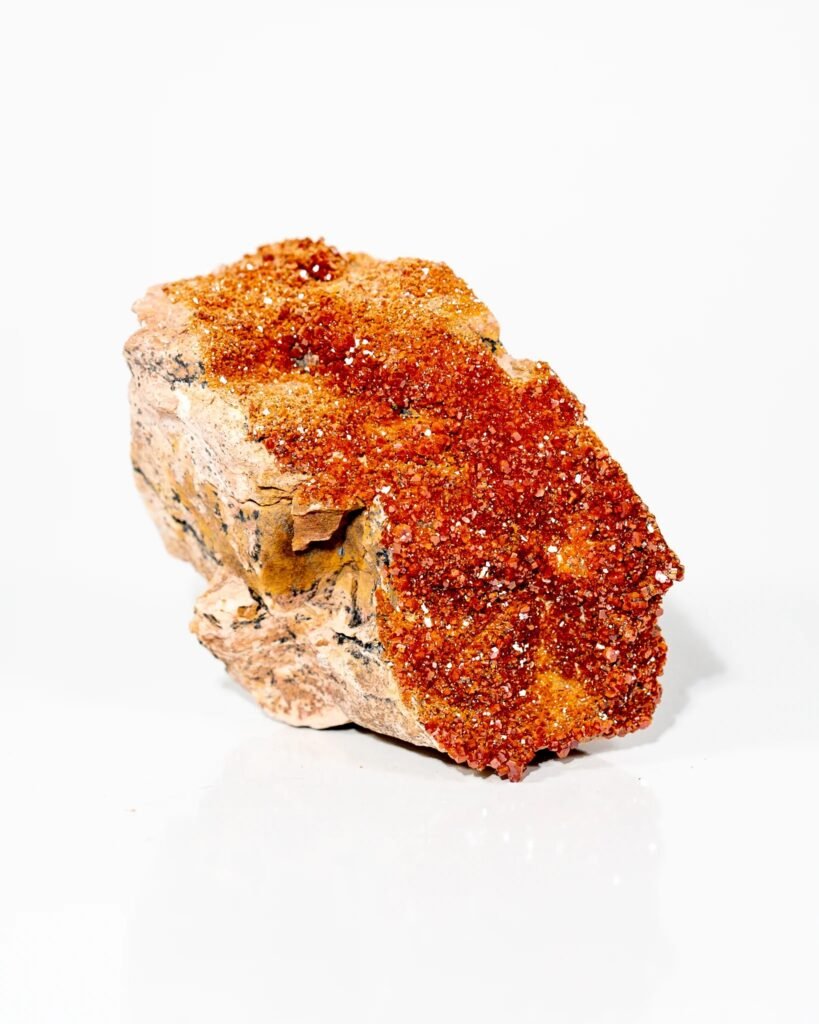
From a mineralogical perspective, Vanadinite is important because its crystal structure incorporates vanadate groups into a lead-rich framework, with chlorine occupying specific structural positions. Its structural relationship with Mimetite and Pyromorphite makes it an interesting member of the apatite group and demonstrates how related crystal structures can accommodate different chemical compositions. Although Vanadinite has historically served as a source of vanadium and lead, it is now valued primarily for mineral collecting, geological research, and educational purposes. Well-formed crystals with vivid colors, sharp hexagonal shapes, and strong luster are particularly desirable among collectors. Famous specimens have been recovered from several regions, especially Morocco, Mexico, and the southwestern United States, where oxidized lead-vanadium deposits have produced abundant and visually impressive crystals. The combination of distinctive chemistry, characteristic crystal habit, high density, and striking color makes Vanadinite an important and easily recognizable mineral for both professional mineralogical study and private collections.
History and Discovery of Vanadinite
Vanadinite has a history closely connected with the development of mineralogy and the scientific study of vanadium-bearing minerals. The mineral was first described in the early 19th century after distinctive specimens were identified in the Zimapan mining district of Hidalgo, Mexico. It was initially known under other names related to its composition and occurrence before the name Vanadinite became established. The mineral was named in reference to its vanadium content, with the name ultimately reflecting the element vanadium itself. During the 19th century, increasing interest in the chemistry of vanadium and its compounds helped establish Vanadinite as an important mineralogical species. Its characteristic crystal form, high density, vivid coloration, and occurrence in oxidized lead deposits made it relatively easy for mineralogists to distinguish from other lead minerals with similar appearances.
As mineralogical classification and analytical techniques developed, Vanadinite became better understood in terms of both its chemical composition and crystal structure. Studies of its relationship with Pyromorphite and Mimetite demonstrated that these minerals share closely related structures within the apatite group, while differences in their dominant anionic groups give them distinct chemical and physical characteristics. Vanadinite also attracted practical interest because it can contain significant amounts of vanadium, an element used in metallurgy and various industrial applications. Although it has been mined as a vanadium-bearing ore in some historical deposits, exceptionally well-formed Vanadinite crystals eventually became highly valued by mineral collectors. Discoveries of colorful specimens in Mexico, Morocco, the United States, and other localities greatly expanded its presence in museums and private collections, helping establish Vanadinite as one of the classic collector minerals associated with oxidized ore deposits.
Formation and Geological Occurrence of Vanadinite
Vanadinite forms primarily as a secondary mineral in the oxidized and weathered zones of lead-bearing ore deposits. It develops when vanadium-bearing fluids or minerals interact with lead-rich minerals near the surface, where exposure to oxygen, groundwater, and changing chemical conditions promotes the formation of new vanadate minerals. Rather than crystallizing directly from the original high-temperature ore-forming environment, Vanadinite commonly develops during the later stages of mineral alteration and weathering. As primary lead sulfide minerals and other ore minerals break down, dissolved lead and vanadium can be transported by groundwater and hydrothermal or supergene fluids. When the chemical conditions become favorable, these elements combine with oxygen and chlorine to produce Vanadinite crystals. This process explains why the mineral is frequently concentrated in cavities, fractures, and open spaces within oxidized portions of lead deposits, where crystals have sufficient room to develop well-defined forms.
The geological occurrence of Vanadinite is commonly associated with complex assemblages of secondary minerals. It may occur alongside Cerussite, Mimetite, Pyromorphite, Wulfenite, Descloizite, and iron or manganese oxide minerals, depending on the composition of the original deposit and the chemistry of the altering fluids. The availability of vanadium is particularly important, as it may originate from vanadium-bearing primary minerals or from surrounding rocks that release vanadium during weathering. Local variations in pH, oxidation state, fluid composition, and the availability of lead and chlorine can influence the size, color, crystal habit, and abundance of Vanadinite. In some deposits, the mineral forms bright red or orange hexagonal crystals covering the surface of a host rock, while in other environments it occurs as fine-grained coatings or compact aggregates. These variations make Vanadinite an informative mineral for understanding the chemical evolution of oxidized ore zones and the interaction between groundwater, host rocks, and pre-existing mineral deposits.
Types and Varieties of Vanadinite
Vanadinite is recognized as a single mineral species rather than a mineral with numerous officially established varieties. However, natural specimens can show considerable differences in color, crystal habit, transparency, crystal size, and surface appearance. These differences are mainly related to trace elements, impurities, oxidation conditions, and the geological environment in which individual crystals developed. For collectors, these visual forms are often described informally according to their appearance or locality rather than being treated as formally recognized mineral varieties.
- Red Vanadinite – Bright red to deep scarlet Vanadinite is among the most recognizable forms of the mineral. Well-developed red crystals can have a strong resinous to adamantine luster and are particularly attractive when they occur as sharp hexagonal prisms.
- Orange Vanadinite – Orange and orange-red crystals are especially common in many well-known specimens. Their color can range from bright orange to darker reddish orange, and clusters of closely packed orange crystals are highly characteristic of attractive collector specimens.
- Brown Vanadinite – Brown to reddish-brown Vanadinite generally has a darker appearance and may occur as individual crystals, granular aggregates, or coatings. Although less vivid than bright red or orange material, sharply formed brown crystals can still display excellent luster and crystal definition.
- Yellow Vanadinite – Yellow to yellow-orange specimens are less commonly encountered than red and orange material. The crystals may be transparent to translucent and can show noticeable color variation across individual crystal clusters.
- Botryoidal or Massive Vanadinite – Not all Vanadinite develops as distinct prismatic crystals. Some specimens occur as fine-grained coatings, compact aggregates, or botryoidal masses covering the surface of a host rock. These forms can provide an attractive textured appearance even when individual crystals are difficult to distinguish.
Major Localities of Vanadinite
Vanadinite occurs in oxidized lead deposits in several parts of the world, but certain localities are particularly well known for producing abundant or exceptionally attractive specimens. Morocco is one of the most important modern sources, especially the Mibladen mining district in the Midelt Province. Specimens from this region are famous for their bright red, orange-red, and reddish-orange hexagonal crystals, which frequently form dense clusters on a contrasting matrix. Mibladen Vanadinite can range from very small crystals covering large areas of the matrix to highly defined individual crystals with strong luster and excellent geometric form. Mexico is another historically significant locality, particularly the Zimapan mining district in Hidalgo, where Vanadinite was first described. Mexican specimens are important both historically and mineralogically and may occur as red, orange, or brown crystals associated with other oxidized lead minerals. In the United States, notable occurrences include several mining districts in Arizona and New Mexico, where Vanadinite has been found in the oxidized zones of lead deposits. These American specimens can display a range of crystal habits and colors and are well represented in historical mineral collections.
Other occurrences of Vanadinite have been documented in countries including Argentina, Australia, Namibia, South Africa, Zambia, and parts of Europe and Asia. The quality and appearance of specimens can vary considerably between localities because Vanadinite formation depends on the availability of lead and vanadium as well as local conditions such as groundwater chemistry, oxidation state, temperature, and the structure of the host deposit. Some localities are primarily important for their geological significance or historical production, while others are better known for exceptionally aesthetic crystals. Locality information is therefore an important part of describing and evaluating Vanadinite specimens, particularly for collectors who specialize in classic mineral localities. The combination of distinctive crystal form, intense coloration, and diverse geological settings has made Vanadinite an important representative of secondary minerals from oxidized lead deposits worldwide.
Crystal Structure of Vanadinite
Vanadinite crystallizes in the hexagonal crystal system and has a structure closely related to other members of the apatite group, particularly Pyromorphite and Mimetite. Its chemical formula, Pb₅(VO₄)₃Cl, reflects a framework dominated by lead cations and vanadate groups, with chlorine occupying specific channels within the crystal structure. The vanadate groups consist of vanadium atoms surrounded by oxygen atoms in a tetrahedral arrangement, while lead atoms occupy several structurally distinct positions. This arrangement produces the characteristic sixfold symmetry of Vanadinite and strongly influences its typical hexagonal prismatic crystal habit. The structural channels containing chlorine are an important feature of the apatite-type framework and contribute to the stability and chemical characteristics of the mineral. Variations in crystal growth conditions can affect the development of crystal faces, resulting in differences in prism length, termination shape, surface luster, and overall crystal proportions among specimens from different localities.
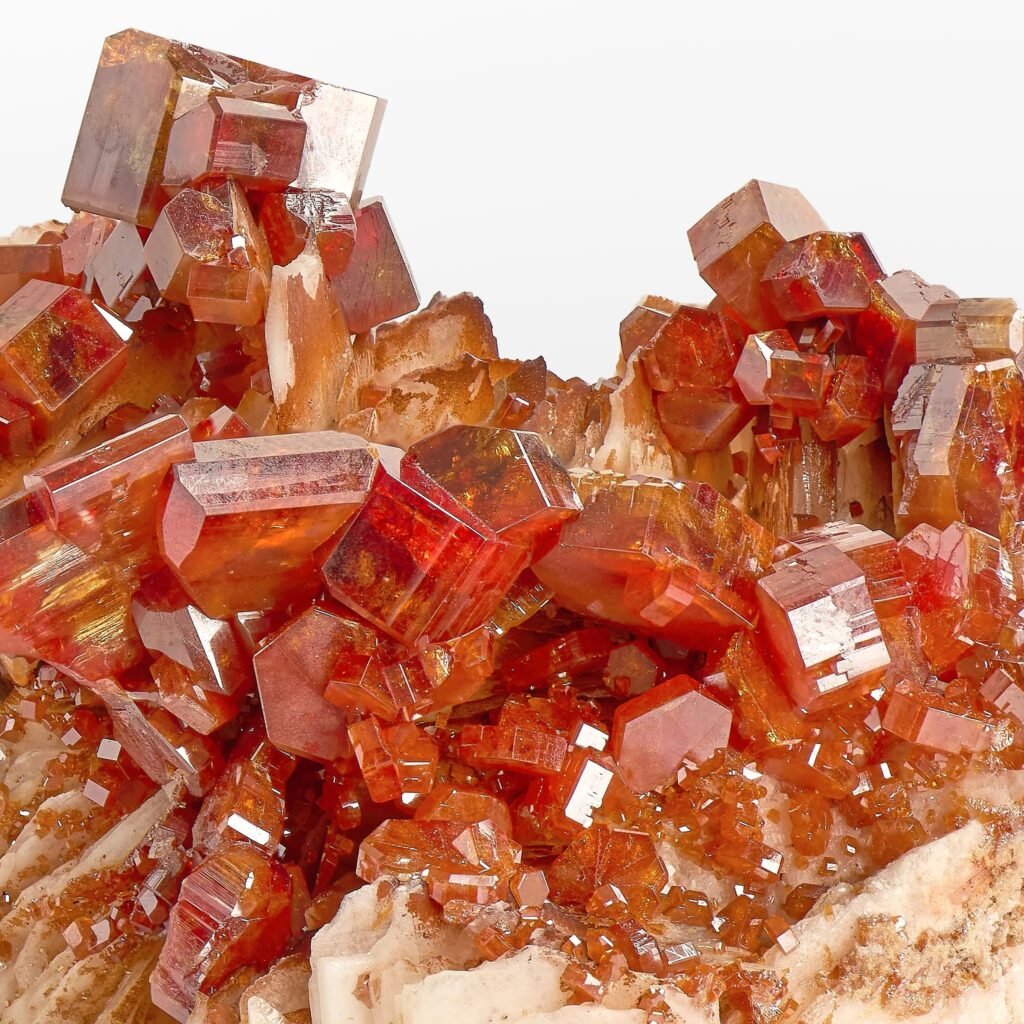
The structural relationship between Vanadinite, Pyromorphite, and Mimetite is particularly significant in mineralogy because these minerals share closely related apatite-type structures while differing in their dominant anionic groups. In Vanadinite, vanadate groups are the principal structural units, whereas related minerals incorporate different chemical groups in comparable positions. This allows these minerals to exhibit similar crystal habits while maintaining distinct chemical and physical properties. The arrangement of lead, vanadium, oxygen, and chlorine within Vanadinite also contributes to its relatively high density and characteristic optical behavior. Well-developed crystals can therefore display strong luster and clearly defined geometric faces, making their external appearance a visible reflection of the ordered atomic structure beneath the crystal surface.
Physical and Chemical Properties of Vanadinite
Vanadinite has several distinctive physical properties that make it relatively easy to recognize among secondary lead minerals. It commonly appears red, orange-red, reddish-brown, yellow, or brown, with color intensity varying according to composition, impurities, and locality. Its luster is typically resinous to adamantine, giving well-formed crystals a bright and attractive surface appearance. Vanadinite has a Mohs hardness of approximately 3, so it is considerably softer than quartz and can be scratched relatively easily by harder materials. Its specific gravity is unusually high, generally around 6.8–7.1, as a result of its substantial lead content. The mineral commonly occurs as short hexagonal prisms, although granular, massive, botryoidal, and crust-like forms are also known. Vanadinite is generally brittle and has an uneven to subconchoidal fracture, while its cleavage is poor or indistinct. Transparent to translucent crystals may show strong internal color and luster, whereas massive material is usually more opaque.
Chemically, Vanadinite is a lead vanadate chloride with the formula Pb₅(VO₄)₃Cl. Its composition is dominated by lead and vanadium, together with oxygen and chlorine, and vanadium occurs primarily in the +5 oxidation state within vanadate groups. The mineral can undergo chemical alteration under changing environmental conditions, particularly in the oxidized zones where it forms. Its chemistry is closely related to other apatite-group minerals, including Pyromorphite and Mimetite, which share similar structural frameworks but differ in their dominant chemical components. Vanadinite is generally stable under the conditions in which it develops, although prolonged exposure to changing chemical environments can result in alteration to other secondary minerals. The combination of high lead content, vanadium-rich composition, distinctive hexagonal structure, high density, and characteristic red to orange coloration gives Vanadinite a particularly recognizable mineralogical profile.
Optical Properties of Vanadinite
Vanadinite displays a range of optical characteristics that contribute significantly to its distinctive appearance. The mineral is commonly transparent to translucent in well-developed crystals, although smaller or heavily included specimens may appear more opaque. Its color is typically red, orange-red, reddish-orange, brown, or yellow, with some crystals showing variations in intensity across different parts of the same specimen. The luster is generally resinous to adamantine, and freshly exposed crystal surfaces can appear particularly bright under direct illumination. Vanadinite is uniaxial and optically negative, reflecting its hexagonal crystal structure. Its relatively high refractive indices contribute to the strong visual brilliance seen in transparent crystals, while the combination of high refractive index and intense body color can give well-formed specimens a particularly saturated appearance.
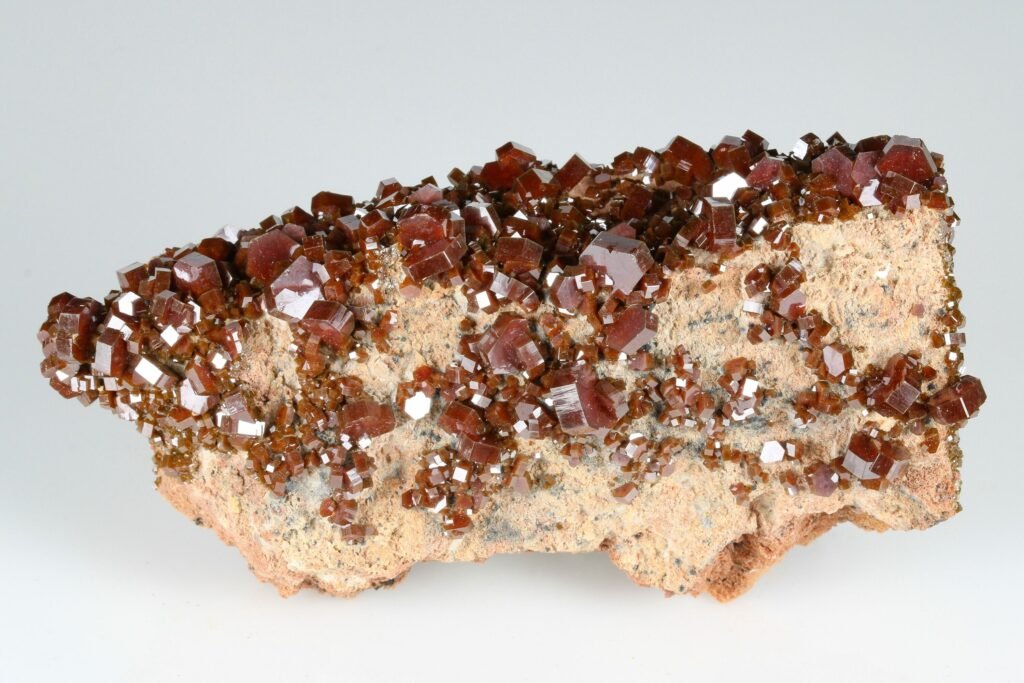
The optical appearance of Vanadinite can vary depending on crystal size, thickness, inclusions, surface condition, and chemical composition. Thin areas of transparent crystals may allow light to pass through more readily and reveal brighter shades of orange or red, while thicker crystals can appear much darker because of their strong absorption of visible light. Crystal faces with a smooth, well-developed surface may produce strong reflections, making the hexagonal geometry especially prominent. These optical features are useful when examining Vanadinite alongside visually similar minerals, but color alone should not be considered sufficient for identification. Its characteristic crystal habit, high specific gravity, relatively low hardness, chemical composition, and association with oxidized lead deposits provide more reliable criteria for distinguishing Vanadinite from other red or orange minerals.
Uses and Applications of Vanadinite
Vanadinite has historically been considered an important source of vanadium because of its relatively high vanadium content and its occurrence in oxidized lead deposits. Vanadium obtained from mineral resources has applications in metallurgy, particularly in the production of specialized steel and other alloys where vanadium can improve strength, hardness, wear resistance, and performance at elevated temperatures. Vanadinite can also contain a significant amount of lead, but it is generally not regarded as a major modern source of lead because more economically important lead ores are available. The importance of Vanadinite as an ore mineral has therefore varied according to the availability of deposits, extraction costs, and demand for vanadium. Today, its direct industrial role is comparatively limited, but its chemical composition remains significant for geological and mineralogical studies of vanadium-bearing ore systems.
The most common modern use of Vanadinite is as a mineral specimen for collectors, museums, educational institutions, and geological research. Its vivid red and orange colors, distinctive hexagonal crystals, high density, and strong luster make it one of the more visually recognizable secondary minerals. High-quality specimens are frequently displayed in mineral collections to demonstrate the relationship between crystal structure, chemical composition, and geological formation. Vanadinite is also useful in teaching mineral identification because its combination of crystal habit, color, hardness, specific gravity, and association with oxidized lead deposits provides several characteristics that can be examined together. Scientific studies of Vanadinite can further contribute to understanding secondary mineral formation, vanadium mobility, oxidation processes, and the chemical evolution of weathered ore deposits. Although it is not widely used as a gemstone because of its softness and lead content, its scientific, educational, historical, and collectible value remains considerable.