
Halite is one of the most recognizable and widely used minerals on Earth. Known commonly as rock salt, halite is the natural mineral form of sodium chloride (NaCl), the same compound found in ordinary table salt. Although most people encounter halite daily as a seasoning, the mineral itself plays a much larger role in geology, industry, chemistry, environmental science, and human history.
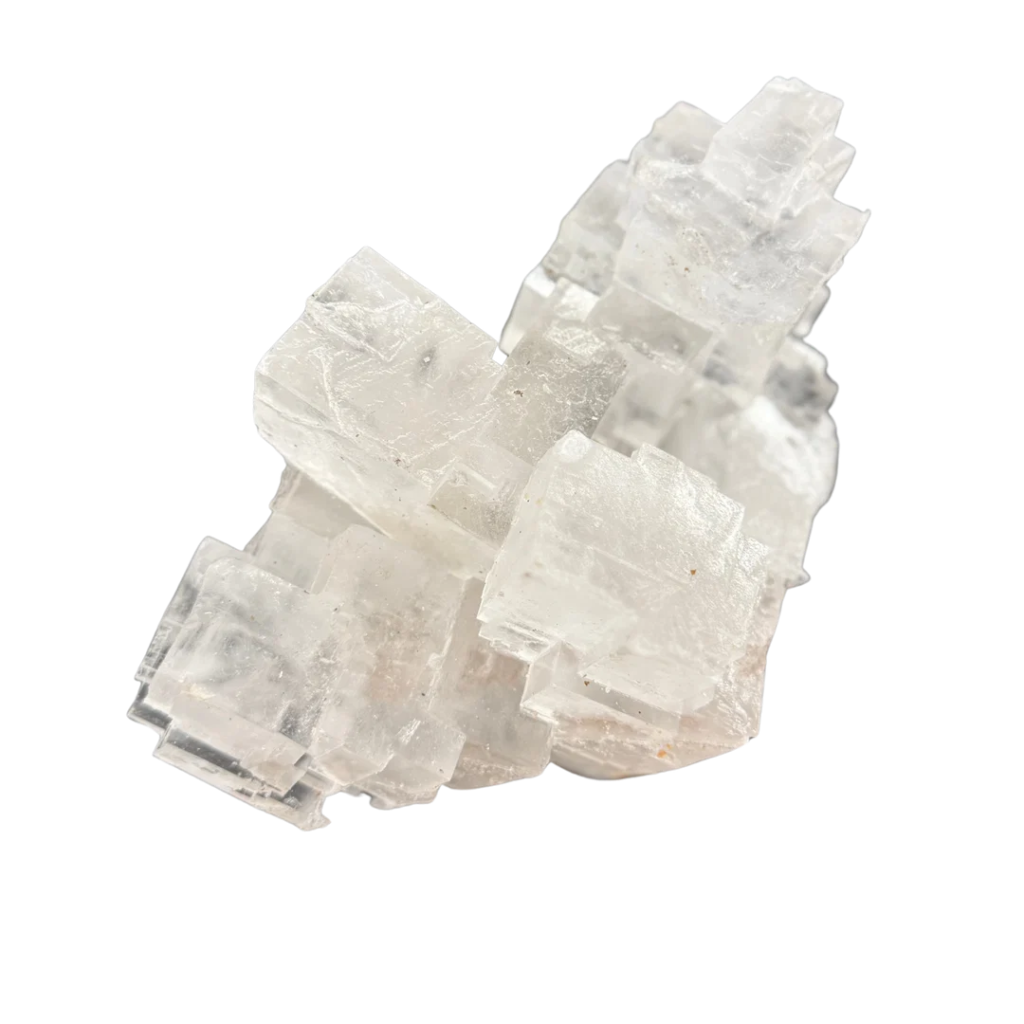
Halite belongs to the halide mineral group and forms through the evaporation of saline water. Large deposits develop when ancient seas, salt lakes, or enclosed bodies of water gradually evaporate, leaving dissolved minerals behind. Over millions of years, these evaporite deposits can become buried beneath layers of sediment and eventually form extensive underground salt beds.Pure halite is typically colorless or white, but natural specimens can appear in shades of gray, yellow, orange, red, blue, pink, or purple because of impurities and structural defects. Its distinctive cubic crystals, salty taste, and excellent cleavage make it one of the easiest minerals to identify. Today, halite is mined on every continent and remains one of the world’s most economically important non-metallic minerals.
History of Halite
Halite has one of the longest and most influential histories of any mineral used by humans. Archaeological evidence suggests that people began collecting and using natural salt deposits thousands of years ago, long before the development of modern agriculture and food preservation techniques. Ancient communities quickly discovered that salt could preserve meat, fish, and vegetables, making it possible to store food for extended periods and survive seasonal shortages. Because of its practical value, halite became an essential resource in many early civilizations.
Throughout history, salt played a major role in economics, trade, religion, and politics. Ancient Egyptians used salt during the mummification process, while the Greeks and Romans considered it a valuable commodity for both daily life and commercial exchange. Major trade routes were established specifically to transport salt across vast distances, and many cities grew around important salt deposits and mining centers. During the Middle Ages, governments often imposed taxes on salt production and distribution because of its economic importance. Even today, the historical influence of halite can still be seen in language, culture, cuisine, and international trade, demonstrating how a simple mineral helped shape the development of human civilization.
Formation of Halite
Halite forms primarily through the evaporation of salt-rich water in environments where the rate of water loss exceeds the rate of replenishment. This process usually occurs in restricted marine basins, inland seas, salt lakes, coastal lagoons, and arid desert environments. When seawater or saline groundwater becomes trapped in these environments, continuous evaporation gradually increases the concentration of dissolved minerals. As the water volume decreases, different minerals begin to crystallize according to their solubility, eventually leading to the precipitation of sodium chloride.
The formation of large halite deposits follows a predictable sequence known as evaporite deposition. Minerals such as calcite and gypsum usually crystallize before halite because they are less soluble. Once the brine becomes highly concentrated, sodium and chloride ions combine to form cubic halite crystals that accumulate on the basin floor. Over time, repeated cycles of flooding and evaporation can produce extremely thick salt layers that may reach hundreds of meters in thickness.
Geological processes continue to influence halite long after its initial formation. Burial beneath sedimentary rocks can compress salt deposits and transform them into massive underground beds. Because halite behaves plastically under pressure, it can slowly flow and create large geological structures known as salt domes. These formations often rise through overlying rock layers and play an important role in petroleum accumulation, groundwater movement, and regional tectonic activity. Many of the world’s most economically important halite deposits originated in ancient oceans that evaporated hundreds of millions of years ago and were later preserved beneath younger sediments.
Crystal Structure of Halite
Halite crystallizes in the isometric, or cubic, crystal system and possesses one of the simplest and most symmetrical atomic arrangements found in nature. Its structure is based on a repeating three-dimensional framework composed of alternating sodium (Na⁺) and chloride (Cl⁻) ions that are held together by strong ionic bonds. Within this arrangement, every sodium ion is surrounded by six chloride ions, while every chloride ion is similarly surrounded by six sodium ions. This balanced and highly organized pattern extends uniformly throughout the crystal, creating the geometric symmetry that gives halite its characteristic cubic form.
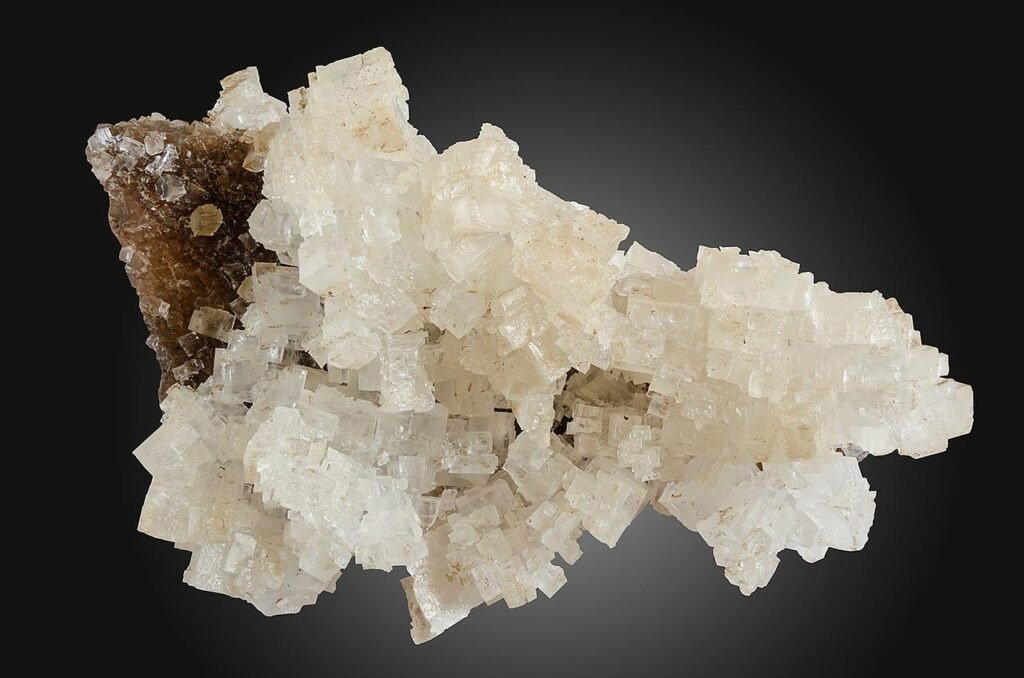
The crystal lattice of halite is classified as a face-centered cubic structure, a configuration that strongly influences its physical behavior. Because the atomic bonds are arranged evenly in three perpendicular directions, the mineral develops three directions of perfect cleavage that intersect at right angles. When mechanical stress is applied, halite does not usually fracture into irregular pieces. Instead, it tends to break along these cleavage planes, producing smaller cubes that retain the original geometry of the crystal. This structural characteristic makes halite one of the easiest minerals to recognize and identify.
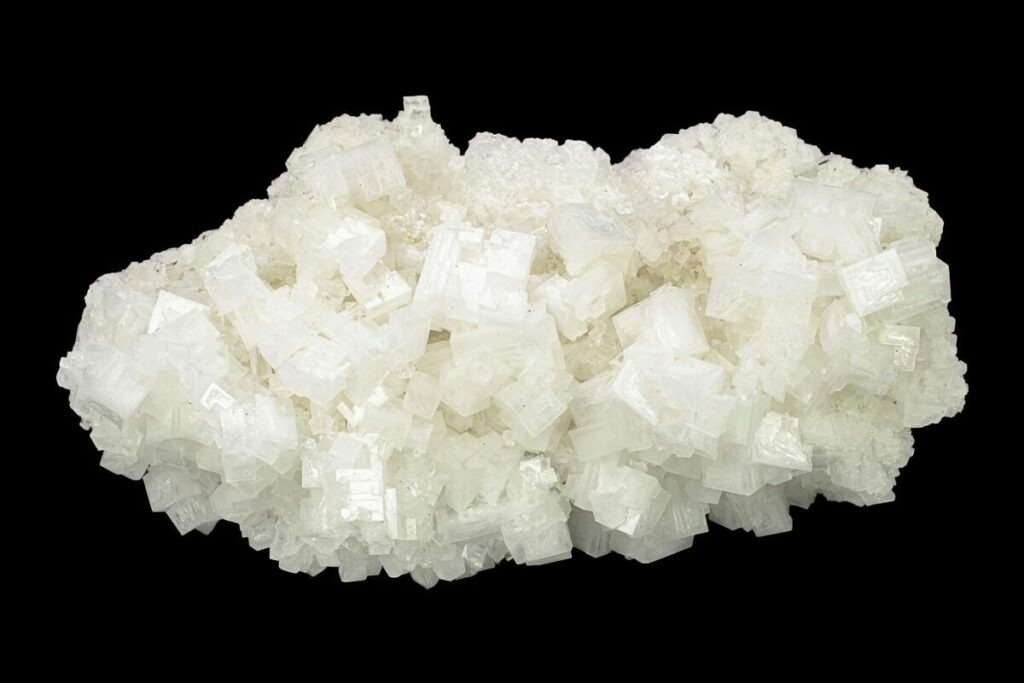
The cubic arrangement of ions also affects other important properties, including crystal growth, transparency, and stability. Halite crystals may develop as simple cubes, stepped hopper crystals, or massive granular aggregates, depending on environmental conditions during formation. The remarkable symmetry of its atomic structure has made halite an important mineral for studying crystallography, ionic bonding, and evaporite geology, and it continues to serve as a classic example in mineralogy and chemistry education.
Physical and Chemical Properties of Halite
Halite possesses a distinctive combination of physical and chemical properties that separate it from most other common minerals. Physically, it is generally colorless or white when pure, although impurities can produce gray, yellow, pink, red, blue, or purple varieties. The mineral is typically transparent to translucent and displays a vitreous, glass-like luster. With a Mohs hardness of only 2 to 2.5, halite is relatively soft and can easily be scratched by a fingernail or a copper coin. It also has a specific gravity of approximately 2.17, making it lighter than many metallic and silicate minerals.
One of the most important characteristics of halite is its exceptional solubility in water. Unlike many minerals that remain relatively stable when exposed to moisture, halite readily dissolves and separates into sodium and chloride ions. This property explains why large halite deposits are commonly found in dry environments where evaporation exceeds precipitation. Chemically, sodium and chloride are essential elements for many biological processes, including nerve function, muscle contraction, and fluid regulation in living organisms. Because of its chemical stability under dry conditions and its ability to dissolve and release ions in aqueous environments, halite plays a significant role in ocean chemistry, groundwater systems, industrial manufacturing, food preservation, and numerous environmental processes. These combined physical and chemical characteristics have made halite one of the most economically valuable and scientifically important minerals in human history.
Applications of Halite
Halite has been an essential mineral throughout human history and remains one of the most widely used natural resources in the modern world. Although it is commonly recognized as the source of table salt, its importance extends far beyond culinary applications. Because sodium chloride is inexpensive, abundant, and chemically versatile, halite serves as a fundamental raw material in numerous industries, including food processing, transportation, agriculture, chemical manufacturing, medicine, and water treatment. Its widespread availability and economic value have made it one of the most important non-metallic minerals extracted worldwide.
In the food industry, halite is used as both a seasoning and a preservative, helping to improve flavor while extending the shelf life of many products. The chemical industry depends heavily on sodium chloride for the production of chlorine, sodium hydroxide, and other industrial chemicals used to manufacture plastics, paper, detergents, textiles, and cleaning products. Halite is also widely applied to roads during winter because it lowers the freezing point of water and helps melt snow and ice. Additional uses include water-softening systems, livestock nutrition, pharmaceutical products, and medical saline solutions. These diverse applications demonstrate how a relatively simple mineral continues to support modern industry and everyday life.
How to Identify Halite
Halite can usually be identified quickly because it possesses several distinctive physical characteristics that are rarely found together in other minerals. Its most recognizable feature is its cubic crystal habit, which reflects the highly symmetrical arrangement of sodium and chloride ions within the crystal structure. Natural crystals often develop into well-defined cubes, while broken specimens typically separate into smaller cubic fragments because of the mineral’s perfect cleavage.
Several physical tests can help confirm the identification of halite. The mineral has a Mohs hardness of only 2 to 2.5, making it soft enough to be scratched with a fingernail. It usually displays a vitreous or glass-like luster and ranges from transparent to translucent. Another important characteristic is its high solubility in water, which distinguishes it from many visually similar minerals. Although halite is famous for its salty taste, mineral identification should rely primarily on physical and laboratory testing rather than direct tasting, particularly when examining unknown specimens that may contain impurities or potentially harmful substances. When its cubic crystals, low hardness, perfect cleavage, and rapid dissolution are considered together, halite becomes one of the easiest minerals to recognize in both field studies and mineral collections.