
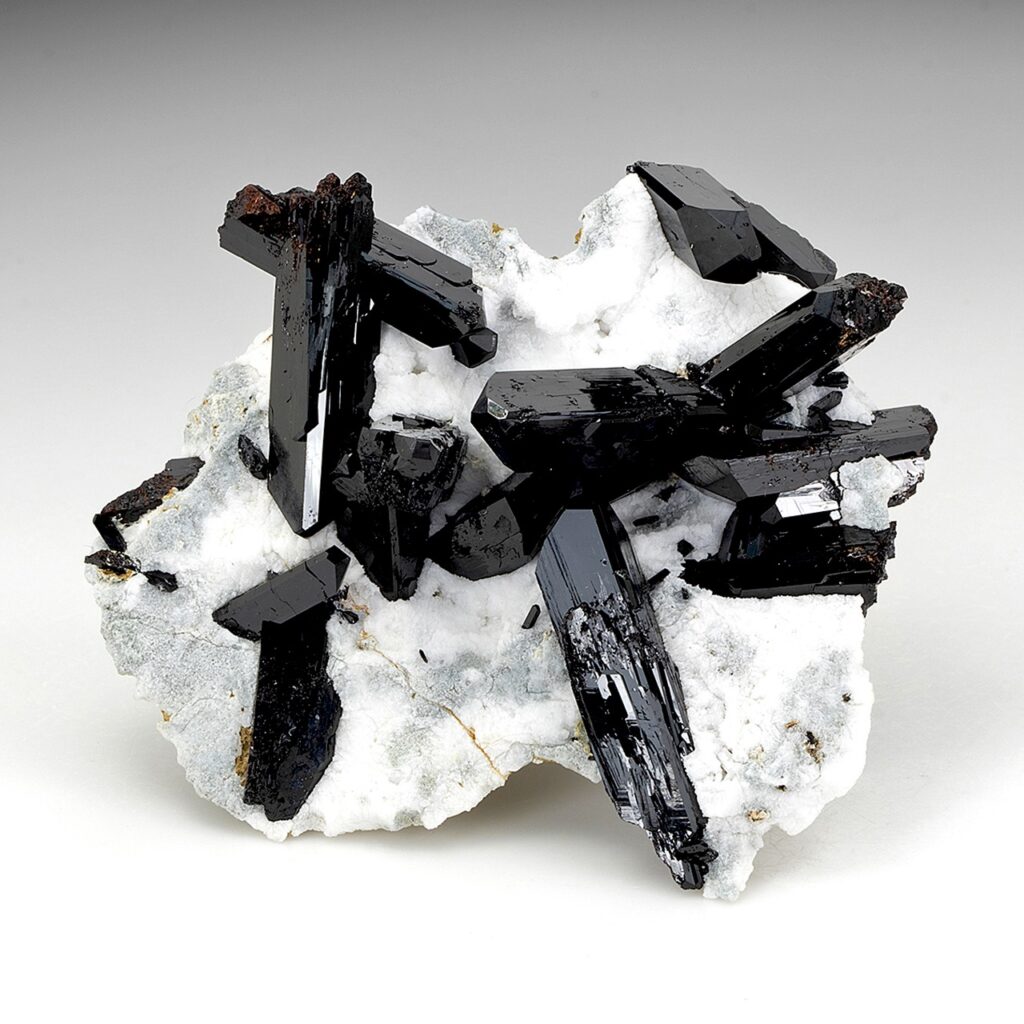
Neptunite is a rare potassium sodium lithium iron titanium silicate mineral belonging to the inosilicate group, recognized for its distinctive dark-colored prismatic crystals, complex chemical composition, and occurrence in highly specialized alkaline geological environments. Unlike common silicate minerals such as feldspar and quartz, neptunite forms only under unusual conditions where elements including lithium, titanium, sodium, and potassium become concentrated during the late stages of igneous activity, resulting in the ideal chemical formula KNa₂Li(Fe²⁺,Mn²⁺)₂Ti₂Si₈O₂₄. This composition combines several elements that are relatively uncommon together in natural mineral structures, with the presence of lithium and titanium being particularly notable due to their association with rare-element mineral deposits and specialized alkaline rocks. Visually, neptunite typically occurs as elongated prismatic crystals with sharp edges and well-developed faces, ranging in color from deep black to reddish-black or dark brown, and exhibiting a vitreous to resinous luster. Although it is not used as a gemstone for commercial jewelry, neptunite is prized among collectors for its rarity, sharp crystal habits, and frequent association with other rare minerals such as benitoite, natrolite, and aegirine. Because of its limited global distribution and specific geological formation requirements, neptunite functions primarily as a collector mineral rather than an industrial resource, yet it retains significant scientific value in mineralogical studies by providing critical insights into the geochemical behavior and concentration mechanisms of rare elements during late-stage magmatic and hydrothermal processes.
History and Discovery of Neptunite
Neptunite was first discovered in 1893 at the Kangerdluarsuk alkaline complex in Greenland, a locality famous for producing numerous rare minerals associated with unusual igneous rocks. The mineral was named after Neptune, the Roman god of the sea, following the traditional practice of naming newly identified minerals after mythological figures, places, or notable characteristics. The discovery expanded scientific understanding of complex silicate minerals containing lithium and titanium, with early mineralogical investigations revealing a unique chemical structure distinct from common chain silicates, leading to subsequent research on its crystal architecture, elemental substitutions, and specialized formation conditions. One of the most famous occurrences was later identified in San Benito County, California, where neptunite became widely recognized for its association with benitoite, producing prized collector specimens featuring sharp black neptunite crystals set against bright blue benitoite and white natrolite matrices. Today, neptunite remains an important mineral species for researchers studying rare-element enrichment, alkaline magmatism, and the geochemical processes governing unusual mineral assemblages.
Formation and Geological Environment of Neptunite
Neptunite forms primarily in highly specialized alkaline igneous environments, such as nepheline syenites, agpaitic pegmatites, and localized hydrothermal veins, where extreme geochemical fractionation allows unusual concentrations of incompatible rare elements—specifically lithium, titanium, sodium, and potassium—to accumulate during the final stages of magmatic crystallization. As these volatile-rich late-stage residual fluids circulate through structural fractures, miarolitic cavities, and contact zones under low-temperature, high-alkalinity conditions, they facilitate the precise stoichiometry required for neptunite crystallization alongside related minerals. Within these restricted geological settings, neptunite typically occurs in characteristic mineral assemblages alongside rare and diagnostic species such as benitoite, natrolite, aegirine, joaquinite-(Ce), and eudialyte, providing critical petrological insights into the fluid evolution, mantle metasomatism, and rare-element transport mechanisms of the host rocks. Because these specific physicochemical conditions and elemental concentrations occur so infrequently across the Earth’s crust, natural neptunite deposits remain geographically restricted to a small number of globally famous alkaline intrusive complexes and hydrothermal mineral localities.
Major Occurrences of Neptunite
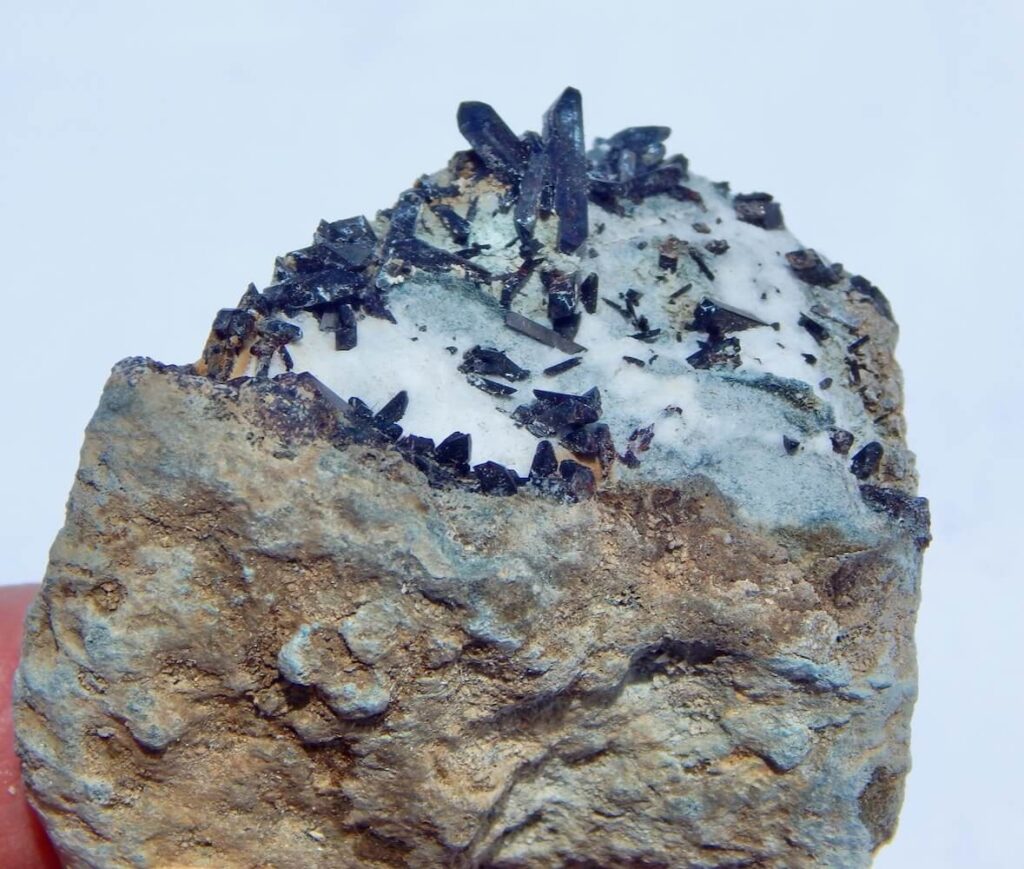
Neptunite is a remarkably rare mineral with a highly restricted global distribution, occurring in only a few specialized geological environments worldwide. The most famous locality is the Benitoite Gem Mine Click to open side panel for more information (historically known as the Dallas Gem Mine) in San Benito County, California, which is world-renowned for producing world-class neptunite specimens characterized by lustrous, sharp black prismatic crystals embedded in brilliant white natrolite matrix, frequently accompanied by rare blue benitoite and joaquinite-(Ce). Historically, the type locality at the Kangerdluarsuk plateau within the Ilímaussaq alkaline complex in South Greenland remains significant as the site of neptunite’s initial discovery in 1893, where it occurs in agpaitic pegmatites alongside eudialyte and aegirine. Additional notable occurrences include the Khibiny and Lovozero alkaline massifs on the Kola Peninsula in Russia, Mont Saint-Hilaire in Quebec, Canada, and localized agpaitic or nepheline syenite complexes in Norway, Malawi, and Namibia; however, because neptunite requires precise concentrations of lithium, titanium, and alkalis under specific hydrothermal conditions, gem-quality, sharply terminated crystals suitable for museum display and fine mineral collections remain exceptionally rare outside of California and Greenland.
Types and Varieties of Neptunite
- Mangan-neptunite (Manganneptunite): A manganese-rich variety (and recognized mineral species end-member) where manganese (Mn²⁺) dominates over iron (Fe²⁺) in the crystal lattice structure.
- Magnesioneptunite: A rare magnesium-dominant analog within the neptunite group, characterized by significant magnesium substitution (Mg) in place of iron and manganese.
- Epi-neptunite: A historical nomenclature term formerly applied to neptunite specimens exhibiting specific morphological variations or altered crystal habits.
- Locality-Specific Varieties: Distinct specimen forms named after major geological deposits, such as Greenlandic neptunite (often occurring as dark, tabular to prismatic crystals in agpaitic pegmatites) and California neptunite (characteristically forming sharp, highly lustrous black prismatic crystals embedded in white natrolite alongside benitoite).
Crystal Structure of Neptunite
Neptunite crystallizes in the monoclinic crystal system (space group C2/c) and features a complex chain-silicate framework built from linked silicon-oxygen tetrahedra and interconnected metal coordination polyhedra. Within this crystal lattice, parallel single chains of SiO₄ tetrahedra are cross-linked by chains of edge-sharing titanium-, iron-, manganese-, and lithium-oxygen octahedra, creating continuous structural channels that accommodate larger alkali cations such as potassium and sodium. This specific monoclinic symmetry directly governs neptunite’s characteristic elongated prismatic crystal habit, enabling well-formed crystals to develop sharp terminations and prominent faces when growing uninhibited within cavities, fractures, or late-stage hydrothermal veins. Titanium ions play a critical stabilizing role within the octahedral sites, while the incorporation of lithium situates neptunite among an unusual class of rare lithium-bearing inosilicates. The complex coordination and interaction between these varied transition metals and alkali ions dictate the mineral’s physical parameters, high refractive indices, and strong optical pleochroism, making the crystal structure of neptunite a primary example of how extreme chemical fractionation in specialized alkaline geological settings yields highly ordered, multi-elemental silicate frameworks.
Physical Properties of Neptunite
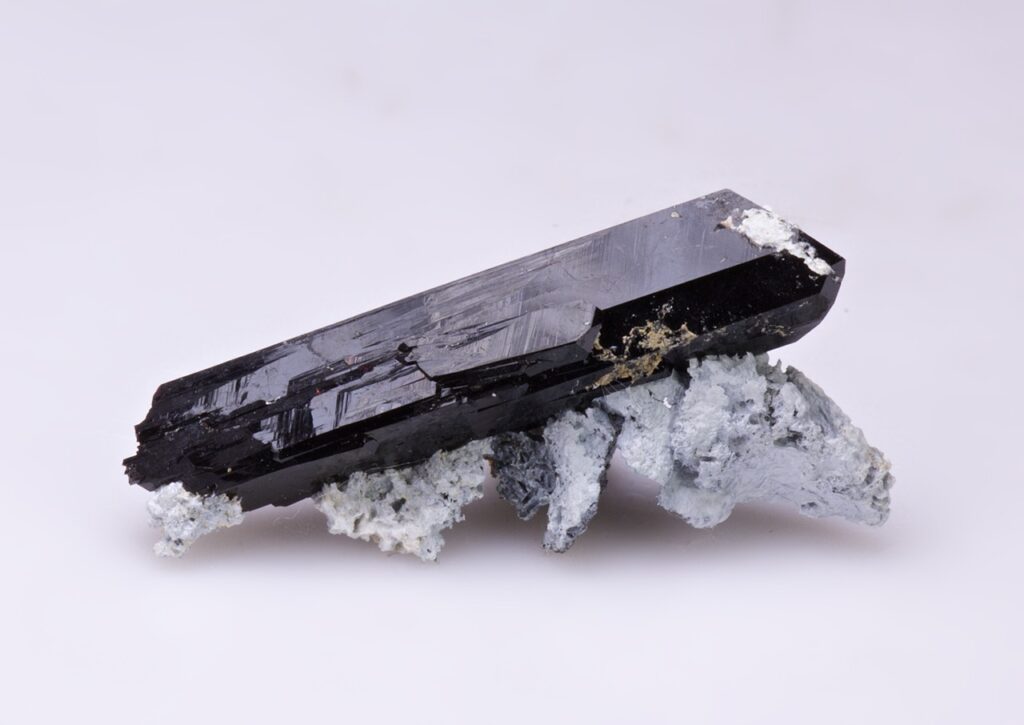
Neptunite displays distinct physical characteristics that reflect its unique monoclinic crystal structure and chemical composition. It typically forms sharp, elongated prismatic crystals with square cross-sections, ranging in color from deep jet black to dark reddish-black or dark reddish-brown, with thin edges often exhibiting deep red transillumination. The mineral possesses a vitreous to resinous luster and produces a characteristic cinnamon-brown to reddish-brown streak, which helps distinguish it from other dark silicate minerals. It demonstrates a Mohs hardness ranging between 5 and 6, a specific gravity of approximately 3.19 to 3.23, and distinct cleavage parallel to the {110} planes, breaking with an uneven to conchoidal fracture. Optically, neptunite is biaxial positive with extremely high refractive indices (nα ≈ 1.690, nβ ≈ 1.700, nγ ≈ 1.730) and exhibits intense pleochroism, changing from dark reddish-brown to pale yellow or orange-yellow depending on the orientation of polarized light.
Chemical Properties of Neptunite
Chemically, neptunite is a complex alkali transition-metal inosilicate with the ideal structural formula KNa₂Li(Fe²⁺,Mn²⁺)₂Ti₂Si₈O₂₄. Its composition represents a unique geochemical synthesis of light alkali elements (lithium, sodium, potassium) alongside transition metals (iron, manganese, titanium) integrated within a silicate framework. Neptunite belongs to a complete solid-solution series with its manganese-dominant analog, mangan-neptunite [KNa₂LiMn²⁺₂Ti₂Si₈O₂₄], where divalent iron (Fe²⁺) and divalent manganese (Mn²⁺) substitute freely for one another in the octahedral sites. The presence of tetravalent titanium (Ti⁴⁺) is structurally essential for maintaining electrostatic charge balance and stabilizing the cross-linked silicate chains. Neptunite is insoluble in common acids under ambient conditions, demonstrates high chemical stability within alkaline hydrothermal systems, and decomposes only under extreme thermal conditions, reflecting the strong covalent bonding within its linked octahedral-tetrahedral network.
Applications and Significance of Neptunite
Although neptunite lacks industrial applications and is not utilized as a commercial ore for extracting titanium or lithium due to its extreme scarcity and limited geographic distribution, it holds substantial value within scientific, educational, and collector domains. In mineralogical and geochemical research, neptunite serves as a vital indicator mineral, providing insights into the late-stage magmatic crystallization, elemental fractionation, and hydrothermal fluid evolution of rare-element-enriched alkaline igneous systems. Beyond its scientific utility, high-quality neptunite specimens—particularly those featuring sharply defined black prismatic crystals resting on contrasting white natrolite matrices from San Benito County, California—are highly prized in the global mineral collecting market and are prominent display features in museum collections worldwide. Additionally, while its brittle nature, distinct cleavage, and dark opacity make it unsuitable for conventional gemstone faceting in commercial jewelry, well-crystallized matrix specimens are occasionally prepared as polished display pieces or lapidary display mounts for specialized mineral collections.