
Adamite is a secondary zinc arsenate mineral with the chemical formula Zn₂AsO₄OH, crystallized within the orthorhombic system and typically restricting its genesis to the hypergene oxidation zones of zinc-bearing base-metal deposits. Formed through the weathering and oxidation of primary zinc sulfides such as sphalerite in the presence of arsenate-rich meteoric waters, it belongs to the olivenite group of minerals, characterized by a crystalline framework where AsO₄ tetrahedra interconnect with zinc-centered coordination polyhedra via edge- and corner-sharing mechanisms. Morphologically, adamite manifests as distinct prismatic or acicular crystals, radiating fibrous aggregates, encrustations, or botryoidal masses, exhibiting medium fractional cleavage, an uneven fracture, a Mohs hardness of 3.5 to 4.0, and a specific gravity ranging from 4.3 to 4.5. While economically non-viable as a primary industrial ore of zinc due to limited localized tonnages and the environmental hazards associated with arsenic extraction, the mineral holds significant academic and paragenetic value; it is noted for its vivid neon green, sulfur yellow, and pale green color variations driven by minor trace-element substitutions, such as copper replacing zinc in cuproadamite or manganese in manganoan adamite. Furthermore, adamite specimens consistently display strong, diagnostic bright green fluorescence under short-wave ultraviolet radiation, a phenomenon often attributed to activation by trace uranyl ions (UO₂²⁺) embedded within the lattice structure. First recognized in the 19th century from specimens obtained at the Ojuela Mine in Mapimí, Durango, Mexico—named in honor of French mineralogist Gilbert-Joseph Adam—the mineral remains a premier reference specimen for studying secondary mineral zonation, solid-solution series, and topographical mineralogy.
History and Discovery of Adamite
First described in 1866 by French mineralogist Charles Friedel, adamite was discovered within the hypergene oxidation zones of the Ojuela Mine in Mapimí, Durango, Mexico—a world-renowned polymetallic deposit famously yielding exceptional secondary zinc and lead species such as hemimorphite, smithsonite, and descloizite. Friedel named the mineral in honor of Gilbert-Joseph Adam, a prominent French mineralogist who had provided the initial type specimens for scientific evaluation. Early crystallographic and chemical investigations focused heavily on its distinctive composition, specifically the paragenetic coexistence of zinc and arsenate ions, which effectively differentiated it from visually analogous arsenate and phosphate minerals. Throughout the late 19th and early 20th centuries, adamite emerged as an important reference phase in mineralogical research, offering critical insights into the thermodynamic and geochemical processes governing supergene enrichment and mineral zonation within oxidized ore bodies. In the modern era, advanced analytical characterization—including X-ray diffraction (XRD) and electron probe microanalysis (EPMA)—has precisely refined the understanding of its orthorhombic crystal framework, solid-solution series, and precise fluid-inclusion formation dynamics. Although it holds negligible economic viability as an industrial zinc ore due to localized distribution, adamite remains a highly prized mineralogical commodity, meticulously sought after by institutions and private collectors for its remarkable structural morphology, trace-element color variations, and intense, diagnostic ultraviolet fluorescence.
Formation and Geological Occurrence of Adamite
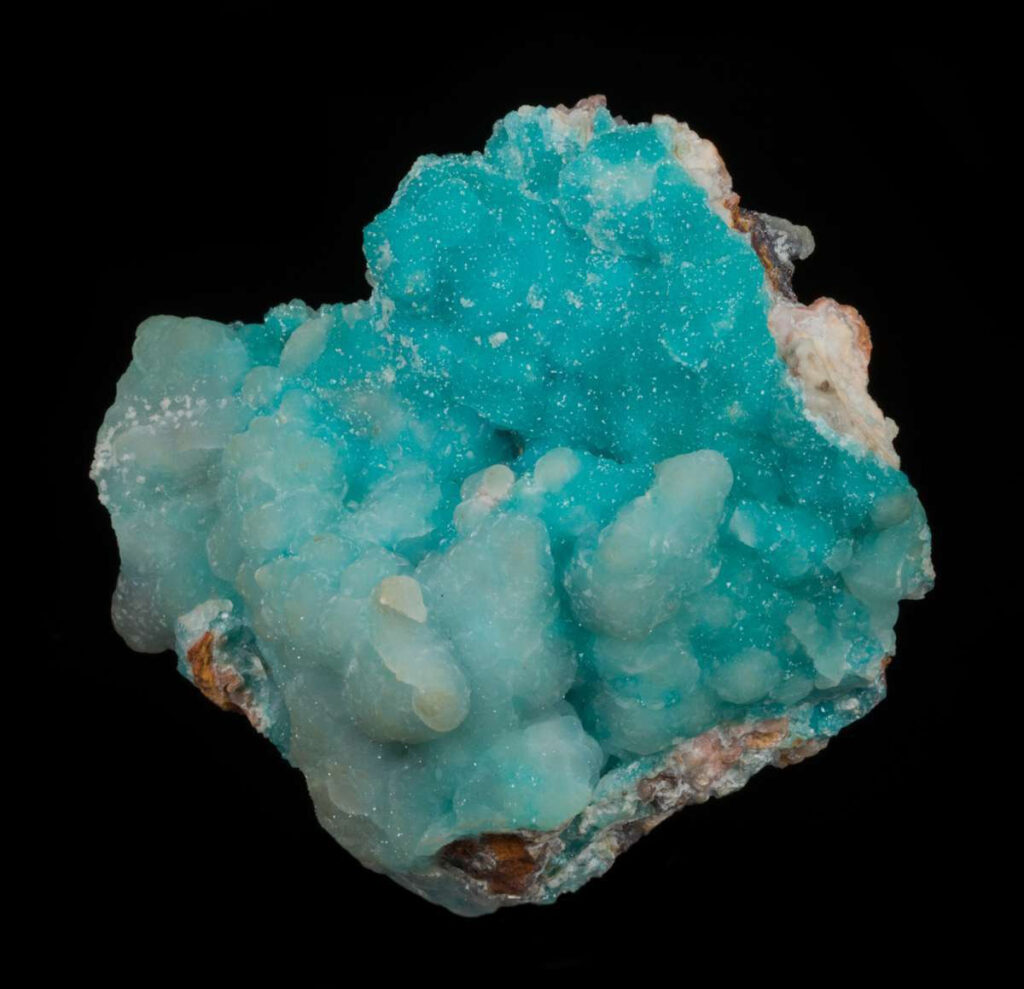
As a classic secondary mineral, adamite forms primarily within the upper, hypergene oxidation zones of zinc-rich hydrothermal ore deposits, where primary sulfide assemblages undergo intense chemical weathering upon exposure to oxygenated meteoric groundwaters. The paragenetic sequence initiates with the dissolution of primary zinc sulfides, predominantly sphalerite, which liberates mobile zinc ions into descending, slightly acidic to neutral aqueous solutions; these ions subsequently react with arsenate anions derived from the oxidation of co-existing arsenic-bearing sulfides like arsenopyrite or tennantite. This localized geochemical environment fosters the precipitation of adamite, typically within the open vugs, fractures, and solution cavities of gossanous host rocks where it develops as distinct crusts, radiating crystal clusters, or botryoidal linings. Under these oxidizing conditions, adamite typically crystallizes alongside a characteristic suite of secondary minerals, commonly tracking with iron-oxide gossans like limonite, or sharing paragenetic space with minerals such as calcite, smithsonite, hemimorphite, quartz, scorodite, and its copper-dominant structural analogue, olivenite. While chemically pure adamite is structurally colorless or white, its highly adaptable orthorhombic lattice readily accommodates minor, chromophoric trace-element substitutions that dictate its celebrated aesthetic variations: minor amounts of copper induce its signature vibrant neon or apple-green hues, manganese generates rare pink-to-purple varieties, and cobalt drives delicate blue-green colorations, altogether marking the mineral as a sensitive geochemical indicator of localized transition-metal zonation.
Types and Varieties of Adamite
- Yellow Adamite (Typical/Nominal Variety): Representing the nominal, chemically pure to near-pure endmember of the species, this variety exhibits a highly recognizable coloration ranging from pale straw-yellow to intense lemon- or sulfur-yellow. This distinctive pigmentation is frequently observed in classic ideomorphic crystals from the Ojuela Mine, Mexico, and is typically governed by the fundamental electronic transitions within the zinc arsenate matrix when free of significant chromophoric transition-metal contaminants.
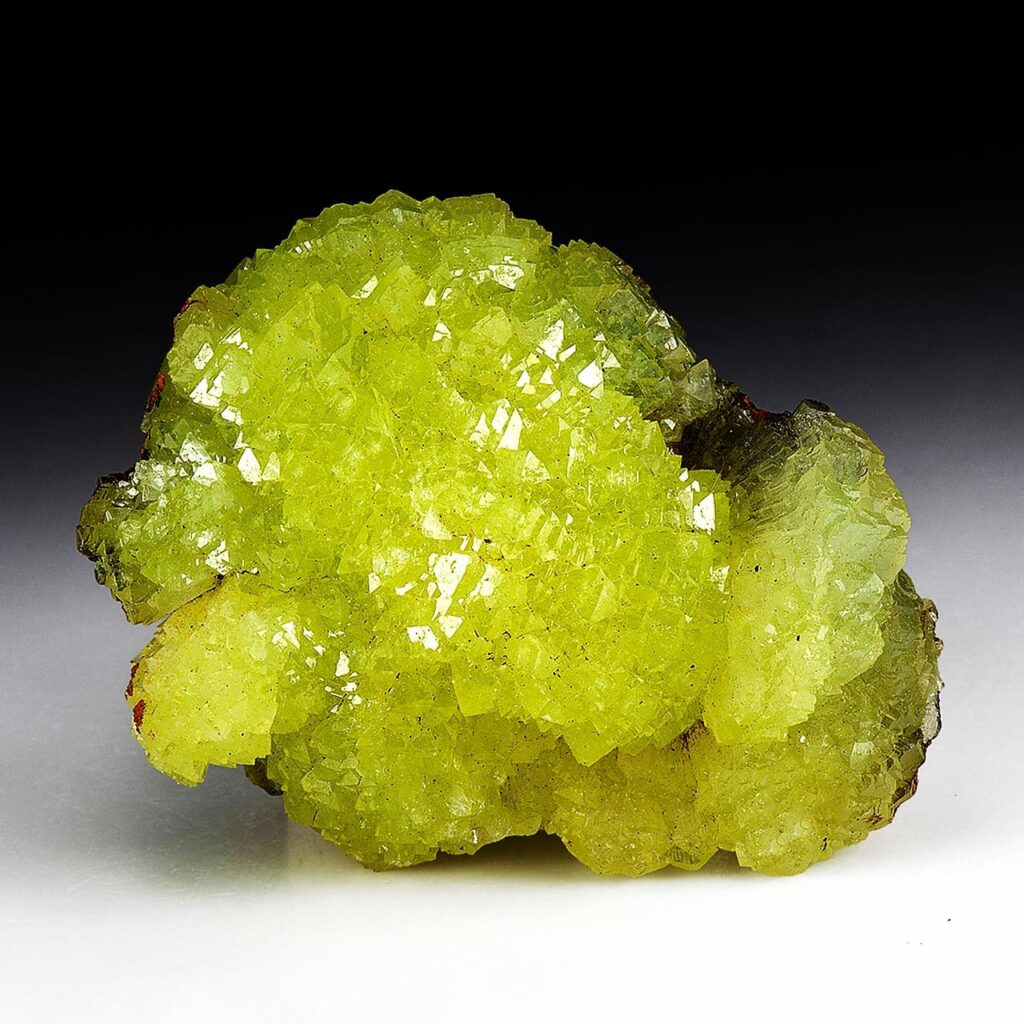
- Cuprian Adamite (Copper-Bearing Adamite / Cuproadamite): A geochemically significant variety defined by the partial, isomorphous substitution of copper (Cu²⁺) ions for zinc (Zn²⁺) ions within the orthorhombic crystal lattice, establishing a partial solid-solution series toward olivenite (Cu₂AsO₄OH). The introduction of copper acts as a potent chromophore, imbuing the mineral with highly coveted, vibrant aesthetic variations ranging from apple-green and deep emerald-green to intense blue-green, depending on the localized concentration and coordination of the copper dopants.
- Cobaltoan Adamite (Cobalt-Bearing Adamite): An uncommon, chemically anomalous variety wherein divalent cobalt (Co²⁺) substitutes into the zinc lattice sites. This specific cation exchange alters the structural absorption spectrum of the mineral, inducing atypical and visually striking color profiles that manifest as delicate pink, magenta, reddish-purple, or deep violet tones, making these specimens exceptionally rare and highly sought after for crystallographic and mineralogical collections.
- Manganoan Adamite (Manganese-Bearing Adamite): Formed via the structural integration of divalent manganese (Mn²⁺) replacing zinc within the coordination polyhedra. This distinct chemical substitution modifies the typical optical properties of the mineral, often producing unique pinkish-orange, brownish-pink, or pale purple crystals that serve as sensitive indicator phases for localized manganese enrichment during the paragenetic evolution of the supergene oxidation zone.
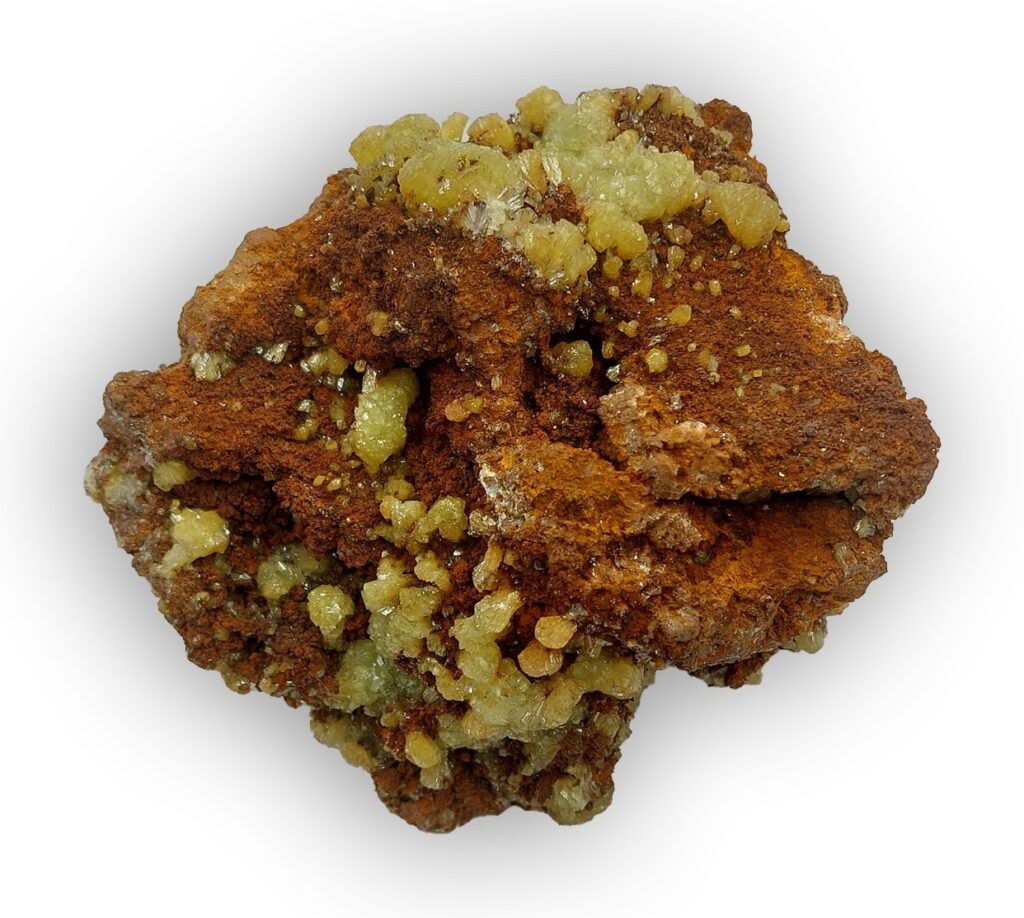
- Botryoidal and Alveolar Adamite (Morphological Varieties): Classified purely by macro-structural growth habits rather than composition, these varieties form when localized geo-chemical fluid dynamics favor rapid nucleation over sustained single-crystal growth. The mineral precipitates as rounded, hemispherical, grape-like aggregates, micro-crystalline crusts, or porous, reniform linings within the cavities of the gossan host rock, routinely exhibiting concentric zoning that reflects fluctuating trace-element chemistry during its depositional history.
Crystal Structure of Adamite
Crystallizing within the orthorhombic crystal system (specifically the space group Pnnm), the atomic architecture of adamite (Zn₂AsO₄OH) forms a highly rigid, three-dimensional framework structural framework characteristic of the olivenite group of minerals. Its crystalline lattice is underpinned by two distinct coordination environments for the zinc cations: one-half of the zinc ions occupy edge-sharing ZnO₄(OH)₂ octahedral sites that align in chains parallel to the c-axis, while the remaining zinc ions occupy distorted ZnO₄OH trigonal bipyramidal sites that laterally cross-link these chains. These zinc-centered polyhedra are further anchored by rigid, isolated AsO₄ tetrahedral arsenate groups, with the hydroxyl (OH⁻) ions coordinating directly to the zinc centers to maintain strict charge neutrality. While the ideal stoichiometry is fixed as Zn₂AsO₄OH, the flexible internal geometry of these coordination polyhedra readily permits the isomorphous substitution of transition-metal dopes into the zinc lattice sites, allowing varying concentrations of copper (Cu²⁺), cobalt (Co²⁺), manganese (Mn²⁺), and nickel (Ni²⁺) to alter both the optical absorption properties and local cell parameters without disrupting the overall structural integrity. Depending on the thermodynamic and geochemical kinetic variables driving this crystal growth—such as fluid supersaturation levels, ambient temperatures, and structural spacing within the gossanous host rock—the macro-structural morphology of adamite adjusts fluidly, manifesting across a broad habit spectrum that spans from highly defined, elongated prismatic crystals to densely packed radiating aggregates, botryoidal crusts, and massive compact linings.
Physical and Chemical Properties of Adamite
From a chemical perspective, adamite is a basic zinc arsenate mineral defined by the ideal stoichiometric formula Zn₂AsO₄OH, classifying it structurally as a prominent member of the olivenite group. The mineral is chemically sensitive to low-pH conditions, undergoing rapid dissolution when exposed to strong acids, and it serves as a host for extensive isomorphous substitution wherein the divalent zinc (Zn²⁺) sites are partially replaced by other transition metals like copper (Cu²⁺), manganese (Mn²⁺), cobalt (Co²⁺), or nickel (Ni²⁺) without disrupting the underlying lattice configuration. Structurally pure adamite is chemically colorless or white; however, these trace-element substitutions act as potent chromophores that dictate its diverse color palette, yielding the signature sulfur-yellow, vibrant neon-green, and rare violet variations observed in natural specimens. Furthermore, its internal lattice frequently accommodates trace concentrations of foreign impurities, most notably uranyl ions (UO₂²⁺), which act as structural activators that cause the mineral to exhibit a brilliant, diagnostic green fluorescence under short-wave ultraviolet radiation.
Physically, adamite possesses a Mohs hardness ranging from 3.5 to 4.0, rendering it relatively soft, while its high zinc and arsenic content contributes to a elevated specific gravity between 4.3 and 4.5. The mineral crystallizes in the orthorhombic system and exhibits an anisotropic optical character, showing a vitreous to sub-adamantine luster on freshly exposed surfaces and a white streak. Crystallographic cleavage is distinct but imperfect on the {101} plane and good on the {010} plane, and when subjected to mechanical stress, the mineral fractures in an uneven to subconchoidal pattern. It is optically biaxial, displaying strong dispersion and varying degrees of pleochroism depending on the concentration of copper or other modifying elements within the specific specimen, making its physical and optical parameters highly reflective of its localized geochemical growth environment.
Localities and Geographic Distribution of Adamite
The premier global locality for world-class adamite specimens is the Ojuela Mine in Mapimí, Durango, Mexico, a classic polymetallic deposit renowned for producing the finest structural and aesthetic examples of the species. At this site, the hypergene oxidation of primary sulfide veins within Cretaceous limestone host rocks has yielded massive vugs lined with exceptional, highly lustrous aggregates of sulfur-yellow, neon-green, and multi-colored cuprian and manganoan adamite pinwheels. Another significant North American locality is the Gold Hill Mine in Tooele County, Utah, USA, which has produced notable specimens of both typical adamite and its copper-rich variations within oxidized arsenic-rich skarn deposits. In Europe, the ancient mining districts of Laurion, Attica, Greece, provide historical and mineralogically significant specimens, where the weathering of ancient zinc-lead slags and primary ore veins in a carbonate matrix has generated highly translucent, crustified coatings of green cuprian adamite alongside other rare arsenates.
Beyond these classic localities, noteworthy occurrences are distributed globally across specialized oxidized ore zones. In Africa, the Tsumeb Mine in Oshikoto, Namibia—highly regarded for its complex paragenetic assemblages—has yielded unique, well-crystallized olivine-green and pale yellow adamite clusters associated with secondary copper-lead-zinc mineralization. Fine specimens have also been recovered from the Aghabar Mine in the Anarak District of Iran, yielding distinct, highly fluorescent yellow crystal groupings. In Europe, the Cap Garonne Mine in Var, France, acts as an important locality for micro-crystals, displaying exceptional color diversity including rare cobaltoan variations. These geographical occurrences demonstrate that while adamite is globally distributed, the development of exceptional, macro-crystalline specimens is restricted to unique geological environments where rich primary zinc and arsenic sulfides intersect with dense carbonate host formations under protracted weathering regimes.
Applications and Scientific Utility of Adamite
Despite its striking visual properties, adamite holds no viable commercial or metallurgical application as an industrial ore for zinc extraction due to its highly localized geological distribution, limited volumetric tonnage, and the severe environmental hazards associated with processing heavy arsenic-bearing compounds. Instead, its utility is highly specialized and primarily centered within advanced academic research, crystallographic modeling, and the global geological specimen economy. Within economic geology, adamite serves as a critical indicator phase for studying supergene enrichment zones and secondary mineral zonation. Because its formation requires specific thermodynamic constraints, its presence allows geochemists to accurately reconstruct past low-temperature fluid environments, tracking historical groundwater chemistry, oxygen fugacity, and pH fluctuations in oxidized base-metal deposits.
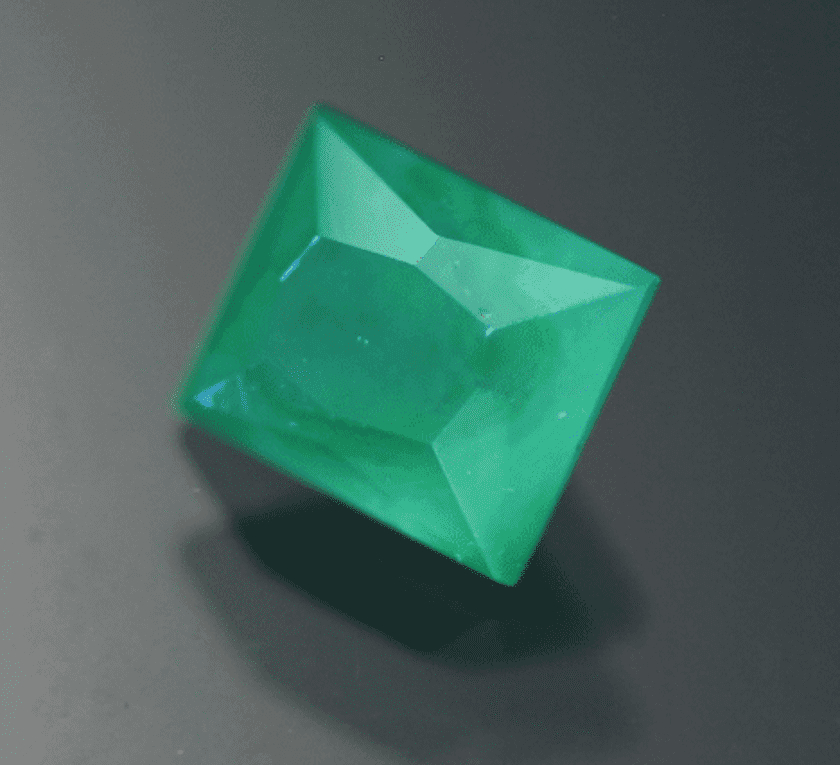
Furthermore, the highly adaptable orthorhombic lattice of adamite makes it a premier natural model for structural mineralogists investigating transition-metal substitution. It is extensively utilized in research concerning solid-solution series—specifically the continuous exchange between zinc and copper toward olivenite (Cu₂AsO₄OH)—helping scientists map out ionic radius tolerances, local cell-parameter distortions, and coordinate polyhedra mechanics via X-ray diffraction and electron probe microanalysis. Due to its diagnostic, brilliant green response under short-wave ultraviolet radiation, adamite is also frequently deployed in optical spectroscopy to study trace-element activation mechanisms, focusing on how trace uranyl impurities (UO₂²⁺) embed themselves within the crystal framework to activate intense luminescence. Finally, on a commercial level, exceptional macro-crystalline aggregates fuel a specialized economic market dedicated to high-end museum curation, educational displays, and private systemic mineralogy collections, where its value is dictated by crystallographic perfection and rare chromophoric variations.