
Huebnerite, frequently denoted in academic mineralogical literature as hübnerite, is a rare and highly significant transition metal tungstate mineral characterized by the chemical formula MnWO₄. As the manganese-dominant endmember of the wolframite solid solution series—forming a continuous compositional spectrum with its iron-rich counterpart, ferberite (FeWO₄)—huebnerite is highly sought after by both industrial metallurgists and systematic mineral collectors. Crystallizing in the monoclinic crystal system, it typically manifests as elongated, vertically striated prismatic crystals that often develop into complex radiating, bladed, or parallel reticulated aggregates. Mineralogists identify huebnerite through its striking optical and physical properties, most notably its deep reddish-brown to brownish-black coloration, which frequently exhibits a distinct, blood-red translucency under intense transmitted light. The mineral possesses a brilliant submetallic to resinous luster, perfect cleavage on the {010} crystallographic plane, a Mohs hardness ranging from 4.0 to 4.5, and a remarkably high specific gravity (typically between 7.1 and 7.3) indicative of its dense metallic composition. Economically, huebnerite serves as a vital primary ore of tungsten, a critical refractory metal utilized extensively in the manufacturing of high-speed hardened steels, specialized aerospace superalloys, and high-temperature electrical components.
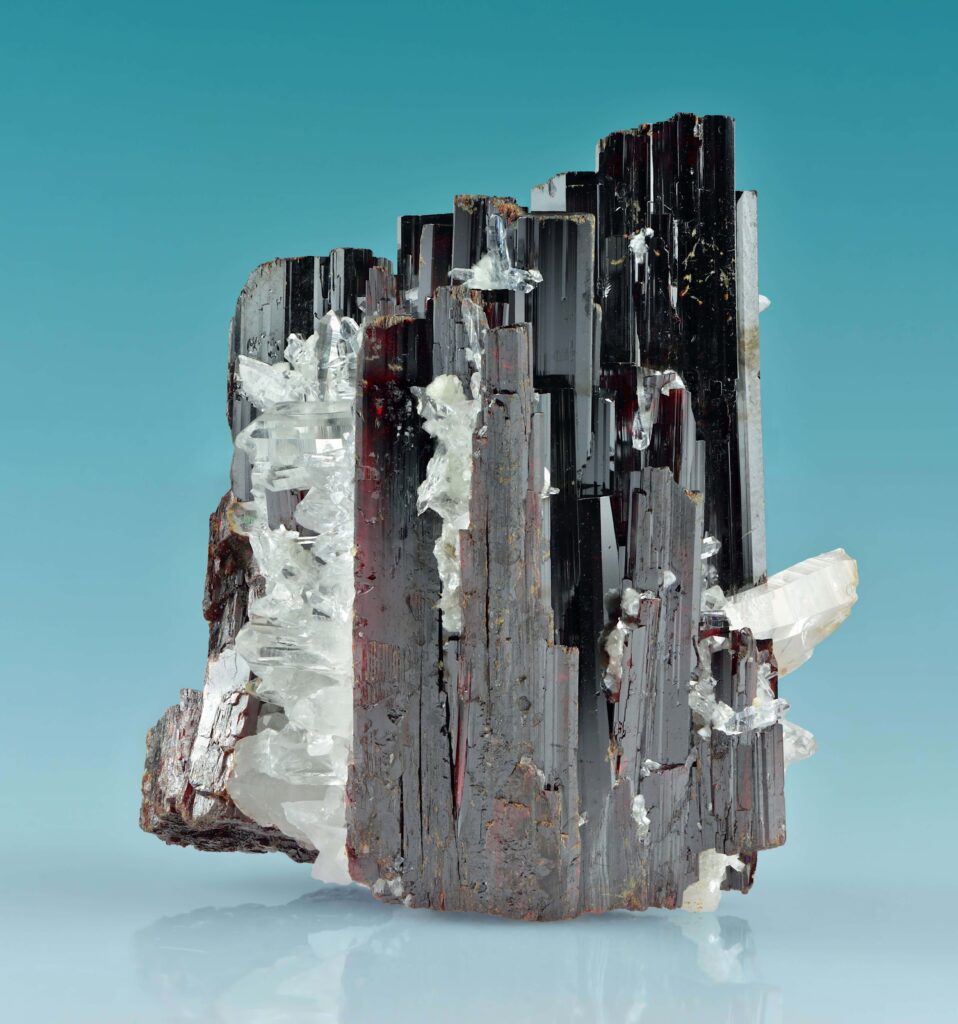
The formal historical provenance of huebnerite is deeply intertwined with the expansive American mining boom of the mid-nineteenth century, a period characterized by rapid metallurgical discovery and geological exploration. The mineral was first officially recognized, chemically analyzed, and introduced to the scientific community in 1865 by the prominent metallurgist Eugene N. Riotte. The type locality for this newly identified species was established in the Erie and Enterprise veins of the Mammoth mining district, situated in the rugged terrain of Nye County, Nevada, in the United States. Upon confirming its distinct chemical composition as a manganese tungstate, Riotte chose to name the mineral “huebnerite” in order to honor Adolph Hübner, a highly distinguished German mining engineer and metallurgist whose significant contributions to nineteenth-century extractive metallurgy were widely respected globally. Since its initial classification in the Nevada desert, the mineral’s historical footprint has expanded internationally as it became a cornerstone resource during periods of rapid industrialization, particularly when the global demand for tungsten-carbide tooling and durable military-grade steel surged during the early twentieth century.
From a geochemical and petrological standpoint, the paragenesis of huebnerite is intimately linked to high-temperature hydrothermal and pneumatolytic processes occurring deep within the Earth’s continental crust. Huebnerite is predominantly classified as a hypothermal to mesothermal vein mineral, meaning it precipitates from superheated, metal-rich aqueous fluids at significant depths and elevated temperatures, typically ranging between 300°C and 500°C. These mineralizing hydrothermal fluids are almost exclusively associated with the late-stage fractional crystallization of silicic magmas, particularly within large granitic intrusions. As the granitic plutons slowly cool, incompatible elements such as tungsten, manganese, and fluorine become highly concentrated in the residual, volatile-rich fluids. These pressurized fluids are subsequently expelled into the surrounding country rock, migrating through structural fissures, fault zones, and fractures where an eventual drop in temperature and pressure induces mineral precipitation. Consequently, huebnerite is most frequently found embedded within massive quartz veins, highly altered greisens, and complex granitic pegmatites. The mineralogy of these hydrothermal deposits is often highly diverse; huebnerite typically crystallizes in close natural association with a specific suite of paragenetic minerals, including milky to smoky quartz, fluorite, cassiterite, arsenopyrite, native bismuth, and molybdenite. Today, world-class geological environments hosting significant huebnerite formations are documented across the globe, with exceptionally aesthetic crystalline specimens historically recovered from the Pasto Bueno district in Peru, the Sweet Home Mine in Colorado, and various pegmatitic fields throughout China and central Europe.
Solid Solution Series and Morphological Varieties of Huebnerite
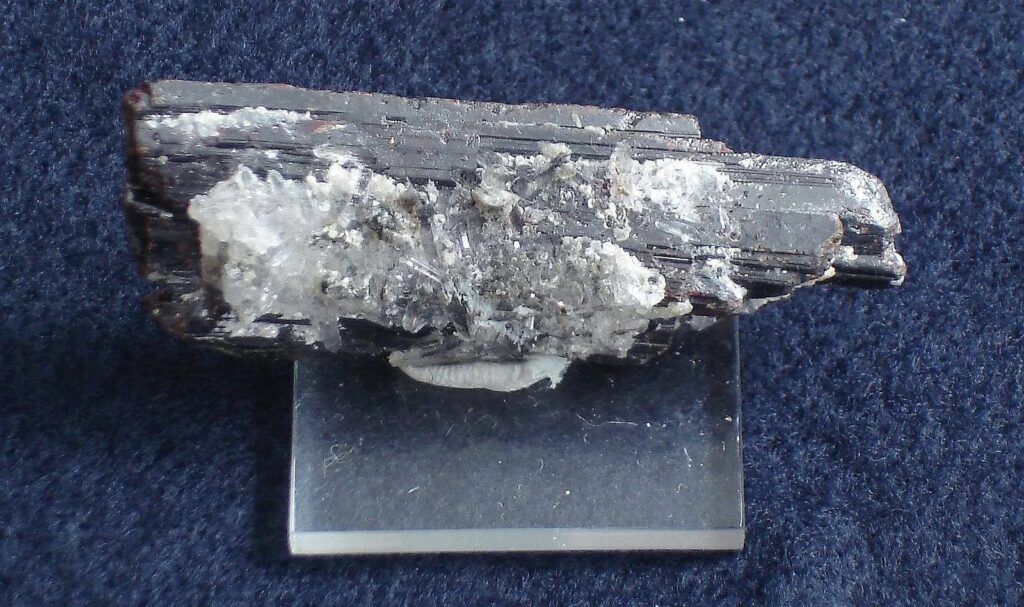
In systematic mineralogy, huebnerite does not exist in isolation but rather serves as the foundational manganese-dominant endmember of the renowned wolframite solid solution series. This isomorphous series forms a continuous compositional spectrum between huebnerite (MnWO₄) and its iron-rich counterpart, ferberite (FeWO₄). When the ratio of manganese to iron is intermediate and freely substituting within the crystal lattice, the mineral is broadly classified under the general term “wolframite.” Consequently, true huebnerite is rigorously defined as possessing a manganese-to-iron ratio exceeding 80:20. While huebnerite lacks chemically distinct sub-varieties, it displays a spectacular diversity of morphological forms depending on its specific paragenetic environment. Collectors and mineralogists frequently categorize these morphological habits into the following distinct descriptive types:
- Elongated Prismatic Crystals: This is the most classic morphological expression, featuring long, distinctively flattened crystals that exhibit deep, parallel vertical striations along their primary faces.
- Bladed and Tabular Habits: In specific constrained hydrothermal environments, huebnerite forms compressed, bladed structures that often intergrow or aggregate into dense, tabular metallic masses.
- Radiating Aggregates: Crystals frequently develop into complex, fan-like radiating clusters that diverge from a central nucleation point within the host quartz matrix.
- Reticulated Meshes: Under certain geochemical conditions, huebnerite forms intricate, interlocked, lattice-like crystalline meshes that create highly complex and delicate structural geometries.
- Twinned and “Gemmy” Specimens: The most aesthetically prized varieties manifest as heavily striated, translucent (often exhibiting a deep blood-red internal glow), twinned crystals that form intersecting “V” shapes or star-like clusters, which are heavily sought after in the premium mineral specimen market.
Crystallographic Architecture and Structural Geometry
The internal atomic arrangement of huebnerite is a fascinating subject of crystallographic study, dictating many of its macroscopic physical behaviors. Huebnerite crystallizes in the monoclinic crystal system, specifically falling within the prismatic crystal class (2/m) and belonging to the P2/c space group. At the microscopic structural level, the mineral’s architecture is built upon a framework of highly distorted, oxygen-coordinated octahedral sites. The structure consists of infinite, zigzag polymeric chains composed of alternating manganese (MnO₆) and tungsten (WO₆) octahedra. These intricate chains extend linearly parallel to the crystallographic c-axis and are cross-linked to adjacent chains by sharing oxygen vertices. It is precisely this robust, directional chain-like atomic arrangement that gives rise to the mineral’s elongated prismatic crystal habit, as well as its pronounced perfect cleavage along a single directional plane. This dense packing of heavy transition metal and metalloid ions within the monoclinic lattice is the primary reason for the mineral’s extraordinary density and structural stability under immense geological pressures.
Physical and Chemical Properties
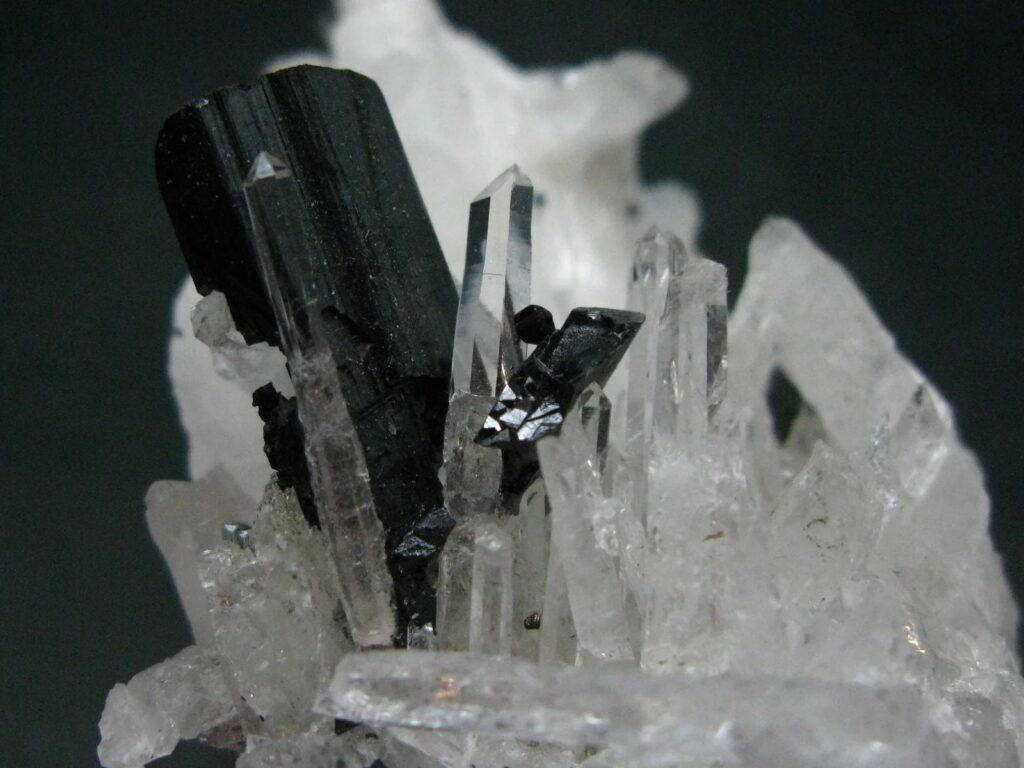
Huebnerite possesses a highly distinctive suite of physical and chemical properties that allow for precise identification in both the field and the laboratory. Physically, the mineral is relatively soft, registering between 4.0 and 4.5 on the Mohs hardness scale, yet it possesses an exceptionally high specific gravity ranging from 7.1 to 7.3—a tactile heaviness that is immediately apparent upon handling and is characteristic of metallic ores. It exhibits perfect, unidirectional cleavage on the {010} crystallographic plane, resulting in uneven to brittle fracture surfaces when broken across the grain. Optically, its luster varies from intensely submetallic to a highly refractive resinous or adamantine sheen. While its external color often appears as an opaque brownish-black, thin splinters or well-formed crystals reveal a breathtaking, deep ruby-red to hyacinth-brown translucency when backlit, leaving a characteristic yellowish-brown to reddish-brown streak on a porcelain testing plate. Chemically, pure MnWO₄ is remarkably resilient; it is practically insoluble in cold hydrochloric or nitric acids. To decompose the mineral for chemical assaying, metallurgists must subject it to prolonged boiling in aqua regia or utilize high-temperature fusion techniques with alkali carbonates (such as sodium carbonate), which subsequently precipitates the tungsten components for industrial extraction.
Strategic Industrial Applications and Economic Significance
Beyond its undeniable aesthetic appeal to museum curators and private gemologists, huebnerite holds profound global economic importance as a primary, high-grade metallurgical ore of tungsten. Tungsten is recognized as a critical refractory metal, boasting the highest melting point of all discovered elements (3,422°C) and exhibiting extraordinary tensile strength. Once extracted and refined from huebnerite feedstock, the majority of this tungsten is synthesized into tungsten carbide (WC), an incredibly hard compound utilized globally in the manufacturing of heavy-duty industrial abrasives, specialized mining drills, and high-performance metal-cutting tools. Furthermore, tungsten derived from huebnerite is an indispensable alloying agent in the production of high-speed hardened steels and cutting-edge aerospace superalloys designed to withstand extreme thermal degradation in jet engines and rocket nozzles. On a smaller, yet highly strategic scale, it is utilized in the fabrication of robust electrical contacts, x-ray tube filaments, and specialized kinetic-energy penetrators in military ordnance. Concurrently, flawless and exceptionally well-terminated natural huebnerite crystals bypass the smelter entirely, holding significant commercial value within the international mineral specimen trade, where they are preserved as testaments to the Earth’s intricate geochemical processes.