
{{ osCmd }} K

Kambaba Jasper

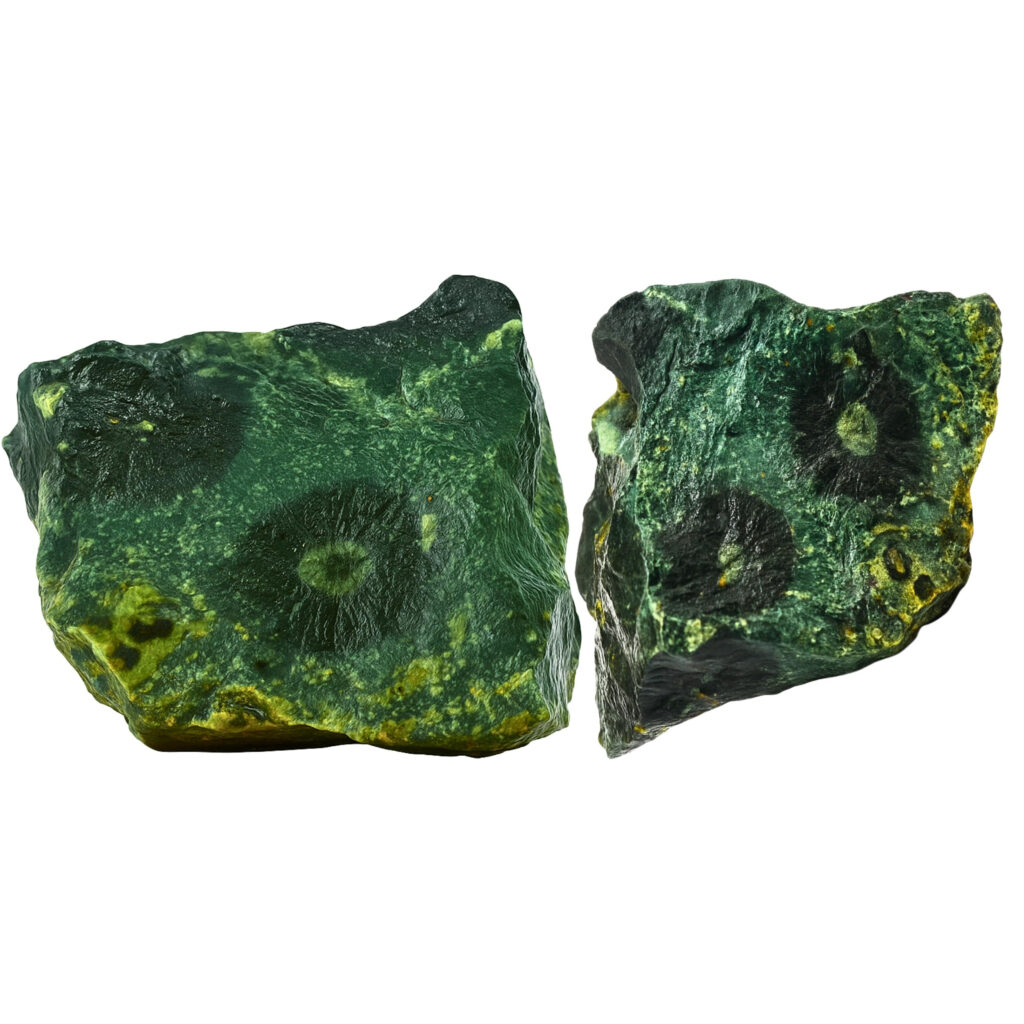
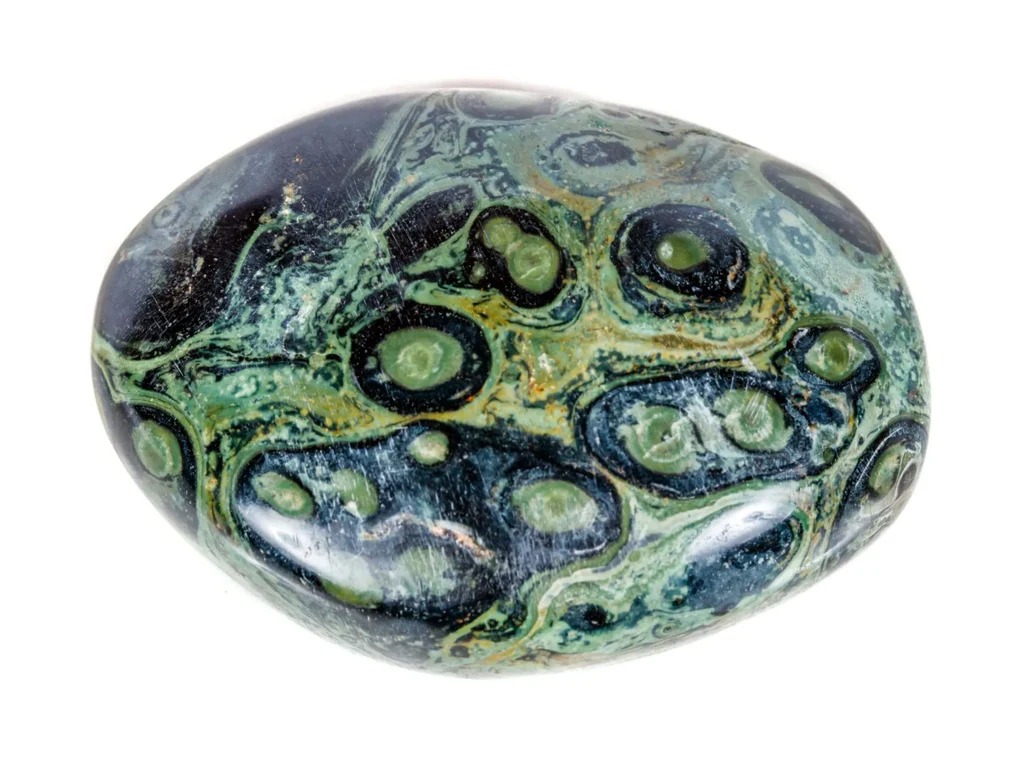
Kambaba Jasper is an opaque, multi-mineral volcanic rock from Madagascar characterized by its dark green rhyolitic matrix and distinctive orbicular structures formed through the silicification of ancient cyanobacterial mats.
Kambaba Jasper Mineral Data
Chemical Formula No fixed chemical formula; composed primarily of microcrystalline silica (SiO₂) with varying amounts of feldspar, amphibole, pyroxene, and other silicate minerals.
Mineral Group Silicified Orbicular Rock (Commercially Classified as Jasper)
Crystallography Amorphous to Cryptocrystalline matrix containing monoclinic (riebeckite/aegirine) and triclinic/monoclinic (feldspar) aggregates
Lattice Constant a = 4.91 Å, c = 5.40 Å (parameters for the primary microcrystalline quartz base matrix)
Crystal Habit Does not occur as distinct crystals; predominantly manifests as dense, massive, fine-grained orbicular rock layers with concentric spherical structure clusters.
Optical Phenomenon Concentric Orbicular Eye Structures Displays distinct concentric swirls and circular dark aggregates ("eyes") caused by the fossilized geometry of ancient microbial mats filled with needle-like amphibole clusters.
Color Range Dark forest green, deep teal, mint-green, and grayish-black groundmass with lighter green to dark green orbicular structures.
Mohs Hardness 6.5 – 7.0 (hard, scratch-resistant, durable for everyday wear and lapidary work)
Knoop Hardness Typically around 480 – 580 kg/mm² (slight variations present due to the heterogeneous mineral distribution between silicate phases).
Streak White to pale grayish-green (reflecting the combination of the quartz matrix and silicate inclusions).
Refractive Index (RI) n = 1.530 - 1.550 (typically read as a spot measure of 1.54 on a gemological refractometer, driven by the dominant quartz phase)
Optic Character Aggregate (individual crystalline components display their own distinct optic properties under microscopic analysis)
Pleochroism Absent to unobservable in bulk form (individual mineral inclusions like riebeckite may exhibit localized pleochroism under thin-section microscopy).
Dispersion Weak to unobservable.
Thermal Conductivity Moderate; feels characteristically cool to the touch at ambient temperature due to its dense silicate composition.
Electrical Conductivity Excellent electrical insulator (non-conductive dielectric material).
Absorption Spectrum Varies depending on the exact density of iron-rich silicates; displays broad, non-specific absorption in the blue and red regions due to iron concentrations.
Fluorescence Typically inert under both Short-Wave and Long-Wave UV light; localized patches may occasionally show a weak, dull green glow due to variations in secondary silica phases.
Specific Gravity (SG) 2.50 – 2.65 (variable depending on the relative density of heavy iron-rich amphiboles versus the lighter quartz and feldspar matrix).
Luster (Polish) Vitreous to dull or slightly waxy in raw structural states; takes a high vitreous to waxy polish when finished.
Transparency Completely opaque; light transmission is zero even on thin edges due to dense iron-rich mineral distribution.
Cleavage / Fracture None / Uneven to sub-conchoidal fracture due to the structural heterogeneity of the composite mineral grains.
Toughness / Tenacity Brittle but structurally tough, cohesive, and highly resistant to impact due to its interlocked, fine-grained microcrystalline matrix.
Geological Occurrence Formed via the metasomatic silicification of Precambrian biogenic sedimentary structures (stromatolites) created by cyanobacterial mats, which were filled and replaced over time by high-temperature, silica-rich volcanic fluid.
Inclusions Abundant microscopic and macroscopic inclusions of needle-like riebeckite, aegirine aggregates, potassium feldspar laths, and preserved structural bands of fossilized microbial colonies.
Solubility Insoluble and inert in standard cold or hot hydrochloric, nitric, and sulfuric acids; slowly attacked and soluble only in hydrofluoric acid (HF).
Stability Highly stable at ambient surface conditions; chemically and structurally stable under normal environmental exposure.
Associated Minerals Microcrystalline Quartz, Cristobalite, Potassium Feldspar, Riebeckite, Aegirine, and Calcite.
Typical Treatments Commonly untreated and used in its completely natural form; occasionally stabilized with colorless polymers or resins if the specific block has natural pitting or fractures.
Notable Specimen The classic orbicular, high-contrast forest green and black material excavated from the primary source deposits in Madagascar.
Etymology The commercial name "Kambaba Jasper" is widely used in the gem trade, although the precise origin of the name remains uncertain.
Strunz Classification Not applicable as a distinct mineral species (classified as a rock); the dominant quartz matrix component corresponds to 04.DA.05.
Typical Localities Exclusively found in the Bongolava Region, Madagascar.
Radioactivity None.
Toxicity Generally non-toxic; however, lapidary artists must wear proper respiratory protection to avoid the inhalation of fine crystalline silica dust during cutting and grinding, which can lead to silicosis.
Symbolism & Meaning Metaphysically regarded as a stone of stability, grounding, and psychological equilibrium. It is associated with the Root and Heart chakras, and is used to mitigate anxiety, support emotional recovery after trauma, and foster alignment with natural earth cycles.

Kambaba Jasper—frequently traded under the synonyms Crocodile Jasper or Green Stromatolite Jasper—is an opaque, dark green to black orbicular volcanic rock rather than a true chalcedony-based jasper. Mineralogically, it is classified as a highly silicified rhyolite or volcanic tuff. The matrix predominantly consists of microcrystalline quartz and potassium feldspar, interspersed with dark, circular aggregates. Optical microscopy and X-ray diffraction verify that these characteristic dark “eyes” and concentric bands are formed by needle-like clusters of iron-rich amphibole minerals, specifically riebeckite and aegirine. The differential concentration of these mineral phases yields the characteristic variations in coloration, ranging from deep forest green and teal to grayish-black.
The geographical distribution of this material is highly restricted, with the primary commercial deposits located exclusively in the Bongolava region of west-central Madagascar. The etymology of the term “Kambaba” corresponds directly to the localized place name of the mining district. In the international gemstone and lapidary markets, the material was introduced systematically during the late 20th century. Due to its unique orbicular morphology, it has historically been marketed under misleading trade names such as “Nebula Stone,” despite having a distinct mineral assemblage and geological origin from the true custom-mixed aegirine-riebeckite nephrite variant found in North America. In contemporary mineral commerce, it is classified as an ornamental carving stone and a collector’s specimen.

The geological genesis of Kambaba Jasper dates back to the Precambrian eon. It represents a fossilized stromatolite formation, which is a sedimentary structures created by the growth of successive layers of phototrophic cyanobacteria (historically classified as blue-green algae). These ancient microbial mats precipitated calcium carbonate and trapped fine sediments in shallow, primeval marine or lacustrine environments. Over geological timescales, subsequent volcanic events introduced high-temperature, silica-rich hydrothermal fluids into the sedimentary strata. This initiated a structural transformation via metasomatic replacement (silicification), wherein the organic structures and original carbonate matrix were progressively replaced by microcrystalline quartz. This process permanently preserved the concentric, layered geometry of the original cyanobacterial colonies within a durable, crystalline silicate matrix, yielding a Mohs hardness of 6.5 to 7.0.

Coloration and Optical Characteristics

The distinctive color palette of Kambaba Jasper consists of a dark green, teal, or grayish-black groundmass containing spherical orbicular aggregates that present deep forest green to mint-green tones. Structurally, the stone is entirely opaque (diapheneity) with zero light transmission through its bulk form. Optically, it exhibits an aggregate refractive index typically ranging between 1.53 and 1.55, reflecting the dominance of its microcrystalline quartz phase. The surface luster varies depending on the finish and mineral concentration; it ranges from vitreous to dull or slightly waxy when polished. Because it is a polychromatic mineral aggregate rather than a single crystal, it displays no pleochroism, and its dispersion is negligible.
Property True Jasper Kambaba Jasper
Classification Opaque variety of microcrystalline quartz (chalcedony). Ornamental rock composed of microcrystalline silica and accessory minerals.
Geological Origin Forms through silica-rich sedimentary, hydrothermal, or volcanic processes. Believed to originate from silicified volcanic or stromatolitic material; exact genesis remains debated.
Primary Composition Predominantly SiO₂ with minor iron oxides, clays, and other inclusions. Microcrystalline silica with feldspar, riebeckite, aegirine, and other silicate minerals.
Typical Colors Red, yellow, brown, green, blue, and multicolored varieties. Dark green, teal, and black with distinctive orbicular patterns.
Texture & Pattern Massive, mottled, banded, brecciated, or dendritic. Orbicular texture with concentric circles and eye-like structures.
Mohs Hardness 6.5–7 6.5–7
Fracture Typically conchoidal. Uneven to sub-conchoidal.
Transparency Opaque. Opaque.
Main Source Found worldwide. Primarily sourced from Madagascar.
Gem Trade Status Recognized jasper variety. Commercial trade name; not a true jasper in the strict mineralogical sense.

Physical and Chemical Properties

Chemically, Kambaba Jasper is a high-silica volcanic rock composed primarily of silicon dioxide (SiO₂). It is not a mineral species but an aggregate rock consisting of a microcrystalline quartz matrix interspersed with potassium feldspar, alongside localized concentrations of iron-rich silicates including the amphiboles riebeckite and aegirine. On the Mohs hardness scale, it rates consistently between 6.5 and 7.0, providing excellent scratch resistance. The material features an uneven to sub-conchoidal fracture profile and exhibits no cleavage planes. Its specific gravity typically falls within the range of 2.50 to 2.65 g/cm³. Chemically stable under standard surface conditions, it resists weak acids but undergoes degradation when exposed to hydrofluoric acid.

Application of Kambaba Jasper

The primary application of Kambaba Jasper is within the lapidary arts and ornamental industries. Due to its high hardness and lack of cleavage, it is highly receptive to polishing, making it an ideal material for cutting into cabochons, beads, and mass-produced tumbled stones. It is also utilized extensively for interior design accents, large-scale ornamental carvings, spheres, and decorative bookends. In the jewelry trade, it is categorized as an exotic or organic-patterned gemstone, primarily set into sterling silver or wire-wrapped designs targeting collector and artisanal markets. It has no industrial or electronic utility due to its structural heterogeneity and variable chemical composition.

Within contemporary esoteric frameworks and crystal healing practices, Kambaba Jasper is categorized as a stone of stability, grounding, and psychological equilibrium. Metaphysical practitioners associate its slow, steady vibrational frequency with the Root (Muladhara) and Heart (Anahata) chakras, utilizing it in meditative exercises designed to mitigate anxiety and release cyclical negative thought patterns. In lithotherapy literature, its signature green coloration is frequently interpreted as a conduit for earth energy and natural cycles, often referred to as a “stone of peace and tranquility.” It is commonly employed as a symbolic focus for emotional recovery following trauma, or as a grounding tool aimed at fostering personal resilience and alignment with nature.

Gemstone Encyclopedia

List of all gemstones from A-Z with in-depth information for each

Birthstone

Find out more about these popular gemstones and their meaning

Community

Join a community of gem lovers to share knowledge, experiences, and discoveries.