
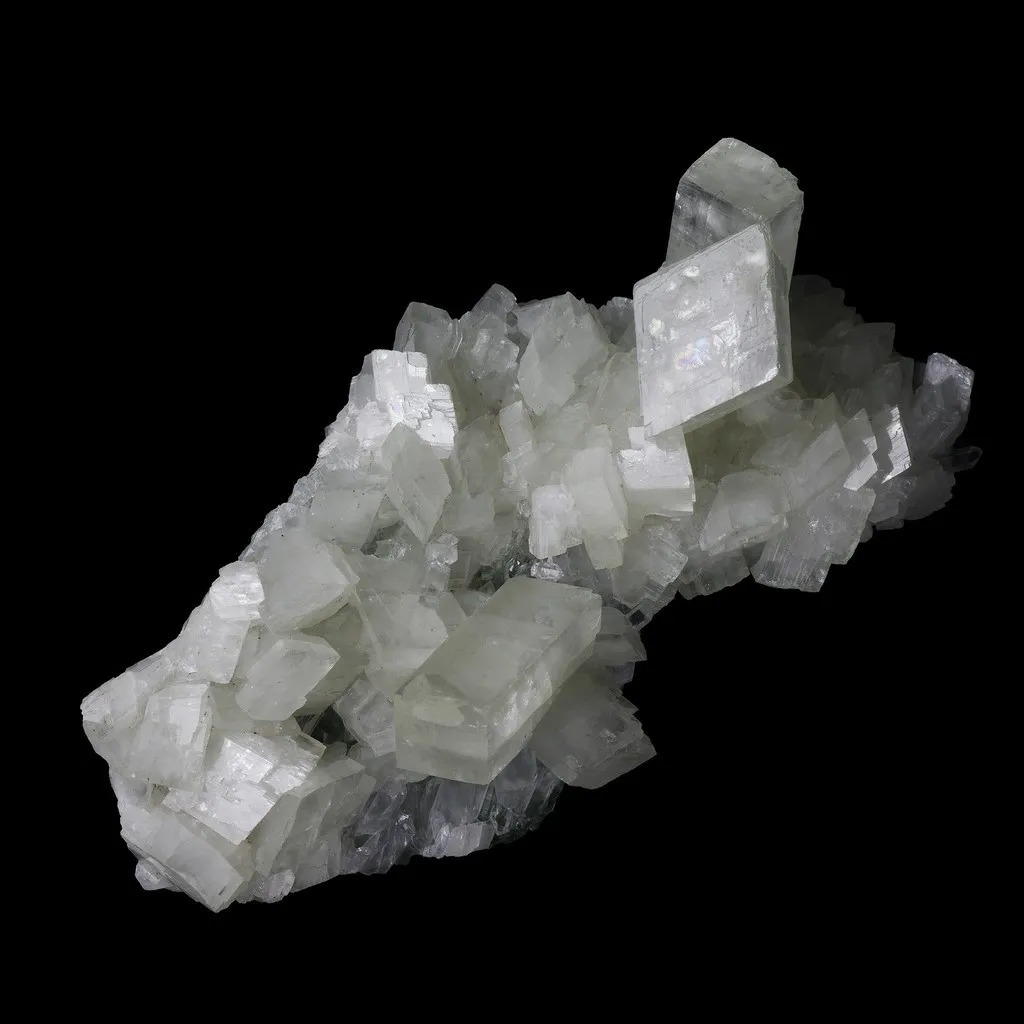
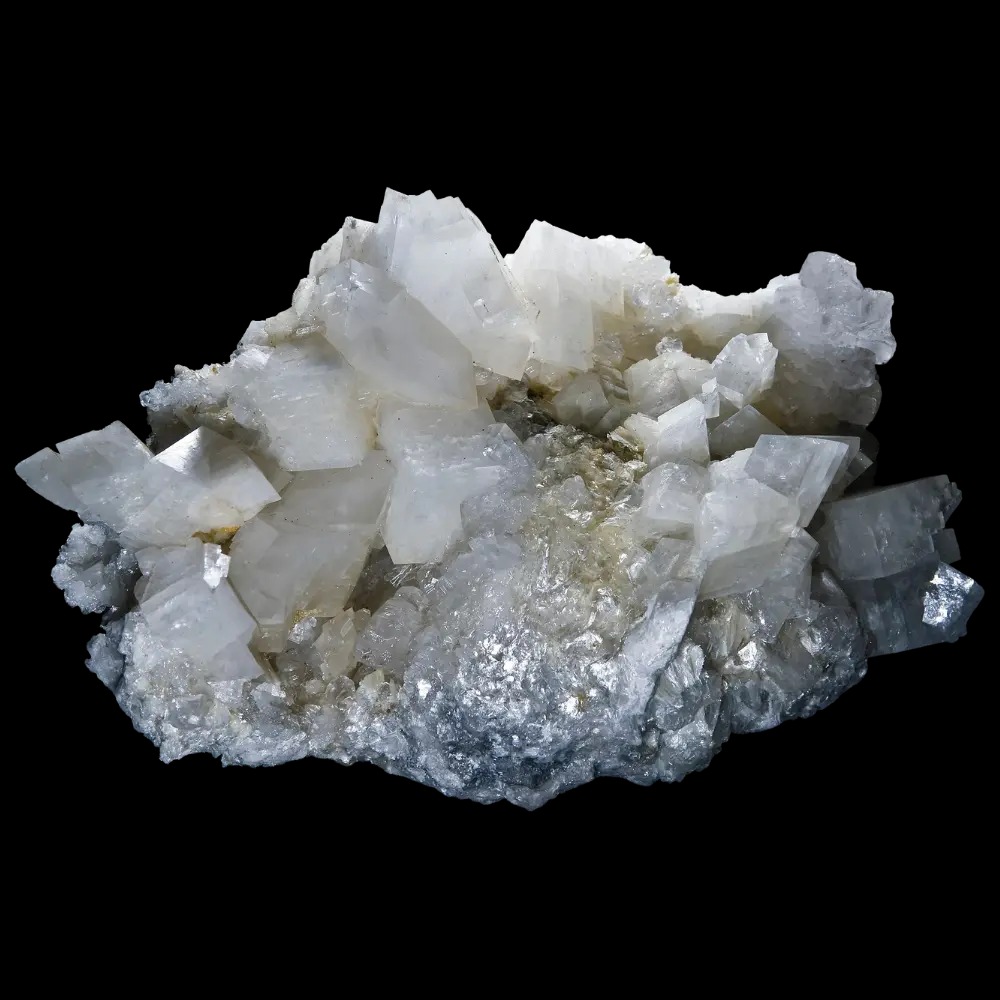
Dolomite is a prominent anhydrous carbonate mineral primarily composed of calcium magnesium carbonate, chemically denoted by the formula CaMg(CO₃)₂. It serves as the principal constituent of the sedimentary rock of the same name (often referred to as dolostone to avoid ambiguity) and the metamorphic rock known as dolomitic marble.Mineralogically, dolomite crystallizes in the trigonal-rhombohedral system, typically forming rhombohedral crystals with characteristic curved faces, saddle-shaped aggregates, or massive, granular aggregates. In its pure form, the mineral is colorless or white; however, impurities such as iron, manganese, or cobalt frequently substitute into the crystal lattice, imparting shades of pink, brown, gray, or yellow.Dolomite is distinguished from calcite (CaCO₃) by its structural arrangement, where alternating layers of calcium and magnesium ions are separated by sheets of carbonate (CO₃²⁻) groups. This highly ordered structure results in a higher density (2.84–2.86 g/cm³) and greater hardness (3.5–4 on the Mohs scale) than calcite, as well as a distinct diagnostic sluggishness in its reaction with cold, dilute hydrochloric acid (HCl), effervescing vigorously only when heated or powdered.
The nomenclature and formal scientific recognition of dolomite are deeply rooted in late 18th-century European geology. The mineral was named in honor of the French naturalist and geologist Dieudonné Sylvain Guy Tancrède de Gratet de Dolomieu (known simply as Déodat de Dolomieu), who first described the unique carbonate rocks in the Tyrolean Alps of northern Italy in 1791. Dolomieu observed that these rocks, while resembling limestone, did not effervesce strongly with weak acids.Shortly thereafter, in 1792, the Swiss chemist Nicolas-Théodore de Saussure chemically analyzed the material and officially named the mineral “dolomite.” This historical discovery gave rise not only to the mineral’s name but also to the naming of the Dolomites, the spectacular, rugged mountain range in northeastern Italy composed predominantly of this rock.The historical study of dolomite later birthed one of geology’s most enduring conundrums: “The Dolomite Problem.” Early geologists quickly realized that while massive dolomite formations are ubiquitous throughout the ancient rock record (spanning from the Precambrian to the Paleozoic), modern counterparts actively precipitating in contemporary marine environments are exceedingly rare.
The genesis of dolomite is a complex geochemical process that has been the subject of extensive scientific debate. Direct primary precipitation of dolomite from ambient seawater under normal Earth-surface conditions (25°C, 1 atm) is kinetically inhibited. This inhibition occurs because magnesium ions (Mg²⁺) are highly hydrated in aqueous solutions, holding onto their surrounding water molecules with great affinity, which prevents them from incorporating into an ordered carbonate crystal lattice at low temperatures. Consequently, the vast majority of geological dolomite is of secondary, diagenetic origin.
This secondary formation occurs via dolomitization, a replacement process wherein magnesium-rich fluids migrate through pre-existing calcium carbonate (CaCO₃) sediments or limestones. The generalized chemical reaction can be expressed as follows:
2CaCO3 (calcite) + Mg2+ → CaMg(CO3)2 (dolomite) + Ca2+
This complex geochemical reaction typically requires highly specific thermodynamic and hydrodynamic conditions to overcome its inherent kinetic barrier. Primarily, elevated temperatures—often associated with deep sedimentary burial or hydrothermal activity—are essential to destabilize the tight hydration shells shielding the magnesium ions. Furthermore, a high Mg²⁺/Ca²⁺ ratio is required to drive the process, a condition frequently facilitated either by the intensive evaporation of seawater within restricted basins (the evaporite model) or through the mixing of fresh meteoric groundwater with marine phreatic waters (the Dorag mixing-zone model). Beyond purely inorganic pathways, modern sedimentary research increasingly highlights the role of microbial mediation, demonstrating that specific sulfate-reducing and methanogenic bacteria can actively facilitate low-temperature dolomite precipitation within hypersaline or alkaline lagoons by altering local water chemistry and neutralizing kinetic inhibitors such as dissolved sulfate. Ultimately, because the crystalline lattice of dolomite is significantly more compact than that of its precursor calcite, this diagenetic replacement typically induces a 13% volume reduction in the solid rock mass. This widespread volumetric shrinkage generates substantial secondary intercrystalline porosity and permeability, explaining why ancient dolomitized strata serve as exceptional regional aquifers for groundwater and rank globally among the most critical structural traps for petroleum and natural gas reservoirs.
Crystal Structure and Symmetry
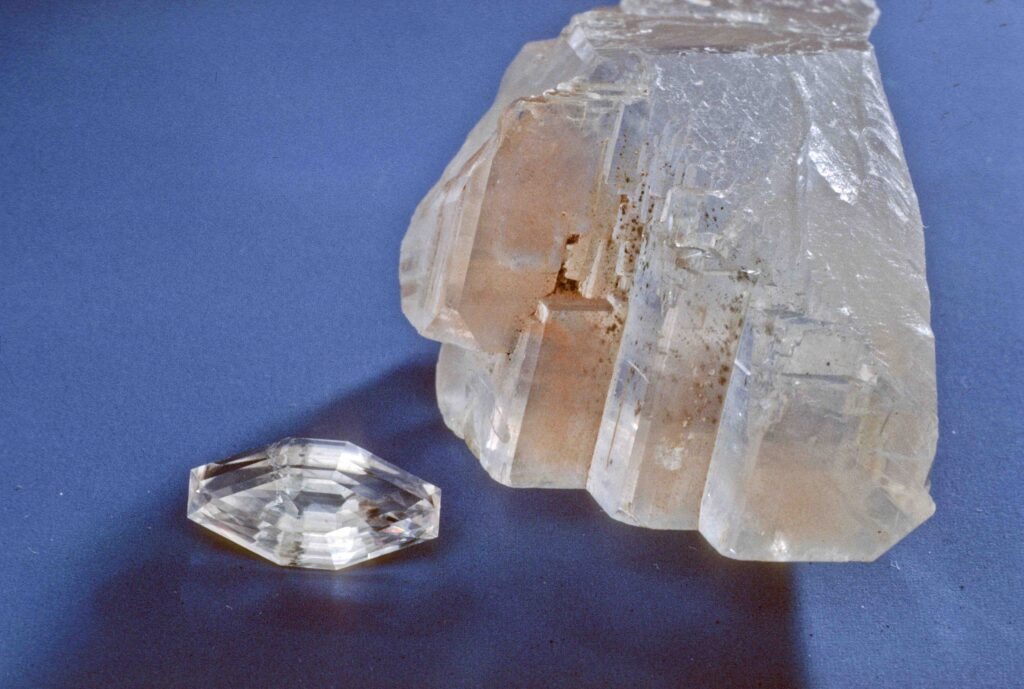
Dolomite, with the ideal chemical formula CaMg(CO₃)₂, crystallizes in the trigonal crystal system and belongs to the rhombohedral space group R-3. Its crystal structure is distinguished by a highly ordered arrangement of alternating calcium-rich and magnesium-rich layers separated by planar carbonate groups (CO₃²⁻), a feature that fundamentally differentiates dolomite from calcite and other simple carbonate minerals. Along the crystallographic c-axis, successive sheets of carbonate anions are interleaved with cation layers in which calcium and magnesium occupy distinct crystallographic positions rather than being randomly distributed throughout the lattice. This cation ordering results from the substantial difference in ionic radius and bonding behavior between Ca²⁺ and Mg²⁺, producing a structure of lower symmetry than that of calcite while simultaneously enhancing structural stability. X-ray diffraction and electron microscopy studies have demonstrated that the degree of cation ordering may vary according to temperature, fluid chemistry, and growth conditions, and incomplete ordering commonly occurs in naturally formed specimens. In sedimentary environments where dolomite precipitates rapidly or forms under kinetic constraints, the resulting material may exhibit partial calcium–magnesium disorder, a metastable state often referred to as protodolomite. The origin of such disordered phases remains closely linked to the long-standing “dolomite problem,” one of the most extensively studied topics in carbonate sedimentology and geochemistry, concerning the apparent discrepancy between the abundance of dolomite in the geological record and the difficulty of reproducing fully ordered dolomite under modern surface conditions.
Color and Optical Properties
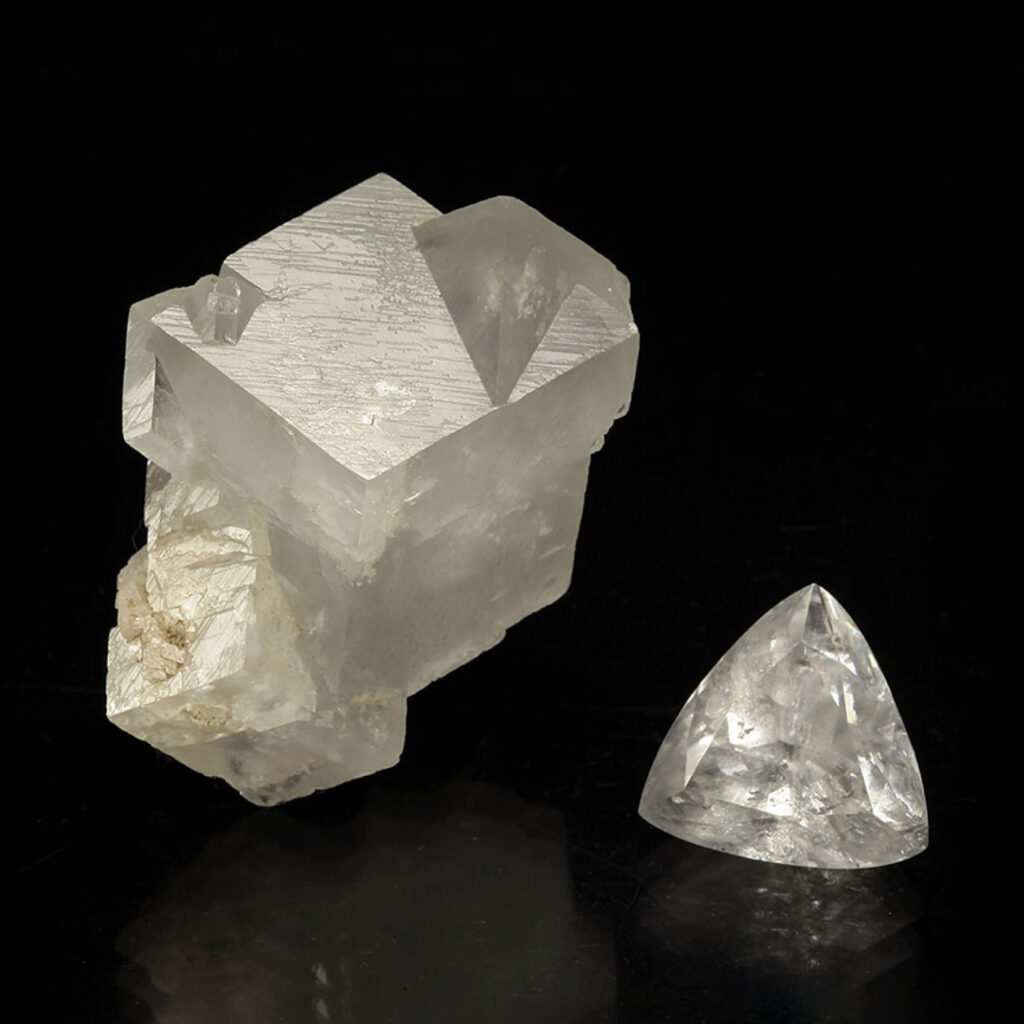
Pure dolomite is typically colorless, white, or faintly translucent; however, natural specimens commonly display a broad range of colors resulting from trace-element substitutions, lattice defects, and microscopic inclusions acquired during crystal growth. Iron commonly imparts gray, tan, yellowish-brown, or brown coloration, whereas manganese may produce delicate pink to reddish hues, and minor concentrations of cobalt can generate vivid magenta or raspberry-colored varieties that are highly sought after by mineral collectors. Dolomite possesses a vitreous to pearly luster and is transparent to translucent depending on crystal size and impurity content. Optically, it is uniaxial negative with refractive indices generally ranging from nω = 1.679–1.681 and nε = 1.500–1.503, producing strong birefringence that is readily observed under polarized light microscopy. This pronounced optical anisotropy results in high-order interference colors and distinctive relief changes during stage rotation, making dolomite an important petrographic indicator in carbonate rocks. In thin section, the mineral commonly exhibits rhombohedral cleavage traces, zoned growth structures, and occasional lamellar twinning, while cathodoluminescence studies often reveal complex compositional banding associated with variations in trace-element concentrations. These optical characteristics provide valuable information regarding diagenetic history, fluid interactions, and the geochemical evolution of carbonate sediments and reservoir rocks.
Mineralogical Varieties
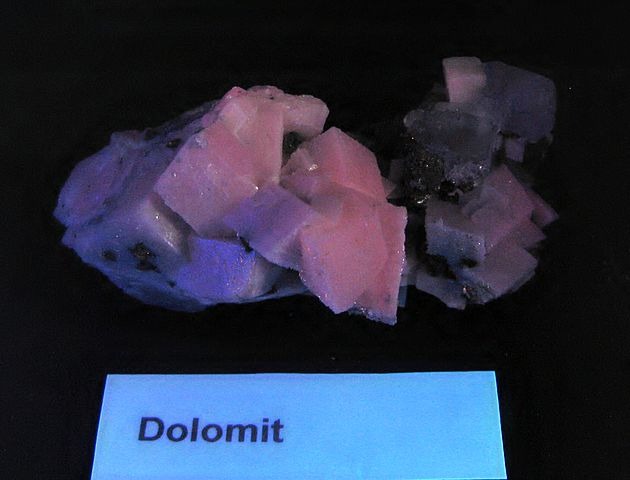
Numerous varieties and compositional derivatives of dolomite have been recognized based on crystal habit, trace-element chemistry, and solid-solution relationships within the dolomite group. One of the most familiar collector terms is Pearl Spar, which refers to aggregates of curved rhombohedral crystals exhibiting a pearly luster and frequently forming distinctive saddle-shaped growths characteristic of hydrothermal environments. Iron enrichment within the dolomite structure leads toward the mineral ankerite, an iron-dominant carbonate that belongs to the dolomite group and forms extensive compositional series through Fe–Mg substitution. Similarly, progressive manganese enrichment results in transitions toward kutnohorite, the manganese-dominant member of the group. Trace concentrations of cobalt may produce the highly attractive cobaltoan dolomite variety, renowned for its intense pink coloration and occurrence in oxidized cobalt-bearing ore deposits. Additional compositional variations involving zinc, nickel, and other divalent cations have been documented in specialized geological settings, reflecting the remarkable flexibility of the dolomite lattice to accommodate substitution while maintaining its fundamental crystal architecture. These varieties provide important evidence for reconstructing ore-forming processes, hydrothermal alteration, fluid evolution, and regional geochemical conditions, making dolomite-group minerals valuable indicators in both economic geology and carbonate sedimentary research.
Physical and Chemical Properties
Dolomite possesses a Mohs hardness of approximately 3.5–4, a specific gravity generally ranging from 2.84 to 2.86 g/cm³, and a characteristic rhombohedral cleavage that produces fragments with interfacial angles near 73° and 107°. Individual crystals are commonly rhombohedral, tabular, or saddle-shaped, although massive granular aggregates are far more abundant in sedimentary and metamorphic rocks. Mechanically, the mineral is relatively brittle and exhibits a white streak regardless of external coloration. Chemically, dolomite is an anhydrous double carbonate that remains stable across a wide range of geological environments and constitutes one of the principal rock-forming minerals of carbonate platforms and dolostones worldwide. Despite its thermodynamic stability, the mineral displays notably slow reaction kinetics at low temperatures, a characteristic that contributes to the difficulty of modern dolomite formation and has significant implications for carbonate diagenesis. Unlike calcite, which reacts vigorously with cold dilute hydrochloric acid, dolomite generally exhibits only weak or delayed effervescence when tested in hand specimen. A stronger reaction is typically observed when the mineral is finely powdered or exposed to warm acid, a property widely used by geologists and mineralogists for field identification. In addition to its geological importance, dolomite serves as a major industrial mineral utilized in refractory materials, metallurgical fluxes, construction aggregates, soil conditioning, glass manufacturing, and various chemical processes, reflecting its widespread abundance and economic significance across numerous sectors.
Uses and Economic Importance
Dolomite is a widely utilized carbonate mineral with significant importance in industry, earth sciences, and mineral collecting. Industrially, it serves as a major raw material in construction, where crushed dolomite and dolostone are used as aggregates for concrete, asphalt, road construction, and building stone. In metallurgy, dolomite functions as an essential flux in iron and steel production, aiding in impurity removal, slag formation, and furnace protection, while calcined dolomite is extensively employed in the manufacture of refractory materials capable of withstanding extreme temperatures. The mineral is also used in agriculture as a liming agent to reduce soil acidity and supply calcium and magnesium, and it plays a role in environmental applications such as water treatment, acid mine drainage remediation, and flue-gas desulfurization. Additional uses include the production of glass, ceramics, paints, fertilizers, magnesium compounds, and various chemical products. Beyond its industrial applications, dolomite is of considerable scientific importance due to its role in carbonate sedimentology, diagenesis, groundwater systems, and petroleum reservoir studies, particularly in relation to the long-standing geological “dolomite problem.” Well-formed crystal specimens, including cobaltoan dolomite and distinctive saddle-shaped varieties, are also valued by museums and mineral collectors, making dolomite a mineral of both economic and mineralogical significance.