
Shattuckite is a rare and visually stunning copper silicate mineral that is highly prized by mineral collectors and lapidary artists alike for its vibrant shades of blue and turquoise. Chemically classified as an inosilicate with the formula Cu₅(SiO₃)₄(OH)₂, it forms as a secondary mineral through the alteration of pre-existing copper deposits. In its pure state, Shattuckite features a relatively low Mohs hardness of 3.5 to 4.0, making its acicular, needle-like crystal aggregates quite fragile. However, when it naturally intergrows with quartz, its durability increases significantly, allowing it to be cut into beautiful, dense cabochons. It often shares its environment with other popular copper-based minerals like Malachite, Chrysocolla, and Azurite, resulting in striking multi-colored matrix stones that are easily distinguished by Shattuckite’s characteristically rich, deep royal blue hues.
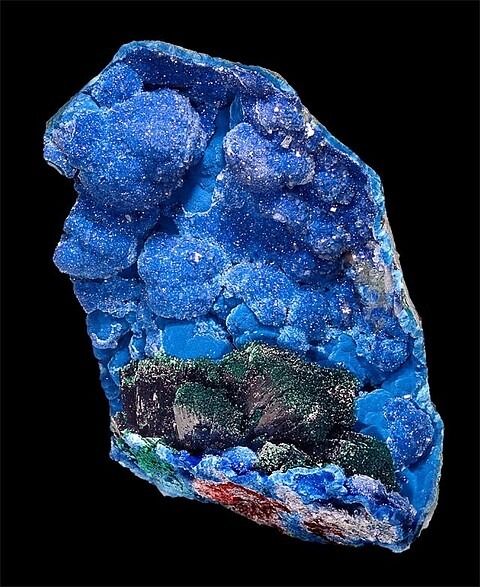
The formation of Shattuckite is a geologically intricate process that occurs primarily within the oxidation zones of copper-rich ore deposits. It begins when oxygenated groundwater slowly percolates through primary copper sulfide minerals such as chalcopyrite, gradually breaking them down over extended geological time. As copper ions are released into solution, they interact with dissolved silica (SiO₂) and water (H₂O) derived from the surrounding host rocks. Under precise geochemical conditions—particularly specific ranges of pH, temperature, and ion concentration—Shattuckite crystallizes from this solution. Rather than forming large, well-defined crystals, it typically develops as fibrous aggregates, radiating tufts, or dense, velvety coatings that line fractures, cavities, and veins. These formations are often intergrown with other secondary copper minerals, producing striking blue-to-cyan mineral assemblages characteristic of oxidized copper zones.
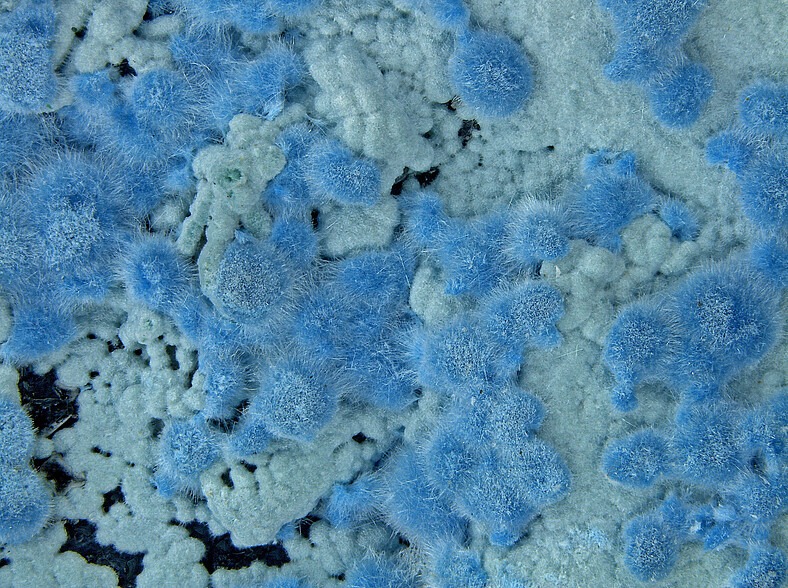
The history of Shattuckite is relatively modern compared to ancient gemstones, officially beginning in 1915 when it was discovered and identified by the American mineralogist Waldemar T. Schaller. The mineral owes its unique name to its type locality, the Shattuck Mine in Bisbee, Arizona, which was one of the most prolific and legendary copper-mining districts in the world during the early 20th century. While the original Arizona mines have long ceased commercial operations, Shattuckite continues to captivate the world through major contemporary deposits discovered in the Kaokoveld Plateau of Namibia and the Democratic Republic of the Congo. Today, because of its rarity, it is never mined for industrial copper extraction; instead, it is exclusively celebrated as a collector’s prized specimen, a unique gemstone for artisanal jewelry, and a popular stone in the metaphysical community.
Crystal Structure, Color, and Optical Properties of Shattuckite
The crystal structure of Shattuckite belongs to the orthorhombic crystal system, specifically falling under the dipyramidal space group. On a microscopic level, its structure is characterized by chains of silica tetrahedra (SiO₃) that extend parallel to the vertical c-axis, which are linked together by copper atoms coordinated with oxygen and hydroxyl (OH) groups. This specific internal arrangement prevents Shattuckite from forming large, well-defined individual crystals; instead, it manifests macroscopically as dense radial aggregates, fibrous masses, or delicate acicular (needle-like) crystals. This unique chain silicate network provides the structural foundation for the mineral’s physical stability, though its distinct cleavage and fragile crystalline form mean it relies heavily on surrounding silica matrixes for structural reinforcement.
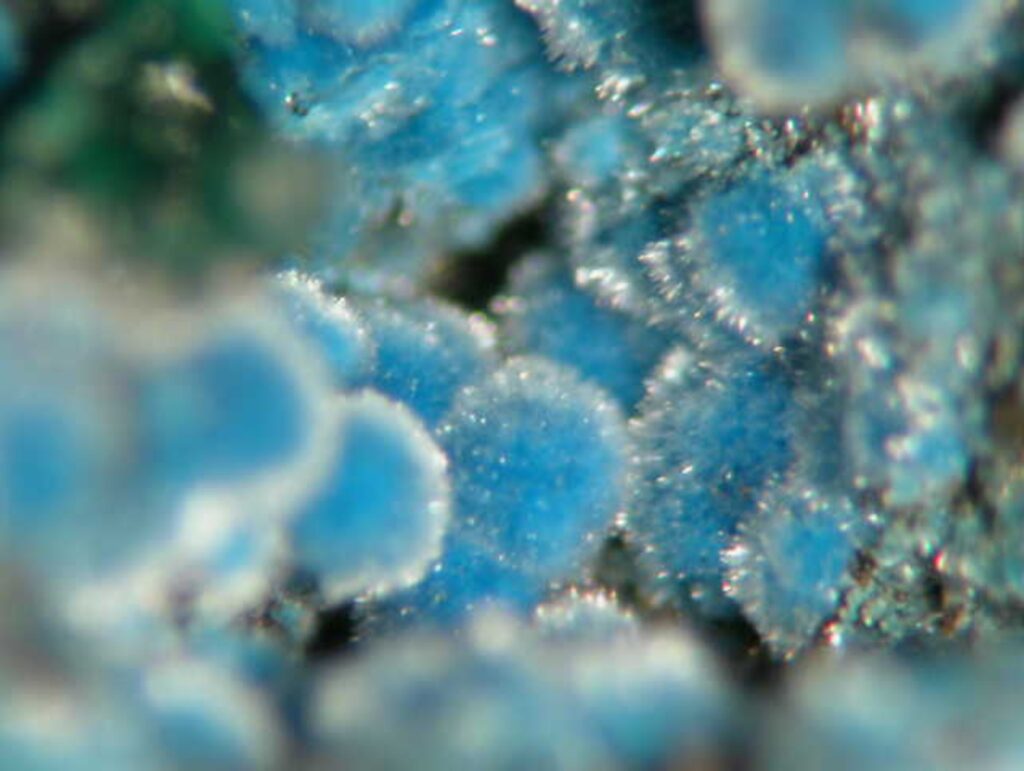
Color is undoubtedly Shattuckite’s most defining and captivating feature, spanning an exquisite spectrum of blues. It ranges from a soft, light pastel blue and vibrant turquoise to a dramatic, deep navy or royal blue. This intense coloration is directly caused by the high concentration of copper ions within its chemical structure, which selectively absorb specific wavelengths of light. Unlike many other copper minerals that display a uniform hue, Shattuckite often exhibits beautiful color zoning or mottling within a single specimen. When intergrown with dark green Malachite or pale blue Chrysocolla, the contrasting shades of blue and green create a visually striking, multi-layered aesthetic that is highly coveted in the gemstone market.
From an optical perspective, Shattuckite is an anisotropic mineral, meaning its optical properties vary depending on the direction light travels through the crystal. It exhibits strong pleochroism, a phenomenon where the gemstone appears to change color—shifting from a light blue to a much deeper, intense blue—when viewed from different angles under polarized light. The mineral possesses a refractive index ranging approximately from 1.75 to 1.81 and is optically biaxial positive. In terms of luster, raw Shattuckite specimens can vary from a soft, silky or velvety sheen in fibrous forms to a vitreous (glassy) luster when found in more compact, crystalline aggregates. It is generally translucent to opaque, allowing light to softly catch its fibrous edges and accentuate its deep, oceanic depths.
Physical and Chemical Properties of Shattuckite
Chemically, Shattuckite is a hydrous copper silicate mineral with the chemical formula Cu₅(SiO₃)₄(OH)₂. It belongs to the inosilicate class, meaning its chemical backbone is built upon chains of silicate tetrahedra. Because it is highly concentrated with copper, Shattuckite is chemically sensitive to acids; it will readily dissolve in hydrochloric acid (HCl), a classic test that mineralogists use to distinguish it from non-carbonate or non-copper minerals. It is stable under normal atmospheric conditions but will break down if subjected to extreme heat, which drives out the hydroxyl (OH) groups bound within its crystal lattice. It is frequently found in a state of chemical transition, often altering into or replacing other copper minerals, which results in fascinating pseudomorphs—where Shattuckite retains the external crystal shape of a different mineral it has completely replaced.
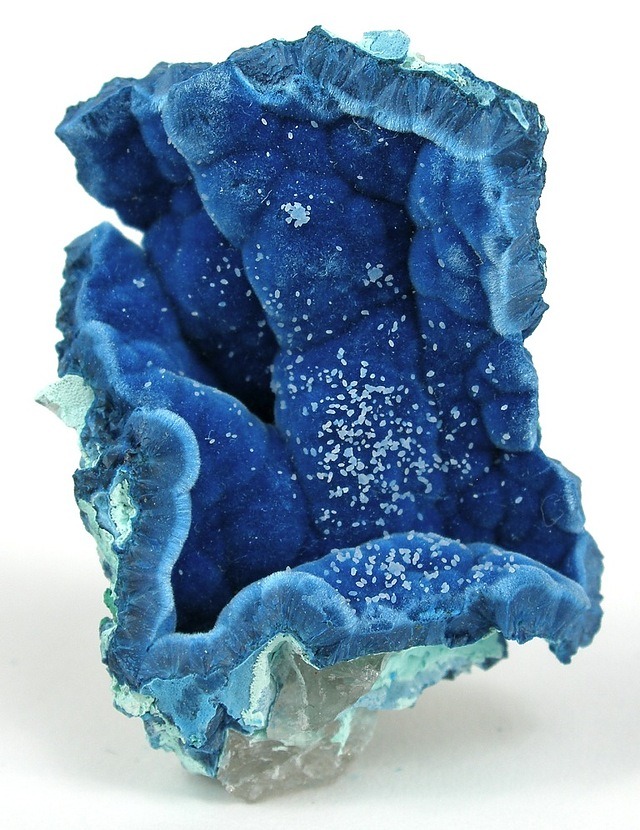
Physically, Shattuckite is relatively soft and fragile when found in its pure state, registering a Mohs hardness of only 3.5 to 4.0. This makes it highly susceptible to scratching and fracturing, which is why raw specimens must be handled with great care. It has a specific gravity ranging from 3.8 to 4.1, making it noticeably dense and heavy for a silicate mineral due to its high copper content. Shattuckite exhibits two directions of distinct cleavage, which causes it to split easily along specific planes, and it breaks with an uneven to splintery fracture. The mineral produces a light blue streak when rubbed across an unglazed porcelain plate. While pure, fibrous masses of Shattuckite are too delicate for practical everyday use, nature frequently solves this problem through silicification—a process where silica fills the gaps between the fibers, hardening the stone into a durable, quartz-rich matrix that safely preserves its beautiful physical properties for jewelry making.
Applications and Uses of Shattuckite
Shattuckite is not an industrial ore mineral, so its applications are primarily aesthetic, scientific, and collectible rather than commercial extraction. In the fields of mineralogy and geological research, it is valued as an important secondary copper silicate that helps scientists map and understand the complex geochemical processes occurring in oxidized copper deposits. Its distinctive, vivid blue coloration and velvety, fibrous habits also make it a highly sought-after specimen for private mineral collections, natural history museums, and educational displays. In the gemstone and lapidary trade, when Shattuckite is naturally stabilized by quartz, it is skillfully cut and polished into cabochons, beads, or carved into unique ornamental objects, where its vibrant blue to teal hues are highly appreciated for artisanal jewelry design. Beyond its physical and academic uses, Shattuckite is widely referenced in metaphysical circles and crystal healing communities; it is deeply associated with communication, heightened intuition, and clarity of expression, making it a highly popular choice for meditation stones, energy work, and spiritual practices.