
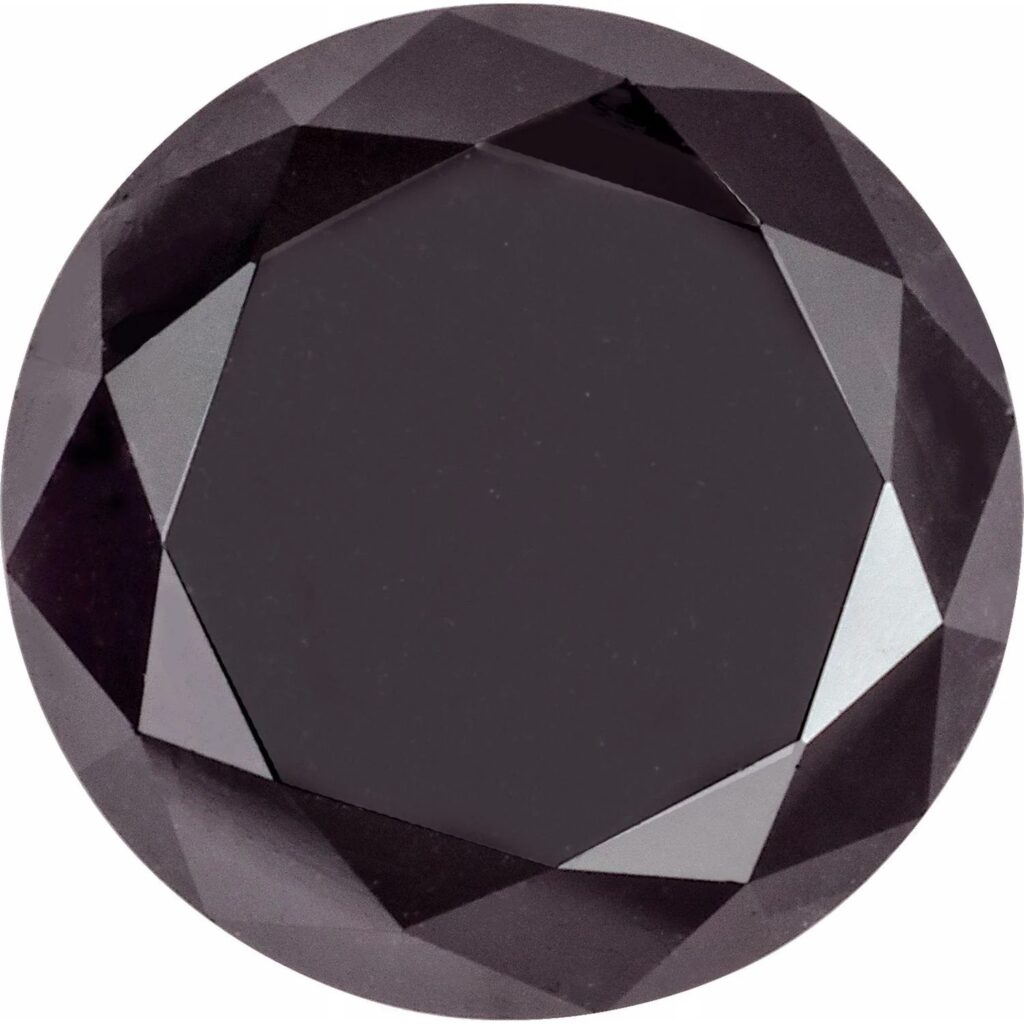
A black diamond, scientifically referred to as carbonado, is a distinct, high-density form of natural diamond characterized by its opaque, dark appearance. Unlike conventional diamonds, which are single crystals formed from a uniform lattice structure, black diamonds are polycrystalline aggregates composed of millions of microscopic diamond crystals sintered together. Their deep black, charcoal, or dark grey color is not inherent to the carbon crystal itself, but is instead caused by high concentrations of dark inclusions, primarily graphite, hematite, and magnetite. Because of this unique composition, black diamonds absorb light rather than refracting it, resulting in a subtle, metallic or vitreous luster instead of the classic brilliance and fire associated with transparent gemstones.

Formation of Black Diamond
The exact geological origin of natural black diamonds, remains a subject of ongoing debate within the fields of mineralogy and geology. Unlike conventional diamonds that form through uniform processes deep within the Earth, several scientific theories attempt to explain the unique existence of these stones. One hypothesis proposes a traditional deep mantle formation, suggesting that black diamonds were created under extreme pressures and temperatures before being transported to the surface by ancient volcanic eruptions through kimberlite or lamproite pipes. An alternative model is the impact origin theory, which argues that massive shock pressures generated during ancient meteorite collisions transformed terrestrial, carbon-rich material into these dense, polycrystalline structures. Taking the cosmic connection a step further, the extraterrestrial origin theory suggests that carbonados actually formed in interstellar space—potentially during a supernova explosion—and were carried to Earth via an asteroid billions of years ago, a hypothesis supported by their unusual porous microstructure and distinct isotopic composition. Adding to the mystery, most natural black diamonds are not found in primary volcanic pipes but are instead sourced exclusively from alluvial sedimentary deposits, predominantly within localized regions of Brazil and the Central African Republic.
History of Black Diamond
The history of black diamond is both scientifically intriguing and culturally distinctive compared to traditional colorless diamonds. Natural black diamonds, commonly known as carbonado diamonds, were first discovered during the mid-19th century in alluvial deposits of Brazil and later in the Central African Republic. Unlike conventional gem diamonds typically associated with deep volcanic kimberlite pipes, carbonado diamonds were found primarily within sedimentary gravels, contributing to ongoing debates regarding their geological origin. For much of history, black diamonds were considered unsuitable for fine jewelry because of their opaque appearance, irregular texture, and difficulty in cutting. Instead, they were valued mainly for industrial purposes such as drilling, grinding, and cutting tools due to their exceptional toughness. During the late 20th and early 21st centuries, black diamonds gained popularity in luxury fashion and designer jewelry as consumer preferences shifted toward unconventional and modern gemstone aesthetics. High-profile jewelry brands and celebrity engagement rings significantly increased public interest in black diamonds, transforming them from industrial materials into sought-after gemstones symbolizing individuality, power, and contemporary elegance.
Crystal Structure and Chemical Properties
At the atomic level, black diamond possesses the same fundamental chemical composition as conventional diamond, consisting almost entirely of carbon atoms arranged within a rigid three-dimensional covalent lattice: C In this structure, each carbon atom forms four exceptionally strong covalent bonds in a tetrahedral arrangement, creating one of the most stable and durable mineral frameworks found in nature. Despite sharing the same chemical foundation as transparent diamonds, the internal crystal architecture of natural black diamond is fundamentally different. Most natural black diamonds, scientifically known as carbonado, are not single crystals but polycrystalline aggregates composed of millions of microscopic diamond grains fused together into a dense interlocking network. These randomly oriented microcrystals form a highly complex structure containing abundant grain boundaries, microscopic pores, and internal cavities throughout the stone. Unlike traditional gem diamonds, which possess distinct octahedral cleavage planes, carbonado black diamonds lack continuous directional cleavage surfaces. This structural difference significantly increases their toughness and resistance to fracturing, making black diamonds far less likely to split under mechanical stress and considerably more difficult to cut or polish. Chemically, black diamonds are highly stable and resistant to most forms of environmental alteration, though their porous structure often contains trace gases and mineral inclusions such as graphite, hematite, magnetite, and sulfides. These conductive mineral phases can also influence the thermal and electrical behavior of the stone, causing some natural black diamonds to exhibit measurable electrical conductivity, a property generally absent in pure transparent gem diamonds.
Color and Optical Properties
The distinctive dark appearance of black diamond results primarily from its internal inclusions and polycrystalline structure rather than from atomic-scale color centers commonly responsible for fancy-colored transparent diamonds. In conventional diamonds, coloration often originates from trace elements such as nitrogen or boron substituting within the carbon lattice. In contrast, black diamonds derive their charcoal-black, dark gray, or graphite-like coloration from dense concentrations of microscopic inclusions, fractures, and opaque mineral phases distributed extensively throughout the stone. These inclusions commonly consist of graphite, hematite, magnetite, and iron-rich sulfide minerals embedded within the polycrystalline diamond matrix. Because incoming light is continuously scattered and absorbed by these dark inclusions and internal grain boundaries, black diamonds become completely opaque and lack the transparency associated with conventional gemstones. Consequently, they do not display the intense brilliance, refraction, or spectral “fire” characteristic of transparent diamonds. Instead of transmitting and internally reflecting light through transparent crystal facets, black diamonds absorb most visible light and exhibit a distinctive reflective surface luster ranging from vitreous to metallic or submetallic depending on polish quality and inclusion density. Well-polished black diamonds often display a dramatic mirror-like sheen with deep graphite tones, giving them a bold and modern aesthetic appearance distinct from traditional diamonds.
Physical and Chemical Properties
Black diamonds retain many of the remarkable physical properties associated with conventional diamonds while also exhibiting several unique characteristics resulting from their polycrystalline composition. Like all diamond materials, black diamonds rank at the maximum hardness of 10 on the Mohs hardness scale: H=10 This extreme hardness reflects the exceptional strength of the carbon-carbon covalent bonds within the crystal lattice and makes black diamonds highly resistant to scratching by virtually all natural materials. However, while traditional single-crystal diamonds are extremely hard, they remain susceptible to splitting along natural cleavage planes. Black diamonds, by contrast, possess significantly greater fracture resistance because their interlocking microcrystalline structure disperses mechanical stress throughout the stone rather than concentrating it along a single crystallographic direction. This gives carbonado exceptional toughness and impact resistance, making it especially valuable for industrial drilling, grinding, and cutting applications. Black diamonds also exhibit very high thermal conductivity, allowing heat to move efficiently through the carbon framework during industrial use. At the same time, their porous internal structure distinguishes them from transparent diamonds, as microscopic voids and cavities are commonly present throughout the stone. Many natural black diamonds additionally display partial electrical conductivity due to interconnected networks of graphite and metallic mineral inclusions within the carbon matrix. Because of this combination of extreme hardness, high toughness, porosity, and dense mineral inclusions, black diamonds are exceptionally difficult to process, and cutting or polishing them requires specialized equipment and advanced industrial techniques.
Comparison: Black Diamond vs. Conventional Diamond
| Property | Black Diamond (Carbonado) | Conventional Diamond |
|---|---|---|
| Crystal Structure | Polycrystalline aggregate; composed of millions of microscopic diamond crystals fused together. Highly porous. | Single-crystal structure forming a uniform, continuous isometric-tetrahedral crystal lattice. |
| Color Origin | Caused by dense, heavy inclusions of dark minerals like graphite, hematite, and magnetite. | Determined by chemical trace elements (e.g., nitrogen, boron) or structural lattice defects. |
| Optical Behavior | Opaque; absorbs light entirely instead of refracting it. Exhibits a sub-metallic to vitreous surface luster. | Transparent to translucent; refracts, reflects, and disperses light, creating high brilliance and “fire.” |
| Natural vs. Synthetic Differences | Natural black diamonds inherit their color from geological mineral inclusions and feature a highly porous, matte texture. Lab-grown or treated black diamonds are typically standard low-grade transparent single-crystals subjected to intense high-temperature, high-pressure (HPHT) treatment or irradiation to artificially turn the structural matrix dark green or black. Treated variations lack internal porosity and display a much smoother, glassier surface luster. | Natural conventional diamonds form organically in the Earth’s mantle over billions of years. Lab-grown counterparts are synthesized using Chemical Vapor Deposition (CVD) or High-Pressure High-Temperature (HPHT) technologies. While they share identical chemical, physical, and optical properties, synthetic variants are distinguished by the complete absence of natural geogenic impurities and specific growth line patterns visible under microscopic lab testing. |
| Cleavage Planes | None; the interlocking matrix eliminates distinct cleavage directions. | Perfect octahedral cleavage; can split along specific planes if struck with sufficient force. |
| Material Toughness | Extremely high toughness; exceptionally resistant to fracturing, chipping, and breaking due to its polycrystalline structure. | High hardness but lower structural toughness; more prone to chipping along cleavage lines upon impact. |
| Geological Source | Found exclusively in alluvial sedimentary deposits in Brazil and the Central African Republic. | Sourced globally from primary volcanic kimberlite or lamproite pipes deep within the Earth’s mantle. |
| Electrical Conductivity | Conductive; the high concentration of internal graphite and iron inclusions allows electrical currents to pass. | Insulator; pure transparent diamonds do not conduct electricity (with the rare exception of boron-rich blue diamonds). |
Applications and Metaphysical Meaning of Black Diamond
Black diamonds possess both significant industrial value and strong symbolic appeal, making them important in modern technology, luxury jewelry, and metaphysical traditions. In the gemstone and jewelry industry, black diamonds are widely used in engagement rings, luxury watches, necklaces, earrings, and contemporary designer jewelry due to their bold opaque appearance and distinctive metallic luster. Their dramatic dark coloration creates strong visual contrast when paired with white diamonds, platinum, or gold, making them especially popular in modern and unconventional fashion designs. Beyond ornamental use, black diamonds also play a major role in industrial applications because of their exceptional hardness, structural toughness, and resistance to abrasion. Natural carbonado black diamonds are commonly utilized in cutting tools, drilling equipment, grinding wheels, abrasive compounds, and high-pressure machining systems where extreme durability is required. Their polycrystalline structure provides superior fracture resistance compared to many transparent gem diamonds, allowing them to withstand intense mechanical stress in industrial environments.

In metaphysical and spiritual traditions, black diamonds are often associated with protection, strength, transformation, and personal empowerment. Many crystal practitioners believe that black diamonds symbolize resilience, mental clarity, authority, and emotional endurance, helping individuals overcome fear, negativity, and internal limitations. Their deep black appearance is commonly linked to grounding energy and the absorption of negative influences, while their extreme hardness symbolizes inner stability and perseverance under pressure. In contemporary spiritual symbolism, black diamonds are also associated with individuality, independence, sophistication, and unconventional elegance. Some traditions regard the stone as a symbol of hidden power, self-mastery, and transformation through adversity. Although these metaphysical interpretations are based on cultural and spiritual beliefs rather than scientific evidence, black diamonds continue to hold strong symbolic significance in modern crystal healing and luxury gemstone culture.