
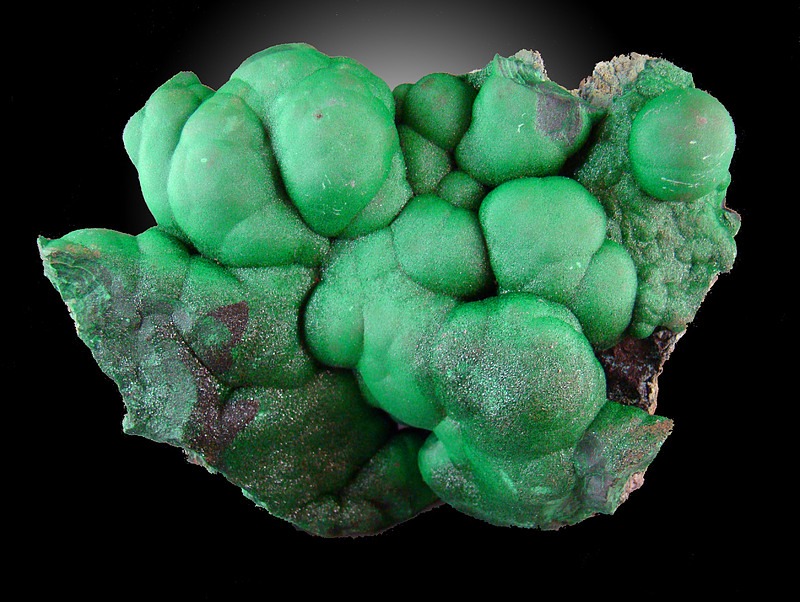
Malachite is a secondary copper carbonate hydroxide mineral with the chemical formula Cu₂CO₃(OH)₂, formed primarily within the oxidized zones of copper deposits through the interaction of copper-bearing solutions and carbonate-rich groundwater. It belongs to the monoclinic crystal system and most commonly occurs as massive, botryoidal, fibrous, or stalactitic aggregates rather than as large individual crystals. The mineral is characterized by its green coloration, which ranges from pale green to dark green depending on copper concentration, internal structure, and growth conditions. When cut and polished, Malachite typically displays concentric banding, orbicular patterns, or layered wave-like structures produced by rhythmic mineral deposition during formation. The name “Malachite” originates from the Greek term molochītis, meaning “mallow-green stone,” in reference to the color of mallow plant leaves. Due to its relatively low hardness of approximately 3.5–4 on the Mohs scale, the mineral is considered comparatively soft and is primarily used in carvings, ornamental objects, cabochons, beads, and decorative stonework rather than faceted jewelry.
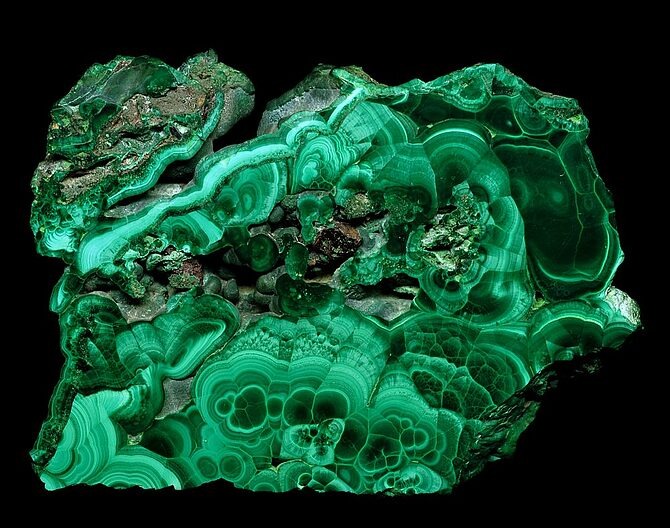
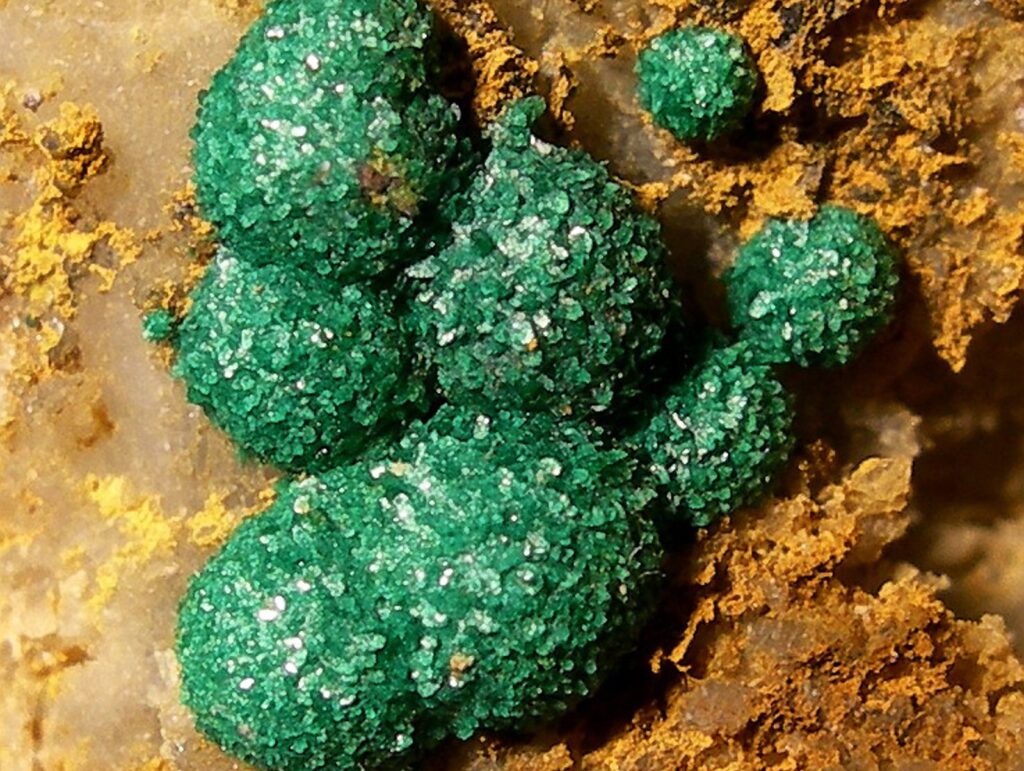
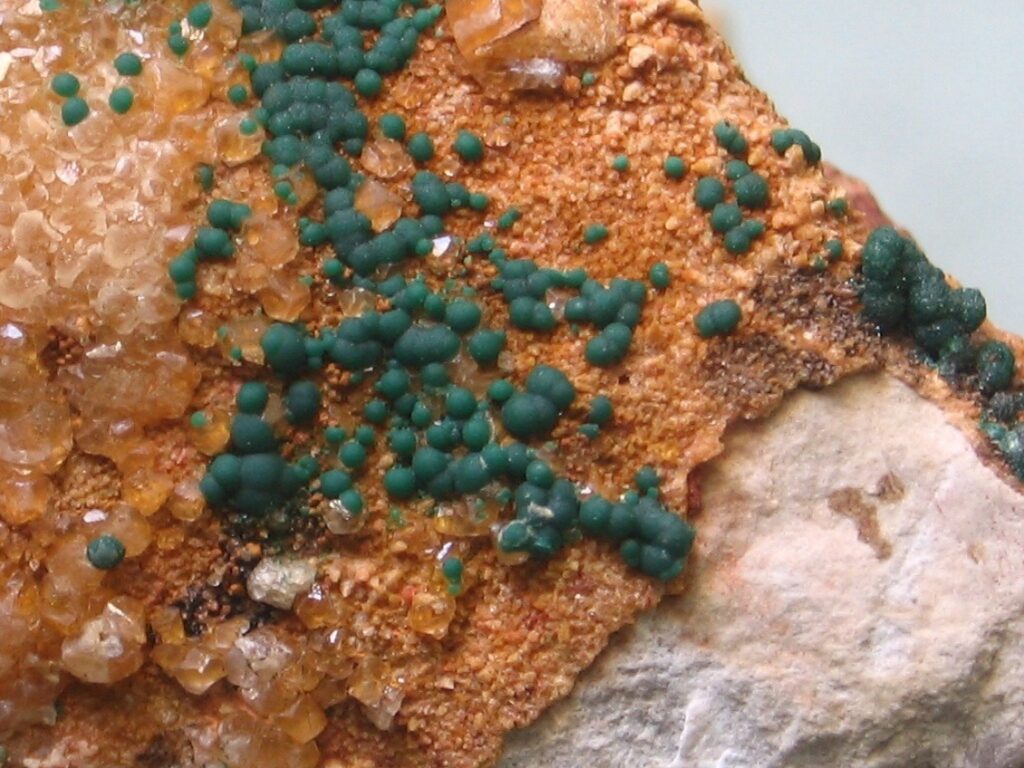
Malachite forms through secondary supergene processes in the oxidized zones of copper deposits, typically occurring relatively close to the Earth’s surface where groundwater, oxygen, and carbonate-bearing fluids interact with pre-existing copper sulfide minerals. The mineral develops when primary copper ores such as chalcopyrite, bornite, or chalcocite undergo chemical weathering and oxidation. During this process, circulating oxygen-rich groundwater dissolves copper ions from the host ore body and transports them through fractures, porous rocks, and weathered geological structures. When these copper-bearing solutions encounter carbonate-rich environments—particularly those associated with limestone or carbonate sediments—the dissolved copper precipitates chemically as Malachite.The formation process is strongly influenced by environmental variables including pH, oxidation potential, groundwater chemistry, fluid saturation, evaporation rates, and the availability of dissolved carbonate ions. Because mineral precipitation occurs incrementally over extended geological timescales, Malachite commonly develops rhythmic depositional layers that produce the mineral’s characteristic concentric banding. Variations in copper concentration, impurity content, and fluid flow conditions during growth create alternating layers of lighter and darker green material, often arranged in orbicular, botryoidal, or wave-like patterns. In many deposits, Malachite occurs alongside other secondary copper minerals such as Azurite, Chrysocolla, Cuprite, and Native Copper, reflecting complex geochemical interactions within oxidized ore zones.Morphologically, the mineral may form crusts coating rock surfaces, fibrous stalactites hanging within cavities, compact massive aggregates, or radial botryoidal structures composed of microscopic needle-like crystals. These growth forms are especially common in arid or semi-arid environments where evaporation enhances mineral precipitation near the surface. Because Malachite forms directly above or adjacent to copper-rich ore bodies, it serves as an important indicator mineral in economic geology and mineral exploration. Historically, the visible presence of Malachite staining on exposed rock surfaces often guided prospectors toward commercially valuable copper deposits hidden below ground. Major occurrences have been documented in the Democratic Republic of the Congo, Zambia, Namibia, Australia, Russia, and the southwestern United States, among other copper-producing regions.
Historically, Malachite has been utilized for several thousand years as both an ornamental material and a source of copper. Archaeological evidence indicates that ancient civilizations, particularly in Egypt and the Near East, mined and processed Malachite for jewelry, pigments, amulets, and copper extraction. Finely ground Malachite powder was widely used as a green mineral pigment in wall paintings, manuscripts, cosmetics, and decorative art due to the relative stability of its color under normal environmental conditions. In later historical periods, the mineral continued to be used in decorative arts, architectural ornamentation, and lapidary work. During the 18th and 19th centuries, large deposits discovered in Russia’s Ural Mountains supplied material for extensive decorative applications, including columns, tabletops, vases, and interior architectural panels produced using the “Russian mosaic” technique. Today, Malachite remains important in mineralogy, gemology, economic geology, archaeology, and museum conservation because of its distinctive appearance, association with copper mineralization, and long history of human use.
Crystal Structure and Mineral Morphology
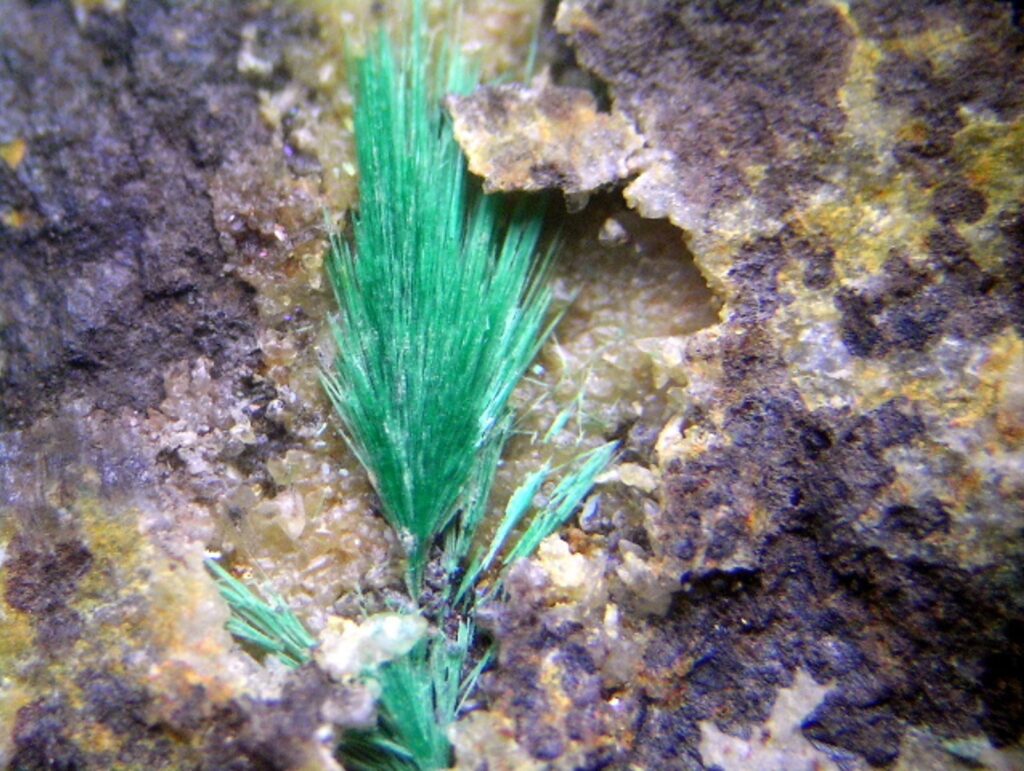
The crystal structure of Malachite is monoclinic, crystallizing within the space group P2₁/a, a symmetry arrangement characteristic of many secondary copper carbonate minerals formed under low-temperature supergene conditions. Although the mineral is capable of producing individual crystals with elongated prismatic morphology, such euhedral specimens are comparatively uncommon in nature and are generally restricted to protected cavities within oxidized copper deposits. In most geological environments, Malachite develops as compact massive aggregates, botryoidal crusts, stalactitic growths, reniform masses, or finely fibrous radial structures. These forms originate through the precipitation of copper-bearing solutions in fractures, voids, and porous host rocks during prolonged hydrothermal alteration and weathering processes. The fibrous aggregates are composed of densely packed acicular or needle-like microcrystals radiating outward from nucleation centers, producing concentric internal growth structures that become especially visible after cutting and polishing. These rhythmic growth layers are responsible for the mineral’s highly diagnostic banded appearance, which may manifest as concentric circles, undulating waves, orbicular forms, or parallel linear structures depending on the geometry of deposition and fluid flow during mineral formation. Because Malachite is typically composed of microcrystalline aggregates rather than large transparent single crystals, gem-quality transparent material suitable for faceting is exceedingly rare. Instead, its aesthetic and mineralogical significance derives from the interaction between its fibrous internal architecture, layered depositional textures, and optical response to polishing, all of which collectively contribute to its distinctive ornamental character.
Coloration and Growth Banding
In terms of coloration, Malachite is defined almost exclusively by a vivid green chromatic range that varies from pale bluish-green and bright emerald-like tones to extremely dark green approaching blackish forest hues. The coloration is directly related to the presence of divalent copper ions (Cu²⁺) within the crystal lattice, which absorb portions of the visible light spectrum through electronic transition mechanisms associated with copper’s partially filled d-orbitals. Unlike many naturally colored minerals whose pigmentation may fade through prolonged ultraviolet exposure, thermal instability, or oxidation, the green coloration of Malachite is comparatively stable under ordinary environmental conditions, contributing to its historical importance as a durable mineral pigment in ancient art and decorative applications. However, the color distribution within individual specimens is rarely homogeneous. Instead, Malachite characteristically exhibits complex banding produced by fluctuating physicochemical conditions during crystal growth, including variations in copper concentration, pH, oxidation potential, groundwater chemistry, and the presence of trace impurities such as iron, zinc, or calcium. These environmental fluctuations generate alternating depositional layers of differing density and chemical composition, resulting in sharply contrasting bands of light and dark green. In polished sections, these bands commonly appear as concentric rings, botryoidal eyes, layered waves, plume-like structures, or intricate radial geometries. The precise patterning of these bands is often unique to each specimen and serves as an important criterion in gemological identification, ornamental valuation, and provenance studies.
Optical Properties and Surface Phenomena
From an optical perspective, Malachite is generally classified as an opaque mineral, meaning that incident light is largely absorbed or reflected rather than transmitted through the crystal mass. Nonetheless, extremely thin fibrous edges or microscopically fine sections may display limited translucency under strong illumination. The mineral possesses a refractive index typically ranging between approximately 1.65 and 1.90, though accurate optical measurement is often complicated by its aggregate structure and opacity. When polished, the tightly packed fibrous aggregates can generate a silky to subadamantine luster caused by directional reflection of light along parallel crystal fibers. In certain rare specimens where the fibrous crystals are exceptionally well aligned, the mineral may display weak chatoyancy, or the cat’s-eye effect, in which a narrow luminous band appears to move across the surface as the viewing angle changes. This phenomenon results from the reflection of light from densely parallel fibrous inclusions or structural channels within the material. Although Malachite lacks the dispersion, transparency, and internal brilliance associated with transparent faceted gemstones such as diamond, sapphire, or tourmaline, its visual appeal arises instead from the dynamic interplay between polished surface reflectivity, fibrous texture, concentric banding, and contrasting tonal variations. Consequently, Malachite is primarily valued as an ornamental and lapidary material in cabochons, carvings, inlays, beads, and decorative architectural applications rather than as a traditional faceting gemstone.
Chemical Composition and Physical Properties
Chemically, Malachite is classified as a basic copper carbonate hydroxide with the idealized formula Cu₂CO₃(OH)₂, placing it within the carbonate mineral group and specifically among secondary copper minerals formed in oxidizing environments. Its composition reflects the interaction between copper-rich aqueous solutions, carbonate ions, and hydroxyl-bearing fluids during supergene alteration processes. The mineral is chemically reactive and exhibits notable sensitivity to acidic environments. When exposed to dilute hydrochloric acid or other weak acids, Malachite undergoes decomposition accompanied by visible effervescence as carbon dioxide gas is released through carbonate breakdown reactions. It is also partially soluble in ammonia and susceptible to gradual alteration when exposed to acidic atmospheric conditions or industrial pollutants over extended periods. Due to its hydrated carbonate composition, Malachite is thermally unstable relative to many silicate gemstones and may darken, fracture, or decompose when subjected to elevated temperatures. This sensitivity makes the mineral vulnerable to damage from household cleaners, acidic solutions, ultrasonic cleaning devices, steam treatment, and prolonged exposure to excessive heat. Physically, Malachite possesses a Mohs hardness ranging from approximately 3.5 to 4, indicating relatively low scratch resistance compared to more durable gem materials such as quartz or corundum. The mineral also exhibits perfect cleavage in one crystallographic direction, although this property is often difficult to observe directly because most specimens occur as cryptocrystalline or fibrous aggregates rather than discrete crystals. Its fracture is typically uneven to splintery, especially in fibrous masses. The specific gravity commonly ranges from about 3.6 to 4.0 g/cm³, reflecting both the high atomic weight of copper and variations caused by porosity, impurities, and structural compactness. Collectively, these chemical and physical characteristics define Malachite as a relatively soft, chemically sensitive, but mineralogically distinctive material whose properties are closely tied to its origin as a secondary copper carbonate mineral formed in near-surface geological environments.
Occurrence and Major Sources of Malachite
Malachite occurs worldwide in the oxidized zones of copper deposits and is most commonly associated with secondary supergene mineralization formed near the Earth’s surface. Because it develops through the chemical alteration of primary copper sulfide minerals, the distribution of Malachite closely corresponds to regions containing significant copper ore systems. The mineral is frequently found in association with Azurite, Chrysocolla, Cuprite, Native Copper, and various iron oxides within weathered hydrothermal environments. Its occurrence is particularly common in arid and semi-arid regions where oxidation processes and groundwater circulation promote the precipitation of secondary copper carbonates.Among the most significant modern sources of Malachite are the copper-rich regions of the Democratic Republic of the Congo and Zambia, especially within the Central African Copperbelt, where large quantities of banded ornamental material and mineral specimens are produced. These deposits are known for yielding massive botryoidal Malachite, fibrous aggregates, and specimens displaying well-developed concentric banding. Namibia is also an important producer, particularly from the Tsumeb mining district, which historically generated high-quality mineral specimens associated with complex copper-lead-zinc ore systems. In Russia, the Ural Mountains were historically one of the most important sources of ornamental Malachite, particularly during the 18th and 19th centuries when large deposits supplied material for decorative architectural applications and lapidary arts. Although many of these classic deposits are now largely depleted, Russian Malachite remains historically significant in mineralogical and decorative contexts.
Additional occurrences are documented in Australia, Mexico, Chile, France, Israel, and the southwestern United States, particularly in copper mining regions of Arizona, New Mexico, and Nevada. In these areas, Malachite commonly forms crusts, vein fillings, stalactitic masses, and cavity coatings within oxidized copper ore bodies. Smaller occurrences are also known from numerous other localities worldwide, reflecting the widespread geological conditions under which secondary copper minerals can form. The quality, color intensity, and internal banding patterns of Malachite vary considerably depending on local geochemical conditions, host rock composition, and the specific processes involved in mineral deposition.
Uses of Malachite
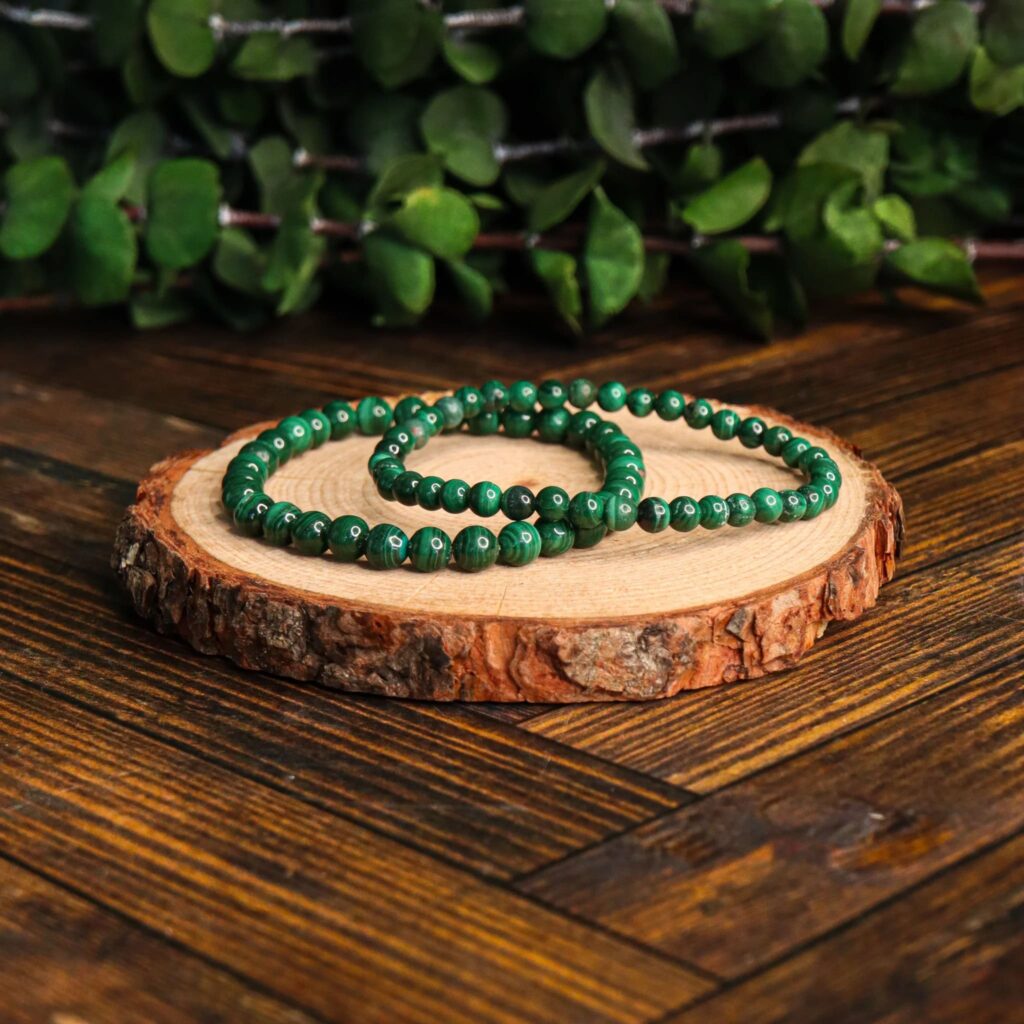
Malachite has been used historically and in modern times for ornamental, industrial, artistic, and scientific purposes. Due to its distinctive banding patterns and relatively soft hardness, it is widely utilized as a decorative stone in carvings, cabochons, beads, sculptures, inlays, tabletops, architectural veneers, and ornamental objects. In lapidary applications, the mineral is typically cut en cabochon or polished into decorative forms rather than faceted gemstones because its opaque and fibrous structure does not support conventional faceting. Historically, Malachite also functioned as a minor copper ore and as a naturally occurring green pigment. Finely ground Malachite powder was used in ancient wall paintings, manuscripts, cosmetics, and artistic pigments before the development of synthetic green colorants. In geology and mineralogy, the mineral remains important as an indicator of secondary copper mineralization and is commonly studied in relation to supergene enrichment processes and oxidized copper deposits.
Toxicity and Safety of Malachite
Malachite contains a high concentration of copper and should therefore be handled with appropriate care, particularly during cutting, grinding, or polishing processes. Solid, polished specimens used in jewelry or decorative objects are generally considered safe for ordinary handling; however, inhalation or ingestion of Malachite dust may be harmful because copper-bearing particles can cause irritation or toxicity when introduced into the body in sufficient quantities. For this reason, lapidary work involving Malachite typically requires adequate ventilation, dust control, and protective equipment. The mineral should not be consumed internally or used in liquid preparations intended for ingestion. Chemically, Malachite is also sensitive to acids, ammonia, household cleaning agents, and high temperatures due to its carbonate composition. Exposure to acidic substances may cause surface damage or release copper compounds through chemical decomposition. As a relatively soft and reactive mineral, Malachite is generally cleaned using mild soap, water, and non-abrasive materials to minimize physical and chemical deterioration over time.
Metaphysical and Cultural Associations of Malachite
Throughout history, Malachite has been associated with various symbolic, cultural, and metaphysical interpretations. Ancient civilizations frequently used the mineral in amulets, jewelry, and ceremonial objects, often attributing protective or spiritual significance to its green coloration and distinctive patterns. In medieval and later cultural traditions, Malachite was sometimes regarded as a protective stone believed to ward off misfortune or negative influences. In modern metaphysical practices and crystal healing traditions, the mineral is commonly associated with transformation, emotional balance, protection, and themes related to personal growth. Because of its green color, it is also frequently connected symbolically with the heart and nature. However, these beliefs are cultural and spiritual interpretations rather than scientifically verified properties, and there is no scientific evidence demonstrating therapeutic or supernatural effects associated with the mineral.