
Gemstone cleavage refers to the tendency of a crystal to break along specific internal planes where atomic bonds are weaker. These planes correspond to the natural arrangement of atoms within the crystal structure. When stress is applied along these planes, the gemstone can split smoothly and predictably, creating flat, reflective surfaces known as cleavage faces.
Similar to how wood splits more easily along its grain, gemstone cleavage refers to the tendency of certain crystals to fracture along specific structural planes. This occurs when a crystal lattice contains internal planes held together by relatively weak atomic bonds, making them natural points of failure.
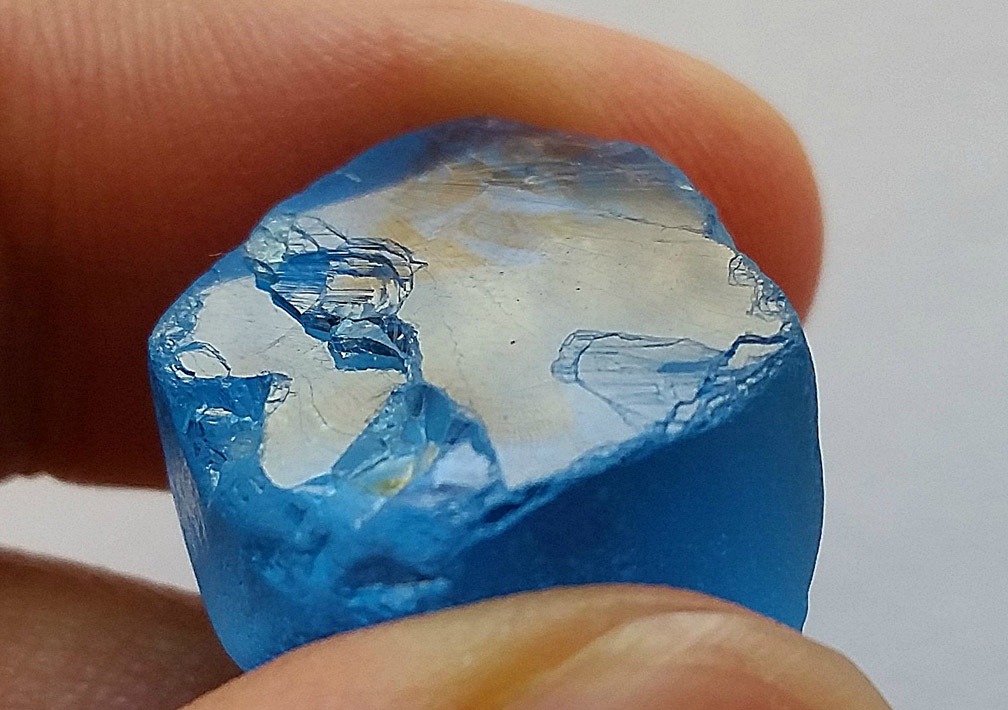
Under perfect conditions, a cleavage plane can appear almost perfectly smooth and flat at the atomic level. Any break in a gemstone that doesn’t follow these planes is classified as either a fracture or a parting.
In gemology, the term ‘cleavage’ applies exclusively to crystalline materials. For instance, glass—a supercooled liquid with atoms arranged randomly rather than in a long-range periodic structure—cannot exhibit cleavage, as it lacks uniform layers of bonds.
Cleavage Grades in Gemology
Perfect
Cleavage is extremely easy to produce, creating smooth, mirror-like surfaces. Even a light, well-placed impact can split these stones.
- Diamond: Despite its extreme hardness, diamond has perfect octahedral cleavage in four directions, a key factor for diamond cutters and a vulnerability during setting.
- Topaz: Features perfect basal cleavage (parallel to the base of the crystal), making it prone to splitting if struck or subjected to rapid temperature changes.
- Mica: Famous for perfect basal cleavage, allowing it to be peeled into incredibly thin, flexible sheets.
- Calcite: Possesses perfect rhombohedral cleavage in three directions, always breaking into slanted, box-like shapes.
Good
Cleavage planes are easily produced and clearly visible, though the surfaces are not as flawlessly smooth as “Perfect” cleavage.
- Spodumene (Kunzite/Hiddenite): Has two directions of good cleavage, making cutting challenging and stones prone to breakage if dropped.
- Feldspar (Moonstone/Amazonite): Exhibits good cleavage in two directions at nearly right angles.
Distinct / Fair
Cleavage is observable and planes are identifiable, but the mineral does not split as readily as stones in higher categories.
- Sphene (Titanite): Shows distinct cleavage that can affect the stone’s durability.
- Apatite: Cleavage is visible but rarely leads to spontaneous splitting.
Imperfect / Weak
Cleavage is difficult to see and the planes are not well-defined. Stones are more likely to break with irregular fractures than along clean lines.
- Beryl (Emerald/Aquamarine): Technically has imperfect basal cleavage, but it usually fractures irregularly in practical gemology.
- Peridot: Shows very weak, imperfect cleavage, rarely a concern for jewelers.
None
The atomic bonds are nearly equal in all directions, so the mineral does not break along flat planes, instead failing through fracture.
- Quartz (Amethyst/Citrine): Does not cleave; it exhibits conchoidal fracture, breaking in curved, shell-like patterns similar to glass.
- Garnet: Generally considered to have no cleavage, typically breaking with sub-conchoidal to uneven fractures.
- Corundum (Ruby/Sapphire): Has no true cleavage. Any flat breaks observed are usually parting rather than cleavage.
Tip: Gems with perfect cleavage are easiest to split, while those with no cleavage are hardest to split.
Cleavage vs. Fracture vs. Parting
Many people confuse cleavage with other types of breaks in gemstones, so let’s clarify:
- Cleavage: A clean break along natural planes of weakness in the crystal. These planes are determined by the internal structure of the gemstone. Cleavage is predictable and often smooth.
- Fracture: A break that occurs in a direction unrelated to the crystal structure. Fractures are irregular, jagged, or conchoidal (shell-like). Quartz often shows conchoidal fractures.
- Parting: Sometimes gemstones break along weaknesses caused by external influences like twinning, growth zones, or stress. Parting resembles cleavage but is less predictable.
Knowing the difference is critical for gemstone cutting and jewelry making. Cleavage planes can influence how a gemstone is faceted, affecting its durability and overall appearance.
Understanding gemstone cleavage is essential for anyone interested in gemstones, whether as a collector, jeweler, or gemologist. Cleavage explains why some gemstones are fragile along certain planes, while others are remarkably resilient. By distinguishing cleavage from fracture and parting, you can better appreciate the science and beauty of crystals while handling them safely.