
Grandidierite stands as one of the most elusive and sought-after minerals in the gemological world, prized for its breathtaking bluish-green hue and remarkable rarity. Chemically classified as a magnesium aluminum borosilicate, this mineral is celebrated for its intense pleochroism, an optical phenomenon where the stone transmits three different colors—typically teal, dark green, and a pale, almost colorless yellow—depending on the viewing angle. With a Mohs hardness of 7.5, it is surprisingly durable for such a rare specimen, yet its scarcity is so profound that it remained virtually unknown to the general public for over a century, appearing almost exclusively in specialized mineralogical textbooks and elite private collections.
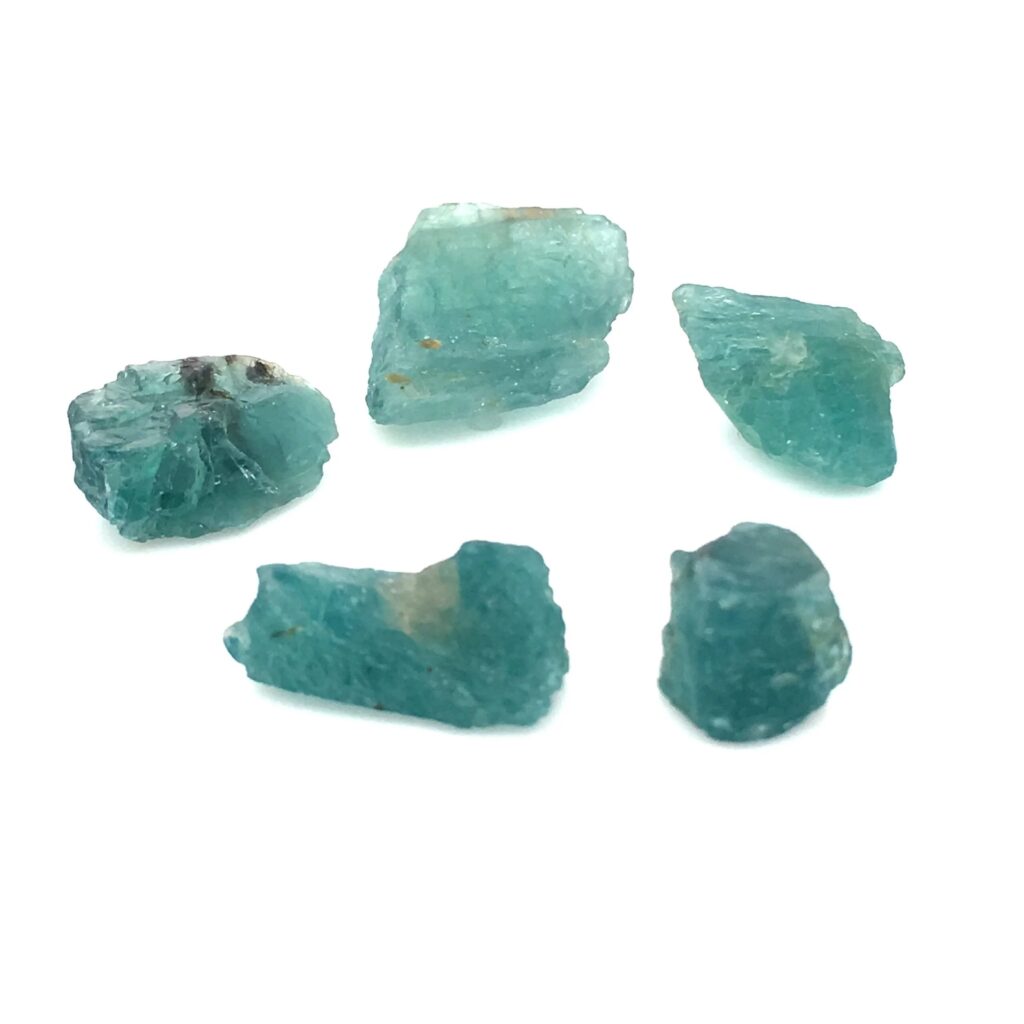
The formation of Grandidierite is a complex geological feat that requires a highly specific “chemical cocktail” and precise environmental conditions. It typically crystallizes in aluminous, boron-rich pegmatites and certain metamorphic rocks under conditions of high temperature and relatively low pressure. The presence of boron is critical, yet the surrounding environment must be devoid of certain other elements that would typically favor the formation of more common stones like tourmaline. The striking neon-teal color that defines the finest specimens is the result of trace amounts of iron within the crystal lattice. Because the conditions required to create transparent, gem-quality crystals are so rarely met in nature, most Grandidierite found is opaque or heavily included, making “clean” faceted stones a true geological miracle.
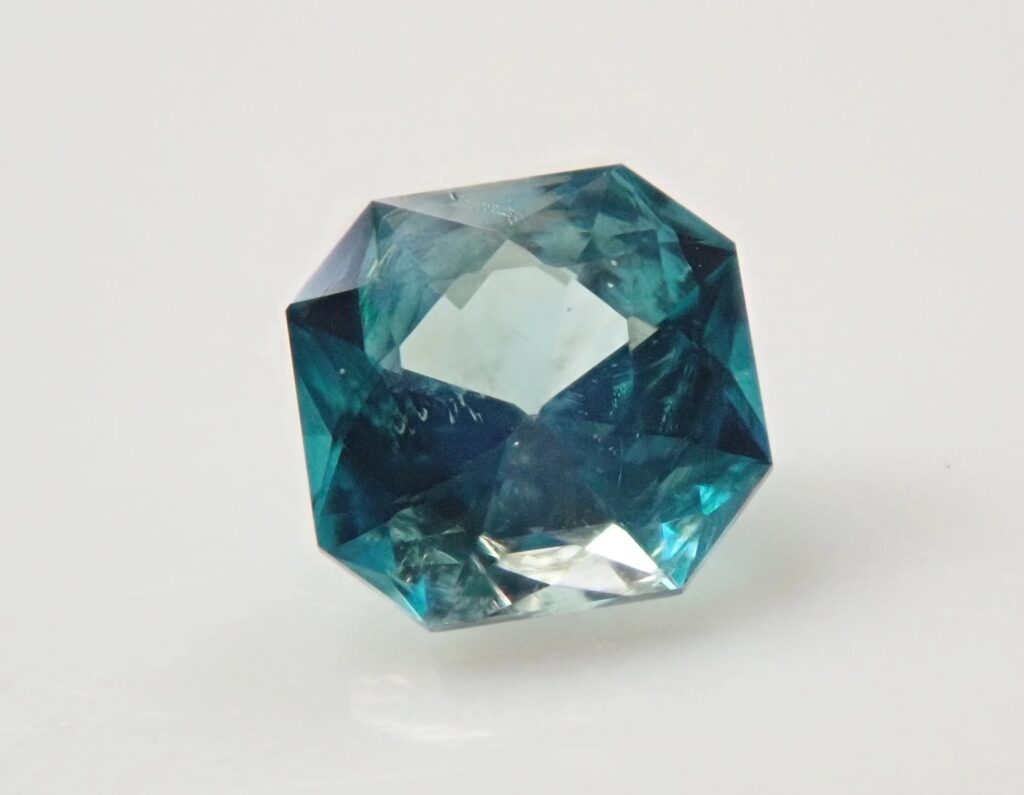
The history of this gemstone is inextricably linked to the island of Madagascar, where it was first discovered in 1902 by the French mineralogist Alfred Lacroix. Finding the mineral among the cliffs of Andrahomana, Lacroix named it in honor of Alfred Grandidier, a celebrated French explorer and naturalist who was a leading authority on Madagascar’s unique natural history. For more than a hundred years following its discovery, Grandidierite was considered a “collector’s ghost,” with only tiny, opaque fragments available. It wasn’t until a significant discovery in Tranomaro, Madagascar, around 2014, that a small cache of transparent, gem-quality material reached the market. Even with this find, Grandidierite remains among the top ten rarest gems on Earth, with large, eye-clean specimens commanding prices that rival the finest diamonds and emeralds.
Atomic Framework of Grandidierite
The crystal structure of Grandidierite is as complex and fascinating as its outward appearance. It belongs to the orthorhombic crystal system, specifically falling within the Pbnm space group. Its internal framework is characterized by a sophisticated arrangement of isolated silicate (SiO₄) tetrahedra and borate (BO₃) triangles, which are linked together by aluminum and magnesium ions. This specific geometric configuration is what gives the mineral its exceptional stability and high Mohs hardness of 7.5.A defining feature of its structure is the coordination of its metallic ions. In Grandidierite, the aluminum atoms occupy three distinct sites with different coordination geometries, while the magnesium atoms are typically found in five-coordinated sites. This unique structural environment allows for the occasional substitution of iron (Fe²⁺) for magnesium, which is the primary driver behind the gem’s signature teal coloration.
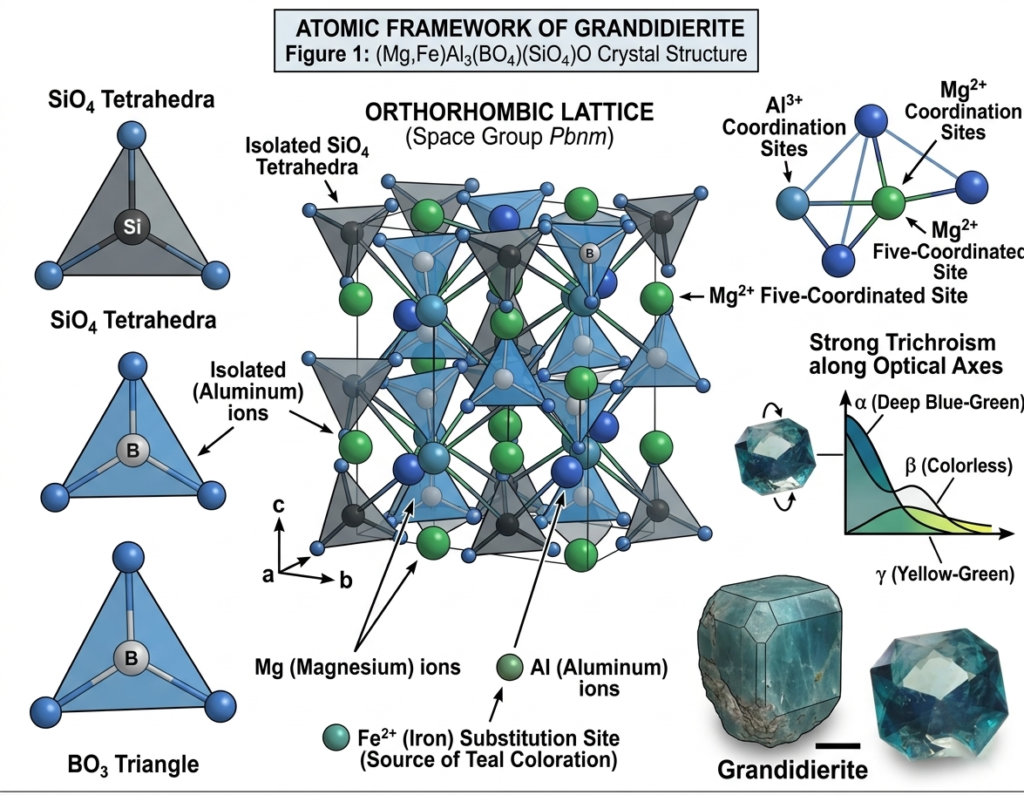
Furthermore, the arrangement of these atomic layers is directly responsible for the mineral’s strong trichroism. Because the crystal lattice is highly anisotropic, light traveling through the stone is absorbed differently along each of its three optical axes. This means that as you rotate the crystal, you are literally seeing the physical manifestation of its internal atomic symmetry, shifting between shades of deep blue-green, colorless, and yellow-green.
Chemical, Physical, and Optical Properties of Grandidierite
The chemical identity of grandidierite is defined by the formula (Mg,Fe)Al₃(BO₄)(SiO₄)O, identifying it as a complex magnesium aluminum borosilicate. Within its crystal lattice, magnesium (Mg) and iron (Fe) ions can substitute for one another, with the iron content serving as the primary coloring agent. Higher concentrations of iron typically result in the highly prized, deep bluish-green or “neon” teal tones. The inclusion of boron (B) is what makes the mineral geochemically distinct, as boron atoms form stable planar groups that link with silicon (Si) tetrahedra and aluminum (Al) octahedra. Because the specific conditions required to concentrate boron, magnesium, and aluminum at the necessary pressure and temperature are exceptionally rare, the chemical formation of grandidierite remains a geological anomaly.
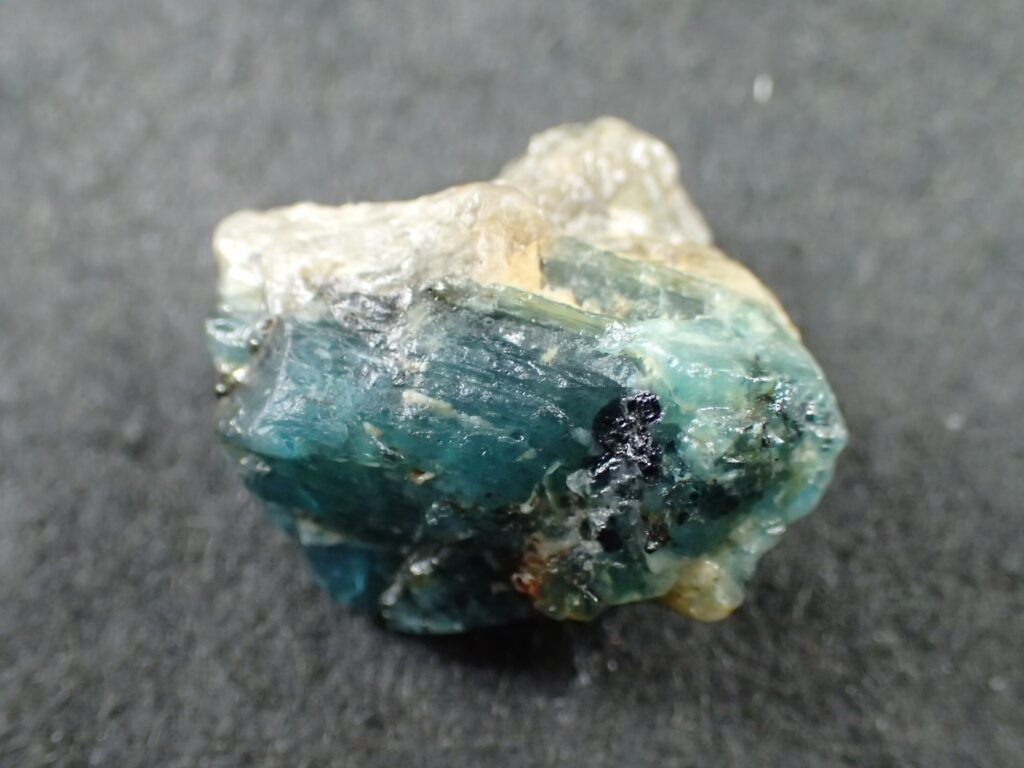
Physically, grandidierite is a durable gemstone with a Mohs hardness of 7.5, making it comparable to beryl and resistant to scratches. It crystallizes in the orthorhombic system, specifically within the Pbnm space group, and typically displays a vitreous to pearly luster. While most specimens found in nature are opaque, the rarest and most valuable examples are transparent to translucent. The stone is most famous for its strong trichroism, an optical property caused by its anisotropic crystal lattice which absorbs light differently along three optical axes. This results in a dramatic color shift depending on the viewing angle, moving between dark blue-green, colorless or pale yellow, and dark green. With a refractive index ranging from 1.583 to 1.639 and a specific gravity between 2.85 and 3.00, grandidierite possesses a distinct technical profile that allows gemologists to distinguish it from other blue-green stones.
Applications and Jewelry Suitability of Grandidierite
Grandidierite is primarily utilized as a high-end collector’s gemstone and an exquisite material for fine jewelry. Due to its remarkable Mohs hardness of 7.5, the stone is highly suitable for various types of jewelry, including rings and pendants, as it is durable enough to resist daily scratches and wear. Its striking teal-blue color and neon-like saturation make it a desirable alternative to other rare stones like Paraiba tourmaline. However, because gem-quality, transparent crystals are exceptionally scarce, most grandidierite jewelry features smaller stones or translucent cabochons, while the rare “eye-clean” faceted specimens are typically held in private investment collections or displayed in prestigious museums.
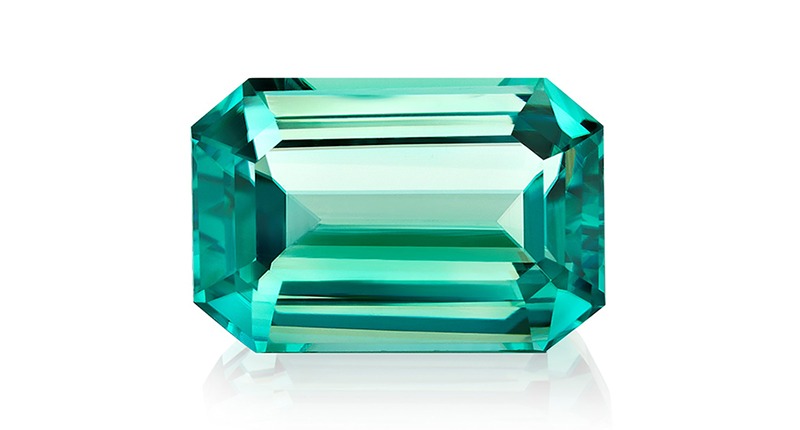
While grandidierite lacks the centuries-old “famous” individual stones associated with diamonds or rubies, its rarity itself is the headline. For over a hundred years after its 1902 discovery, it was considered a “collector’s ghost” because no gem-quality material existed. The most significant breakthrough occurred in 2014 with the discovery of transparent crystals in Tranomaro, Madagascar, which finally allowed for the creation of world-class faceted jewelry pieces. Today, any transparent grandidierite weighing over two carats is considered a major find in the gemological world, and such stones are frequently featured in “top ten rarest gemstones” lists globally.
Metaphysical and Symbolic Meanings of Grandidierite
Beyond its scientific allure, grandidierite is highly regarded in the metaphysical community for its unique energetic vibrations. Symbolically, its striking teal-blue color is often associated with the fluid energy of the ocean and the vastness of the sky, representing emotional clarity and open communication. It is frequently linked to both the heart and throat chakras, as practitioners believe it aids in bridging the gap between one’s inner feelings and their outward expression.In the realm of spiritual healing, grandidierite is often called a “stone of new beginnings”. Because of its immense rarity and the specific geological conditions required for its formation, it is seen as a symbol of resilience and the ability to manifest beauty from pressure. Many believe that carrying or wearing the stone can help clear mental fog, reduce stress, and encourage a more balanced perspective during times of transition. While these metaphysical attributes are not scientifically verified, they add a layer of personal and symbolic depth for collectors who value the stone for more than just its physical beauty.