
Cleavelandite is a distinctive variety of albite, which is a member of the plagioclase feldspar group. Unlike the more common blocky crystals of albite, cleavelandite is defined by its unique tabular or lamellar growth habit. It typically forms as thin, platy, or blade-like crystals that often cluster together to create intricate fan-shaped or radiating aggregates. While it is most frequently found in a pearly white or colorless form, it can occasionally exhibit pale blue or greenish tints. Due to its striking geometric structure and vitreous luster, it is highly valued by mineral collectors and often serves as the aesthetic base or matrix for rare gemstones like tourmaline and aquamarine.
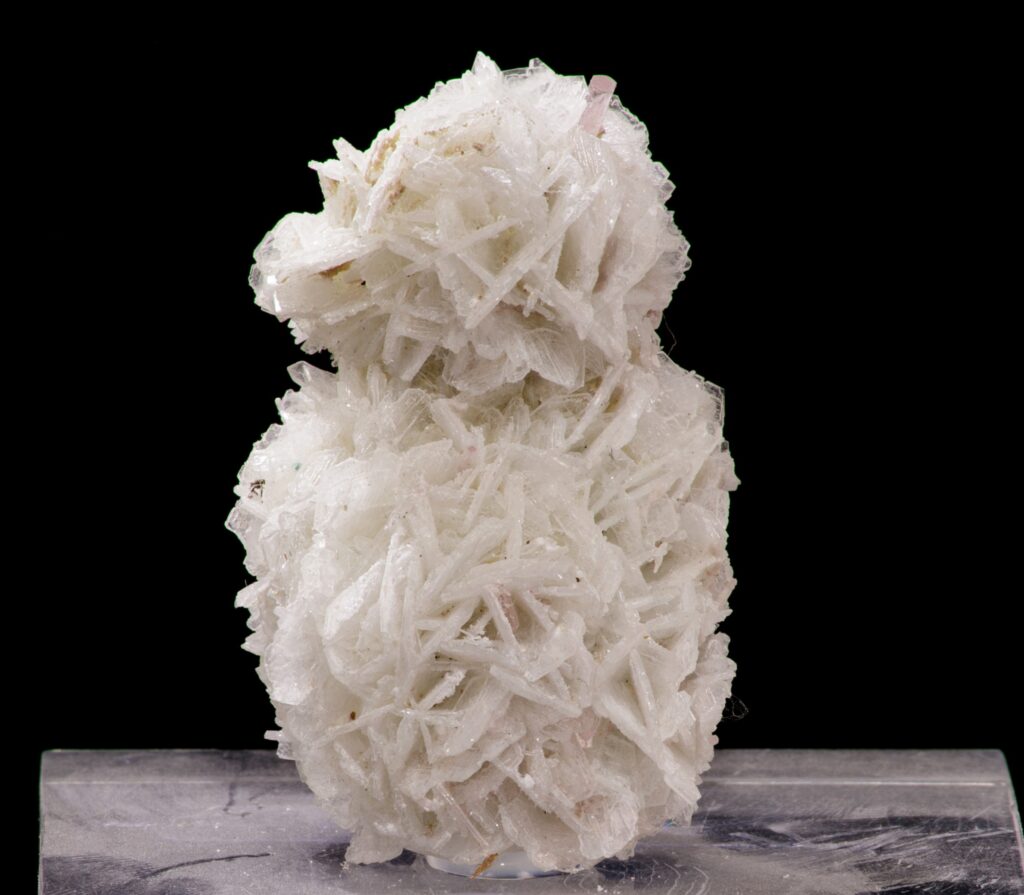
The formation of cleavelandite occurs primarily within granitic pegmatites during the final, fluid-rich stages of magma cooling. It typically crystallizes through a hydrothermal process where sodium-rich fluids interact with previously formed minerals. In many cases, cleavelandite forms through a replacement process, where it slowly takes the place of earlier potassium feldspars. Because it develops in these late-stage pockets where rare elements are concentrated, it is frequently associated with lithium-bearing minerals and rare gemstones. The presence of these bladed crystals is often a geological indicator that a pegmatite is well-zoned and potentially rich in rare mineral species.
The history of cleavelandite is closely linked to the development of mineralogy as a formal science in North America. The variety was named in 1823 by Henry J. Brooke to honor Parker Cleaveland, a professor at Bowdoin College who is often referred to as the father of American mineralogy. Cleaveland authored the first comprehensive American textbook on the subject in 1816, which helped standardize the study of minerals in the United States. Throughout the history of mining, cleavelandite has been an important indicator for prospectors; because it forms in the same environment as high-value crystals, finding a vein of cleavelandite often signaled that a significant pocket of gemstones was nearby.
Crystal Structure of Cleavelandite
The crystal structure of cleavelandite is a specialized manifestation of the triclinic crystal system, which is the least symmetrical of the seven crystal systems. As a variety of albite, cleavelandite shares the same chemical formula, NaAlSi₃O₈, and its fundamental framework is built upon a three-dimensional network of silicate and aluminate tetrahedra. In this structure, each oxygen atom is shared between two tetrahedra, creating a robust tectosilicate arrangement. The sodium ions occupy relatively large interstitial sites within this framework, providing charge balance for the substitution of aluminum for silicon in the tetrahedral positions.What distinguishes cleavelandite from typical albite is its extreme tabular habit, which is a direct result of preferential growth along specific crystallographic axes. While standard albite crystals often grow in more equidimensional or blocky shapes, cleavelandite grows as thin, elongated plates or blades. This occurs because the rate of crystal growth is significantly accelerated along the b-axis and c-axis compared to the a-axis. This preferential development results in the characteristic blade-like appearance that defines the variety. These blades are often found in complex, radiating aggregates that can resemble the petals of a flower.
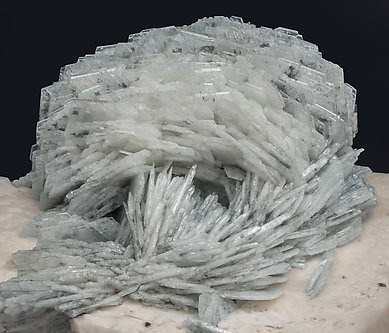
The internal arrangement of cleavelandite is also defined by its twinning laws, which are common across the plagioclase feldspar group. The most frequent is albite law twinning, where the crystal structure is reflected across the (010) plane. In cleavelandite, this twinning is often polysynthetic and occurs on a microscopic scale, contributing to the pearly luster and slight shimmering effect seen on the surface of the blades. Because these crystals form in late-stage pegmatitic environments where space may be constrained, the structure often adapts to its surroundings, resulting in the warped or curved blades frequently sought after by mineral collectors.The physical properties of the cleavelandite structure include a Mohs hardness of 6 to 6.5 and perfect cleavage in two directions, specifically along the {001} and {010} planes. This cleavage is a direct consequence of the bonding strengths within the tectosilicate framework. In cleavelandite, the thinness of the blades often makes this cleavage even more apparent, as the mineral can be easily split or flaked along its flat surfaces. This structural fragility, combined with its high surface area in fan-shaped clusters, makes it an ideal host matrix for other minerals to anchor to during the final hydrothermal stages of a pegmatite’s life cycle.
Optically, cleavelandite is a triclinic mineral that belongs to the biaxial positive class. It is generally transparent to translucent, with a luster that varies from vitreous (glassy) to pearly, especially on the cleavage surfaces. While pure albite is colorless or white, cleavelandite often appears in shades of bluish-white, pale green, or even light grey due to trace impurities or light scattering within its lamellar structure. It has a refractive index typically falling between 1.525 and 1.536. One of its most diagnostic optical features is its common polysynthetic twinning, which can sometimes be seen as fine, parallel striations on the crystal faces. Under ultraviolet light, some specimens may exhibit a weak fluorescence, typically appearing in dim shades of white or pink.
Applications of Cleavelandite
The applications of cleavelandite span from scientific research to aesthetic and spiritual uses, primarily driven by its unique crystal habit and its role as a host mineral for rare gemstones.In the realm of scientific study and mineralogy, cleavelandite serves as a vital diagnostic tool for geologists. Its presence in granitic pegmatites acts as a reliable indicator of advanced geological differentiation. Because it forms during the final hydrothermal stages, researchers use it to map the evolution of mineral-rich pockets and to identify the chemical shifts that occur during the cooling of magma chambers.
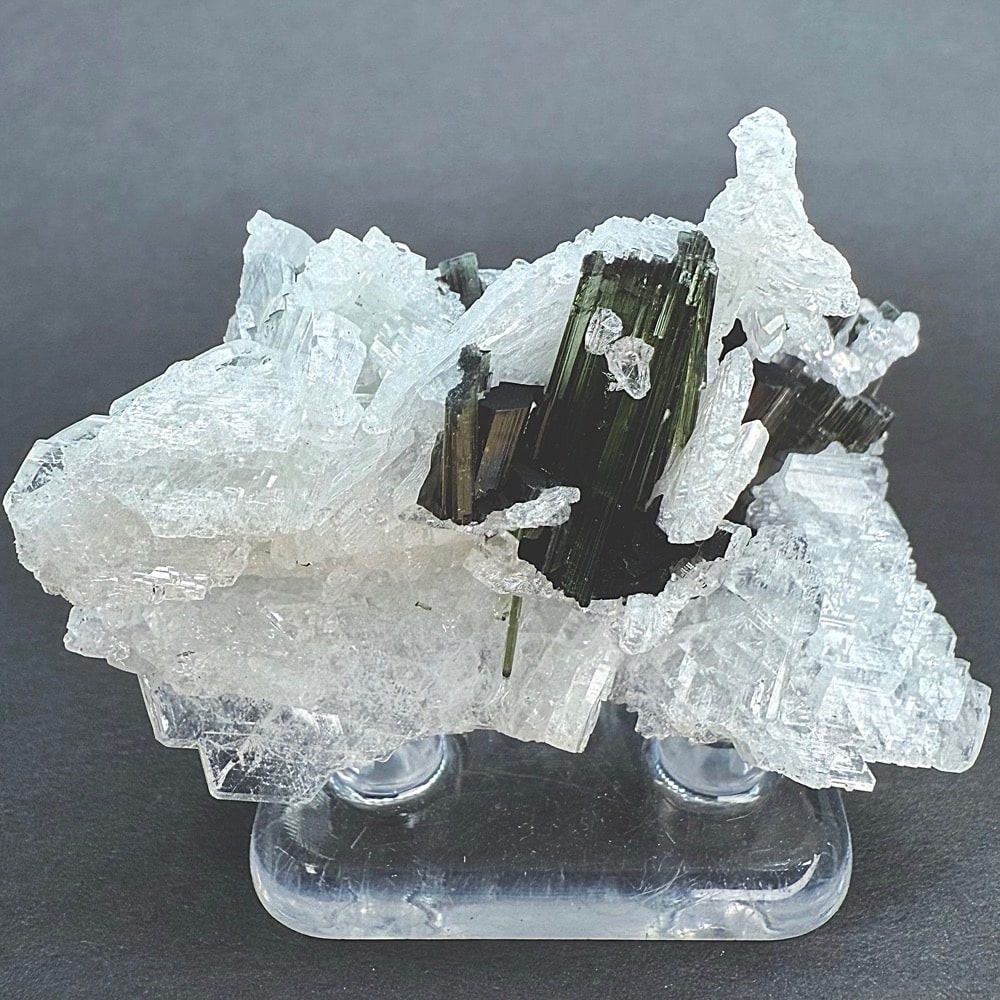
For the gem and mineral industry, cleavelandite’s most significant application is as a high-value matrix for collectors. It provides a stunning, geometric foundation for more colorful crystals like tourmaline, beryl, and spodumene. These aesthetic combinations are highly sought after for museum displays and private collections because the contrasting white blades of cleavelandite dramatically highlight the vibrant hues of the associated gemstones.
In addition to its aesthetic value, cleavelandite is utilized in metaphysical practices. Practitioners use it as a tool for personal transformation and focus, believing its bladed structure helps navigate complex life changes and emotional transitions. It is often used in meditative settings to foster clear communication and to provide a symbolic sense of stability during periods of professional or personal shift.