
Spectrolite is a rare and premium variety of labradorite feldspar, distinguished by its exceptionally vivid and full-spectrum display of colors. While standard labradorite is often translucent and typically flashes shades of blue or green, Spectrolite is characterized by a dark, opaque base that makes its iridescent “fire” appear much more intense. It is capable of reflecting the entire visible spectrum—including rare reds, oranges, yellows, and purples—earning it the reputation of being one of the most beautiful varieties of feldspar in the world. Due to its unique quality and regional significance, it has been designated as the national stone of Finland.
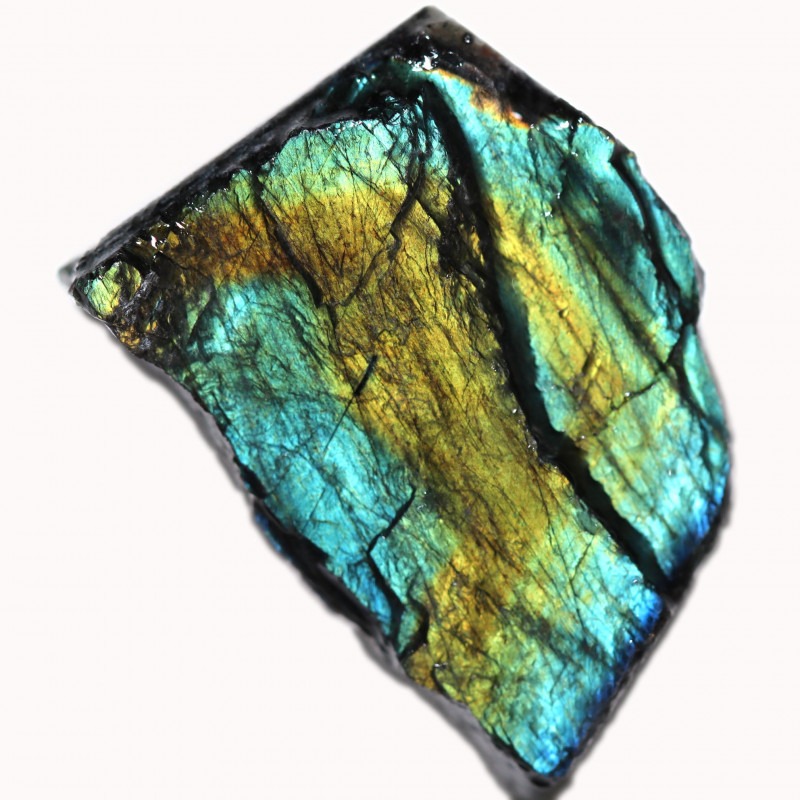
The formation of Spectrolite dates back approximately 1.7 billion years during the Svecofennian mountain-building period. It was born from the slow cooling of magma deep within the Earth’s crust, which allowed different feldspar minerals to separate into microscopic, alternating layers known as lamellae. The stunning visual effect, called labradorescence, occurs when light hits these thin layers and undergoes interference. The specific thickness and precision of these layers in Finnish Spectrolite are what allow it to filter and reflect such a wide and vibrant array of colors compared to labradorite found in other parts of the world.
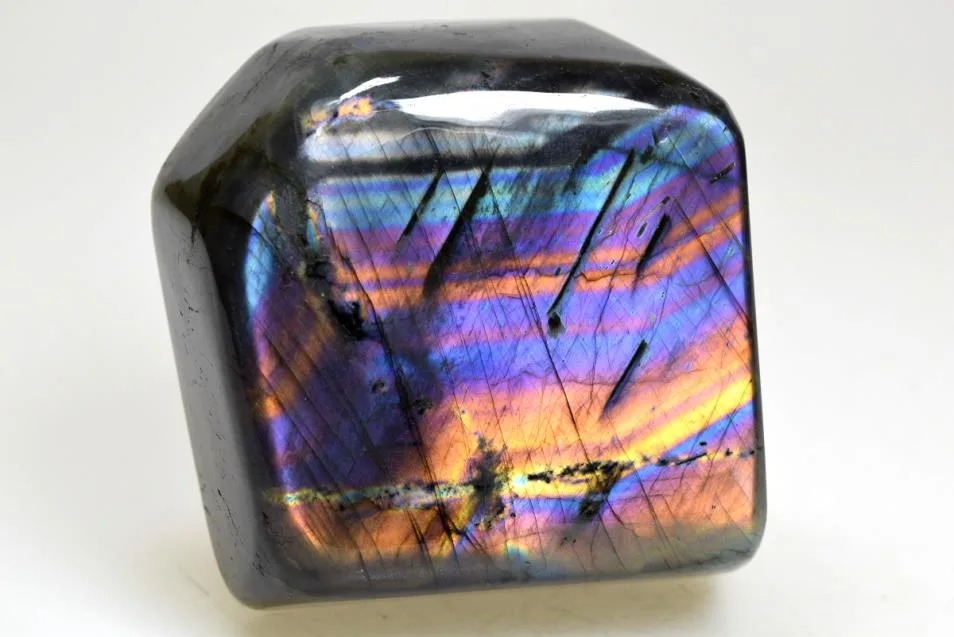
The history of Spectrolite is uniquely tied to the events of World War II. It was discovered by accident in 1940 while Finnish soldiers were constructing the Salpa Line—a massive series of fortifications along the eastern border—to defend against a Soviet invasion. While blasting rocks in the Ylämaa region, soldiers noticed that the dark stone fragments shimmered with brilliant hues in the sunlight. After the war, the stone was studied by Professor Aarne Laitakari, who coined the name “Spectrolite” to highlight its ability to display the full spectrum of light. Today, the village of Ylämaa remains the primary source of this gemstone, maintaining its legacy as a symbol of Finnish geological heritage.
The Crystal Structure of Spectrolite
The crystal structure of Spectrolite is defined by its membership in the plagioclase feldspar group, specifically as a high-quality variety of labradorite. It belongs to the triclinic crystal system, characterized by three axes of unequal lengths that intersect at oblique angles. Its chemical composition is represented by the formula (Ca, Na)(Al, Si)₄O₈, consisting of a complex framework of silicon and aluminum tetrahedra.The most significant aspect of Spectrolite’s structure is its lamellar twinning, which formed through a process called exsolution as magma cooled over approximately 1.7 billion years. During this slow cooling, the mineral separated into microscopic, alternating layers of different feldspar compositions. These layers are so precise and uniform that they function as a natural diffraction grating.
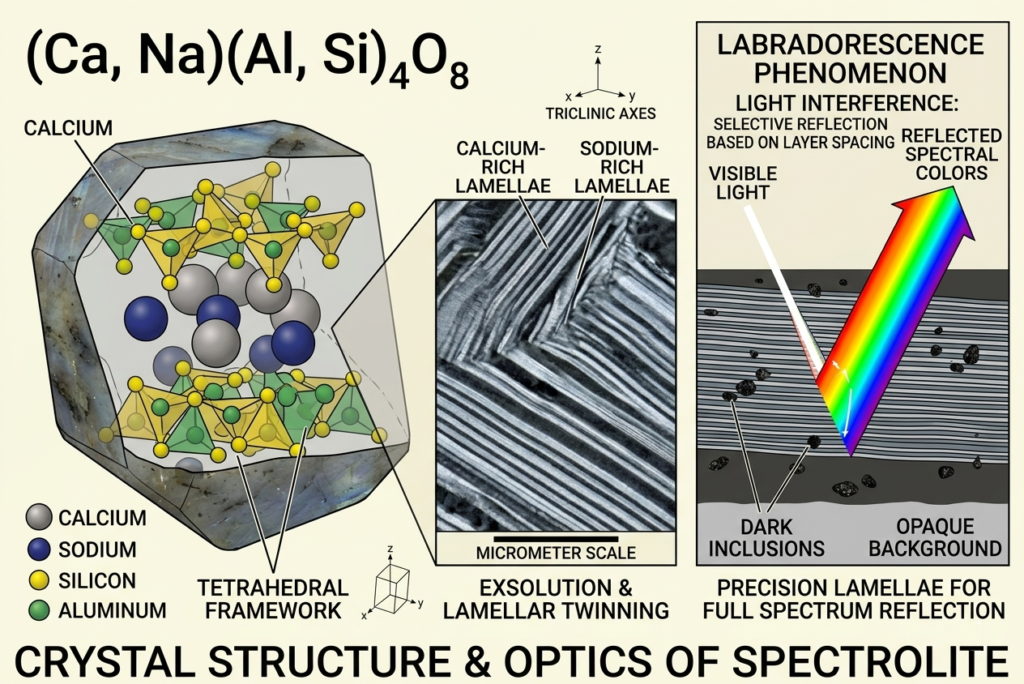
This internal architecture is what enables the optical phenomenon of labradorescence. When light enters the crystal, it reflects off these internal planes, creating interference that filters and amplifies specific wavelengths. Because the layers in Finnish Spectrolite are exceptionally well-organized, they can reflect a full spectrum of colors, including rare reds and purples. Furthermore, the structure often contains microscopic inclusions of magnetite or ilmenite, which provide the dark, opaque background necessary to highlight the intensity of these spectral flashes.
Physical and Optical Properties of Spectrolite
The physical and optical properties of Spectrolite are defined by its durability and its extraordinary interaction with light. It has a hardness of 6.0 to 6.5 on the Mohs scale and features two directions of perfect cleavage at nearly 90-degree angles, which requires precision during the cutting and polishing process. While its base color is typically a dark, opaque gray or black, it is world-renowned for its superior labradorescence, which displays a full spectral range including rare reds, oranges, yellows, and purples. These intense, “electric” colors are highly direction-dependent, shifting or disappearing as the stone is rotated, and are significantly enhanced by the dark, high-contrast background provided by microscopic mineral inclusions.
Metaphysical and Symbolic Meanings of Spectrolite
Spectrolite is widely revered in metaphysical circles as a “stone of transformation,” believed to act as a powerful protective shield that balances and strengthens the human aura. Because its internal structure allows it to display a full spectrum of colors, it is symbolically linked to the ability to see through illusions and uncover hidden truths that lie beneath the surface of everyday reality. Many practitioners associate the stone with the enhancement of intuition and psychic abilities, viewing it as a spiritual bridge that connects the physical world with higher states of consciousness and spiritual awakening.
Beyond its mystical associations, Spectrolite carries a deep historical and cultural weight as the national stone of Finland. Its discovery in 1940 during the construction of the Salpa Line—a massive series of military fortifications built to defend the country’s eastern border—has tied the stone’s identity to themes of resilience, strength, and national preservation. To the Finnish people, it serves as a lasting symbol of the rugged beauty found within their natural landscape, representing the light and brilliance that can be found even within the hardest, darkest stone. This combination of spiritual mystery and historical fortitude makes Spectrolite a unique gemstone that resonates with both the seeker of wisdom and the admirer of heritage.
Applications of Spectrolite
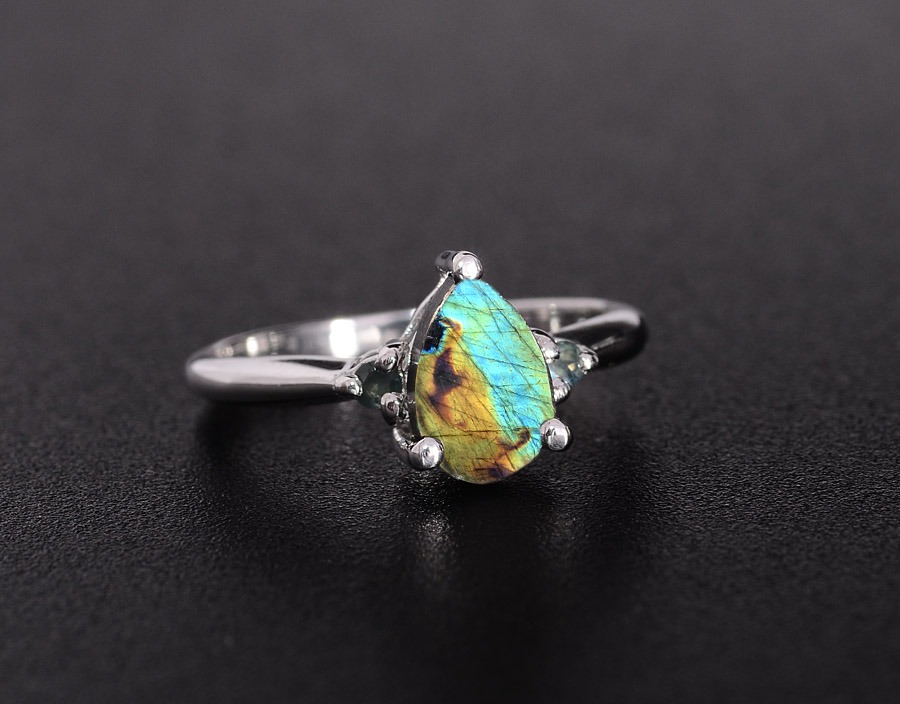
The applications of Spectrolite span across diverse fields, ranging from high-end fashion to large-scale architectural projects. In the realm of jewelry and ornamental arts, the gemstone is highly prized for its full-spectrum labradorescence, which includes rare shades of red, orange, and purple. It is frequently featured in pendants, rings, and statement pieces, where it is often cut into cabochons to maximize its vibrant color display. As the national stone of Finland, it also holds a prominent place in traditional Finnish jewelry and commemorative designs. Beyond personal adornment, Spectrolite is utilized as a premium decorative material in architectural and interior design. Its physical durability and striking visual impact make it suitable for luxury surfaces such as countertops, tabletops, and dramatic wall accents in high-profile residential and commercial spaces. In its native Finland, the stone is even used for exterior cladding and decorative elements in architectural projects. Historically, while high-quality specimens are reserved for aesthetics, the surrounding feldspar rock from the original quarries has been used in local infrastructure and road construction since its discovery during the fortification of the Salpa Line. In addition to its physical uses, Spectrolite serves a significant role in the metaphysical and holistic market. It is commonly fashioned into polished palm stones or spheres for use in meditation and energy work. Practitioners value the stone as a symbolic shield for protecting the aura and balancing personal energy, often placing it within living or working environments to aid in spiritual awakening and the enhancement of intuition.