
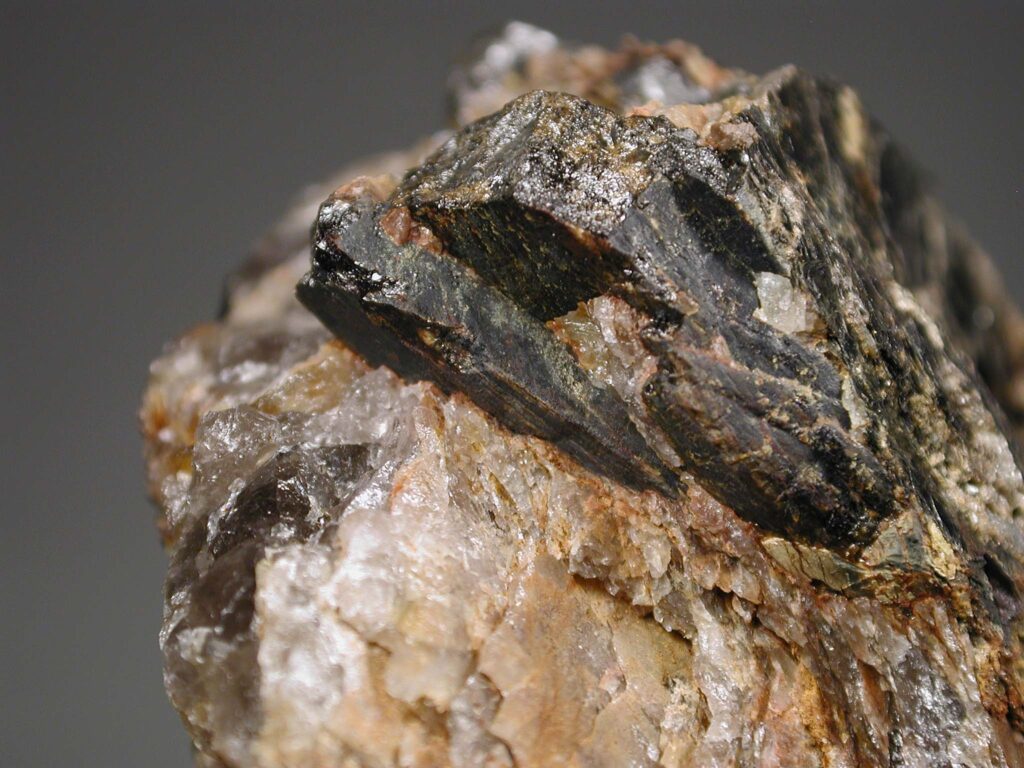
Fergusonite is a rare and complex oxide mineral primarily composed of yttrium and niobium, though it often hosts a suite of rare earth elements (REEs) such as cerium and neodymium. Classified by mineralogists as a metamict mineral, it is prized by collectors for its vitreous to sub-metallic luster and its fascinating ability to lose its internal crystal structure over time due to self-irradiation from trace amounts of uranium and thorium. The mineral was first identified in 1826 by the Austrian mineralogist Wilhelm Karl Ritter von Haidinger, who named it in honor of Robert Ferguson of Raith, a prominent Scottish politician and mineral enthusiast. Geologically, Fergusonite typically forms in granitic pegmatites and rare-element carbonatites, crystallizing during the late-stage cooling of magma where incompatible elements like niobium and yttrium become highly concentrated. Whether found as elongated prismatic crystals or as rare, faceted gemstones, Fergusonite stands as a testament to the complex geochemical processes that concentrate the Earth’s rarest elements.
Radioactivity and the Metamictization of Fergusonite
The radioactivity of Fergusonite is not an inherent property of its primary chemical components, yttrium and niobium, but is instead the result of minor substitutions within its complex crystal lattice. During the late-stage magmatic crystallization process that forms Fergusonite, trace amounts of radioactive actinides—specifically uranium (U) and thorium (Th)—are frequently incorporated into the mineral’s structure. These heavy elements possess ionic radii similar to those of the rare-earth elements (REEs), allowing them to “hitchhike” into the lattice sites typically occupied by yttrium.
Once these radioactive isotopes are trapped within the solid mineral, they begin a spontaneous decay process that spans millions of years. As the nuclei of uranium and thorium atoms break down, they emit alpha particles (He nuclei) and recoiling daughter nuclei. These high-energy particles act like microscopic projectiles, physically striking the surrounding atoms and knocking them out of their precisely ordered positions. This internal bombardment leads to a phenomenon known as metamictization.
Over geological time, the cumulative damage from this self-irradiation destroys the long-range periodic order of the crystal lattice. What was once a structured, repeating arrangement of atoms eventually becomes a disordered, amorphous, and glass-like state. While the external shape of the crystal (the crystal habit) often remains intact—a condition known as a “pseudomorph”—the internal physics of the mineral are fundamentally altered. This radioactive origin is also responsible for the characteristic expansion and micro-fracturing often observed in Fergusonite specimens, as the transition from a crystalline to an amorphous state typically results in a decrease in density and an increase in volume.
Practical Uses of Fergusonite
In practical terms, Fergusonite is valued more for the specific elements it contains than for its use as a whole mineral. Its primary value lies in being a source of yttrium and niobium, two metals that are essential for modern technology. Yttrium extracted from this mineral is used to create the red colors in LED screens and to make specialized glass and camera lenses. Niobium is equally important, as it is added to steel to create incredibly strong and heat-resistant alloys used in jet engines and high-tech construction.
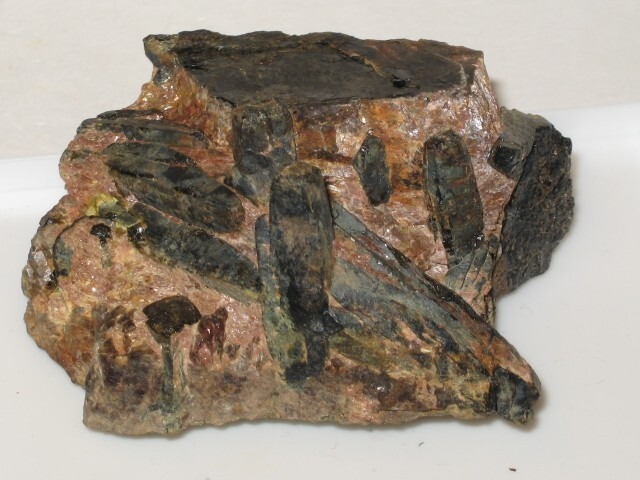
Because Fergusonite is naturally radioactive, it also serves a very specific purpose in scientific laboratories. Researchers study these specimens to see how radiation breaks down solid materials over millions of years. This isn’t just for academic curiosity; it helps scientists understand how to build better containers for storing nuclear waste by seeing which structures hold up best against radiation over long periods. While you won’t find it in a typical jewelry store due to its rarity and radioactive nature, it is a stable item in professional mineral collections and geological research.